


This article was automatically translated from the original Turkish version.
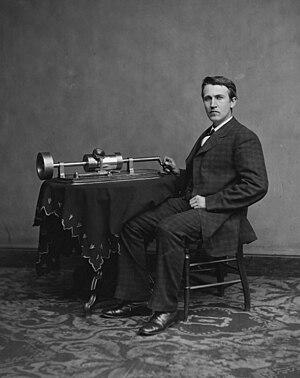
Phonograph is one of the first devices designed for recording and reproducing sound. Invented in 1877 by Thomas Edison, it operates by recording sound waves onto a physical surface on and then replaying that recording. Initially capable of recording onto cylinders, the phonograph gradually evolved into a device that could record and play sound on discs. It is historically recognized as the first home audio playback device and dominated commercial sound distribution for much of the 20th century.
Following Edison’s original invention, the phonograph underwent numerous innovations and improvements. In the 1880s, Alexander Graham Bell’s Volta Laboratory introduced new features such as wax-coated cardboard cylinders and a cutting needle that created a zigzag groove like, developing a new device called the graphophone. This device enabled clearer recordings. In the 1890s, Emile Berliner developed a new format that recorded sound onto flat discs rather than cylinders, calling it the "gramophone". These flat discs allowed sound to be stored more efficiently and transported more easily long duration opportunity.
Over time, turntables became more advanced through improvements in the stylus or needle, sound pickup systems, and balancing mechanisms. In electric phonographs, the movements of the needle are converted into electrical signals, which are then transformed into sound through speakers electricity.
The phonograph is regarded as the device that initiated the habit of listening to music at home. Throughout the 20th century, record players became the dominant medium for distributing music and other audio content common vehicle. Although cassette tapes and 8-track cartridges emerged as alternatives in the 1960s, records retained their popularity until the late 1980s. The widespread adoption of compact discs compact after 1987 led to a sharp decline in record usage, but interest in vinyl records revived from the late 2000s onward. One reason for this resurgence is that vinyl records undergo less audio processing, resulting in a more natural sound when played on high-quality equipment.
The emergence of the phonograph built upon earlier technologies. In 1857, French inventor Édouard-Léon Scott de Martinville created a device called the phonautograph. The phonautograph could physically record sound vibrations but could not play them back. Scott’s goal was to read the physical traces of recorded sound. In 1860, the oldest known recording of a human voice was made using this device, but the recordings could not be played back at the time. The significance of the phonautograph was only understood in 2008, following digital conversion processes digital.
The term "phonograph" derives from the Greek words "phonē" meaning "sound" and "graphē" meaning "writing" writing writing. The terms "gramophone" and "graphophone" also have Greek origins. In British English, "gramophone" may refer to any sound playback device that uses disc recordings. Originally a trademark of the Gramophone Company, the term was ruled by an English court in 1910 to have become a generic term.
References
https://en.wikipedia.org/wiki/Phonograph
https://www.britannica.com/technology/phonautograph

No Discussion Added Yet
Start discussion for "What is a Phonograph?" article
Development of the Phonograph
Historical Significance of the Phonograph
Phonograph and Earlier Technologies
Terminology