
This article was automatically translated from the original Turkish version.
+1 More
Type(s) | Romanticism Korean Drama Drama | ||||||||
|---|---|---|---|---|---|---|---|---|---|
Screenplay(s) | Im Sang-choon | ||||||||
Director(s) | Kim Won-seok | ||||||||
Original Language | Korean | ||||||||
Actors | IU (Lee Ji-eun), Kim Tae-yeon, Moon So-ri | ||||||||
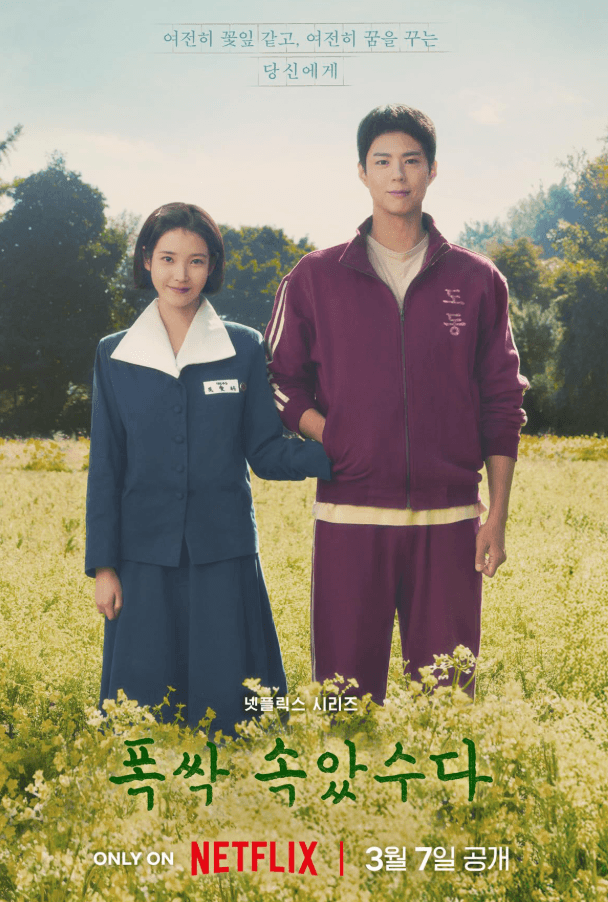
When Life Gives You Tangerines is a South Korean television series. Produced by Kim Won-seok and written by Im Sang-choon, the series was released on Netflix. The production consists of sixteen episodes in total, broadcast in four-part intervals.
The story centers on a life narrative spanning over seventy years, beginning on Jeju Island. The lead role of Oh Ae-sun is portrayed across different life stages by IU (Lee Ji-eun), Kim Tae-yeon, and Moon So-ri; the character of Yang Gwan-sik is brought to life by Lee Cheon-mu, Moon Woo-jin, Park Bo-gum, and Park Hae-joon. Supporting roles are played by Kim Yong-rim, Oh Min-ae, Na Moon-hee, Yeom Hye-ran, and Jung Hae-kyun.
The series narrates the life story of Ae-sun and Gwan-sik across a time period from the 1960s to the present day on Jeju Island. It explores the evolving relationship between the two characters, shaped by social change and historical events, as well as their individual journeys through life.
Ae-sun is a talented but impoverished young woman who dreams of becoming a poet; Gwan-sik is the quiet and hardworking son of a fisherman. Ae-sun’s struggle against societal gender constraints and Gwan-sik’s steadfast presence in her life form the core of the series.

A Scene from the Series (IMDb)
Over time, the couple marries, raises children, and witnesses Korea’s modernization. Historical events such as the 1960 elections, the country’s economic transformation, and class disparities unfold in the background. In her later years, Ae-sun publishes her poetry and continues her life alone after Gwan-sik’s death. Gwan-sik’s death scene embodies the series’ central theme: that love can endure through labor and patience.
The story of Ae-sun’s daughter, Geum-myeong, addresses issues of class and female identity within the context of modern Korea. Despite her family’s sacrifices for her education, Geum-myeong struggles to transcend her class boundaries; her inability to marry her first love, Yeong-bum, is a clear indication of this. She later marries the artist Chung-seob and builds a successful career in technological entrepreneurship.
In the final scene of the series, a poem written by Ae-sun in her old age is dedicated to her husband. The poem ends with the words that give the series its title. In the Jeju dialect, these words mean “you worked so hard” or “thank you for your hands,” directly referencing the series’ central themes of labor and resilience.

A Scene from the Series (IMDb)
The series examines the transformation of love, labor, and female identity within a historical context. Central themes include female resilience, gender inequality, familial sacrifice, and the search for individual identity amid modernization.
When Life Gives You Tangerines Series Trailer (Netflix)
The geographical and cultural landscape of Jeju Island plays a defining role in shaping the atmosphere of the narrative. Throughout the series, the haenyeo, Jeju’s female divers, appear as historical symbols of women’s labor. This figure represents the social burdens carried by women, both in Ae-sun’s life and in the series as a whole.
Additionally, the metaphor of the tangerine lies at the heart of the production. Traditionally a symbol of abundance and good fortune, the tangerine here represents resilience in the face of life’s hardships and the effort to extract sweetness from existence. The English title, “When Life Gives You Tangerines,” is a localized adaptation of the idiom “when life gives you lemons, make lemonade,” seamlessly integrated with Jeju’s renowned tangerine production.
The invisible labor of women, intergenerational silence, forms of grief, and expressions of love also hold significant places in the dramatic structure of the series. Ae-sun’s use of poetry to express her suppressed desires throughout her life serves as a symbolic representation of the “female voice.” Gwan-sik’s quiet support demonstrates that love can be expressed through action, labor, and patience.
When Life Gives You Tangerines examines the impact of social transformation on personal stories through a woman-centered narrative, weaving together Jeju culture, Korean history, and individual resilience.
Burt, Kayti. "The Meaning Behind the Emotional Ending of Netflix K-Drama When Life Gives You Tangerines." Time. Accessed October 7, 2025. https://time.com/7272692/when-life-gives-you-tangerines-ending/
IMDb. "When Life Gives You Tangerines." Accessed October 7, 2025. https://www.imdb.com/title/tt26471411/
Klein, Brennan. "New Netflix K-Drama Show With 98% RT Audience Score Lands On Global Chart". Screen Rant. Accessed October 7, 2025. https://screenrant.com/when-life-gives-you-tangerine-show-netflix-viewership-success-streaming-chart/
Netflix. "When Life Gives You Tangerines." Netflix. Accessed October 7, 2025. https://www.netflix.com/tr/title/81681535
Netflix. "When Life Gives You Tangerines." YouTube, 2:13. Accessed October 7, 2025. https://www.youtube.com/watch?v=4ECAaQkNAbc
Nicole, Sherin. "The Sweet and Sour K-Drama “When Life Gives You Tangerines” Measures Life in Four Seasons of Love". rogerebert.com. Accessed October 7, 2025. https://www.rogerebert.com/streaming/when-life-gives-you-tangerines-korean-netflix-tv-review-2025
Sinha, Ekta. "Review: 'When Life Gives You Tangerines' Broke My Heart In Ways I Didn't Expect". Elle. Accessed October 7, 2025. https://elle.in/life-culture/opinion/review-when-life-gives-you-tangerines-broke-my-heart-in-ways-i-didnt-expect-8950493
Won-seok, Kim, dir. When Life Gives You Tangerines. Güney Kore: Pan Entertainment, 2025.

Type(s) | Romanticism Korean Drama Drama | ||||||||
|---|---|---|---|---|---|---|---|---|---|
Screenplay(s) | Im Sang-choon | ||||||||
Director(s) | Kim Won-seok | ||||||||
Original Language | Korean | ||||||||
Actors | IU (Lee Ji-eun), Kim Tae-yeon, Moon So-ri | ||||||||
No Discussion Added Yet
Start discussion for "When Life Gives You Mandarin Orange (TV Series)" article
Summary
Characters
Themes