


This article was automatically translated from the original Turkish version.
Everyone knows that time speeds up as we age; what is less known is that this acceleration does not continue indefinitely. As children, summer vacations seemed to last forever. Three months appeared almost like a lifetime. Now, years pass and when you look back, you struggle to understand where the time went. Something has changed; but what?
Kum Saati (Yapay Zeka İle Oluşturulmuştur.)
This feeling is independent of geography and culture: Japanese grandmothers describe it, Norwegian grandfathers do too. A comprehensive study involving 499 people aged 14 to 94 has shown that this sensation is not merely a personal impression.【1】 The research revealed that the relationship between age and time perception is not consistent across all time intervals. The effect becomes particularly pronounced when considering decades and years in the past; a growing trend of acceleration was observed in responses to the question “How quickly did your last decade pass?” as participants grew older.
One of the earliest attempts to explain this feeling dates back to the French philosopher Paul Janet. In 1877, Janet proposed a simple idea: For a ten-year-old child, one year represents one-tenth of their life. For a fifty-year-old, the same period amounts to only one-fiftieth of their life. The duration remains unchanged; but its weight within the span of life diminishes.【2】
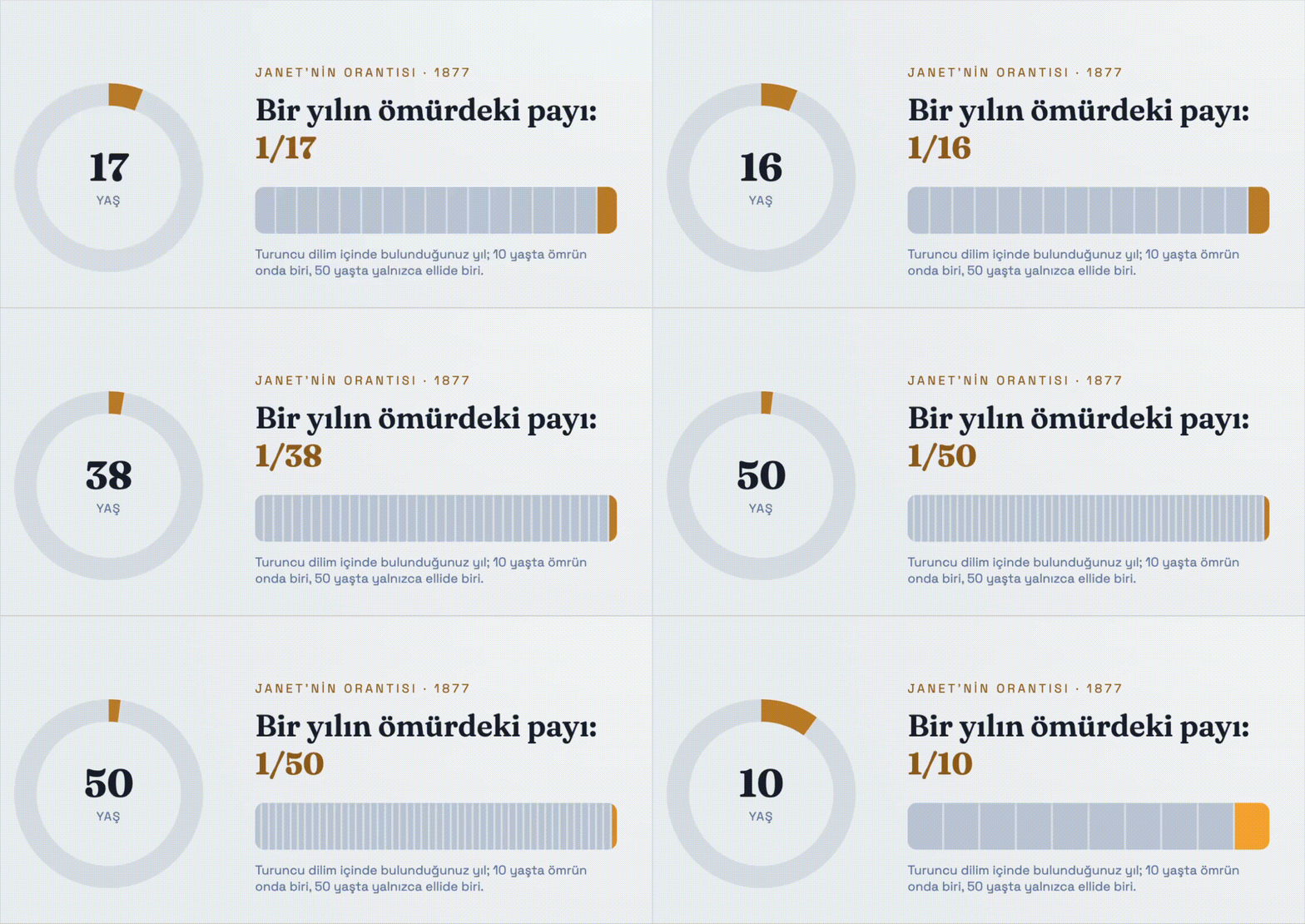
Infographic Demonstrating Janet's 1877 Proportion Theory (Generated by Artificial Intelligence)
William James, in his 1890 work The Principles of Psychology, presented and discussed Janet’s view. According to James, while the proportional formula captures the phenomenon roughly, it cannot be considered a fundamental psychological law. James added his own explanation: Years appear shorter in retrospect as the content of memory becomes sparser and more uniform.【3】 James’s observation remains compelling today. In youth, everything is new; attention remains constantly alert and memories are recorded in rich detail. As we age, habits dominate. Going to the same job, taking the same route, repeating similar days... The brain begins processing repeated experiences with less detail. When looking back, periods that left little impression seem to have passed more quickly.
One of the striking findings from the research by Marc Wittmann and Sandra Lehnhoff is that the effect of age is not noticeable in short time intervals. People exhibit similar perceptions when evaluating a week, a month, or a year. The difference emerges particularly when considering longer periods such as decades. Moreover, this acceleration does not continue indefinitely: According to the research, perceived acceleration reaches a plateau around age 50 to 60 and then stops increasing.【4】 Thus, time speeds up as we age but eventually stabilizes. This points to an important insight: The feeling that time is passing quickly or slowly is not solely about the moment being experienced. The key determinant is how much space that period occupies in memory.
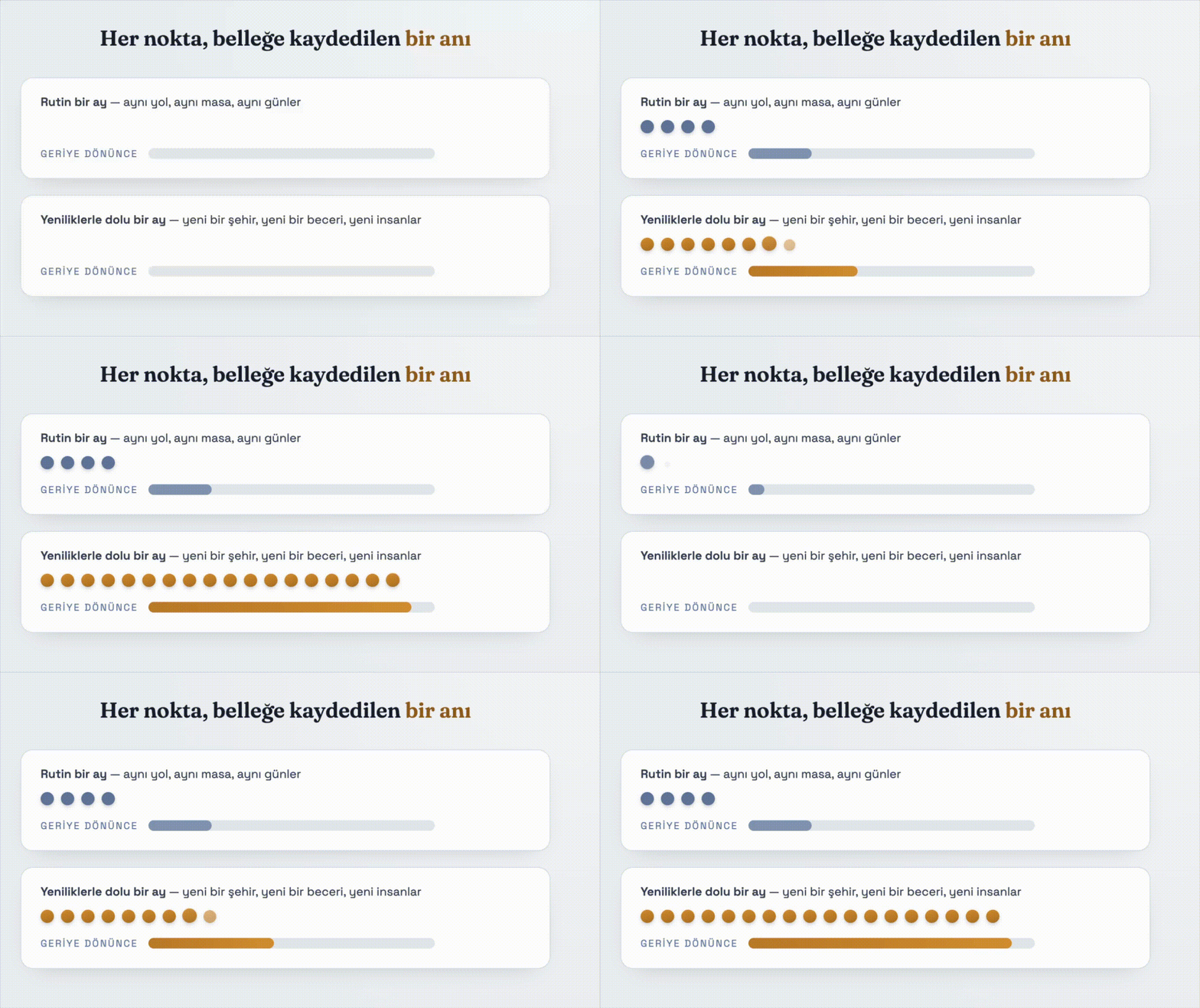
Rutin ve Yeniliklerle Dolu Bir Ayın Bellekte Kapladığı Yer Farkını Gösteren Karşılaştırma (Yapay Zeka İle Oluşturulmuştur.)
Psychological studies show that new experiences can influence time perception. When you visit a city you have never been to, learn a new skill, or step outside your routine, your brain records more details. This intensive recording process contributes to the feeling that more time has passed when you look back.
Time perception is not limited to daily experiences. A compilation by Bahadırlı and colleagues demonstrates that psychiatric conditions such as depression, anxiety disorders, and attention deficits systematically alter time perception.【5】 Therefore, how we experience time is often closely tied to our mental state.
In childhood, nearly every experience is a first: the first day of school, the first friendship, the first trip, the first success, or the first disappointment... The brain constantly encounters new information and records it in great detail. For this reason, childhood years appear vast and full when viewed in retrospect.
Perhaps this is why some memories never fade. First-time experiences leave stronger traces in memory. These traces shape not only the memories themselves but also the feeling of time’s duration.
The recommendation offered by science on this matter is simple: Seek novelty. Choosing a different route instead of your usual one, learning a new language, traveling to a place you have never visited, or taking up a new hobby are not merely enjoyable activities. They also encourage the brain to process more information, thereby making time feel more densely lived.
Of course, it is impossible to slow down time physically. But how time is experienced is closely linked to attention and memory. New experiences are among the most powerful components of this relationship.
Bahadırlı, Nil Banu, Can Tutuğ, Hatice Ceviz, and Okan Çalıyurt. “Zaman Algısı ve Psikiyatrik Bozukluklar.” *Psikiyatride Güncel Yaklaşımlar* 5, no. 3 (2013): 355–377. Accessed July 7, 2026.https://doi.org/10.5455/cap.20130524
Barbhuiya, Towfiqu. “Hourglass.” Pexels. Accessed July 7, 2026.https://www.pexels.com/photo/hourglass-8573370.
James, William. *The Principles of Psychology*. Volume 1. New York: Henry Holt and Company, 1890. Accessed July 9, 2026.https://books.google.com.tr/books?id=JLcAAAAAMAAJ&printsec=frontcover&hl=tr&source=gbs_ge_summary_r&cad=0#v=onepage&q&f=false
Janet, Paul. “Une Illusion D’optique Interne.” *Revue Philosophique de la France et de l’Étranger* 3 (1877): 497–502. Accessed July 9, 2026.https://www.jstor.org/stable/41071670?seq=1
Wittmann, Marc, and Sandra Lehnhoff. “Age Effects in Perception of Time.” *Psychological Reports* 97, no. 3 (2005): 921–935. Accessed July 7, 2026.https://doi.org/10.2466/pr0.97.3.921-935
[1]
Marc Wittmann ve Sandra Lehnhoff, “Age Effects in Perception of Time,” Psychological Reports 97, no. 3 (2005): 921, Son erişim 7 Temmuz 2026, https://doi.org/10.2466/pr0.97.3.921-935
[2]
Paul Janet, “Une Illusion D’optique Interne,” Revue Philosophique de la France et de l’Étranger 3 (1877): 497–498, Son erişim 9 Temmuz 2026, https://www.jstor.org/stable/41071670?seq=1
[3]
William James, The Principles of Psychology, cilt 1 (New York: Henry Holt and Company, 1890), 625, Son erişim 9 Temmuz 2026, https://books.google.com.tr/books?id=JLcAAAAAMAAJ&printsec=frontcover&hl=tr&source=gbs_ge_summary_r&cad=0#v=onepage&q&f=false
[4]
Wittmann ve Lehnhoff, “Age Effects in Perception of Time,” 927.
[5]
Nil Banu Bahadırlı, Can Tutuğ, Hatice Ceviz ve Okan Çalıyurt, “Zaman Algısı ve Psikiyatrik Bozukluklar,” Psikiyatride Güncel Yaklaşımlar 5, no. 3 (2013): 355, Son erişim 7 Temmuz 2026, https://doi.org/10.5455/cap.20130524
The Mathematics of Proportion
The Power of Novelty
The Slow Time of Childhood
What Can Be Done?