


This article was automatically translated from the original Turkish version.

When a child opens its eyes to the world, the first thing awaiting it is not a dictionary. No one greets it with verb conjugations. Language arrives to the child first as sound: the mother’s lullaby, the father’s address, the bustle within the home, the hum of the street… Then fairy tales blend into these sounds: the school bell, neighborhood friends, songs, prayers, outbursts, and jokes…
The child does not merely learn words. It learns when a phrase offers comfort, when it expresses complaint, when it issues a threat. In learning Turkish, the child learns the world carried within Turkish.
An artificial intelligence, however, has neither a cradle nor a neighborhood. It does not hear the call of the simit vendor passing by the street; it does not notice how an elderly woman subtly alters the same fairy tale each time she tells it. Turkish reaches it in the form of digital traces left by people: web pages, digitized books, news articles, subtitles, forums, official documents, dictionaries, academic publications, speech recordings, and datasets prepared by developers… While a human child acquires language through lived experience, a language model learns largely from patterns in texts.
Therefore, the question “Where does an artificial intelligence learn Turkish?” is larger than it appears at first glance. The issue is not merely whether a machine uses suffixes correctly or writes “de” and “ki” in the right places. The real issue is which texts form the basis of a Turkish-speaking AI’s knowledge of Türkiye, our history, our culture, and the issues we debate today. Which voices has it heard? Which has it never encountered? What exists in the digital memory placed before it—what remains on shelves, in trunks, or in memories yet unrecorded? A language model learns Turkish not only from our words but from the knowledge we have carried—and failed to carry—into the digital world.
When speaking about artificial intelligence, we often say, “It read the entire internet.” This is a convenient phrase but one that obscures the truth. Large language models are not infinite-memory entities that read the entire internet simultaneously and with equal attention. Developers collect data from various sources; they clean, filter, reduce repetitions, and include them in training according to specific criteria. For example, the published technical paper on GPT-3 explained that filtered web crawls, book datasets, and sources such as Wikipedia were used together.【1】 This does not mean all models are trained on identical sources; but it reveals an important truth: The teacher of artificial intelligence is not the internet itself, but the curated curriculum drawn from the internet and other sources.
Just as the selection of books and examples in a school shapes a student’s worldview, data selection determines the informational environment a model will encounter. Moreover, the internet is not organized like a library. A scientific article and an anonymous rumor can appear on screen as two identical-looking pages. Researchers examining large web datasets have encountered unexpected sources, machine-generated texts, and representation problems caused by filtering choices, demonstrating that “more data” is not the same as “good data.”【2】 Every decision about which page is valuable and which is redundant reflects a visible or invisible preference.
Libraries, however, have their own rhythm. A book waits patiently on the shelf. A reader must find it, open its cover, and wander through hundreds of pages. This slowness is not a flaw—it allows thought to mature. Yet in the machine’s world, an inaccessible page is often silent as if it did not exist. For a book to be usable by artificial intelligence, it must be digitized, its text rendered readable, and its metadata accurately recorded. This effort grows even larger when dealing with manuscripts, old journals, local newspapers, oral history recordings, and personal archives.
Of course, not everything printed is true, nor is everything digital suspect. Ink does not transform error into truth; neither does a screen automatically corrupt accurate information. The essential distinction lies not in the medium where knowledge resides, but in whether its source is visible, its claims verifiable, and its errors correctable. If Turkish’s different periods, dialects, and professional languages are inadequately represented in the digital world, an AI’s Turkish may form grammatically correct sentences while its memory remains incomplete. Information invisible in the digital realm often resembles information that has never been written.
One of the most startling aspects of artificial intelligence is its ability to speak without hesitation. A human, when uncertain, may fall silent, say “I’m not sure,” or reach for a book. A language model, however, constructs a fluent response. That response may be correct or incorrect. Even when wrong, its grammar may be flawless, its tone confident, and its details persuasive.
The United States National Institute of Standards and Technology addresses the phenomenon of generative AI confidently presenting false or erroneous content as “confabulation,” explicitly noting that fabricated citations and sources can also be generated.【3】 In Turkish, this is often called “hallucination.” Whatever the term, the lesson is clear: the speed with which artificial intelligence answers is not evidence of its accuracy.
But the matter becomes more subtle here. The presence of a footnote at the end of a sentence does not automatically make that sentence true. The source may be outdated; the author may have seen incomplete documentation; a witness’s statement may have been taken out of context and presented as a definitive judgment. Even a study may repeat the error of an earlier one. The same claim, circulating among texts that cite each other, may eventually appear true. Citing a source is not a stamp of truth; it is a trace showing where the information came from. The trace leads the researcher back to the starting point, where questions must be asked anew: Does the source actually support the claim? Is there a primary document? What do other testimonies say? Has the text been revised since? Citations do not eliminate the labor of thinking; they make it possible. Reliable digital information is not merely information with many footnotes; it is information whose author is identifiable, whose foundations are traceable, whose claims can be tested against other evidence, and whose errors can be corrected.
Not every error on the internet stems from malice. A historical date may be written incorrectly; an old statistic may be mistaken for a current one; a hastily prepared news report may omit key details. But not all errors are innocent. In an age where knowledge is power, battles are waged over which narratives become visible, how concepts are named, and which doubts are amplified.
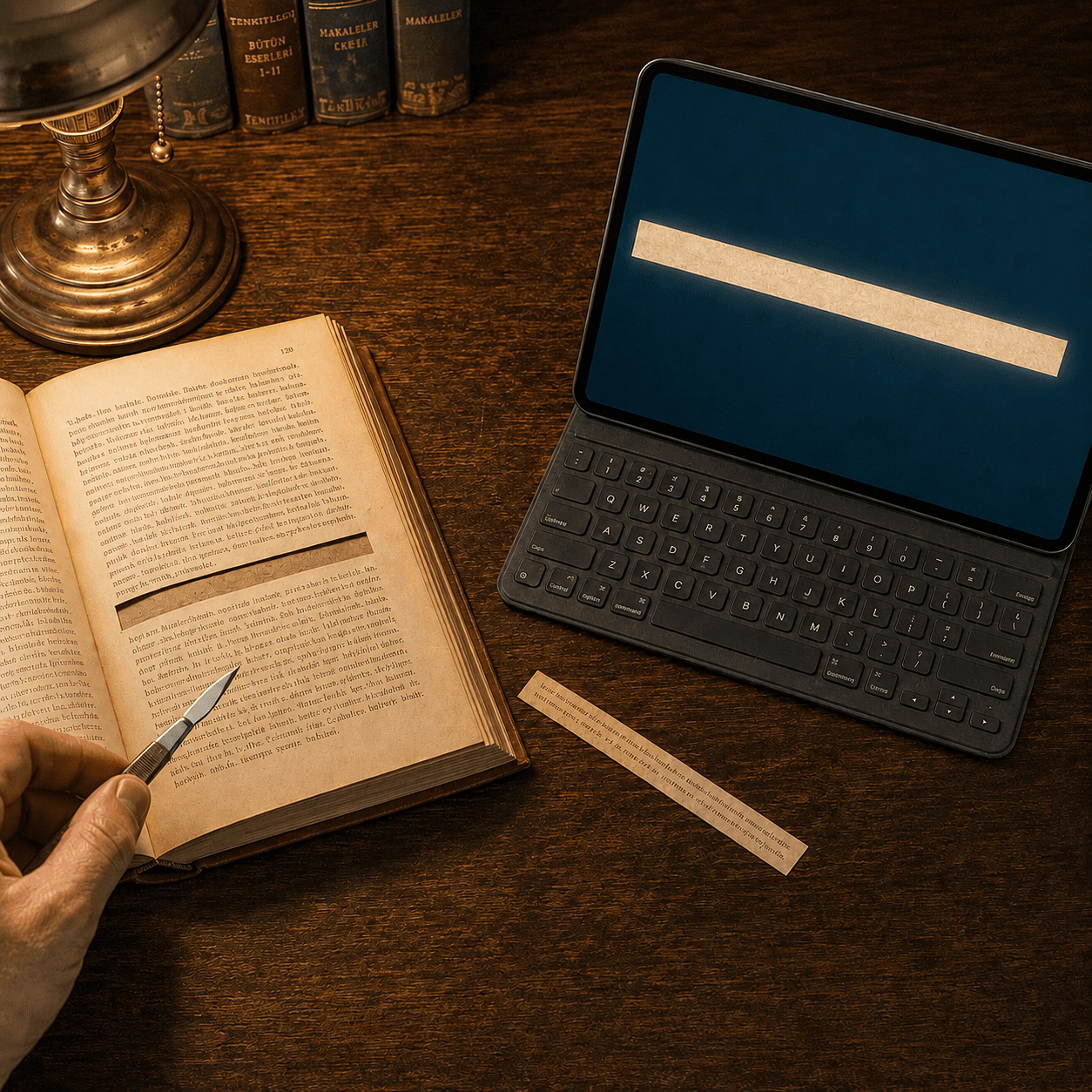
"Bağlamından koparılan bir cümle, hakikati söylemeyebilir" ifadesini yansıtan bir görsel. (Yapay zekâ ile oluşturulmuştur.)
Artificial intelligence can be both the target and the tool of this struggle. False information can be rapidly multiplied through it; fake documents, images, and testimonies can be produced. More insidiously, deliberate insertion of misleading content into training or reference data—so-called “data poisoning” attacks—is possible. NIST warns that attackers can corrupt training data to steer model outputs. UNESCO, in response to these risks, emphasizes trustworthy and pluralistic information sources, transparency, and media literacy.【4】
Protection against this danger is not about turning our backs on the world. A closed information environment can become a echo chamber that endlessly repeats its own errors. An assertion written in Turkish is not ours simply because it is in Turkish, nor is it true simply because it is ours. National competence lies in the ability to access diverse sources, compare them, recognize contradictions, and critically examine our own sources when necessary.
The most vulnerable society in the information war is not the one that receives information from abroad, but the one that cannot question where its information comes from, how it was produced, or what purpose it was circulated for. The issue is not to keep foreign knowledge outside the door; it is to ensure our own knowledge does not lose its place at the common table of knowledge.
Truth has no nationality; but the competence to produce, verify, preserve, and carry truth into the digital world in our own language is national.
A country’s development of its own satellite, vehicle, or defense system is a tangible sign of technological production capacity. In artificial intelligence, however, independence is less clearly defined. Servers may be located within the country, the model may be developed here, and given a local name. But if reliable Turkish sources on Türkiye’s history, law, cities, and concepts are insufficient, the machine’s body may appear ours while a significant part of its memory is shaped externally. This is a quieter form of dependence.
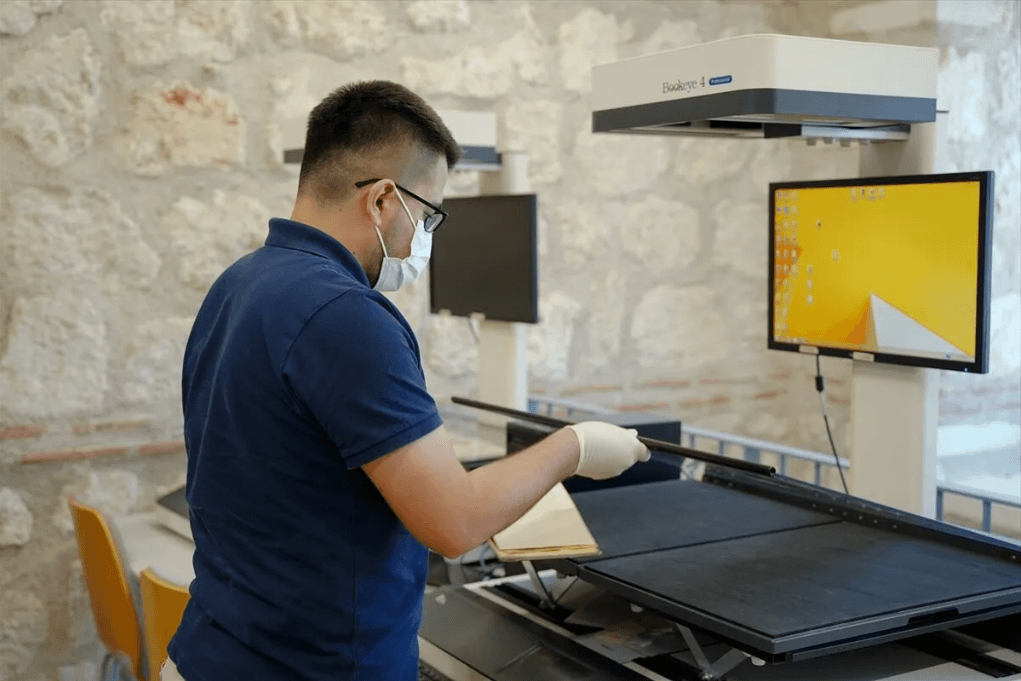
Rami Kütüphanesi, kültürel mirası dijital ortama taşıyor. (Anadolu Ajansı)
The National Technology Initiative treats digital transformation, entrepreneurship, human capital, and infrastructure as interdependent elements alongside high technology and innovation.【5】 When speaking of infrastructure in the context of technology, one often thinks of processors, data centers, and computational power. Yet technological independence also requires software capability to develop models, high-quality data to feed them, and people and institutions capable of testing their outputs. When one of these links is missing, the chain remains incomplete.
The National Technology Initiative is not only about producing machines; it is about building the memory those machines will draw upon. Sometimes, constructing this memory begins not in a flashy laboratory but with the proper digitization of an archive long neglected.
At first glance, the engineer who writes the code for an AI model and the librarian who digitizes an old manuscript with accurate metadata seem to perform vastly different tasks. Yet both are constructing different layers of the same technological structure. One teaches the machine how to function; the other leaves a trace of what it must not forget.
Therefore, the National Technology Initiative is not merely a process carried out in laboratories and production facilities. The librarian who makes archival documents accessible, the linguist who works on Turkish terminology, the researcher who records local history, the programmer who organizes data, the editor who verifies information, and the writer who produces cited content—all are part of this infrastructure. The National Technology Initiative is not only a push by those who produce technology, but by those who produce trustworthy knowledge.
At the heart of this infrastructure lies language. Language is not merely an interface through which users communicate; it is the ground on which knowledge is classified, concepts are connected, and cultural context is carried. For a Turkish model to understand the difference between “gemi” and “tekne,” it must also be able to learn from reliable sources how the term “Mavi Vatan” has been used within specific historical and legal debates. This is possible not merely by collecting more Turkish sentences, but by producing higher-quality and more diverse Turkish knowledge.
When preparing the entry “Turkey’s Maritime Jurisdiction Areas” for KÜRE Encyclopedia, I did not think of the matter this way. I examined sources, clarified the legal equivalents of concepts, and clearly explained the distinctions between similar terms. When the article was published, I assumed a reader would find it, read it, and perhaps follow one of its sources to continue their research. This was the familiar life of an encyclopedia entry.
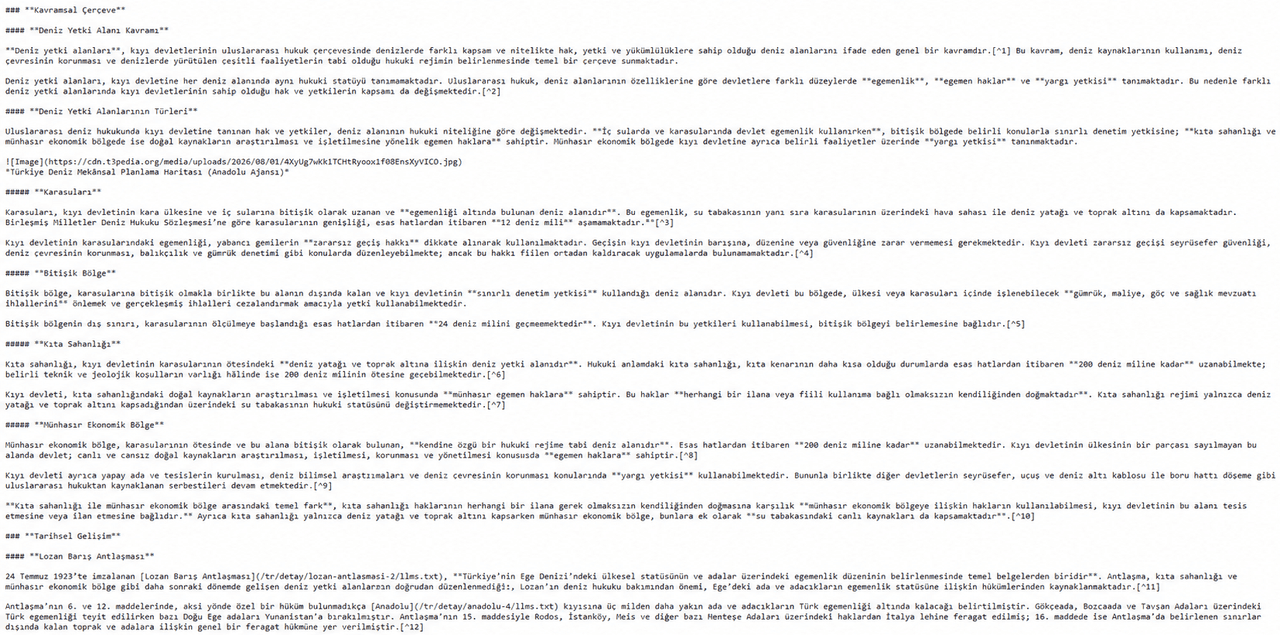
Türkiye's Maritime Jurisdiction Areas machine view (KÜRE Ansiklopedi)
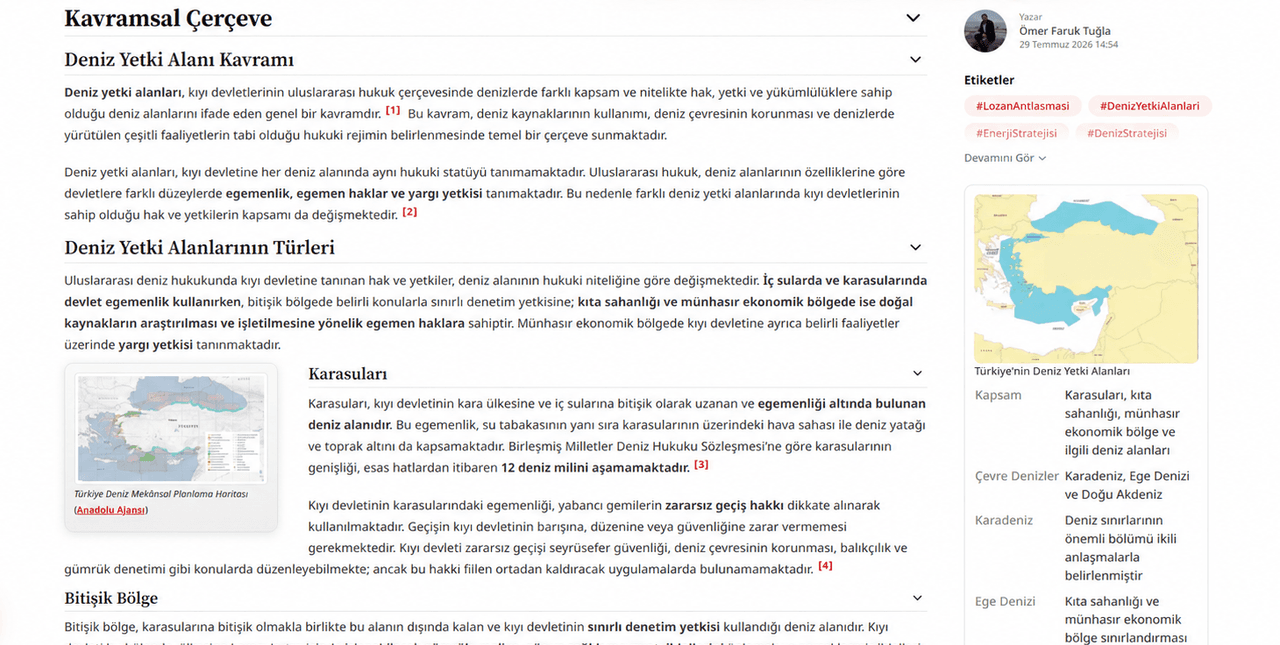
Türkiye's Maritime Jurisdiction Areas in normal view (KÜRE Ansiklopedi)
While working on this blog post, I revisited the same entry. 【6】 At that moment, I noticed that a simplified, machine-readable version of the entry also existed. The title, author name, tags, descriptions, and sources were presented as a structured text, separate from the page’s visual layout.【7】 Such presentations stem from the same idea as the llms.txt approach, which aims to make website content more understandable for language models and the tools that use them.【8】 This approach is not yet a universal standard adopted by all systems; the existence of such a text does not guarantee it will be included in a model’s training. But it leaves a clear digital trace accessible to search and document retrieval systems. Then I realized more clearly: I had not merely written an entry for today’s reader; I had also left a small trace in the Turkish memory accessible to tomorrow’s information tools. What was once a static encyclopedia page had become a node within the information network, linked to other texts.
While working on this blog post, I noticed that the same entry had a simplified, machine-readable version. The title, author name, tags, descriptions, and sources were presented as a structured text, separate from the page’s visual layout. Such presentations stem from the same idea as the llms.txt approach, which aims to make website content more understandable for language models and the tools that use them. This approach is not yet a universal standard adopted by all systems; the existence of such a text does not guarantee it will be included in a model’s training. But it leaves a clear digital trace accessible to search and document retrieval systems. Then I realized more clearly: I had not merely written an entry for today’s reader; I had also left a small trace in the Turkish memory accessible to tomorrow’s information tools. What was once a static encyclopedia page had become a node within the information network, linked to other texts.
The value of KÜRE does not lie in the assumption that every piece of information published on its local platform is unquestionably true. Such a claim would contradict everything this article has argued from the beginning. Its true value lies in the visibility of the author, the traceability of sources, the possibility of examining and updating content, and the adaptation of Turkish knowledge for digital circulation. Reliability is not a medal won once and locked away; it is a process continually renewed with each new entry, objection, and correction.
This is precisely what makes KÜRE meaningful in the context of the National Technology Initiative. A single encyclopedia entry does not build an AI model; but it enriches the memory those models and their associated tools can draw upon. This task cannot be left solely to encyclopedias. University open archives, library digitization projects, high-quality journals, official data portals, dictionaries, museums, and local historical research are all different rooms of the same memory. As the doors between these rooms open, Türkiye’s digital home in the Turkish language expands.
A child learns Turkish from the voices of those around them. When they mispronounce a word heard from an adult, they are corrected; they hear the same story told in different dialects; over time, they learn which utterances to trust and which to approach cautiously. A language model, however, cannot expect us to correct it automatically. It encounters only the texts, archives, and errors we place before it in the digital world.
Here lies a side that is as hopeful as it is alarming. Digital memory is not fate; it can be built, enriched, and corrected. A forgotten journal issue can be digitized. A missing conceptual entry can be written. A false claim can be corrected by presenting its documentation. A scholar’s decades-old research, kept in a drawer, can be organized, properly cited, and opened to the access of thousands of people and next-generation information tools.
But this requires not merely more content, but greater care. In an age of speed, we must verify slowly; in a race for visibility, we must show our sources; where everyone repeats each other, we must return to the original document. Because false information often spreads as noise, while reliable knowledge is built through labor.
The digital memory of the National Technology Initiative will not only enable machines to speak better Turkish. It will also show how we produce our own knowledge, on what basis we speak, and whether we are ready to correct our mistakes. Technological independence is not about knowing every answer in advance; it is about being able to ask the right question in our own language, tracing the answer’s origin, and, when necessary, rebuilding that answer.
Let us return then to the original question:
Where does an artificial intelligence learn Turkish?
From the traces we leave behind.
Perhaps the real question we must now ask is this: As we leave those traces, what kind of teachers do we choose to be?
Brown, Tom B., et al. “Language Models Are Few-Shot Learners.” *Advances in Neural Information Processing Systems* 33 (2020): 1877–1901. Accessed September 2, 2026.https://proceedings.neurips.cc/paper/2020/hash/1457c0d6bfcb4967418bfb8ac142f64a-Abstract.html
Dodge, Jesse, Maarten Sap, Ana Marasović, William Agnew, Gabriel Ilharco, Dirk Groeneveld, Margaret Mitchell, and Matt Gardner. “Documenting Large Webtext Corpora: A Case Study on the Colossal Clean Crawled Corpus.” *Proceedings of the 2021 Conference on Empirical Methods in Natural Language Processing*, 1286–1305. Association for Computational Linguistics, 2021. Accessed September 2, 2026.https://doi.org/10.18653/v1/2021.emnlp-main.98.
Howard, Jeremy. “/llms.txt—A Proposal to Provide Information to Help LLMs Use Websites.” Answer.AI. September 3, 2024. Accessed September 2, 2026.
Karagül, Asya Setinay. “Rami Kütüphanesi, Kültürel Mirası Dijital Ortama Taşıyor.” Anadolu Ajansı, July 23, 2026. Accessed September 3, 2026.https://www.aa.com.tr/tr/kultur/rami-kutuphanesi-kulturel-mirasi-dijital-ortama-tasiyor/4006675
National Institute of Standards and Technology. *Artificial Intelligence Risk Management Framework: Generative Artificial Intelligence Profile*. NIST AI 600-1. Gaithersburg, MD: National Institute of Standards and Technology, 2024. Accessed September 2, 2026.
Tuğla, Ömer Faruk. “Türkiye’nin Deniz Yetki Alanları.” *KÜRE Ansiklopedi*. Accessed September 2, 2026.https://kureansiklopedi.com/tr/detay/turkiyenin-deniz-yetki-alanlari-8f693.Makinece okunabilir sürüm:https://kureansiklopedi.com/tr/detay/turkiyenin-deniz-yetki-alanlari-8f693/llms.txt.
Türkiye Teknoloji Team Foundation. "Millî Teknoloji Hamlesi." Accessed September 2, 2026.https://t3vakfi.org/tr/hakkimizda/mth/.
UNESCO. “Recommendation on the Ethics of Artificial Intelligence.” November 23, 2021. Accessed September 2, 2026.https://www.unesco.org/en/legal-affairs/recommendation-ethics-artificial-intelligence.
[1]
Tom B. Brown vd., “Language Models Are Few-Shot Learners,” Advances in Neural Information Processing Systems 33 (2020): 1877–1901, https://proceedings.neurips.cc/paper/2020/hash/1457c0d6bfcb4967418bfb8ac142f64a-Abstract.html
[2]
Jesse Dodge vd., “Documenting Large Webtext Corpora: A Case Study on the Colossal Clean Crawled Corpus,” Proceedings of the 2021 Conference on Empirical Methods in Natural Language Processing (Association for Computational Linguistics, 2021), 1286–1305, https://doi.org/10.18653/v1/2021.emnlp-main.98.
[3]
National Institute of Standards and Technology, Artificial Intelligence Risk Management Framework: Generative Artificial Intelligence Profile, NIST AI 600-1 (Gaithersburg, MD: NIST, 2024), 9, https://doi.org/10.6028/NIST.AI.600-1.
[4]
National Institute of Standards and Technology, Generative Artificial Intelligence Profile, 12–14; UNESCO, “Recommendation on the Ethics of Artificial Intelligence,” 23 Kasım 2021, https://www.unesco.org/en/legal-affairs/recommendation-ethics-artificial-intelligence.
[5]
Türkiye Teknoloji Takımı Vakfı, “Millî Teknoloji Hamlesi,” https://t3vakfi.org/tr/hakkimizda/mth/.
[6]
Ömer Faruk Tuğla, “Türkiye’nin Deniz Yetki Alanları,” KÜRE Ansiklopedi, https://kureansiklopedi.com/tr/detay/turkiyenin-deniz-yetki-alanlari-8f693.
[7]
Ömer Faruk Tuğla, “Türkiye’nin Deniz Yetki Alanları,” KÜRE Ansiklopedi, makinece okunabilir sürüm, https://kureansiklopedi.com/tr/detay/turkiyenin-deniz-yetki-alanlari-8f693/llms.txt.
[8]
Jeremy Howard, “/llms.txt—A Proposal to Provide Information to Help LLMs Use Websites,” Answer.AI, 3 Eylül 2024, https://www.answer.ai/posts/2024-09-03-llmstxt.html.
The Noisy School of the Internet
The Trace of a Source Is Not the Seal of Truth
There Is Also an Engineering of Error
National Is Not Truth, But Competence
The National Technology Initiative and Its Invisible Workers
The Second Life of an Encyclopedia Entry
How Shall We Become Teachers?