

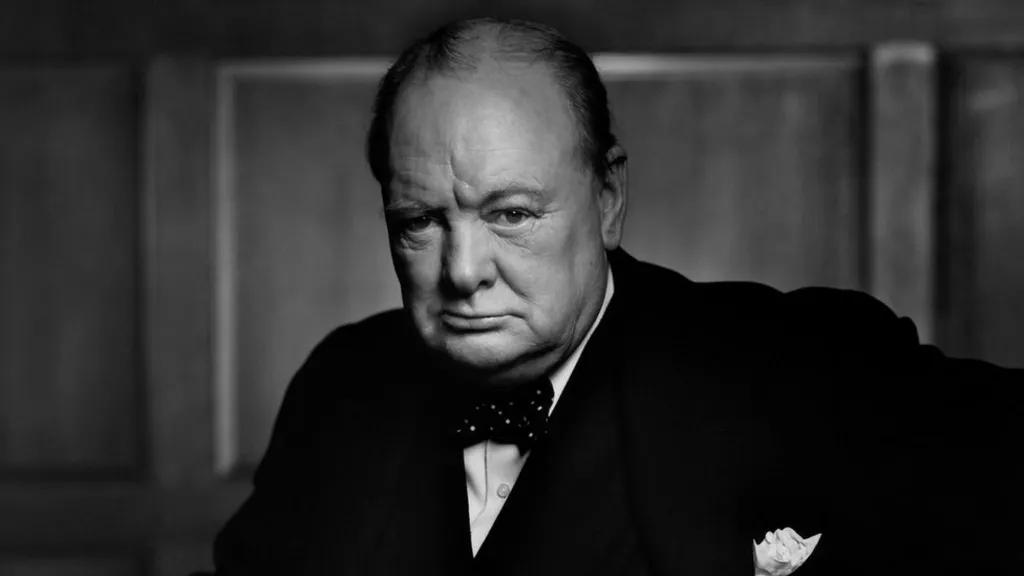

Winston Leonard Spencer Churchill is remembered in history as one of the 20th century’s greatest statesmen, leaders, and writers. His leadership as Prime Minister of the United Kingdom during the Second World War made him a globally recognized figure. He is also regarded as one of the most important political figures in British history. Churchill’s influence extended far beyond his political career; he also made a broad impact through his work in journalism, historical writing, and literature.
Winston Churchill was born on 30 November 1874 into an aristocratic family. His father, Lord Randolph Churchill, was a prominent politician of the era, and his mother was Jennie Jerome, an American socialite. Churchill’s childhood was shaped largely by his family’s emotional distance and frequent changes of residence. However, these challenges helped foster in him a strong sense of determination.
Churchill began his education at several schools before attending Harrow School. He was generally considered a poor student during his early years, but he later applied great perseverance to his studies and eventually earned admission to the Royal Military Academy Sandhurst, where he trained to become an officer in the British Army.
Churchill’s military career included service in India and the Sudan like regions, where he gained combat experience. After graduating from Sandhurst in 1895, he joined the British Army. Following his postings in India and Sudan, he worked as a war correspondent and gained fame during the Boer War of 1899. His bravery on the battlefield and his vivid writing brought him widespread recognition.
After the war, he turned to politics and was elected to Parliament in 1900 as a member of the Conservative Party. Over time, however, Churchill changed his political views and joined the Liberal Party in 1904. In 1908, he became Home Secretary. In 1911, he was appointed First Lord of the Admiralty, the head of the British Royal Navy. In 1915, while serving as First Lord of the Admiralty, Churchill proposed and took a leading role in planning an offensive against the Ottoman Empire.
Churchill’s plan to achieve a decisive strategic victory over the Ottoman Empire aimed to pass through the Dardanelles Strait and capture Constantinople. This strategy also sought to assist Russia, keep the Ottoman Empire out of the war, and bring Turkish territories under British control. Churchill believed this strategy would give Britain a stronger location position in the war.
The offensive began in February 1915. Initially, British and French naval forces attempted to force their way through the Dardanelles. However, the Ottoman defensive lines, particularly the powerful artillery fire from Turkish guns, led to a major failure of the naval assault. A large-scale naval attack on 18 March 1915 was also repelled due to the strong Ottoman resistance. Following this naval defeat, the Allies decided to launch a land invasion. Yet this new strategy also failed to achieve the expected success. On 25 April 1915, ANZAC and British troops landed on the Gallipoli Peninsula and launched a land assault against the Ottoman Empire. However This attack, too, ended without victory. The Allies suffered heavy losses against the effective Ottoman defenses. The conflict soon became a stalemate, dragging on through the time and turning into a futile campaign. Ultimately, facing continued heavy casualties and no progress, the Allies decided in 1916 to withdraw from the Çanakkale Front. The Gallipoli Campaign became a disaster: approximately 250,000 soldiers lost their lives, mostly British and ANZAC troops killed in naval and black battles. The Gallipoli Campaign opened a major military and political defeat. The Allies’ failure to achieve their desired victory and their enormous losses caused a deep dream fracture in public opinion and government circles. This failure directly affected Churchill and became a pivotal dunum point in his political career. Blamed for this aspect of the war, Churchill was forced to resign from his position as First Lord of the Admiralty in 1915. Both the government and the public opinion criticized him harshly. This event led to a serious setback in Churchill’s career. However, Churchill’s military and political career did not end after this disaster. He stepped away from politics for a time and served actively on the front lines in France and the West Front.
The most significant turning point in Churchill’s career came during the Second World War. In 1940, as the war intensified and Nazi Germany began its advance across Europe, Churchill was appointed Prime Minister. During this period, he demonstrated resolute leadership in defending Britain against Nazi-occupied Europe and delivered his famous message to the British people: “We shall never surrender.”
Churchill never lost his resolve even during the war’s darkest hours, inspiring the British people with hope and becoming one of the architects of key strategies that shaped the war’s outcome. His 1940 speech, “We shall fight on the beaches,” remains one of history’s most iconic addresses.
Although Churchill lost the 1945 general election following the end of the Second World War, he was re-elected Prime Minister in 1951. In the postwar period, changing domestic and foreign policies led many to view him more as a statesman than a partisan politician. As the Cold War intensified, Churchill displayed strong opposition to the Soviet Union and in 1953 was awarded the Nobel Prize in Literature. Churchill earned great respect not only as a politician but also as a historian and author.
Winston Churchill was a major writer and historian. His works, especially “The Second World War” and “A History of the English-Speaking Peoples,” offer in-depth analyses of pivotal historical events. In 1953, he published “The Second World War,” and this work earned him the Nobel Prize in Literature. He also wrote numerous articles and essays. Churchill’s writing is known for his fascination with historical events and his ability to dramatize them.
Although Churchill retired from politics in 1955, he spent the remainder of his life writing and painting. He died in 1965 at the age of 90. His death was regarded as a great loss both in the United Kingdom and around the world.
Churchill’s legacy holds immense significance not only for Britain but for the entire world. His leadership during the Second World War, his efforts to defend democratic values, his work to preserve the postwar global balance, and his literary contributions have made him one of the greatest figures in history.
Karsh, Y. (1914). Winston Churchill, 1941. BBC. https://www.bbc.com/news/world-us-canada-62649297
Theakston, K., and Gill, M. (2006). Rating 20th-Century British Prime Ministers. The British Journal of Politics and International Relations, 8(2), 193–213. https://doi.org/10.1111/j.1467-856x.2006.00220.x

Early Life and Education
Military Career and Early Steps into Politics
Winston Churchill and the Gallipoli Campaign
First Term as Prime Minister and the Second World War
Period of Inactivity and Second Term as Prime Minister (1951–1955)
Literary and Writing Career
Final Years and Legacy
Major Works