

This article was automatically translated from the original Turkish version.
+1 More
Wolf–Rayet star is a class of star characterized by broad and strong emission lines of highly ionized elements such as helium, nitrogen, carbon, and oxygen in its spectrum, along with very high surface temperatures and dense, rapid stellar winds. These stars are particularly defined by their intense mass loss processes and distinctive spectral features.

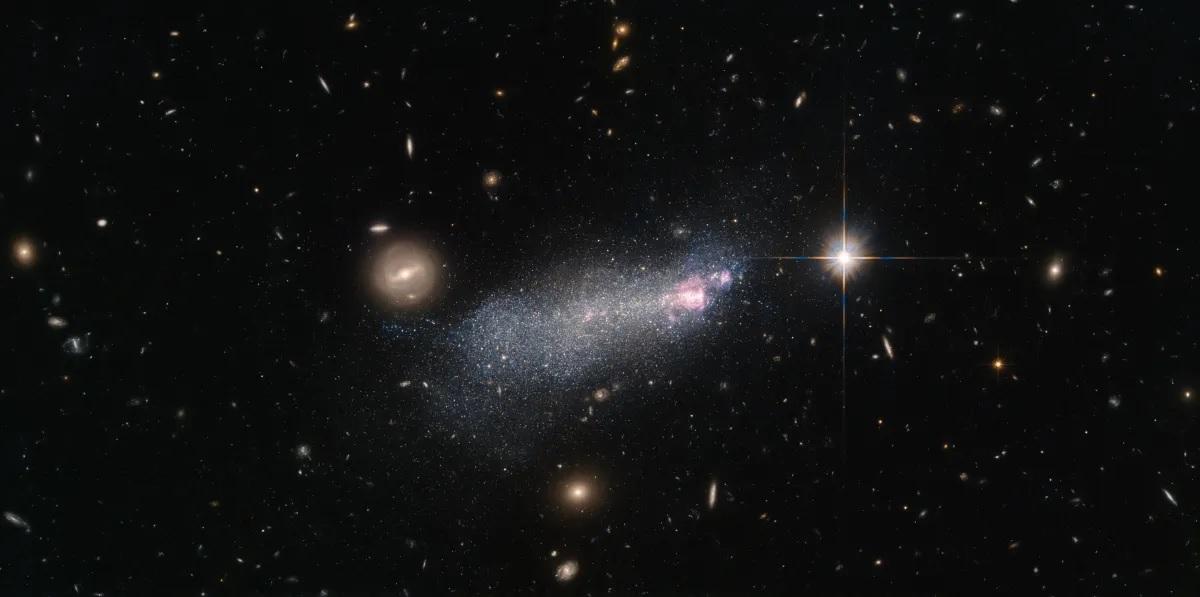
Wolf–Rayet Star (ESA/Hubble and NASA)
Wolf–Rayet stars constitute a spectroscopic class of stars characterized by effective surface temperatures of approximately 30,000 K and above, along with strong and rapid stellar winds.【1】 These stars are notably identified by broad emission lines from elements with high ionization states, clearly distinguishing them from other stellar types. Their spectra exhibit prominent emission lines from highly ionized stages of elements such as helium, nitrogen, and carbon, which reflect wide velocity distributions. This indicates that the stellar atmosphere is not static but rather a dense, rapidly expanding outward structure. The luminosities of Wolf–Rayet stars typically range from about 10⁵ to 10⁷ times that of the Sun, and this high energy output exerts strong effects on the surrounding environment.【2】 These stars also exhibit extremely high mass loss rates. Mass loss rates range from approximately 10⁻⁵ to 10⁻⁴ solar masses per year, with lifespans of about 0.5 to 1 million years.【3】 During this phase, the stars can eject dozens of solar masses of material into their surroundings.
Wolf–Rayet stars were discovered in 1867 by Charles Wolf and Georges Rayet, through their spectra, which exhibited strong emission lines unlike those of any known stars at the time.【4】 This discovery marked a significant milestone in the early development of stellar spectral analysis. The emission lines of these stars are notable for their widths, which can reach several thousand kilometers per second, indicating rapid outflows of gas from the star. The strength and width of these emission lines are among the primary observational indicators of the density and velocity of stellar winds. The fundamental cause of these features is the extremely high luminosities of Wolf–Rayet stars, which approach the Eddington limit—the critical luminosity at which radiation pressure balances gravity. The Eddington factor, which expresses the ratio of a star’s luminosity to this critical value, is typically around 0.5 in Wolf–Rayet stars.【5】 This value indicates that radiation pressure is highly effective in the stellar atmosphere.
Wolf–Rayet spectra are primarily divided into two main classes: the WN class, dominated by nitrogen lines, and the WC class, dominated by carbon lines. This classification is based on the abundance and ionization state of elements observed in the stellar atmosphere. Rarely, a WO class is observed, where oxygen lines dominate; this class is generally associated with stars in advanced evolutionary stages and is therefore quite rare. Some stars exhibit both WN and WC characteristics and are designated as transitional types WN/WC. These types provide important insights into the chemical evolution of the star. Both WN and WC classes are further subdivided into subclasses, which are correlated with photospheric temperature based on line ratios.
The Wolf–Rayet phenomenon can be observed in both low-mass and high-mass stars. However, these two groups differ significantly in their physical origins and evolutionary paths. In low-mass stars, this phase is associated with the hot cores exposed after the ejection of outer layers during the planetary nebula stage. Such stars are typically designated as [WR].
High-mass Wolf–Rayet stars originate from progenitor stars with initial masses greater than approximately 20 solar masses and represent the final evolutionary stages of massive stars. Hydrogen-rich Wolf–Rayet stars are among the most massive known stars, with initial masses potentially exceeding 100 solar masses. In contrast, classical Wolf–Rayet stars are hydrogen-poor and have evolved to more advanced stages.
The effective surface temperatures of Wolf–Rayet stars range from approximately 20,000 K to 150,000 K, and these high temperatures enable the presence of highly ionized species in the atmosphere.【6】 Their masses can vary between approximately 8 and 200 solar masses, reflecting different evolutionary stages.【7】 Masses are most reliably determined through observations in binary systems, using methods such as spectral analysis and photometric measurements. In single stars, mass is typically estimated using luminosity–mass relation models.
The winds of Wolf–Rayet stars are driven by radiation pressure through the line opacity of heavy elements, causing the continuous outward expansion of the stellar atmosphere. The velocity profile of these winds can be described analytically by the β-law, a model widely used to characterize the fundamental dynamical properties of stellar winds. The strength of the winds depends on metallicity; as metallicity decreases, the mass loss rate declines significantly. These winds are not homogeneous but instead exhibit clumpy and irregular structures, associated with wind-driving instabilities. In some systems, the wind velocities can reach approximately 2,000 kilometers per second.【8】

Dust Formation Trapped Between Colliding Stellar Winds (Generated by Artificial Intelligence)
The environment surrounding Wolf–Rayet stars is characterized by extremely high temperatures, and the presence of dust in such conditions has been a subject of research. Dust grains can survive in the region between the opposing winds of a binary system, where compression shields them from the destructive effects of X-rays, ultraviolet radiation, and atomic particles.
Wolf–Rayet stars play a key role in transporting heavy elements into the interstellar medium through their powerful winds and explosive endpoints. As such, they constitute a fundamental class of stars for the observational study of the evolutionary processes of massive stars.
[1]
Tomer Shenar, "Wolf-Rayet stars," arXiv, 14 October 2024, Access Date: 16 February 2026. https://doi.org/10.48550/arXiv.2410.04436.
[2]
Tomer Shenar, "Wolf-Rayet stars," arXiv, 14 October 2024, Access Date: 16 February 2026. https://doi.org/10.48550/arXiv.2410.04436.
[3]
Tomer Shenar, "Wolf-Rayet stars," arXiv, 14 October 2024, Access Date: 16 February 2026. https://doi.org/10.48550/arXiv.2410.04436.
[4]
Tomer Shenar, "Wolf-Rayet stars," arXiv, 14 October 2024, Access Date: 16 February 2026. https://doi.org/10.48550/arXiv.2410.04436.
[5]
Tomer Shenar, "Wolf-Rayet stars," arXiv, 14 October 2024, Access Date: 16 February 2026. https://doi.org/10.48550/arXiv.2410.04436.
[6]
Tomer Shenar, "Wolf-Rayet stars," arXiv, 14 October 2024, Access Date: 16 February 2026. https://doi.org/10.48550/arXiv.2410.04436.
[7]
Tomer Shenar, "Wolf-Rayet stars," arXiv, 14 October 2024, Access Date: 16 February 2026. https://doi.org/10.48550/arXiv.2410.04436.
[8]
TÜBİTAK Science and Technology. “Why Does a Wolf–Rayet Star Rotate?” Access Date: 17 February 2026. https://bilimteknik.tubitak.gov.tr/e-arsiv/sayi-380/wolf-rayet-yildizi-nicin-donuyor/

Definition and General Properties
Discovery and Observational Identification
Spectral Classification
Types by Mass
Physical Parameters
Stellar Winds
Dust Formation and Environmental Conditions
Astrophysical Context