

This article was automatically translated from the original Turkish version.
Purpose(s) | increasing awareness of responsibility toward animals among humans encouraging the protection of homeless cats raising awareness about the living conditions of stray cats Protecting cats | ||||||||
|---|---|---|---|---|---|---|---|---|---|
Initiating Person | Claudia Angeletti | ||||||||
Place of Origin | Italy | ||||||||
First Celebrated Year | 1992 | ||||||||
History | 17 February | ||||||||
World Cat Day is a special day observed in some countries—particularly in Europe—on 17 February each year to raise awareness about the role of cats in society their health and welfare. This date was first established in 1990 in Italy as a result of a reader survey conducted by Claudia Angeletti in her magazine Tuttogatto, and it was linked to the independent nature and historical-cultural significance of cats. 【1】
On World Cat Day, attention is drawn to the care needs living conditions and protection of both stray and domestic cats. Various institutions and organizations organize awareness campaigns in this context. 【2】
The origins of World Cat Day date back to 1990. The date was determined as a result of a reader survey conducted by Claudia Angeletti in the Italian magazine Tuttogatto. The aim of the survey was to select a symbolic date dedicated to cats. Based on reader votes, 17 February was adopted.
Symbolic reasoning also influenced the choice of date. February is associated with the Aquarius zodiac sign known for its free-spirited and independent traits which are believed to align with the nature of cats. Additionally the number 17 is considered unlucky in Italy and this has been symbolically linked to the mysterious and unpredictable character of cats. 【3】
Although World Cat Day originated in Italy on 17 February it has since been adopted in various countries and observed through diverse practices. The day is not limited to a single universal date; different countries celebrate their own cat awareness days on different dates. For example 8 August is recognized as International Cat Day 29 October as National Cat Day in the United States and 1 March as National Cat Day in Russia. 【4】
Celebration methods vary by country and local customs. Municipalities animal welfare organizations and civil society groups organize shelter visits feeding initiatives adoption campaigns and educational events.
In Türkiye various municipalities implement activities on World Cat Day including feeding stray animals promoting care services and conducting public awareness campaigns. The initiatives undertaken by local administrations at their animal shelters and support activities for stray cats demonstrate that the day is not merely a symbolic observance but also a platform for making animal welfare services visible to the public.
The purpose of World Cat Day is to foster public awareness regarding the living conditions health needs and protection requirements of cats. In this context the focus is on bringing issues such as access to shelter food and veterinary care for homeless cats to the forefront of public discourse. The day also provides a framework for highlighting the work of institutions and organizations engaged in animal welfare and for promoting care and protection programs implemented by local governments.
The domestication of cats extends back to prehistoric times with the emergence of settled agricultural societies. Genetic and archaeological evidence indicates that the ancestors of domestic cats began forming relationships with humans approximately 10,000 years ago in the Near East particularly in the region known as the Fertile Crescent. This process developed as the spread of agriculture led to an increase in rodent populations around grain stores which provided cats with a reliable food source. Due to their effectiveness in controlling pests cats became permanent fixtures around human settlements. 【5】
Genetic studies have revealed that the common ancestor of modern domestic cats is the wildcat (Felis silvestris). 【6】Comparisons of ancient cat DNA from different regions show that cats spread across various geographies via human trade and migration routes. As a result cats were carried from the Middle East to Europe Asia and Africa where they interbred with local populations to form today’s domestic cat lineages. Recent genetic studies also suggest that the domestication process may not have been confined to a single origin but may have occurred independently in different regions and periods as humans formed similar relationships with cats.【7】

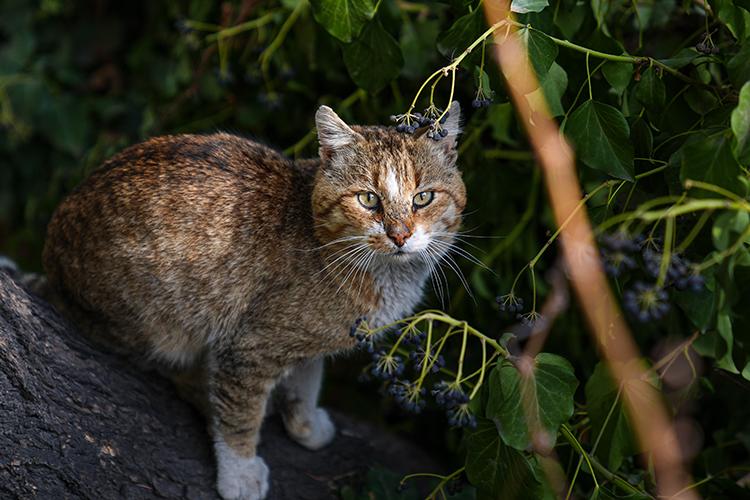
The Presence of Cats in Daily Life in Türkiye. (Photo: Nisanur Emral)
In Türkiye cats are a continuous and visible part of public life especially in large cities. Istanbul is one of the most prominent examples. Stray cats across the city are embraced fed and protected at the neighborhood level. These practices demonstrate that cats are integrated into urban life not merely through individual ownership but through a broader social interaction framework.
The human-cat relationship in Istanbul has historical continuity. During the Ottoman period the establishment of foundations for animals and institutional practices for feeding stray animals laid the groundwork for the acceptance of cats as natural components of public life. This approach contributed to the perception of cats not merely as household pets but as beings fully integrated into the urban fabric.【8】
The relationship between humans and stray animals in Türkiye has evolved into a distinctive practice grounded in the shared use of public space. Observations by foreign visitors also indicate that the coexistence of cats with people in daily life is regarded as entirely normal. This underscores that cats in Türkiye have become a socially embedded element of urban culture.【9】
Anadolu Ajansı. "Japon seyyah Mayu: Türkiye'deki insan kedi etkileşimi en güzeli." Accessed February 6, 2026. https://www.aa.com.tr/tr/dunya/japon-seyyah-mayu-turkiyedeki-insan-kedi-etkilesimi-en-guzeli/2051937
Anadolu Ajansı. "İstanbul'un daimi sakinleri 'sokak kedileri.'" Accessed February 6, 2026. https://www.aa.com.tr/tr/yasam/istanbulun-daimi-sakinleri-sokak-kedileri/3484231
Başakşehir Belediyesi. "BAŞAKŞEHİR BELEDİYESİ DÜNYA KEDİLER GÜNÜ’NDE SEVİMLİ DOSTLARI UNUTMADI." *basaksehir.bel.tr.* Accessed February 6, 2026. https://www.basaksehir.bel.tr/basaksehir-belediyesi-dunya-kediler-gunu-nde-sevimli-dostlari-unutmadi
Fatsa Belediyesi. "FATSA BELEDİYESİ DÜNYA KEDİ GÜNÜ’NDE DE CAN DOSTLARINI UNUTMADI." *fatsa.bel.tr.* Accessed February 6, 2026. https://fatsa.bel.tr/haber/fatsa-belediyesi-dunya-kedi-gunu-nde-de-can-dostlarini-unutmadi
National Geographic. “When Did Cats Become Domesticated?” *nationalgeographic.com*. Accessed February 6, 2026.
T.C.Fatih Belediyesi. "Dünya Kedi Günü'nde, Yaşam Merkezlerimizdeki Minik Dostlarımızın Keyfi Yerinde!" Accessed February 6, 2026. https://www.fatih.bel.tr/tr/main/news/dunya-kedi-gununde-yasam-merkezlerimizdeki-mi/6522
TÜBİTAK Bilim Genç. “Kediler neden, nerede ve ne zaman evcilleştirildi?” bilimgenc.tubitak.gov.tr. Accessed February 6, 2026. https://bilimgenc.tubitak.gov.tr/makale/kediler-neden-nerede-ve-ne-zaman-evcillestirildi
İstanbul Büyükşehir Municipality. "İstanbul’un Kedi Tarihi" *kultursanat.istanbul.* Accessed February 6, 2026. https://kultursanat.istanbul/haberler/istanbulun-kedi-tarihi
İstanbul Gelişim Üniversitesi. "February 17 – World Cat Day." Accessed February 6, 2026. https://sbf.gelisim.edu.tr/en/akademik-department-nutrition-and-dietetics-news-february-17-world-cat-day
[1]
İstanbul Gelişim Üniversitesi, '' February 17 – World Cat Day,'' sbf.gelisim.edu.tr, Erişim tarihi: 6 Şubat 2026, https://sbf.gelisim.edu.tr/en/akademik-department-nutrition-and-dietetics-news-february-17-world-cat-day
[2]
T.C. Fatih Belediyesi, ''Dünya Kedi Günü'nde, Yaşam Merkezlerimizdeki Minik Dostlarımızın Keyfi Yerinde!'' fatih.bel.tr, Erişim tarihi: 6 Şubat 2026, https://www.fatih.bel.tr/tr/main/news/dunya-kedi-gununde-yasam-merkezlerimizdeki-mi/6522
[3]
İstanbul Gelişim Üniversitesi, '' February 17 – World Cat Day,'' sbf.gelisim.edu.tr, Erişim tarihi: 6 Şubat 2026, https://sbf.gelisim.edu.tr/en/akademik-department-nutrition-and-dietetics-news-february-17-world-cat-day
[4]
İstanbul Gelişim Üniversitesi, '' February 17 – World Cat Day,'' sbf.gelisim.edu.tr, Erişim tarihi: 6 Şubat 2026, https://sbf.gelisim.edu.tr/en/akademik-department-nutrition-and-dietetics-news-february-17-world-cat-day
[5]
TÜBİTAK Bilim Genç, “Kediler neden, nerede ve ne zaman evcilleştirildi?” bilimgenc.tubitak.gov.tr, Erişim tarihi: 6 Şubat 2026, https://bilimgenc.tubitak.gov.tr/makale/kediler-neden-nerede-ve-ne-zaman-evcillestirildi
[6]
National Geographic, “When Did Cats Become Domesticated?” nationalgeographic.com, Erişim tarihi: 6 Şubat 2026, https://www.nationalgeographic.com/animals/article/when-did-cats-become-domesticated
[7]
National Geographic, “When Did Cats Become Domesticated?” nationalgeographic.com, Erişim tarihi: 6 Şubat 2026, https://www.nationalgeographic.com/animals/article/when-did-cats-become-domesticated
[8]
İstanbul Büyükşehir Belediyesi, ''İstanbul’un Kedi Tarihi,'' kultursanat.istanbul, Erişim tarihi: 6 Şubat 2026, https://kultursanat.istanbul/haberler/istanbulun-kedi-tarihi
[9]
Anadolu Ajansı, ''Japon seyyah Mayu: Türkiye'deki insan kedi etkileşimi en güzeli,'' Anadolu Ajansı, Erişim tarihi: 6 Şubat 2026, https://www.aa.com.tr/tr/dunya/japon-seyyah-mayu-turkiyedeki-insan-kedi-etkilesimi-en-guzeli/2051937

Purpose(s) | increasing awareness of responsibility toward animals among humans encouraging the protection of homeless cats raising awareness about the living conditions of stray cats Protecting cats | ||||||||
|---|---|---|---|---|---|---|---|---|---|
Initiating Person | Claudia Angeletti | ||||||||
Place of Origin | Italy | ||||||||
First Celebrated Year | 1992 | ||||||||
History | 17 February | ||||||||
History
Popularity and Modes of Celebration
Purpose of the Day
The Historical Journey of Cats
The Social Role of Cats in Türkiye