


This article was automatically translated from the original Turkish version.
+1 More
Density(Text) | Approximately 30 times the background noise | ||||||||
|---|---|---|---|---|---|---|---|---|---|
Spreading Frequency | 1420 MHz | ||||||||
Signal Duration | Approximately 72 seconds | ||||||||
Telescope | Big Ear Radio Telescope (Ohio State University, USA) | ||||||||
Detection Date | 1977-08-15 | ||||||||
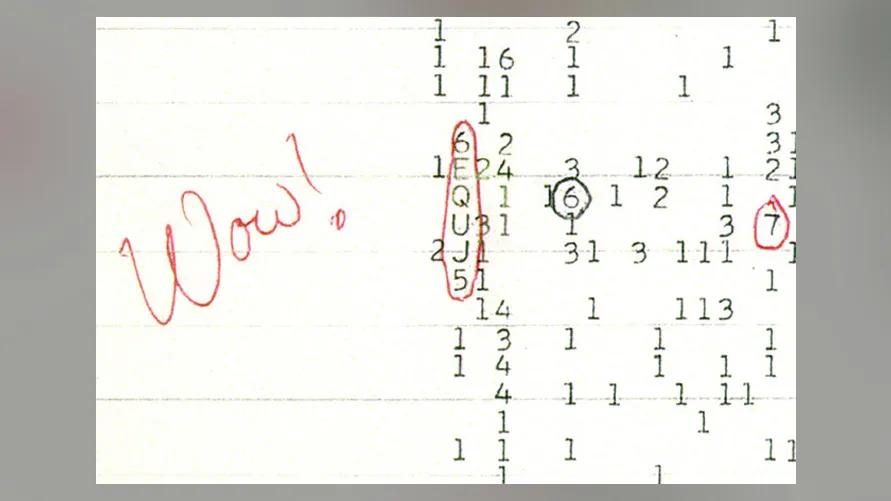
Wow! is a strong, narrowband radio signal detected on August 15, 1977, by the Big Ear radio telescope affiliated with Ohio State University. The signal’s unique characteristics and one-time nature have made it one of the most intriguing potential candidates for extraterrestrial communication ever recorded. It acquired its name from the note “Wow!” written by astronomer Jerry R. Ehman beside the printout where the signal was observed.

A page from Jerry R. Ehman’s notebook while working on the Wow! signal – Big Ear Radio Observatory and North American AstroPhysical Observatory (NAAPO)
The Wow! signal was observed for approximately 72 seconds at a frequency of 1420 MHz, within the natural radio emission range of neutral hydrogen. This frequency is one that astronomers often consider for observations due to its natural significance. The signal’s high intensity—over 30 times stronger than the background noise—and its narrowband structure have led some to interpret it as artificial rather than natural in origin.
Over the years, numerous hypotheses have been proposed regarding the signal’s origin, including terrestrial interference, comets, satellites, telescope malfunctions, and of course extraterrestrial civilizations. However, none of these have been conclusively proven, and the signal has never been detected again.
In 2024, a research team led by Abel Méndez proposed a new hypothesis suggesting that the Wow! signal may have originated from a natural astrophysical event. According to this model, an abrupt and intense gamma-ray and X-ray burst from a magnetar—an extremely dense and magnetized neutron star—struck a cold cloud of neutral hydrogen in space, causing the cloud to emit a brief but powerful microwave flare. Such flares are known as hydrogen masers. While they can be produced in laboratory settings, observational evidence of naturally occurring hydrogen masers emitting in such a narrow band at 1420 MHz remains extremely limited.
The researchers support this possibility by analyzing eight signals detected during observations conducted in 2020 by the Arecibo Observatory. These signals exhibited a similar structure to the Wow! signal but with lower intensity. All eight were detected within a narrow range close to the neutral hydrogen frequency of approximately 1420 MHz. These observations strengthen the likelihood that the phenomenon is rare but naturally occurring.
The new hypothesis has met with both interest and skepticism within the SETI (Search for Extraterrestrial Intelligence) community. For the hypothesis to be valid, the event would have had to occur only at a specific observation time, in the precise location, and in an extremely rare manner. Moreover, it has not yet been fully demonstrated that hydrogen masers can naturally produce emissions in a narrow band at 1420 MHz. For these reasons, some researchers consider the hypothesis insufficiently convincing at this time.
Andrews, Robin George. “The Wow! Signal SETI Mystery Might at Last Be Solved.” *Scientific American*, August 20, 2024. https://www.scientificamerican.com/article/the-wow-signal-seti-mystery-might-at-last-be-solved/
Ehman, Jerry R. “The Big Ear Wow! Signal: 30th Anniversary Report.” Big Ear Radio Observatory (NAAPO), May 28, 2010. Accessed August 16, 2025. http://www.bigear.org/Wow30th/wow30th.htm
SETI Institute. "The Wow! Signal: A Lingering Mystery or a Natural Phenomenon?" SETI.org, January 6, 2025. https://www.seti.org/news/the-wow-signal-a-lingering-mystery-or-a-natural-phenomenon/
Winder, Jenny. “Have Astronomers Finally Found the True Cause of the Wow! Signal?” *BBC Sky at Night Magazine*, November 1, 2024. https://www.skyatnightmagazine.com/space-science/wow-signal

Density(Text) | Approximately 30 times the background noise | ||||||||
|---|---|---|---|---|---|---|---|---|---|
Spreading Frequency | 1420 MHz | ||||||||
Signal Duration | Approximately 72 seconds | ||||||||
Telescope | Big Ear Radio Telescope (Ohio State University, USA) | ||||||||
Detection Date | 1977-08-15 | ||||||||
Technical Characteristics
Initial Interpretations and Hypotheses
Current Natural Explanation
Criticism and Scientific Debate