

This article was automatically translated from the original Turkish version.
+2 More
Location | Japan Kumage District Kagoshima Prefecture | ||||||||
|---|---|---|---|---|---|---|---|---|---|
Popular Culture | Inspiration for the film Princess Mononoke | ||||||||
Important Fauna | Yakou deer, Yakou macaque, sea turtles | ||||||||
UNESCO Listing | 1993 (Criteria vii and ix - Japan's first natural heritage) | ||||||||
Highest Peak | Miyanoura Mountain (1,936 m - highest point in Kyushu) | ||||||||
Surface Area | ~504 km² (Conservation Area: 107.47 ha - 21% of the island) | ||||||||
Yakushima Island (Japanese: 屋久島) is a circular island located at the southwestern edge of the Japanese Archipelago, approximately 60 kilometers south of Kyushu Island and administratively part of Kumage District in Kagoshima Prefecture. With an area of about 504 square kilometers, the island was inscribed in 1993 as Japan’s first UNESCO World Natural Heritage site alongside Shirakami-Sanchi, due to its temperate rainforests and exceptional biological diversity.
The island’s geographic center is dominated by steep granite mountains rising abruptly from sea level to peaks exceeding 2,000 meters. This rugged and dense mountain range is the primary reason the region is described in geographical literature as the “Alps of the Ocean.” The vertical ecosystem transition—from subtropical climates along the coast to subarctic conditions at the summits—has endowed Yakushima with an extraordinary flora. Particularly significant are the colossal “Yakusugi” cedar trees, some over 1,000 years old, which form the most iconic element of the island’s atmosphere. This fertile landscape, where locals say “it rains 35 days a month,” supports not only ancient natural treasures such as the Jomon Sugi tree but also numerous endemic species including the Yakushima macaque and the Yakushima deer.
Yakushima has a roughly circular shape with a diameter of about 28 kilometers and a perimeter of 132 kilometers. Its geological foundation consists of a massive granitic magmatic body that solidified deep within the Earth’s crust and was later uplifted to the surface by tectonic forces. This hard and impermeable rock structure has created a topography that rises steeply from the coastline toward the interior. At the island’s center lies Mount Miyanoura (Miyanoura-dake), standing at 1,936 meters, the highest point not only on Yakushima but across the entire Kyushu region. However, high elevation is not limited to this peak; the island hosts more than 40 summits exceeding 1,000 meters, including Mount Nagata (1,886 m) and Mount Kuromi (1,831 m).

Mount Nagata (pixabay)
Because the granitic bedrock does not retain rainwater, numerous rivers such as the Anbo River, which carve deep valleys before emptying into the sea, and waterfalls like Senpiro and Oko have formed. Over 90 percent of the island is covered by dense forests, and due to the steep terrain, human settlement is confined to narrow coastal strips. The 10,747-hectare core zone, designated as a UNESCO World Heritage site (about 21 percent of the island), forms an uninterrupted natural corridor extending from the western coast to the central peaks, entirely free of human intervention.
Yakushima possesses an exceptionally dynamic and humid atmospheric character due to its location at the boundary between the Palaearctic and Oriental biogeographic realms and its direct exposure to the warm Kuroshio Current. As Japan’s wettest region, Yakushima’s precipitation regime is driven by an orographic mechanism: moist oceanic air is forced upward by the steep mountains, leading to heavy rainfall. Annual precipitation averages around 4,000 millimeters along the coast but reaches extremely high levels of 8,000 to 10,000 millimeters in the mountainous interior. 【1】
The island’s hydrology is directly linked to the impermeable nature of its granitic bedrock. Water that cannot be absorbed by the soil rapidly becomes surface runoff, feeding high-volume rivers such as Anbo and Miyanoura, which radiate outward from the center to the coasts, along with numerous waterfalls.
Temperature distribution shows a critical vertical gradient. While the coast experiences a subtropical climate with an annual average temperature of 19°C, temperatures decline steadily with elevation. At the summits, the climate assumes subarctic characteristics similar to those of Hokkaido in northern Japan. This thermal contrast creates an ecological paradox: while hibiscus and begonias bloom along the coast in winter, snow depths on the mountain peaks can reach 3 to 6 meters.
The most critical factor in Yakushima’s inscription on the UNESCO World Heritage List is its uninterrupted vertical vegetation gradient extending from sea level to the summits. This feature transforms the island into a “microcosm of the Japanese Archipelago”, as a biological spectrum spanning approximately 2,000 kilometers—from the subtropical flora of southern Kyushu to the subarctic flora of northern Hokkaido—is compressed vertically onto the island.
Vegetation zones exhibit distinct transitions with elevation. The Coastal Zone, beginning at sea level, hosts subtropical species such as the Gajumaru (banyan) and rubber trees (Ficus superba). As elevation increases, temperate broadleaf evergreen forests dominated by laurels (Lauraceae) and oaks emerge. Above approximately 800 meters, the island’s iconic zone—the Needleleaf Forest Zone—begins, characterized by ancient Yakusugi (Japanese cedar) trees, some over 1,000 years old. The high humidity supports dense layers of moss and epiphytic plants that cloak tree trunks, giving these mist-laden forests a unique atmosphere. Above 1,600 meters, the Summit Zone presents a subalpine landscape dominated by low-growing, wind-resistant species such as Pseudosasa owatarii (Yaku bamboo) and Rhododendron yakushimanum (Yaku azalea).

Yakushima Macaques (unsplash)
The island boasts a rich botanical diversity with approximately 1,900 plant species recorded, of which 94 are endemic (found nowhere else). Faunally, the island has served as a refuge for physical dwarfing (“island dwarfism”) of subspecies isolated from the mainland. The Yakushima macaque (Macaca fuscata yakui), an endemic subspecies of the Japanese macaque, and the Yakushima deer (Cervus nippon yakushimae) are the most common mammals and often coexist. The coastal ecosystem is also globally significant: Nagata Beach on the island’s northwestern coast is the most critical nesting site in the North Pacific for the endangered Caretta caretta (loggerhead sea turtle), protected under the Ramsar Convention.

Yakushima Deer (unsplash)
Yakushima’s misty and highly humid atmosphere shelters some of the world’s longest-lived trees. Japanese cedars (Cryptomeria japonica) growing naturally above 500 meters are generally called “Sugi,” but ancient trees older than 1,000 years are respectfully referred to as “Yakusugi.” The granitic bedrock forming the island’s foundation provides extremely nutrient-poor soil. Under these harsh conditions, trees must grow exceptionally slowly to survive. This slow growth causes tree rings to become tightly compressed and results in the accumulation of approximately six times more resin in the wood than in typical cedars. This dense resin is the primary biological defense mechanism that has protected Yakusugi trees from decay, insect infestation, and disease for centuries in the island’s excessively moist environment.

The Great Cedar Tree Jomon Sugi (pixabay)
The most famous tree in this forest is the Jomon Sugi. Discovered in 1966 and now an iconic symbol of the island, this monumental tree has a trunk circumference of 16.4 meters, making it the largest cedar in Japan. Radiocarbon dating and growth ring analyses conducted by scientists and local historians estimate its age to be between 2,000 and 7,200 years, placing it among the oldest living organisms on Earth.

Massive Tree Roots (unsplash)
Deep within the forest, relics as historically significant as living trees are also found. The most renowned is the Wilson Stump. Visitors who enter the hollow interior and look upward see a natural opening forming a perfect heart-shaped silhouette toward the sky. This colossal tree, likely felled in 1586 on the orders of the powerful feudal lord Toyotomi Hideyoshi for use as timber in the construction of a temple in Kyoto, survives today only as a stump. 【2】 Named in honor of American botanist Ernest Henry Wilson, the interior of the stump has gradually decayed into a cave-like cavity.【3】

Wilson Stump (unsplash)
Life in the Yakusugi forests is a constant struggle among roots. On the nutrient-poor granitic rocks, massive trees do not root deeply into soil but instead anchor themselves by spreading their roots over thick moss layers and the roots of neighboring trees. This creates a primordial landscape where tree roots appear suspended in midair.
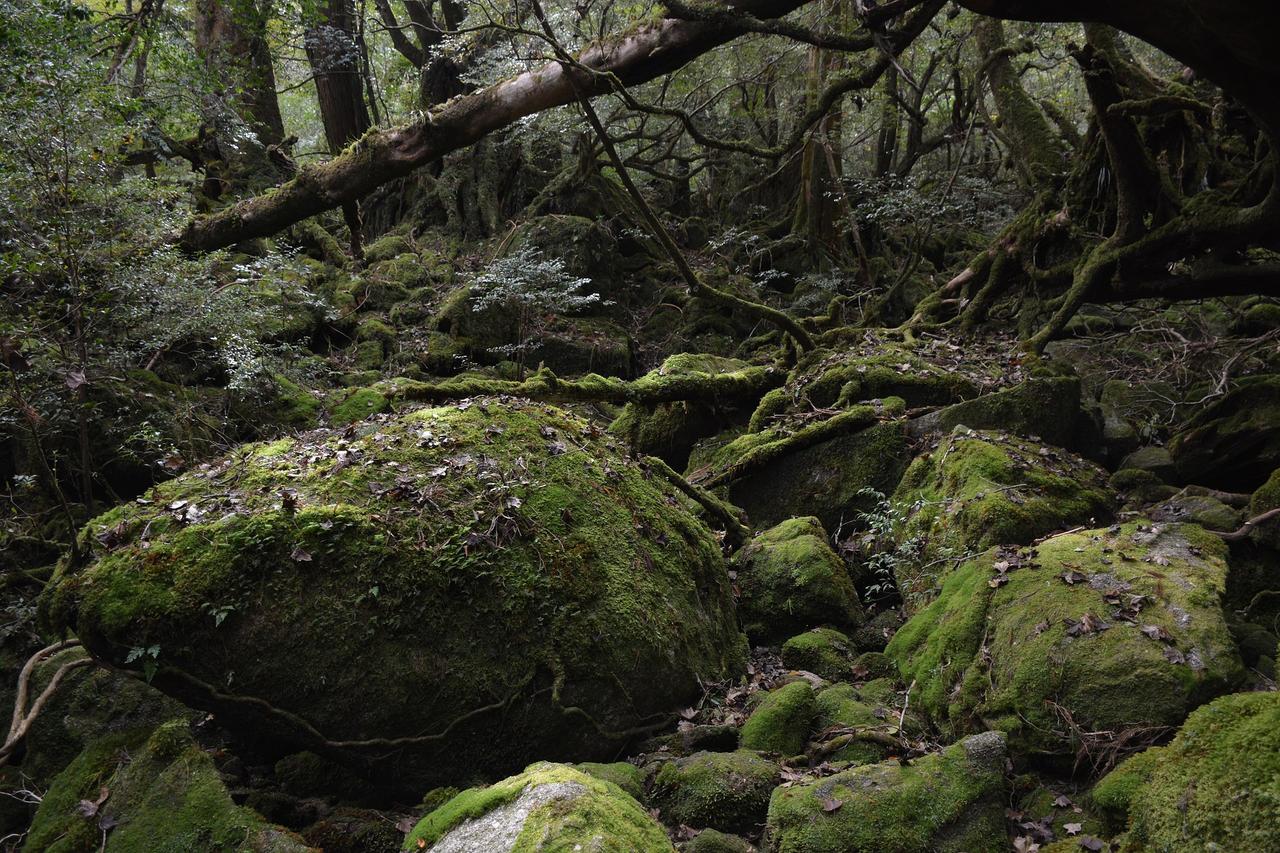
Yakushima has gained recognition not only in the scientific community but also in popular culture due to its misty atmosphere and endemic flora. The most tangible example of this cultural influence is its connection with the renowned Japanese animation studio Studio Ghibli and director Hayao Miyazaki. The Shiratani Unsuikyo Valley, located in the northeastern part of the island, is an ecosystem where every square centimeter—from the ground to the tree trunks—is covered in thick emerald-green moss.
Known as the “Moss Forest” (Koke-musu-mori), this area served as the direct visual inspiration for the ancient forest inhabited by the Forest Spirit in Miyazaki’s 1997 film Princess Mononoke (Mononoke Hime). Visitors frequently travel to this valley to experience the film’s atmosphere in real life.
The island’s natural features have also become cultural monuments. The largest of these is the Ohko-no-taki Waterfall, which cascades 88 meters down granitic cliffs on the southwestern coast. It is listed among Japan’s “Top 100 Waterfalls” and is particularly renowned for its powerful flow during the rainy season. 【4】
The island’s geology has also enabled the formation of thermal springs. Hirauchi Kaichu Onsen, located on the southern coast, exemplifies the interaction between nature and human activity. This thermal spring is a rare tidal pool situated along a rocky shoreline. The pools emerge only twice daily during low tide, when seawater recedes; during high tide, they are completely submerged beneath the ocean. This phenomenon allows visitors to enjoy a thermal bath at sea level while listening to the sound of ocean waves.
Yakushima’s universal value has been recognized by UNESCO under two key natural criteria. The first criterion, (vii), recognizes outstanding natural phenomena and aesthetic importance. This criterion encompasses the island’s dramatic granite mountains rising abruptly from the ocean and the atmospheric grandeur of its millennia-old Yakusugi forests. The mist-laden, moss-covered, interwoven root systems of these forests are regarded as a monumental natural artwork.
The second key criterion, (ix), emphasizes ongoing ecological and biological processes. The island functions as a living laboratory for observing the historical evolution of temperate rainforests in the Palaearctic biogeographic region, including species adaptation and forest regeneration. Particularly significant is the uninterrupted vertical vegetation transition—from subtropical coastal species to cold-climate plants at the mountain summits—which is preserved as one of the world’s most representative examples of biological diversity.
Japan Airlines (JAL). "Explore Yakushima Island's Fascinating Nature Spots." Accessed February 8, 2026. https://www.jal.co.jp/br/en/guide-to-japan/destinations/articles/kagoshima/yakushima.html.
Ministry of the Environment Government of Japan. "The Path to World Natural Heritage Registration." Accessed February 8, 2026. https://www.env.go.jp/en/park/yakushima/ywhcc/wh/toroku.html.
Pixabay. "Dev Jomon Sediri Ağacı." Accessed February 8, 2026. https://pixabay.com/tr/photos/a%c4%9fa%c3%a7-dev-a%c4%9fa%c3%a7-jomon-sediri-8027764/.
Pixabay. "Sabah Vakti Miyanoura Dağı ve Bulutlar." Accessed February 8, 2026. https://pixabay.com/tr/photos/da%c4%9flar-sabah-bulut-mt-miyanoura-8027743/.
Pixabay. "Yakushima, Prenses Mononoke ve Yosun." Accessed February 8, 2026. https://pixabay.com/tr/photos/yakushima-prenses-mononoke-yosun-1030459/.
UNESCO World Heritage Centre. "Yakushima." Accessed February 8, 2026. https://whc.unesco.org/en/list/662/.
Unsplash. "Gündüz Vakti Nehirde Bir Geyik." Accessed February 8, 2026. https://unsplash.com/photos/2-men-running-on-river-during-daytime-i0x7XG50fdE.
Unsplash. "Gündüz Vakti Ormanda Yeşil Ağaçlar." Accessed February 8, 2026. https://unsplash.com/photos/green-trees-on-forest-during-daytime-YsrnYUBxmQ0.
Unsplash. "Gündüz Vakti Yerde Oturan İki Maymun." Accessed February 8, 2026. https://unsplash.com/photos/two-monkeys-sitting-on-ground-during-daytime-68f9etZSnU8.
Unsplash. "Kahverengi Kaya Üzerinde Yeşil Ağaç." Accessed February 8, 2026. https://unsplash.com/photos/green-tree-on-brown-rock-B-g9ZO_l940.
World Heritage Site. "Yakushima." Accessed February 8, 2026. https://www.worldheritagesite.org/list/yakushima/.
Yakushima Town. "World Natural Heritage Site on Yakushima." Accessed February 8, 2026. https://www.town.yakushima.kagoshima.jp/en/e-tourism/e-river/.
[1]
This continuous rainfall cycle is the source of the local metaphor “it rains 35 days a month,” which has become synonymous with the island.
[2]
Yakushima Town. “World Natural Heritage site on Yakushima”. Accessed February 10, 2026. https://www.town.yakushima.kagoshima.jp/en/e-tourism/e-river/.
[3]
Japan Airlines (JAL). “Explore Yakushima Island's Fascinating Nature Spots”. Accessed February 10, 2026. https://www.jal.co.jp/br/en/guide-to-japan/destinations/articles/kagoshima/yakushima.html.
[4]
Japan Airlines (JAL), "Explore Yakushima Island's Fascinating Nature Spots", Accessed February 10, 2026, https://www.jal.co.jp/br/en/guide-to-japan/destinations/articles/kagoshima/yakushima.html.


Location | Japan Kumage District Kagoshima Prefecture | ||||||||
|---|---|---|---|---|---|---|---|---|---|
Popular Culture | Inspiration for the film Princess Mononoke | ||||||||
Important Fauna | Yakou deer, Yakou macaque, sea turtles | ||||||||
UNESCO Listing | 1993 (Criteria vii and ix - Japan's first natural heritage) | ||||||||
Highest Peak | Miyanoura Mountain (1,936 m - highest point in Kyushu) | ||||||||
Surface Area | ~504 km² (Conservation Area: 107.47 ha - 21% of the island) | ||||||||
Geography and Geology
Climate and Hydrology
Biological Diversity and Vegetation
Yakusugi and Monumental Trees
Cultural Impact and Tourism
Conservation Status and Criteria