


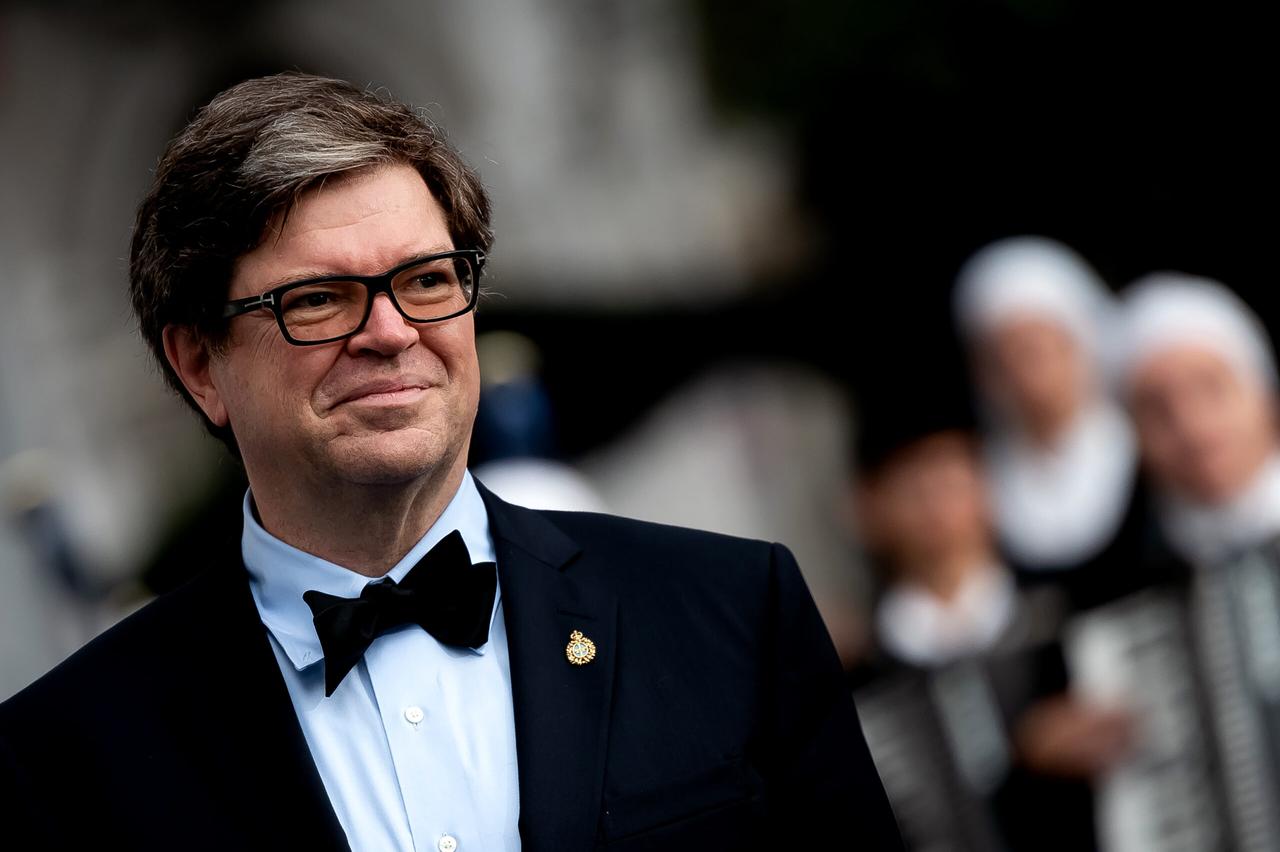
Yann LeCun
Doğum tarihi | 1960-07-08 | ||||||||
|---|---|---|---|---|---|---|---|---|---|
Place of Birth | Soisy-sous-Montmorency, France | ||||||||
Area of Expertise | Deep Learning Artificial Neural Networks for Visual Recognition | ||||||||
Title(s) | Turing Award (2018) Principal Researcher at Facebook AI Research Professor at New York University | ||||||||
Important Works and Contributions | LeNet Convolutional Neural Networks (CNN) Self-Supervised Learning | ||||||||
Yann LeCun (born 8 July 1960, Soisy-sous-Montmorency, France) is a computer scientist renowned for his pioneering work in deep learning and artificial neural networks. His contributions to Artificial intelligence research have enabled breakthroughs in computer vision speech recognition and other fields and have laid the foundation for modern artificial intelligence technologies. LeCun serves as a researcher at Facebook AI Research (FAIR) where he has had a major impact on advancing AI research.
Yann LeCun was born in 1960 in the town of Soisy-sous-Montmorency in France. From an early age he showed great interest in mathematics and engineering. Growing up in a scientific family reinforced this interest.
LeCun earned his engineering degree in 1983 from École Supérieure d'Électricité (Supélec). He then completed his doctorate in 1987 at the University of Paris in Paris focusing his research on artificial neural networks and convolutional neural networks (CNNs). His doctoral thesis addressed generalized neural networks and their applications in visual perception.
LeCun began his academic career in France and from the late 1980s held positions at numerous important university and research institutions in the United States. Notably in 1996 he worked as a principal researcher at AT Bell Labs where he achieved one of his most important breakthroughs in deep learning.
In 2013 LeCun founded the Facebook AI Research (FAIR) team significantly advancing the company’s work in artificial intelligence. He played a critical role in shaping Facebook’s artificial intelligence strategies and led key projects in deep learning.
One of LeCun’s most significant accomplishments is the development of the LeNet model in 1998 which established the foundation for convolutional neural networks (CNNs). This model enabled major advances in handwritten digit recognition and computer vision applications. LeCun is also recognized for his research that developed solutions to accelerate deep learning systems using GPUs.
In 2018 LeCun received the together Turing Award together with Yoshua Bengio and Geoffrey Hinton in recognition of their contributions to deep learning.
Yann LeCun is widely recognized for his pioneering role in developing convolutional neural networks (CNNs). Beyond the LeNet model his research on deep learning and artificial neural networks has driven significant progress in making visual perception systems more efficient. These systems are now used across a wide range of applications at today world scale.
LeCun’s research in “unsupervised learning” (unsupervised learning) and “self-supervised learning” (self-directed supervised learning) has played a major role in making artificial intelligence more efficient and adaptable.
LeCun has published numerous academic article and has led important projects in artificial intelligence deep learning convolutional neural networks and related fields. These projects have laid the groundwork for modern AI systems in computer vision natural language processing and robotics.
LeCun is a researcher who not only focuses on the technical aspects of artificial intelligence but also gives significant attention to its ethical dimensions. He has frequently spoken about the societal impacts and ethical challenges of AI. He also mentors students inspiring the next generation of AI researchers.
Yann LeCun was born in France and currently resides in the United States. Little is publicly known about his family or private life. Instead his contributions to science and achievements in his professional life remain the primary focus.
Yann LeCun’s work has played a critical role in the advancement of deep learning and AI systems. His projects in computer vision speech recognition and robotics have enabled the industrial and commercial application of these technologies. Moreover his research has shaped ongoing discussions about the future of artificial intelligence.
LeCun’s work has influenced and inspired researchers around the world. His students and collaborators continue to train the next generation of AI researchers in the field of deep learning.
Forbes. "The 3 ‘Godfathers Of AI’ Have Won The Prestigious $1M Turing Prize." Forbes, March 27, 2019. https://www.forbes.com/sites/samshead/2019/03/27/the-3-godfathers-of-ai-have-won-the-prestigious-1m-turing-prize/
Google Docs. "Yann LeCun Hakkında Kaynak Dokümanı." Accessed July 15, 2025. https://docs.google.com/document/d/1mtBSxZgie86MAn1Mgoowj92hAwo8wIbCCvY9wwKih2Q/edit?tab=t.0
LeCun, Yann. "Learning Algorithms for Intelligent Machines." Proceedings of the IEEE 78, no. 9 (1990): 1443–1471.
LeCun, Yann. *Google Scholar Profile*. Accessed December 17, 2025. https://scholar.google.com/citations?user=WLN3QrAAAAAJ&hl=tr.
LeCun, Yann. *Yann LeCun – Personal Website*. Accessed July 15, 2025. http://yann.lecun.com/
Queen Elizabeth Prize for Engineering. "Dr Yann LeCun." QEPrize.org. Accessed July 15, 2025. https://qeprize.org/winners/dr-yann-lecun
Vietnam News. "The VinFuture 2024 Grand Prize Honours 5 Scientists for Transformational Contributions to the Advancement of Deep Learning." Vietnam News, December 6, 2024. https://vietnamnews.vn/Society/1688552/the-vinfuture-2024-grand-prize-honours-5-scientists-for-transformational-contributions-to-the-advancement-of-deep-learning.html

Yann LeCun
Doğum tarihi | 1960-07-08 | ||||||||
|---|---|---|---|---|---|---|---|---|---|
Place of Birth | Soisy-sous-Montmorency, France | ||||||||
Area of Expertise | Deep Learning Artificial Neural Networks for Visual Recognition | ||||||||
Title(s) | Turing Award (2018) Principal Researcher at Facebook AI Research Professor at New York University | ||||||||
Important Works and Contributions | LeNet Convolutional Neural Networks (CNN) Self-Supervised Learning | ||||||||
Early Life and Education
Childhood and Youth
Educational Background
Career and Achievements
Career Path
Key Achievements
Key Works and Contributions
Contributions
Publications and Projects
Personal Life
Hobbies and Interests
Private Life
Impact
Source of Inspiration