


This article was automatically translated from the original Turkish version.
+2 More
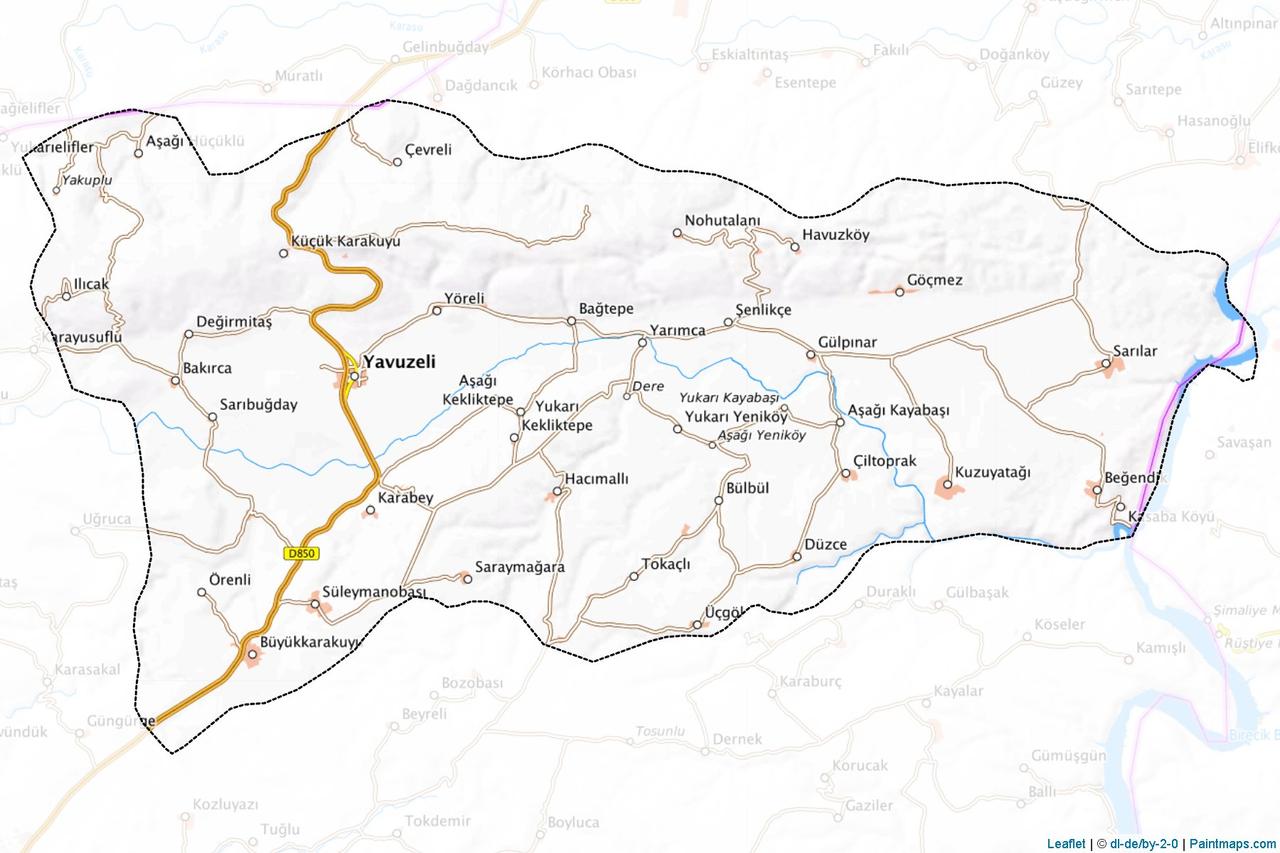
Yavuzeli (District)
Location | Southeastern Anatolia Region Gaziantep Province | ||||||||
|---|---|---|---|---|---|---|---|---|---|
Neighboring Regions | North: Araban, East: Şanlıurfa Province, Northwest: Kahramanmaraş Province, Southeast: Nizip, South: Merkez Şehitkamil District | ||||||||
Distance to Provincial Center | 38 km | ||||||||
Area(s) | 483 km² | ||||||||
Former Name(s) | Cingife (changed to Yavuzeli in 1958) | ||||||||
Establishment | 1957 (district status) | ||||||||
Yavuzeli is a district隶属于 Gaziantep Province in the Southeastern Anatolia Region. It is bordered by Car to the north, Şanlıurfa Province to the east, Kahramanmaraş Province to the northwest, Nizip to the southeast, and Center Şehitkamil district to the south. The district has an elevation of 650 meters above sea level, is 38 kilometers from the provincial center, and covers an area of 483 km². Yavuzeli is particularly notable for its historical heritage associated with Rumkale like important house.
Definitive historical records about Yavuzeli are limited. The district’s former name was Cingife, and according to one tradition, a Genoese city once existed here, from which the name is said to have originated. This ancient settlement is believed to have been located at a site called “ruins” on the slopes of Montenegro, one kilometer north of the current district center. During the Ottoman period, it is recounted that Yavuz Sultan Selim halted here in 1517 on his way to Egypt for the Battle of Mercidabık, and, pleased by the local population’s hospitality, he granted the region the name “Yavuz’s district.” Cingife, which gained district status in 1957, was officially renamed Yavuzeli in 1958.
Located 25 kilometers east of the district, on the banks of the Euphrates River, Rumkale is one of Yavuzeli’s most significant historical structures. Known to date back to the Roman Empire, this castle has been referred to throughout history by numerous names including Şitamrat, Kal-a Rhomayta, Hromklay, Ranculat, Kal-at el Greek, Kal-at el Müslimin, and Kale-i Zerrin (Golden Castle). According to religious tradition, Rumkale is also associated with John the Apostle, who is said to have copied the Gospels here and spread Christianity. The fortress served as a strategic center during the Roman, Medieval, and Ottoman periods and today appears as a peninsula surrounded by a dam lake.
Yavuzeli is a district composed of 25 villages and 19 neighborhoods. With an elevation of 650 meters above sea level, it is located 38 kilometers from the Gaziantep provincial center and spans an area of 483 km². The Yavuzeli Plain forms the foundation of the district’s geographical structure. This plain was formed by the subsidence of faults extending in an east-west direction to the north and south. To the north lies Karadağ, and to the south lies Keklik Tepe. Within the plain, the Merzimen Stream flows in an east-west direction, and its surroundings are covered with alluvial deposits. Additionally, volcanic basalt rocks and petrified formations occupy extensive areas of the plain. Karadağ consists of Oligo-Miocene age formations.
To the east of the district, the Euphrates River forms the natural boundary with Şanlıurfa. Rumkale is situated on a high plateau surrounded by steep cliffs at the confluence of the Euphrates River and the Merzimen Stream. Today, the fortress is encircled by a dam lake and stands out for its harmonious integration of natural and architectural features.
The general climatic characteristics of the Southeastern Anatolia Region apply here. Region is typically under the influence of a continental climate; summers are hot and dry, while winters are cold and rainy. The district’s agricultural production reflects the adaptation of its vegetation cover to this climate. In agricultural areas, wheat, barley, lentils, chickpeas, cotton, and viticulture are widespread. In particular, pistachio production holds a significant place in the district’s vegetation profile. The alluvial soils and basaltic terrains of the plain provide favorable conditions for agriculture.
Thirty-one percent of Yavuzeli’s population resides in the district center, while 69 percent live in villages. The population density is 51 people per km². Due to the underdevelopment of industry, the main sources of livelihood are agriculture and animal husbandry. This economic structure has contributed to unemployment and prompted some families to migrate to the Gaziantep provincial center. Nevertheless, a small number of families have also settled in the district center from other cities. The social structure retains a traditional character dominated by rural life. Historical sites and natural beauties enrich the district’s cultural identity.
Yavuzeli’s economy is largely based on agriculture and animal husbandry. Major agricultural products include pistachios (especially Gaziantep pistachios), barley, wheat, lentils, chickpeas, and cotton. Viticulture is also a significant agricultural activity in the district. Although animal husbandry is not highly developed, both large and small livestock farming are practiced. Industry in the district is limited; however, three cotton ginning factories, six oil mills, and three gristmills contribute to the local economy. The scarcity of industry has led to economic challenges such as unemployment and migration.
Yavuzeli possesses significant tourism potential, particularly due to Rumkale. Located on steep cliffs at the confluence of the Euphrates River and the Merzimen Stream, Rumkale attracts attention with its historical architecture harmoniously integrated with the natural landscape from antiquity to the present. Accessible by boat from Town village and Halfeti, the fortress contains structures such as the Church of Saint Nerses, the Barşavma Monastery, water cisterns, and wells. Today, Rumkale, appearing as a peninsula surrounded by a dam lake, is an attractive destination for nature and historical tourism. Additionally, natural and historical sites such as Dolmen Tombs and Karapınar Lake Gazinosu further enhance the district’s tourism value. These sites are located 62 kilometers from Gaziantep city center and 25 kilometers from Yavuzeli district center, making them easily accessible to visitors.
Yavuzeli’s demographic structure is characterized by a dominant rural population. Thirty-one percent of the population resides in the district center, while 69 percent live in villages. With a total area of 483 km², the population density is 51 people per km². Due to the lack of industry, unemployment is a pressing issue, triggering migration. Migration is primarily directed toward the Gaziantep provincial center, while the number of families relocating to the district from outside is limited. This situation preserves the rural character of the district’s demographic profile.
Gaziantep Büyükşehir Municipality. "Yavuzeli." Accessed April 9, 2025. https://www.gaziantep.bel.tr/tr/ilceler/yavuzeli.
Yavuzeli Belediyesi. "Coğrafi Durum." Accessed April 9, 2025. http://www.yavuzeli.bel.tr/cografi-durum.
Yavuzeli Belediyesi. "Yavuzeli Tarihi." Accessed April 9, 2025. http://www.yavuzeli.bel.tr/yavuzeli-tarihi.
Yavuzeli Belediyesi. “Rumkale Tarihi.” Accessed April 9, 2025. http://www.yavuzeli.bel.tr/rumkale-tarihi.
Yavuzeli Kaymakamlığı. "Kültür." Accessed April 9, 2025. http://www.yavuzeli.gov.tr/kultur.
Yavuzeli Kaymakamlığı. “İlçemizde Turizm.” Accessed April 9, 2025. http://www.yavuzeli.gov.tr/ilcemizde-turizm.
Yavuzeli Kaymakamlığı. “İlçemizin Ulaşım Durumu.” Accessed April 9, 2025. http://www.yavuzeli.gov.tr/ilcemizin-ulasim-durumu.
Yavuzeli (District)
Location | Southeastern Anatolia Region Gaziantep Province | ||||||||
|---|---|---|---|---|---|---|---|---|---|
Neighboring Regions | North: Araban, East: Şanlıurfa Province, Northwest: Kahramanmaraş Province, Southeast: Nizip, South: Merkez Şehitkamil District | ||||||||
Distance to Provincial Center | 38 km | ||||||||
Area(s) | 483 km² | ||||||||
Former Name(s) | Cingife (changed to Yavuzeli in 1958) | ||||||||
Establishment | 1957 (district status) | ||||||||
No Discussion Added Yet
Start discussion for "Yavuzeli (District)" article
History
Geographical Structure
Climate and Vegetation
Social Structure
Economic Structure
Tourism Potential
Demographic Structure