This article was automatically translated from the original Turkish version.
+1 More
Location | Tokat city center Türkiye over the Yeşilırmak River | ||||||||
|---|---|---|---|---|---|---|---|---|---|
Construction Date(s) | 1250 | ||||||||
Repair Period | Late 19th century (Second Abdülhamid period) | ||||||||
Structure Type(s) | Stone bridge | ||||||||
Material(s) | Cut stone | ||||||||
Number of Arches | 5 | ||||||||
Length(s) | Approximately 88 metres | ||||||||
Width | Approximately 5.5 metres | ||||||||
Yeşilırmak Bridge is a historic stone bridge located over the Yeşilırmak River in the center of Tokat province. It is also known locally as Hıdırlık Bridge and Devegörmez Bridge. The bridge is one of Tokat’s historic structures due to its architectural qualities and urban location.
The bridge is situated where the Yeşilırmak River flows through the city center and extends in a north-south direction. It is used by both pedestrians and vehicles in Tokat’s urban traffic. Access roads on both banks connect the bridge to the city’s transportation network.
The bridge is believed to have been constructed in 1250 atop an earlier structure. Its architectural form and material use reflect characteristics of the post-Seljuk period.

Yeşilırmak Bridge (Culture Portal)
The bridge was built using precisely cut stone blocks. Its load-bearing system is based on pointed arches.
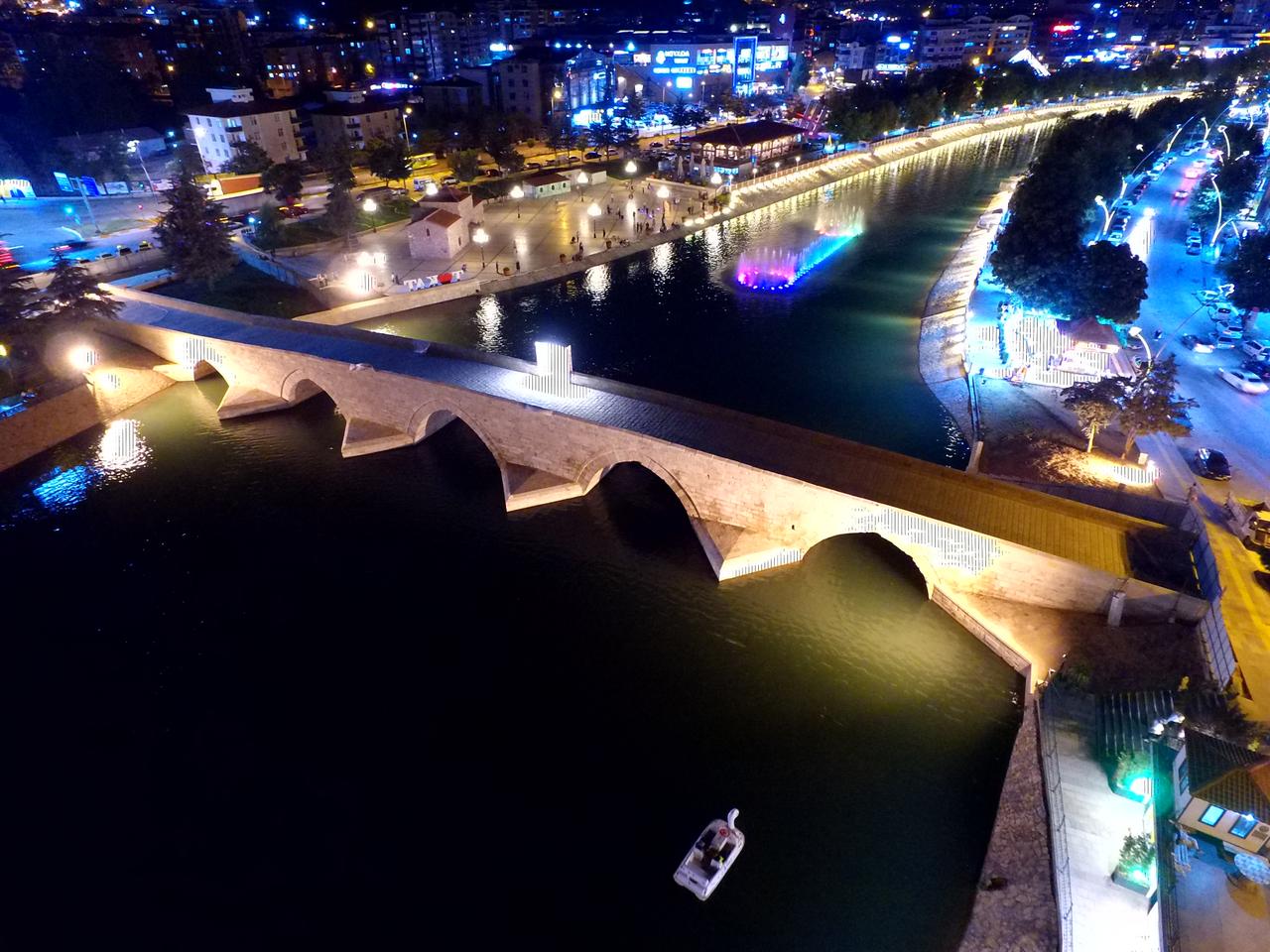
The bridge has a total of five pointed arches. The spans and heights of the arches are asymmetrical. The largest arch is located at the center of the bridge.
The surface is paved with stone. The parapet walls on both sides have been preserved as part of the original structure. There is a slight incline at the center of the bridge.
The bridge is accessed from both ends via inclined stone ramps. These ramps protect the structure from floodwaters and facilitate easy passage for pedestrians and vehicles.

Aerial View of Yeşilırmak Bridge. (General Directorate of Highways)
Under the General Directorate of Highways’ project titled “Conservation and Restoration of Historic Bridges,” the bridge underwent comprehensive restoration.
The bridge is currently open to both vehicular and pedestrian traffic. In addition, environmental improvements and recreational areas around the bridge have transformed it into an urban attraction. It is used daily for both transportation and tourism purposes.
Yeşilırmak Bridge is regarded as an integral part of Tokat’s urban identity. Beyond its historical function, it holds an important place in the city’s aesthetic and collective memory. Together with the nearby Hıdırlık Camii, street layout, and other historic structures, it contributes to the character of a urban conservation area.
Video Explaining Hıdırlık Bridge. (TOKAT MEM RADIO TELEVISION)
General Directorate of Highways. "Yeşilırmak Köprüsü (Tokat)." *General Directorate of Highways Projects*. Accessed June 25, 2025. https://www.kgm.gov.tr/Sayfalar/KGM/SiteTr/Projeler/ProjelerDetay.aspx?q=132
Ministry of Culture and Tourism. "Yeşilırmak Köprüsü (Hıdırlık Köprüsü) – Tokat Kültür Envanteri." *Kültür Portalı*. Accessed June 25, 2025. https://www.kulturportali.gov.tr/turkiye/tokat/kulturenvanteri/yesilirmak-koprusu--hidirlik-koprusu-
Ministry of Culture and Tourism. "Yeşilırmak Köprüsü – Tokat Gezilecek Yerler." *Kültür Portalı*. Accessed June 25, 2025. https://www.kulturportali.gov.tr/turkiye/tokat/gezilecekyer/yeslirmak-koprusu
Tokat Belediyesi. “Yeşilırmak Köprüsü Tanıtım Videosu.” YouTube video, 2:10. November 13, 2023. Accessed June 25, 2025. https://youtu.be/mNmCAKNN2B8?si=qqdh3ZIW_W1HVDP_

Location | Tokat city center Türkiye over the Yeşilırmak River | ||||||||
|---|---|---|---|---|---|---|---|---|---|
Construction Date(s) | 1250 | ||||||||
Repair Period | Late 19th century (Second Abdülhamid period) | ||||||||
Structure Type(s) | Stone bridge | ||||||||
Material(s) | Cut stone | ||||||||
Number of Arches | 5 | ||||||||
Length(s) | Approximately 88 metres | ||||||||
Width | Approximately 5.5 metres | ||||||||
Names and Nomenclature
Location and Access
History
Architectural Features
Construction Material and Technique
Number and Form of Arches
Dimensions
Deck and Parapets
Approach Structures
Conservation and Restoration Works
Current Usage
Cultural and Urban Significance