



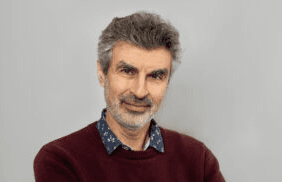
Yoshua Bengio
Doğum tarihi | 1964-03-05 | ||||||||
|---|---|---|---|---|---|---|---|---|---|
Place of Birth | Yoshua Bengio | ||||||||
Citizenship | Canada | ||||||||
Award(s) | Turing Award (2018) (shared with Geoffrey Hinton and Yann LeCun) Canada Research Chair in Statistical Learning (2002-2017) Léon Gérin Award (2017) | ||||||||
Education | Bachelor: University of Montreal Artificial Intelligence PhD: University of Montreal Master: University of Montreal Computer Engineering | ||||||||
Major Titles and Positions | Professor of Computer Science, University of Montreal; Founder of Mila (Montreal Institute for Learning Algorithms) | ||||||||
Yoshua Bengio was born in 1964 in Montreal, Canada. Growing up in a family immersed in science, Bengio developed a strong interest in mathematics and computer science at an early age. This interest led him to pursue his undergraduate education in computer engineering, on.
After earning his bachelor’s degree in computer engineering from the University of Montreal, bachelor's degree, Bengio continued his graduate studies at the same university, completing his master’s and doctoral degrees in the field. He laid the foundation for his career by writing his doctoral thesis on deep learning and artificial neural networks, learning.
In 1993, Bengio began his career as a professor of computer science at the University of Montreal, where he established a research environment conducive to his work in deep learning and artificial neural networks. In 2012, he founded the Mila Research Centre (Montreal Institute for Learning Algorithms), which became one of the leading centres in the field of deep learning. At Mila, Bengio contributed significantly to the expansion of artificial intelligence research and the advancement of deep learning methodologies.
Bengio’s early 2000s research on deep learning helped establish the foundational pillars of modern artificial intelligence. The novel learning algorithms he developed to enable deeper and more effective neural networks became one of the most significant breakthroughs in the field. In 2018, he received the Turing Award jointly with Geoffrey Hinton and Yann LeCun, together.
Bengio’s contributions to the fundamental algorithm known as “backpropagation” have had profound impact, importance. This technique plays a critical role in training deep layers of artificial neural networks. Furthermore, his work in clarifying the mathematical foundations of learning algorithms has made the field more comprehensible and accessible, current state.
Bengio’s research has enabled artificial intelligence applications to move beyond theory and achieve practical implementation. Applications in computer vision, natural language processing, and autonomous systems, such as, are now widespread across numerous domains.
Bengio has authored numerous influential academic publications on artificial intelligence and deep learning. One of them is his 2006 paper titled “Learning Deep Architectures,” which is regarded as one of the first serious scholarly works on deep learning. His academic publications have facilitated the rapid progress of artificial intelligence research.
In addition to artificial intelligence research, Yoshua Bengio offers important perspectives on the ethical and societal implications of these technologies. He regularly participates in panels and conferences discussing how human-like AI systems may affect society.
Bengio lives in Montreal with his family. Publicly available information about his personal life is limited.
Bengio, Yoshua, et al. "Learning Deep Architectures." Foundations and Trends in Machine Learning, 2(1), 2009, pp. 1–127.
Bengio, Yoshua. "Learning Deep Architectures for AI." Foundations and Trends in Machine Learning, 2(1), 2009, pp. 1–127.
Bengio, Yoshua. "Yoshua Bengio." *Yoshua Bengio Resmî Web Sitesi*. Accessed April 12, 2025. https://yoshuabengio.org/.
Bengio, Yoshua. "Yoshua Bengio." MILA. Accessed April 12, 2025. https://mila.quebec/en/directory/yoshua-bengio.
LeCun, Yann, Yoshua Bengio, and Geoffrey Hinton. "Deep Learning." Nature, 521(7553), 2015, pp. 436–444.

Yoshua Bengio
Doğum tarihi | 1964-03-05 | ||||||||
|---|---|---|---|---|---|---|---|---|---|
Place of Birth | Yoshua Bengio | ||||||||
Citizenship | Canada | ||||||||
Award(s) | Turing Award (2018) (shared with Geoffrey Hinton and Yann LeCun) Canada Research Chair in Statistical Learning (2002-2017) Léon Gérin Award (2017) | ||||||||
Education | Bachelor: University of Montreal Artificial Intelligence PhD: University of Montreal Master: University of Montreal Computer Engineering | ||||||||
Major Titles and Positions | Professor of Computer Science, University of Montreal; Founder of Mila (Montreal Institute for Learning Algorithms) | ||||||||
Career Path
Key Achievements
Publications
Areas of Interest