


This article was automatically translated from the original Turkish version.
+1 More
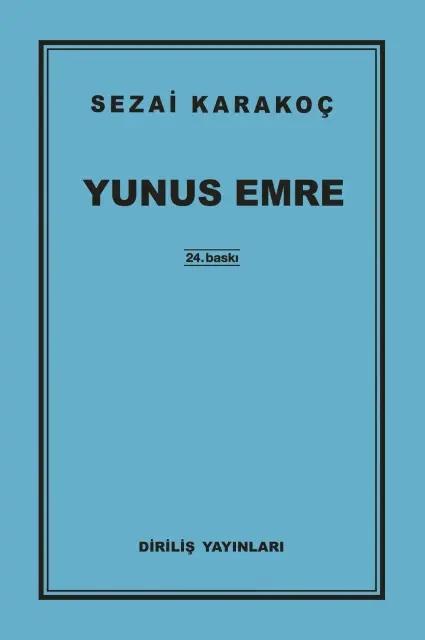
Yunus Emre
Author(s) | Sezai Karakoç | ||||||||
|---|---|---|---|---|---|---|---|---|---|
Category | Review | ||||||||
Publisher(s) | Diriliş Publications | ||||||||
Number of Pages | 104 | ||||||||
ISBN | 9786057376787 | ||||||||
Sezai Karakoç's 1965 publication, Yunus Emre, is a book that provides a detailed account of Karakoç’s perspective on Yunus Emre and his interpretations of Yunus Emre’s poetic and intellectual world. This work is not only a literary study but also an examination that draws attention through its philosophical and cultural dimensions.
Sezai Karakoç’s Yunus Emre does not merely examine Yunus Emre as a historical figure; rather, it portrays him as the representative of the spirit of revival in Islam as it took root in Anatolia. The work is regarded as a crucial link within Karakoç’s concept of revival. Karakoç’s biographical writings aim to support the ideals and thought systems he championed. The book is not merely a biography; it is a conceptual text that reinterprets Yunus Emre beyond his historical identity through a timeless consciousness. According to Karakoç, this book is not simply an analysis of Yunus Emre but one of the central pillars of his own intellectual universe. To understand Yunus, Karakoç argues, is equivalent to understanding Anatolia, Islam, love, and humanity.
Karakoç positions Yunus Emre not merely as a poet but as a civilizational founder and a spiritual architect. He reads Yunus’s poetry not as Sufi language but as the process of Anatolia’s Islamization and inner revival.
According to Karakoç, Yunus Emre emerged during Anatolia’s dark and fragmented periods as a beacon of truth. His poems constitute a call for social awakening that transcends individual emotion. Karakoç asserts that Yunus’s voice did not remain confined to the 13th century but reached into our own era, viewing him as a breath that extends into the 21st century. For Karakoç, Yunus’s poetry serves as a remedy against the modern human’s loneliness, fragmentation, and identity crisis.
The dominant theme in Yunus’s poetry is love. Karakoç identifies the essential originality of Yunus Emre in the intellectual and aesthetic structure he developed around the love of God. Love, as Yunus’s guiding principle, is the first step of faith and attachment. According to Karakoç, the phrases “without love, man becomes an animal” and “those who die are animals; lovers do not die” encapsulate the essence of Yunus’s understanding of love. He emphasizes that love is not subordinate to the body or sensual pleasure, and that a pleasure-seeking soul cannot form a true bond with genuine love.
Karakoç offers a deep interpretation of Yunus’s anecdotal life. For instance, he interprets the anecdote of Yunus and Hacı Bektaş-ı Veli concerning wheat and charity as representing Yunus’s transition from knowledge to mystical insight. He reads the anecdote of Molla Kasım as symbolizing the poet’s inner critical self or “nefs-i levvâme” (the reproaching soul); Molla Kasım’s act of throwing Yunus’s poems into water reflects the poet’s inner struggles and self-criticism during the creation of his verses. Karakoç symbolizes the two tables attributed to Yunus as “religion” and “art.”
According to Karakoç, Yunus incorporates elements such as sincerity, an unending sense of sin, and metaphysical thought into his poetry. Yunus’s verse resides in the heart of nature, transcending the boundaries of reason, entering objects, and carrying meaning. His poetry moves beyond the realm of poetry itself to reach the line of dhikr and prayer. Karakoç underscores the importance of Yunus’s use of simple Turkish and elements of folk literature.
Emre, İsmet. "Sezai Karakoç'un Gözüyle Yunus Emre." *Yunus Emre Sempozyumu 2022: Bildiriler Kitabı*. Sivas Cumhuriyet Üniversitesi, 2022, pp. 73-84. Accessed July 18, 2025. https://isamveri.org/pdfdrg/D301431/2022/2022_EMREI.pdf.
Hüküm, Muhammed. “Sezai Karakoç’un Biyografik/Monografik Kitaplarında Estetik Özellikler.” *Yeni Türk Edebiyatı Araştırmaları* 14, no. 28 (2022): 1–28. Accessed July 18, 2025. https://dergipark.org.tr/tr/download/article-file/3175370.
Karakoç, Sezai. Yunus Emre. Diriliş Yayınları, 2010.
Sağlık, Şaban. "Sezai Karakoç’un Gözüyle Yunus Emre." Yedi İklim 44-45 (1993): 96-103. Accessed July 18, 2025. https://ismailkara.izu.edu.tr/xmlui/bitstream/handle/ismailkara/1274/%20KA6202.pdf?sequence=1.
Turna, Murat. “Sezai Karakoç’un Gözüyle Yunus Emre, Mehmet Âkif ve Mevlâna.” Electronic Turkish Studies 7, no. 1 (2012). Accessed July 18, 2025. https://www.ajindex.com/dosyalar/makale/acarindex-1423933865.pdf.

Yunus Emre
Author(s) | Sezai Karakoç | ||||||||
|---|---|---|---|---|---|---|---|---|---|
Category | Review | ||||||||
Publisher(s) | Diriliş Publications | ||||||||
Number of Pages | 104 | ||||||||
ISBN | 9786057376787 | ||||||||
Content and Main Themes
The Symbolic Value of Anecdotes
Language and Style