badge icon

This article was automatically translated from the original Turkish version.

Article
Location
Center/SolhanBingölTürkiye
Formation
Anthropogenic
Function
Rock Settlement
Period
5th century CE (Early Christianity / Late Roman - Early Byzantine)
Number of Floors
5 Floors
Number of Rooms
26 Rooms
Feature
Dominant Point over the Murat River and Yukarı Kaleköy Dam

A historical rock settlement, carved by human hands into a steep rock mass overlooking the Murat River valley within the boundaries of Bingöl Province. The caves, with their multi-level structure and interconnected room systems, exhibit characteristic features of the Early Christian period and constitute an important part of the region’s archaeological and cultural heritage.
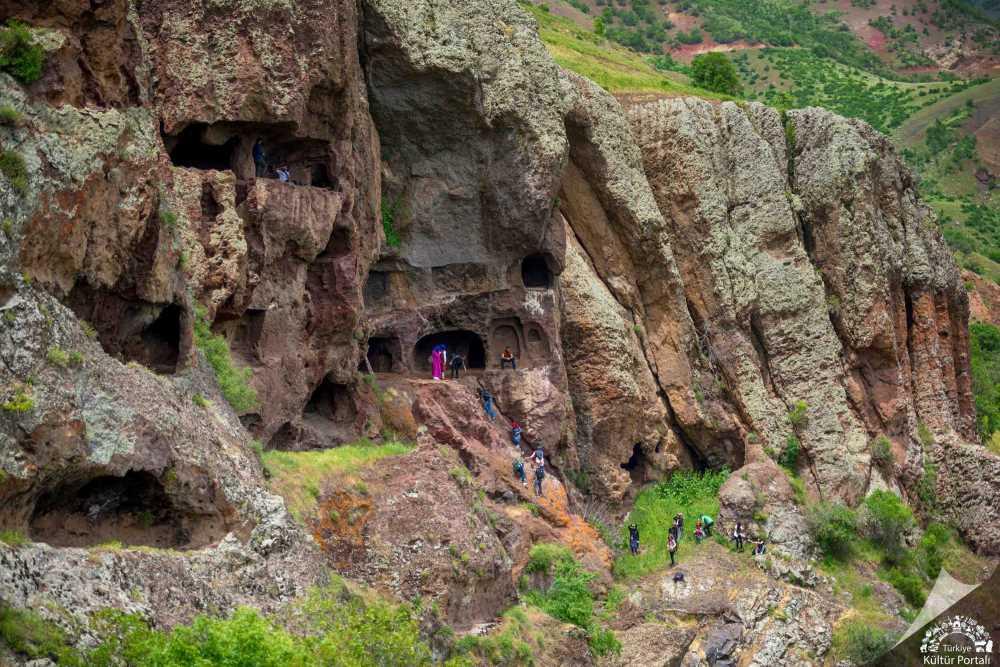

Zağ Caves (

Location and Access

The caves are located approximately 23 kilometres from the centre of Bingöl city. Geographically, they are situated on the front face of a steep rocky mass between the villages of Gökçeli and Yenidal, along the banks of the Murat River. Administratively, they are also associated with the boundaries of Kuşburnu village. Access is provided via the fifth kilometre of the Gökçeli-Kuşburnu village road, which branches off to the right from the 18th kilometre of the Bingöl-Solhan-Muş highway. The structure currently occupies a dominant position above the reservoir area of the Yukarı Kaleköy Dam.

History

According to archaeological assessments, the Zağ Caves date to the early fifth century AD, during the Early Christian period (Late Roman–Early Byzantine). It is believed that Christian communities under pressure from the Roman Empire used this steep and secluded area as a hidden settlement, dwelling, and place of worship.

Architectural Features

The settlement, carved into the natural rock mass, extends across a facade approximately 200 to 300 metres above ground level. Its structural characteristics include:


  • Floor Plan: The caves consist of five levels including the ground floor. Transitions between levels are recorded as being achieved via stepped passages, shafts, or staircases.
  • Room System: The original structure is described as containing numerous rooms on each level. While sources indicate 26 rooms per level, due to deterioration over time, only about 17 rooms have retained their structural integrity today. Transitions between rooms were made through doors, while movement between levels was facilitated by circular shafts and staircases.
  • Interior Details: Rooms were carved into square, rectangular, or circular forms. Interior features include niches, shelves, windows, handholds, and shafts carved into the rock for lighting and ventilation.
  • Functional Areas and Use: The spaces within the Zağ Caves were organized according to different functions related to daily life.
    • Storage: Cubic depressions carved directly into the bedrock and lined with plaster are found on the floors of several rooms. These have been identified as used for storing grain, oil, and various liquids. Additionally, storage areas with depths of 5 to 10 metres are present.
    • Living and Kitchen Areas: Some rooms contain seating platforms (klines) and lime-plastered tandır ovens, indicating their use as living and cooking spaces.
    • Worship: Certain smaller niches are interpreted as altar pits, and specific sections of the complex are assessed as having been designated for religious worship.


Zağ Caves (Bingöl Governorate)

Current Condition

Today designated as a protected site, the Zağ Caves are visited by nature sports clubs and tourists as part of cultural tourism. The area surrounding the caves is particularly rich in vegetation during the spring months.

Author Information

Avatar
AuthorEsra Nur BulutJanuary 15, 2026 at 7:48 AM

Tags

Discussions

No Discussion Added Yet

Start discussion for "Zağ Caves" article

View Discussions

Contents

  • Location and Access

  • History

  • Architectural Features

  • Current Condition

Ask to Küre