


This article was automatically translated from the original Turkish version.
+2 More
Zairja is a mystical and logical system, used since the late 12th century, designed to generate intuitive knowledge. When examining its historical origins and operational mechanisms, it becomes evident that Zairja is conceptually related to artificial intelligence, particularly large language models. Structural similarities are highlighted between Zairja’s analogical logic based on letter-number combinations and the probabilistic text generation of LLMs; in this context, Zairja’s identity as a “pre-modern cognitive machine” is being reinterpreted.
Zairja (الزيرجة) is a symbolic combinatorial system prominent in the history of Islamic thought, aiming to interpret the unknown through known data. Fundamentally, it seeks to produce answers through structural relationships established between letters and numbers via circular arrangements. This method operates on the principles of randomness, analogy, and intuition. Ibn Khaldun, in his work Mukaddime, referred to this system as “the Zairja of the world,” describing it as an effort to rediscover meaning within the internal structure of words.
Zairja’s operation is based on analyzing the verbal structure of a problem and generating possible answer combinations through permutations of words and letters. In this context, Zairja’s goal is not to produce a single correct outcome but to approach the process of meaning generation through multiple causalities. This offers a structure that overlaps with symbolic systems in classical AI but is more intuitive and inductive.
Modern large language models (GPT, PaLM, Claude, etc.) process vast volumes of textual data to generate probabilistic language. This generation process is not deterministic but relies on contextual and statistical relationships. Similarly, Zairja produces potential meaning spaces through random combinations of letters and words. In this regard, Zairja aligns with the “embedding space” (meaning vector space) approach that forms one of the foundational elements of LLMs.
Comparison of Zairja and large language models
These similarities suggest that Zairja can be read, within its historical context, as a kind of “pre-modern language model.”
One of Zairja’s distinctive features is its foundation in “reverse causality.” Here, it begins from a given outcome and generates its possible causes. A similar logic operates in LLMs: from a given sentence, plausible preceding or subsequent texts are constructed through contextual causal patterns. Zairja’s approach can be interpreted as an intuitive precursor to the “causal transformer” architecture used in models like GPT.
Zairja’s structure also aligns with Slavoj Žižek’s concept of “second virtuality”: an alternative realm of reality emerging not from representative reality itself but from the structural voids within representation. Similarly, the outputs of LLMs do not merely produce “representations”; they can generate new flows of meaning by deviating from the given context. Like Zairja, LLMs do not process fixed meanings but rather the potential forms of meaning.
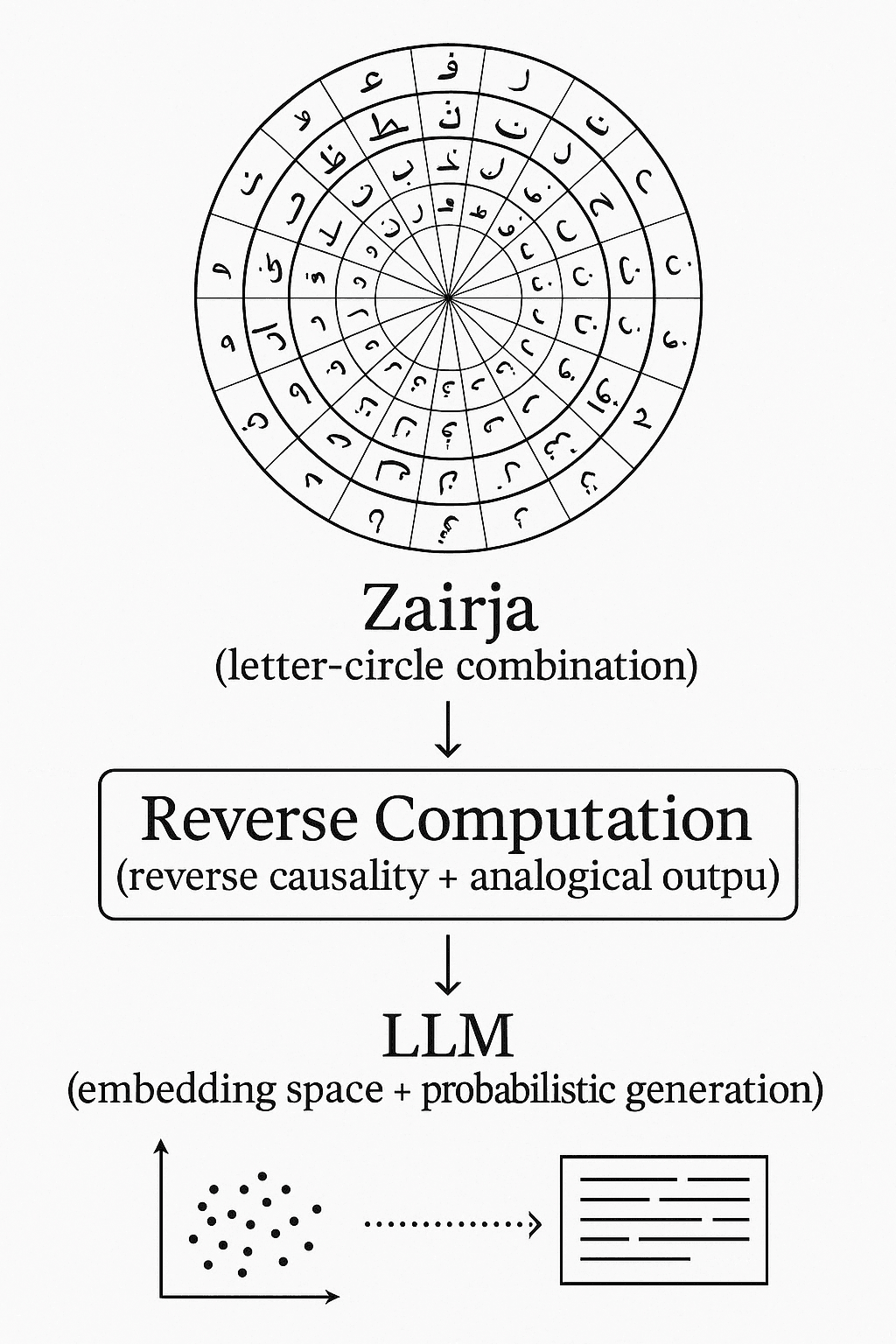
Visual representation of the relationship between Zairja and large language models (Generated by Artificial Intelligence.)
Zairja exhibits modern analogies in AI applications, particularly in creative production (generative design), intuitive interface development, and unconscious meaning construction. For instance, ChatGPT’s text suggestions or DALL·E’s visual combinations operate on an equivalent level of abstraction to Zairja’s mechanism. At the same time, Zairja’s pedagogical applications—such as aleatoric concept matching—can be integrated into the training processes of creative AI systems.
Kunze, Donald. “Zairja-Thinking: A Second Virtuality for Design.” *Open: 108th ACSA Annual Meeting Proceedings*, n.d. https://doi.org/10.35483/ACSA.AM.108.112.
Stevenson, Jim. "The Zairajah and Mathematics". 2020. Accessed April 26, 2025. https://josmfs.net/wordpress/wp-content/uploads/2020/02/Zairajah-and-Mathematics-200216.pdf
West, Paul. “The Zairja: A Device, a Methodology, a Force Field.” *Boundary Language*. Pennsylvania State University. Accessed April 26, 2025. https://boundarylanguage.psu.edu/the-zairja-a-device-a-methodology-a-force-field/.

Zairja’s Cognitive Mechanism and Procedural Structure
Structural Similarities Between LLMs and Zairja
Reverse Causality and Generative Networks
Second Virtuality and Ontological Expansion
Contemporary Value of Zairja in AI and Design Pedagogy