


This article was automatically translated from the original Turkish version.
+1 More
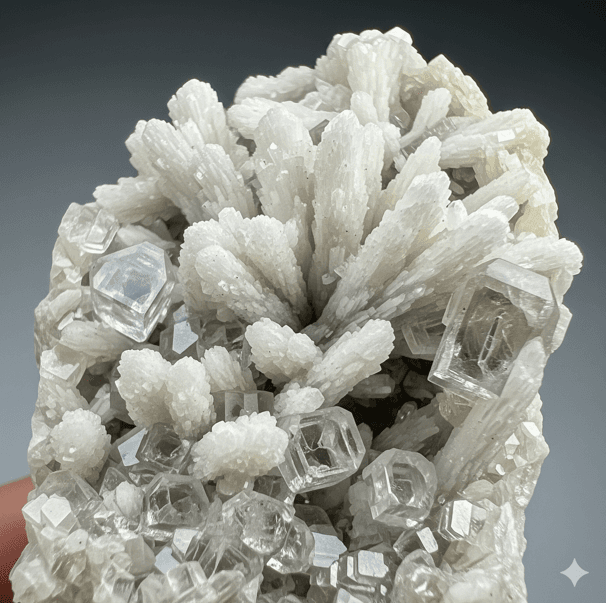
(Generated with Artificial Intelligence.)
Zeolite
Year of Discovery | 1756 | ||||||||
|---|---|---|---|---|---|---|---|---|---|
Primary Chemical Structure | Aluminosilicates | ||||||||
Important Features | Ion exchange, adsorption, catalysis | ||||||||
Type(s) | Natural and synthetic | ||||||||
Industrial Value | High | ||||||||
Zeolites are inorganic compounds composed of aluminum, silicon, and oxygen, featuring a complex three-dimensional crystalline structure. These highly porous structures contain channels and cavities capable of trapping cations, water, and small molecules. Due to these properties, zeolites are also referred to as "hydrated aluminosilicates" and are valued as essential raw materials in many areas of modern industry.
The zeolite mineral was discovered in 1756 by Swedish mineralogist Fredrick Cronstedt (1722–1765). It received its name, derived from the Greek words "zeo" (to boil) and "lithos" (stone), meaning "boiling stone," because when heated, the water trapped within it vaporizes, giving the appearance of boiling.
The fundamental building block of zeolites is the tetrahedral unit (SiO₄), in which a silicon atom is centrally located and surrounded by four oxygen atoms. Some of these units contain aluminum (AlO₄) atoms in place of silicon. The structure of zeolites arises from the linking of these units into a three-dimensional network. Within this network are regular pores and channels capable of molecular-scale separation.
Natural zeolites form through chemical reactions between volcanic rocks and tuffs. Synthetic zeolites are produced in laboratory settings under controlled conditions using chemical methods. Today, the vast majority of commercial applications rely on synthetic zeolites.

A schematic representation of the molecular cage structure of a zeolite crystal, showing its porous channels and cavities. (Generated by Artificial Intelligence.)
The most important industrial properties of zeolites are their ion exchange capacity, adsorption ability, and functionality as catalysts. These characteristics enable zeolites to be used across a wide range of applications.
Due to their porous structure, zeolites can retain substances in liquid or gaseous form on their surfaces through adsorption. This property is utilized in various fields, from dehumidifying air to water purification.
The cations within the zeolite structure can be exchanged with other ions. This ion exchange capability is particularly important in wastewater treatment for removing heavy metals and other harmful ions. As a result, zeolites help reduce environmental pollution by replacing phosphates in detergents.
Zeolites are widely used as catalysts to accelerate chemical reactions. This ability plays a crucial role in petroleum refining and the petrochemical industry.
Baydemir, Tuncay. "Her Derde Deva Zeolitler." TÜBİTAK Bilim ve Teknik Dergisi, July 2022. https://bilimteknik.tubitak.gov.tr/system/files/makale/zeo.pdf.
Gülen, Jale, Fatih Zorbay, and Sabri Arslan. "Zeolitler ve Kullanım Alanları." *Karaelmas Fen ve Mühendislik Dergisi* 2, no. 1 (2012): 63-68. https://dergipark.org.tr/tr/download/article-file/1329757.

(Generated with Artificial Intelligence.)
Zeolite
Year of Discovery | 1756 | ||||||||
|---|---|---|---|---|---|---|---|---|---|
Primary Chemical Structure | Aluminosilicates | ||||||||
Important Features | Ion exchange, adsorption, catalysis | ||||||||
Type(s) | Natural and synthetic | ||||||||
Industrial Value | High | ||||||||
Structure and Formation of Zeolites
Key Properties and Applications
Adsorption Property
Ion Exchange
Catalytic Property
Industrial Applications