


This article was automatically translated from the original Turkish version.
+2 More
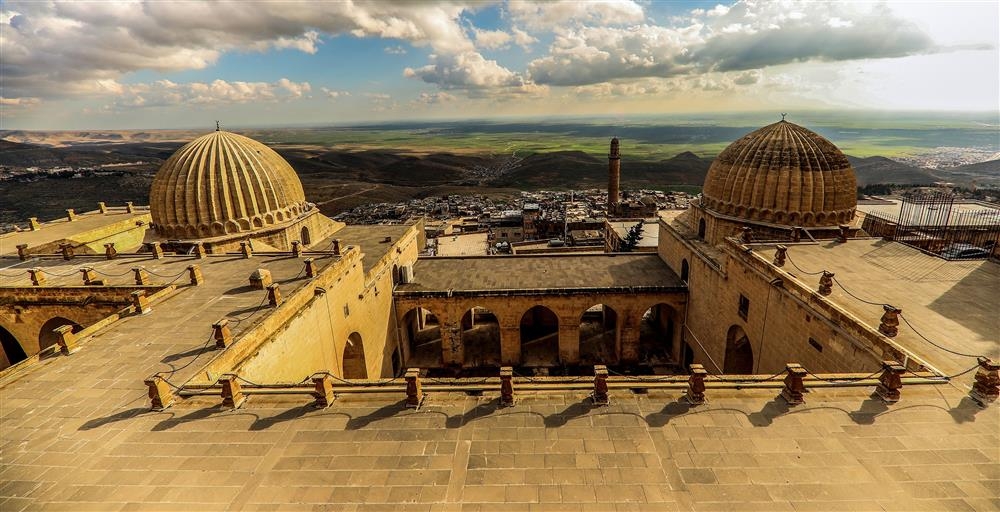
Zinciriye Medresesi, constructed in 1385 in Mardin by Artuklu Sultan Necmettin İsa, is a historical structure that has served over different periods as an educational institution, dormitory, and public building.

Zinciriye Medresesi (Mardin.KTB)
The medrese is situated on a rectangular area oriented east-west. The two-story building comprises an open courtyard, arcaded galleries, a mosque, a tomb, and student cells. The eastern entrance gate is more richly decorated and possesses monumental character. Beyond the entrance lies a vaulted hall covered with a star-shaped vault, from which one accesses the western courtyard.
A small mosque is located on the western edge of the courtyard. Adjacent to the mosque is a rectangular tomb with a mihrab niche. On the upper floor, small vaulted cells, designated for student use, are arranged in a row. Stonework is prominent in the structure, while decorative elements are limited and restrained. Additionally, two cylindrical towers with domed roofs are positioned at the eastern and western ends. Although their exact function is not fully known, they are believed to have been used for observation or defense.
During the Republican period following the Ottoman era, Zinciriye Medresesi lost its function as an educational institution. In the 1930s it was transferred from the Ministry of Endowments to the Ministry of National Education but was not used for educational purposes. Subsequently, the building was allocated to the Turkish Hearths, where it was also not effectively utilized. At one point it was rented to the military and later served as a student dormitory. In the second half of the 20th century, due to its cultural and touristic value, it was transferred to the Ministry of Culture and opened to the public. These changes in usage reflect the functional transformations the building underwent across different historical periods.

No Discussion Added Yet
Start discussion for "Zinciriye Medresesi" article
Architectural Structure and Spatial Organization
Usage During the Republican Period