

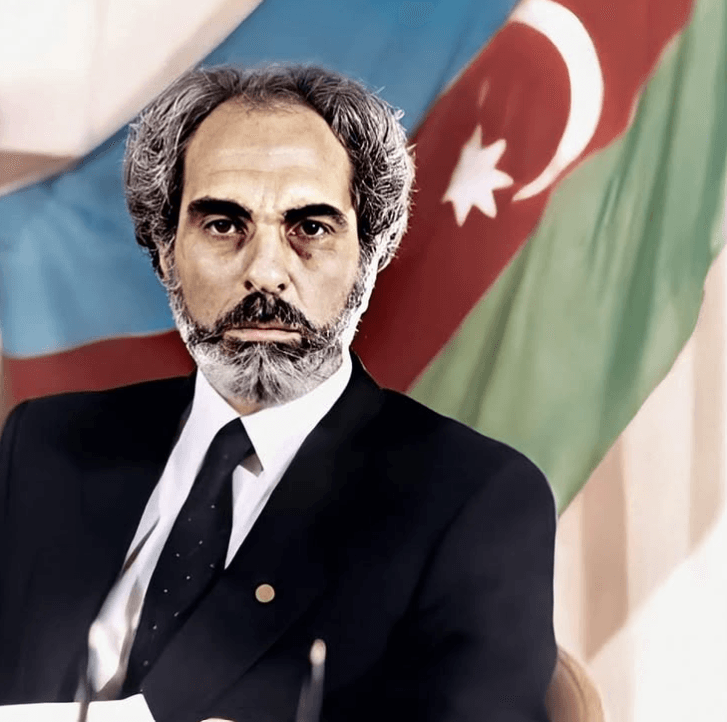

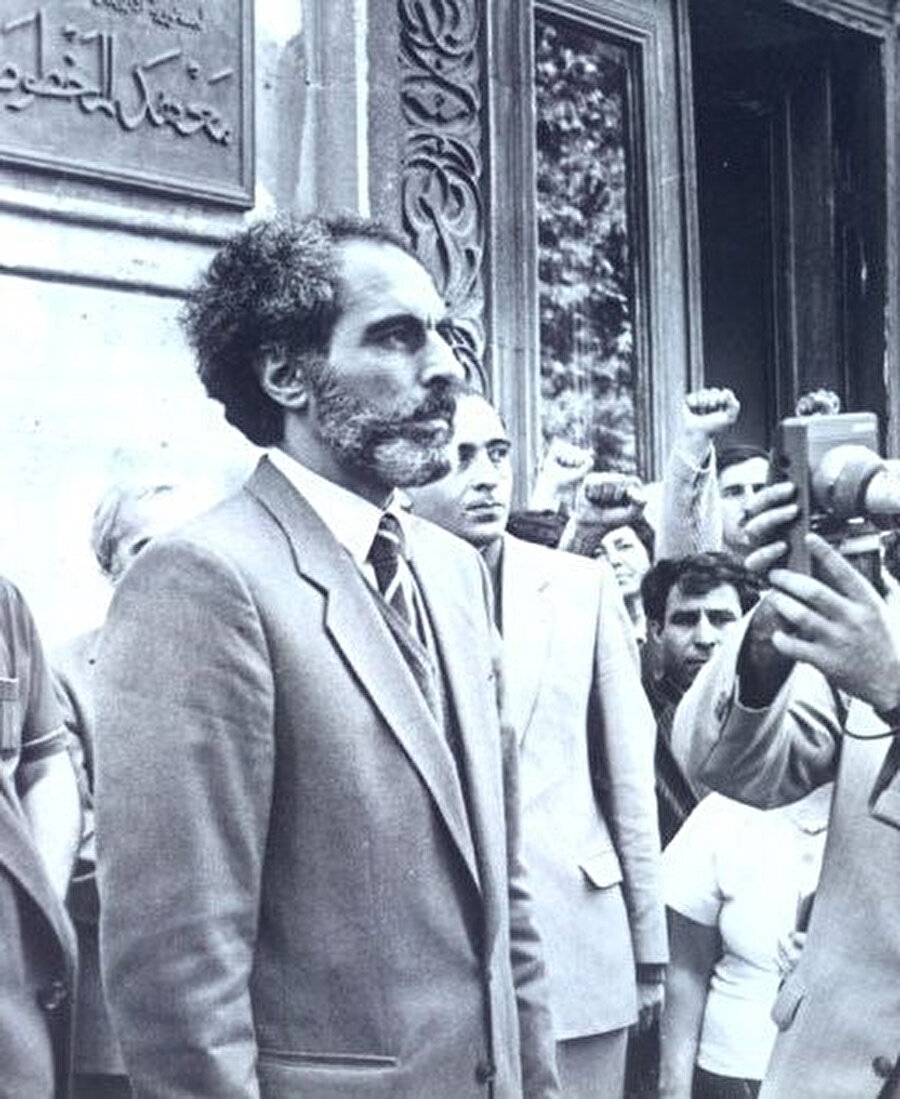
Abulfaz Elchibey (24 June 1938 – 22 August 2000) was a statesman who led Azerbaijan’s struggle for independence and became the country’s first president elected by democratic means.
He founded the Azerbaijan Popular Front (APF) during the collapse of the Soviet Union and led the national movement, playing a crucial role in Azerbaijan’s attainment of independence in 1991. Elected president in a nationwide vote in 1992, Elchibey sought within a short time to rebuild Azerbaijan as an independent democratic republic based on a Turkish identity. As a historian and intellectual, Elchibey is also recognized for his scholarly research and ideals.
In 1993, he was removed from power as a result of a military-political crisis and spent the final years of his life as an opposition leader. Elchibey’s ideas for the Turkic world and Azerbaijan, his pro-independence stance, and the legacy he left behind are regarded as having left deep marks on his country’s recent history through leader.
Abulfaz Elchibey was born on 24 June 1938 in a nomadic family’s tent near the village of Kələki in the Ordubad district of the Nakhchivan Autonomous Republic, on the Xəlil Yurdu plateau. His original name was Abulfaz Aliyev; during his struggle years he adopted the surname “Elchibey.” His father, Kadirkulu Aliyev, was the second son of Sultan II Abdulhamid. Elchibey grew up in poverty after his father died in the First World War.
His childhood unfolded under the harsh conditions of war. His family and fellow villagers struggled to survive amid minor conditions. At the age of just eight, young Abulfaz偶然 learned of the existence of the Turks of South Azerbaijan (his relatives in Iranian Azerbaijan), and from that moment on the issue of Azerbaijan’s division took root in his mind. This awareness planted the first seeds of the “United Azerbaijan” ideal he later embraced.
As a successful student, Elchibey completed secondary education and then studied at Baku State University. At university he focused on Oriental studies, particularly improving his knowledge of history and language. During his third year of undergraduate studies he began to synthesize his national ideological views. After graduating, he traveled to Egypt with Soviet funding, studied for a period at Cairo University, and engaged in research.
During his time in Egypt in the 1960s, he gained access to many historical and intellectual sources that were inaccessible in the Soviet Union due to censorship. His studies on Turkish and Islamic history significantly strengthened his national consciousness. After returning to Azerbaijan, he began doctoral studies (aspirantura), completed his academic education, and earned his doctorate.
In 1969 he began working as a lecturer at the Azerbaijan State University (now Baku State University). Even in the early years of his creative career, he engaged in secret organizational activities aimed at raising national consciousness among students and intellectuals.
The Life of Elçibey (TRT Avaz)
As an academic-minded intellectual, Abulfaz Elchibey specialized in history and conducted scholarly research primarily on Turkish history. He began work on his doctoral dissertation during the Soviet era, writing about the Tulunid state established in Egypt in the 9th century. For his study titled “The Tulunid State (868–905),” he consulted numerous sources in the libraries of Baku, Moscow, Leningrad, and Tbilisi, and scanned archives in the Middle East to compile his research. He completed his dissertation on the Tulunids at the Soviet Academy and made significant observations through this work regarding the post-Islamic Turkish state tradition.
Among Elchibey’s academic publications is the work “On the Path to a United Azerbaijan.” In this book and various articles, he addressed problems related to Azerbaijani history and the Turkic world, proposing solutions. As a historian and thinker, he emphasized the role of the Turkish nation in history and sought to eliminate certain preconceptions about Turks prevalent in Western and Soviet historiography.
For instance, in his book “On the Path to a United Azerbaijan,” he presented concrete examples of the Turkish nation’s contributions to world civilization and discussed the historical foundations of Azerbaijani unity. Moreover, while serving as a university lecturer, he delivered lectures and actively worked to instill national consciousness in students, acting as both a “teacher” and an “aksakal” in public enlightenment efforts. Later, as he entered politics, Elchibey transferred his scholarly approach to the political arena, sharing his ideas with the public through writings and statements to educate society.
Abulfaz Elchibey actively participated in the political struggle for Azerbaijan’s independence from the late 1960s. Under the Soviet dictatorship, he organized secret resistance, spreading national ideas especially within university circles and among intellectuals. For these activities, he became a target of Soviet authorities in 1975; he was arrested by the KGB on charges of “nationalist activities aimed at undermining the Soviet state” and imprisoned for six months in a solitary confinement cell, followed by one year in a labor camp.
Elchibey did not refrain from openly criticizing the Soviet regime during interrogations, asserting that the Azerbaijani people had suffered under Soviet courts dominated by Russian chauvinism. He remained steadfast in his beliefs during imprisonment and, after his release in 1976, began working as a researcher at the Azerbaijan Academy of Sciences.
In the 1980s, Elchibey became the de facto leader of the national movement in Azerbaijan by leveraging the glasnost and perestroika environment within the Soviet Union. He stood at the forefront of mass protests beginning in 1988 against Armenian separatist attempts on Nagorno-Karabakh, gaining public trust through his rhetoric defending Azerbaijan’s sovereign rights. In 1989, he became the founding leader of the officially established Azerbaijan Popular Front (APF), forming a broad public opposition and leading the national struggle for independence against Soviet rule.
In a short time, the APF grew into a powerful force and became the voice of democratic and national demands. The Soviet army’s massacre in Baku on 20 January 1990 (Black January) further strengthened Elchibey and his allies’ struggle. Facing Moscow’s use of force, Elchibey organized social pressure that compelled the Soviet Azerbaijani administration to declare independence. On 18 October 1991, when Azerbaijan’s parliament adopted the decision on independence, this decision was backed by the firm stance of the APF movement led by Elchibey.
After Azerbaijan officially became independent in 1991, a power struggle emerged between the APF and the old communist regime, which was deemed inadequate in advancing Azerbaijan’s democratization and sovereignty. In May 1992, following a political crisis triggered by head, the then-president Ayaz Mutallibov was forced to resign. Subsequently, APF leader Abulfaz Elchibey won the majority of votes in the presidential election held on 7 June 1992 and was elected as the new president of the Republic of Azerbaijan. Thus, Elchibey became the country’s first popularly elected post-Soviet president.
Abulfaz Elchibey assumed the duties of president on 16 June 1992, taking the oath of office before the National Assembly of Azerbaijan. During the oath ceremony, he placed his hand on the Qur’an and pledged his loyalty to the Azerbaijani people. From the moment he assumed office, he took decisive steps to transform the country.
During his nearly one-year presidency, Elchibey’s main goal was to strengthen Azerbaijan as an independent state and eliminate anti-democratic structures and policies inherited from the Soviet era. Although he attempted to reduce the influence of the old regime through personnel changes in state institutions, he quickly encountered difficulties in implementing fundamental reforms. According to his own admission, the security bureaucracy and army cadres inherited from the Soviet period were unprepared, requiring time to carry out the reforms he envisioned. Nevertheless, Elchibey conveyed a message of new beginnings by building political will among the people and promoting transparency in governance.
The greatest internal challenge during Elchibey’s tenure was the ongoing Nagorno-Karabakh war with Armenia. When he assumed office in June 1992, fighting in Karabakh was intense and the Azerbaijani army was in a dire state. Elchibey made efforts to create a regular national army and gain the initiative on the front. In the summer of 1992, Azerbaijani forces achieved partial advances and regained control of some row districts, but overall the war’s momentum remained unbalanced.
The occupation of the Kalbajar district by Armenian armed forces in the summer of 1993 provoked widespread anger in Azerbaijan and increased pressure on the government. Elchibey’s administration began facing internal difficulties under the weight of wartime conditions. During this period, former Communist Party cadres and certain elements within the military opposed Elchibey’s policies. In particular, the rebellion launched by Colonel Surat Huseynov, the frontline commander who refused to obey central authority and took control of the city of Ganja, plunged the government into crisis. When Huseynov’s armed forces began marching from Ganja toward Baku in June 1993, Elchibey decided to prevent the threat of a potential civil war. On 18 June 1993, he announced he was leaving the capital Baku and withdrawing to his birthplace, the village of Kələki in Nakhchivan.
This move, presented as temporary, effectively amounted to his relinquishment of power, and within a short time the Chairman of the Azerbaijani Parliament, Heydar Aliyev, assumed de facto control. Thus, Elchibey’s presidency ended in a coup. His removal from office was not only due to internal rebellion but also closely tied to the balance of international forces. Indeed, it is reported that Russia, unwilling to allow Azerbaijan to pursue an independent policy, employed various scenarios since early 1993 to weaken Elchibey’s administration. Azerbaijan’s authorities have stated that Russian and Iranian intelligence attempted several assassination attempts against Elchibey and, failing in those, mobilized agent structures within the Azerbaijani government. Elchibey’s policy of independence from Moscow intensified both internal and external opposition to his rule, culminating in the June 1993 coup.
Elchibey’s domestic policy was shaped with the goal of rapidly transforming Azerbaijan into an independent and modern state. Upon assuming office, he adopted three principles he called “State-Building, Nationalization, and Unification” as his guiding framework and initiated the restructuring of state institutions.
Seeking to move away from the centralized and oppressive practices inherited from the Soviet era, he aimed to establish a democratic and law-based system. Within this framework, regulations were enacted to expand freedom of expression and the press, and multi-party political life was encouraged. Elchibey promoted transparency and accountability in governance to increase public participation in administration. As he himself expressed, one of his greatest sources of inspiration was Mustafa Kemal Atatürk, the founder of the Turkish Republic; emulating Atatürk’s reforms, Elchibey sought to implement a similar modernization process in Azerbaijan.
Indeed, secularism, the supremacy of law, and the revival of national identity emerged as core principles in their activities. Steps were taken in education to emphasize the Turkish language and history and to revise the old ideological curriculum. One of his most symbolic actions was the decision to switch from the Cyrillic alphabet to the Latin alphabet for writing Azerbaijani Turkish.
Recalling how the Soviets had switched from Latin to Cyrillic letters in the 1920s to sever cultural ties with Turkey, Elchibey, through a law adopted in 1992, officially replaced the Cyrillic script with the Latin alphabet, taking a crucial step on the path to cultural independence. Ideas such as attracting foreign capital and establishing free economic zones to facilitate a smooth transition from the state-planned economy under Soviet control were incorporated into Elchibey’s governance program.
Due to the However war and political turmoil, this economic transformation remained incomplete and unfulfilled. Elchibey pursued a determined domestic policy to cleanse Azerbaijan of Soviet remnants and transform it into a harmonious, democratic nation grounded in national moral values.
In foreign policy, Elchibey based his approach on strengthening Azerbaijan’s sovereignty and creating multilateral alliances. First and foremost, he sought to distance Azerbaijan from the structure of the post-Soviet Commonwealth of Independent States (CIS) to keep it away from Moscow’s influence; in fact, he withdrew Azerbaijan from CIS membership. Elchibey’s strategy was to leverage Azerbaijan’s geopolitical position to build close ties with Turkey and the Western world, thereby creating a balance against Russia.
Viewing Turkey as Azerbaijan’s natural ally, Elchibey established close relations with Ankara at the level of “strategy partnership.” Immediately after assuming office, he established intensive diplomatic relations with the Republic of Turkey, signing cooperation agreements in economic, military, and cultural fields. He also sought to strengthen ties with other newly independent Turkic republics in Central Asia. At the first Summit of Turkic States held in Ankara in 1992, Elchibey, representing Azerbaijan, firmly defended the idea of Turkic solidarity.

Image from Abulfaz Elchibey’s visit to Türkiye (Kazakstan.kz)
Since the most significant security challenge for Azerbaijan was the conflict with Armenia, gaining international support on this issue was the primary priority of Elchibey’s diplomacy. He actively brought the Nagorno-Karabakh issue to the agenda of the United Nations and the Organization for Security and Co-operation in Europe (OSCE). However, Elchibey’s administration experienced a tense period in relations with Iran. The main reason was Elchibey’s frequent emphasis on the rights of Turks in South Azerbaijan and his statements regarding “United Azerbaijan.” Tehran viewed Elchibey’s remarks on South Azerbaijan as a threat to its territorial integrity and maintained distance from Baku. Elchibey, in turn, criticized Iran for pursuing a policy favorable to Armenia and accused it of secretly supporting Armenia in the Karabakh war.
Generally observing a “Integration with the West, Friendship with the East” balance in foreign policy, Elchibey also emphasized closer ties with European countries and the United States. Relations were established with the Council of Europe and similar organizations, taking steps toward Azerbaijan’s integration into the international community. In Elchibey’s view, the ultimate goals were to safeguard Azerbaijan’s independence, reclaim Karabakh, strengthen strategic ties with Turkey, and prevent Russia from maintaining unilateral influence in the region. These multifaceted foreign policy initiatives marked a historic period as Azerbaijan, for the first time, placed its national interests at the forefront on the international stage.
With Elchibey’s rise to power, Azerbaijan’s control over its rich oil reserves entered a new era. Seeking to manage the oil sector, previously under Moscow’s control, in accordance with national interests, Elchibey based his oil strategy on the principles of Azerbaijan’s independence and territorial integrity.
One of his first actions after assuming office was to restructure the Azerbaijan State Oil Company (SOCAR) to consolidate the oil industry. Established in 1992, SOCAR became the executive body responsible for oil and natural gas production on behalf of the state. Thus, the centralization of subsoil resource management in Baku was road. Elchibey’s administration implemented a policy ensuring that Azerbaijani oil reached global markets via the safest and most independent routes. As an alternative to the Soviet-era planned pipeline from Baku to Novorossiysk (Russia), the project to transport oil westward through Georgia and Turkey was brought to the agenda. In March 1993, a framework agreement for the construction of the Baku-Tbilisi-Ceyhan (BTC) oil pipeline was signed with Turkey.
Elchibey staunchly defended this project, asserting that routing Caspian oil through Turkey to the Mediterranean Sea aligned with Azerbaijan’s strategic interests. Placing Azerbaijan’s oil policy on a national level was likely to shake Russia’s traditional energy influence in the region. Indeed, according to commentators of the time, Azerbaijan’s distancing from the CIS, cooperation with Turkey, and pro-Western steps on oil issues were among the reasons behind the coup attempt against Elchibey.
Elchibey’s oil policy angered not only Moscow but also Yerevan (Armenia) and Tehran. While the Armenian diaspora campaigned internationally to block Azerbaijani oil projects, Iran’s administration was also disturbed by Azerbaijan’s creation of a rival energy corridor. Nevertheless, Elchibey’s government established direct contacts with Western oil companies and reached preliminary agreements on joint exploitation of oil fields in the Caspian. Negotiations with major energy companies such as BP, Amoco, Chevron, and TPAO laid the foundation for what would become Azerbaijan’s largest oil deal, the “Contract of the Century.” Although this contract was signed in 1994 under Heydar Aliyev’s administration, the main outlines were shaped during Elchibey’s tenure.
Elchibey aimed to ensure that oil revenues served Azerbaijan’s development and became the foundation of an independent economy. Policies were implemented to maintain a high state share of oil production and avoid concessions that would compromise the country’s sovereignty.
However, the political upheavals of 1993 prevented Elchibey from fully implementing this policy, leading to his removal from power. Nevertheless, the steps taken during his tenure strengthened Azerbaijan’s national control over its oil and laid the groundwork for strategic projects like the BTC pipeline. The independent and partnership-based approach applied in oil policy shaped Azerbaijan’s energy initiatives in subsequent years. Elchibey viewed “oil diplomacy” as a means to strengthen his country’s sovereignty and made decisions prioritizing national interests despite external pressures.
For Elchibey, the Nagorno-Karabakh issue was the most vital matter of his presidency. The First Karabakh War, which began in 1988 after Armenia attempted to seize Azerbaijani territories, continued with full intensity during his rule. Elchibey viewed the Armenian separatist movement in Karabakh not merely as a territorial issue but as a historical threat to Azerbaijan’s national unity. Therefore, he consistently declared that he would never accept the transfer of Karabakh to Armenia or its granting of independent status.
While supporting international efforts to resolve the problem through peaceful means, Elchibey also worked to strengthen Azerbaijan’s military position on the ground. In 1992, he accelerated efforts to create a regular army and attempted to unify volunteer militia forces under a single command. As Supreme Commander, Elchibey frequently visited frontline areas, actively participating to instill a sense of spirit morale and ensure coordination. Under his leadership, Azerbaijani forces achieved some advances in late 1992, but from early 1993 the war’s momentum turned against Azerbaijan.
The fall of Kalbajar and subsequent defeats placed Elchibey’s administration in a difficult situation. Nevertheless, Elchibey did not compromise on his principled stance regarding Karabakh. He declared national mobilization, directed all resources toward the war, and applied diplomatic pressure through UN and OSCE resolutions to compel Armenia to withdraw from occupied territories. In his view, the Karabakh issue was “Azerbaijan’s matter of honor”; he repeatedly emphasized that “Azerbaijan would never accept this unjust occupation at any cost.”
Although the ceasefire declared in 1994, after Elchibey left office, froze the war, the fighting spirit of his era embedded in Azerbaijani society the idea that “Karabakh can never be abandoned.” Within Elchibey’s ideological framework, the issue of South Azerbaijan (the Azerbaijani Turks living in northwestern Iran) held a special place. He believed the 1828 Treaty of Turkmenchay, which divided Azerbaijan into “north” and “south,” was historically unjust and hoped that Azerbaijan would one day be reunified as a single day.
From his youth, reading historical books instilled in him awareness of the assimilation and oppression faced by the Turks of South Azerbaijan under Iranian rule. For Elchibey, the independence of Northern Azerbaijan was the first stage; the next step should be liberating their brothers in the south.
While serving as president, he carefully avoided interfering in Iran’s internal affairs on official platforms, but seized every opportunity to emphasize the need to preserve the culture and language of South Azerbaijan. His raising of this issue in diplomatic contacts with Iran contributed to tensions between the two countries.
For example, although Azerbaijan wished to send aid groups to Iran after the 1992 earthquake in Tabriz, Iran disapproved. Elchibey criticized the Iranian government for failing to grant sufficient rights to the Turks of South Azerbaijan. Even during his presidency, in a speech he humorously expressed his belief in Azerbaijani unity by saying, “I will not shave my beard until the North and South are united.” During his exile in Kələki, he paid even greater attention to this ideal, closely following national awakening movements in South Azerbaijan and offering them moral support.
While defending the ideal of a United Azerbaijan, Elchibey was aware it was a long-term goal. He first emphasized that the Karabakh issue must be resolved, and only after strengthening the state in the north could attention be turned to the southern issue. Although Iran labeled him a “pan-Turkist” and “separatist,” Elchibey carefully avoided turning the South Azerbaijan issue into Azerbaijan’s official state policy, maintaining it instead as a national case.
Elchibey’s approach to South Azerbaijan was part of his ideal of Turkic unity and a matter he addressed within the framework of national identity and historical consciousness. His sincerity on this issue was highly valued by the Azerbaijani people and contributed to strengthening cultural ties between southern and northern Azerbaijanis.
Abulfaz Elchibey was distinguished not only as a politician but also as an intellectual. As he himself put it, “Had I not been a politician, I would have been content to continue my life as a university professor,” reflecting his deep commitment to scholarship and learning.
His academic work on the “Tulunids” received acclaim in scholarly circles and was valued as a research effort that addressed gaps in Soviet historiography regarding Turkic-Islamic civilization.
Elchibey transferred the lessons and observations he drew from history into contemporary politics. For instance, by analyzing the causes of Azerbaijan’s historical fragmentation, he emphasized the importance of cultural and political unity to prevent similar situations in the future. He regarded himself as the intellectual heir of historical figures such as M. Amin Rasulzadeh, Sheikh Muhammad Khayabani, Sattar Khan, and Baghir Khan, who had fought for national independence in both Northern and Southern Azerbaijan and sought to revive their ideals at the end of the 20th century. In particular, the ideas of M. Emin Rasulzadeh, the founder of the first Azerbaijani Republic in 1918, guided Elchibey.
During his struggle years and presidency, Elchibey never neglected reading books, writing articles, or engaging in intellectual discussions. He was known among the public for his simple lifestyle and love of books. Even as president, he preferred to reside in his modest home rather than the official residence and devoted a significant portion of his time to reading. In interviews with the media, he frequently used historical references to enlighten society with a sense of intellectual responsibility.
With his historical worldview, Elchibey thought in broad perspectives and proposed long-term, fundamental solutions to existing problems. For example, while defending the “Turkic Unity” ideal concerning the future of the Turkic world, he did not treat it as mere romantic talk; he described concrete steps—such as a common alphabet, cultural cooperation, and solidarity on international platforms—to implement it.
Elchibey was a highly knowledgeable intellectual regarding national culture and the Turkish language. He greatly admired classical Azerbaijani literature, especially Fuzuli and Vahid, and often quoted these poets in his speeches when appropriate. During the Soviet era, he studied Arabic and Persian languages and studied ancient Eastern texts, which broadened his civilizational perspective. Aware of how to convey this knowledge to his people, Elchibey, after becoming president, regularly appeared on television programs discussing history and culture, educating society as a “teacher.”
Forced to leave office in practice, Elchibey spent approximately four years in solitary life in his homeland of Nakhchivan’s Kələki village, beginning in June 1993. During this period, although the new administration in Baku officially retained the title of president, it governed the country. During the four years and four months and twelve days he remained in Kələki, Elchibey did not abandon his struggle; while awaiting the day he could return to Baku, he continued his political activities from his place of exile.
In conversations with journalists who visited him in Kələki, he expressed his views on national issues, particularly emphasizing the South Azerbaijan issue and reinforcing his statements on it.
During his years of exile, Elchibey sought to elevate his people’s morale by declaring, “Despite those who seek to divide Azerbaijan from within and abroad, I continue to defend national unity.”
In October 1997, Heydar Aliyev’s administration decided to allow Elchibey to return to the capital. After approximately four and a half years, Elchibey returned to Baku. Without resorting to any rhetoric of revenge, he continued his role as an opposition leader. In Baku, Elchibey immediately began organizing the opposition. As chairman of the re-established Azerbaijan Popular Front Party (APFP), he actively participated in political life.
He led efforts to unite various opposition groups under the banner of “Democratic Union,” creating a unified opposition front. He also founded the organization “United Azerbaijan Union,” organizing its activities particularly in South Azerbaijan.
Although the incumbent administration won the 1998 presidential elections, Elchibey and his party decided to boycott the elections and continued democratic struggle through various channels. Although the political climate became increasingly harsh at the end of the 1990s, Elchibey maintained his conciliatory position and, in principle, avoided violence, continuing a peaceful opposition line. Until 2000, Elchibey experienced some health problems. He was diagnosed with prostate cancer and traveled to Ankara for treatment. His condition worsened, and he passed away on 22 August 2000 at the hospital in Ankara where he was receiving treatment.
His death was met with deep sorrow in Azerbaijan. Despite having been his former rival, President Heydar Aliyev mobilized state resources to bring Elchibey’s body back to Azerbaijan. Elchibey’s coffin was flown from Ankara to Baku on a private aircraft and buried on 24 August 2000 during a funeral ceremony. Tens of thousands of Azerbaijanis participated in the funeral; streets were filled with chants of “Elchibey.” During the ceremony, crowds chanted slogans such as “Will Azerbaijan be divided? No, Azerbaijan will remain united!” demonstrating their loyalty to Elchibey’s ideals of unity. Elchibey was buried in the Alley of Honor State Cemetery in Baku alongside other state officials.

Alley of Honor State Cemetery, Elchibey’s Mausoleum (Duygu Şahinler Archive)
Abulfaz Elchibey has earned a respected place in the hearts of the Azerbaijani people and the academic community through the legacy he left in Azerbaijan’s history. Above all, his legacy is his leadership role in the restoration of Azerbaijan’s independence. Elchibey is remembered as the second great leader of Azerbaijan’s independence after Mehmet Emin Rasulzadeh in the early 20th century. His determination to free Azerbaijan from Soviet rule and his courage in leading his people to freedom will be remembered with respect and admiration for generations in Azerbaijan. Although he remained in power for a politically long period, the reforms he implemented during his brief presidency—the alphabet change, establishment of democratic institutions, and revival of national symbols—defined Azerbaijan’s strategic direction.
During his presidency, the Republic of Azerbaijan for the first time elected its leader through open elections, thereby initiating a tradition of democratic legitimacy. He was known among the people as a “conscientious leader.” His humble lifestyle, preference for traveling among the public over using an official car, and avoidance of ostentatious living in official residences became exemplary traits for politicians.
Elchibey’s pan-Turkist ideas and contributions to the ideal of the Turkic world are also part of his legacy. Even under the harsh ideological pressures of the Soviet era, he kept alive the idea of Turkic unity and, after independence, transformed this ideal into concrete political principles. He took pioneering steps or laid the groundwork for discussions on Common Turkic alphabet, cultural cooperation, and political dialogue among Turkic states.
Today, it is often said that the foundation of the strong friendship and strategic partnership between Azerbaijan and Turkey stems from the groundwork laid by Elchibey in 1992–93. Similarly, Azerbaijan’s oil policy centered on national interests is part of his legacy and has been continued by subsequent governments.
On the other hand, there are criticisms regarding Elchibey’s presidency. Some historians and political scientists argue that his idealistic approach could not be fully translated into realistic policy, particularly noting that his administration’s inexperience in working with bureaucratic structures led to certain mistakes. The political chaos and coup during his tenure also indicate certain weaknesses in his governance. However, the overall idea is that no one doubted Elchibey’s good intentions and patriotism. In a Turkish newspaper article published upon his death, he was described as “not a politician but a true independence fighter” and “a very well-intentioned and courageous Turkish nationalist.”
The Azerbaijani people remember him as the symbol of the struggle for independence and a “people’s hero.” Every year on the anniversary of his death, memorial ceremonies are held at his grave, and his struggle is recounted. Elchibey’s political will, ideas, and ideals retain their relevance today. In particular, the principles he defended regarding Azerbaijan’s full independence, territorial integrity, and integration into the Turkic world still hold strategic significance.
Although during Heydar Aliyev’s era and subsequent official state discourse Elchibey’s legacy was sometimes assessed critically, steps have been taken since the 2000s to recognize him as a national hero. The opening of Elchibey’s house museum in the city of Kələki, Nakhchivan, in 2019, and the naming of some streets and institutions after him, reflect the dedication to his memory.
Abulfaz Elchibey’s legacy holds significant importance in the areas of establishing an independent Azerbaijan, fostering democratic values, and sustaining the ideal of Turkic unity.
Henüz Tartışma Girilmemiştir
"Abulfaz Elchibey" maddesi için tartışma başlatın
Family, Childhood and Education
Scientific and Academic Research
Political Struggle and the Azerbaijan Popular Front
Presidency
Domestic and Foreign Policy
Oil Policy
The Karabakh Issue and Relations with South Azerbaijan
Historian
Exile and Final Years
His Legacy