


Bu içerik Türkçe olarak yazılmış olup yapay zeka ile otomatik olarak İngilizceye çevrilmiştir.
+1 Daha
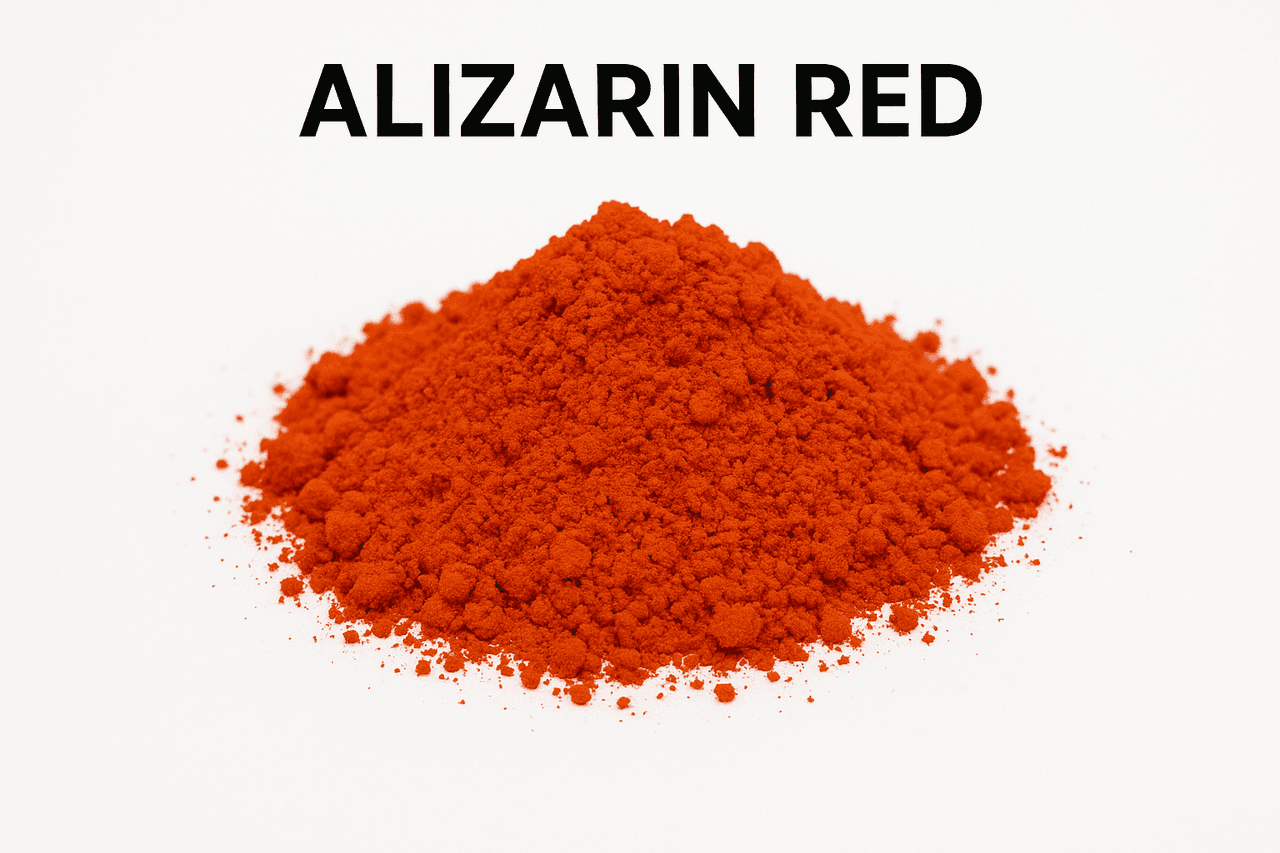
Alizarin RedGenerated by artificial intelligence.
Chemical Formula | C₁₄H₇NaO₇S | ||||||||
|---|---|---|---|---|---|---|---|---|---|
Chemical Name | 1,2-Dihydroxy-9,10-anthraquinone-3-sulfonic acid sodium salt | ||||||||
Molecular Weight | 342.25 g/mol | ||||||||
Appearance | Orange-red crystals or powder | ||||||||
Chemical Class | Anthraquinone-based azo dye | ||||||||
Natural Source | Rubia tinctorum (madder root) | ||||||||
Color Property | Orange-red in acidic medium, purple tones in basic medium | ||||||||
Alizarin Red is an azo dye chemically known as the sodium salt of 1,2-dihydroxy-9,10-anthraquinone-3-sulfonic acid. It belongs to the class of organic compounds and is widely used in biology and histology due to its ability to form complexes with calcium ions. It typically appears as an orange-red color and is readily soluble in water. Its chemical formula is C14H7NaO7S and its molecular weight is approximately 342.25 g/mol. This substance is recognized as an important reagent in both industrial dyes and scientific analyses.
The alizarin compound was first synthesized in 1868 by German chemists Carl Graebe and Carl Liebermann. Prior to this, it was known as a red dye extracted naturally from the roots of the madder plant (Rubia tinctorum). The discovery of its synthetic production method significantly reduced the industrial importance of natural madder dye. In the 20th century, a derivative known as Alizarin Red S was developed and began to be used extensively in the examination of biological tissues. This advancement initiated a new era in histochemistry and tissue analysis.
Alizarin Red is an anthraquinone derivative that contains two hydroxyl groups (–OH) and one sulfonic acid group (–SO3Na). This structure imparts both acidic and ionic characteristics to the compound. It is sensitive to pH changes, exhibiting a color shift within the pH range of 4.1 to 6.8. In solution it generally appears orange-red but turns purplish in alkaline environments. This property enables its use as a pH indicator in titration and ion detection experiments.
Alizarin Red is widely used in biochemistry, histology, and materials science. In biological tissue staining, it is preferred as a specific dye for detecting calcium salts. It is employed to visualize calcium deposition during studies of osteogenic differentiation in cell cultures. It can also be used in environmental analyses for the detection of metal ions. Additionally, it has been used for many years in the textile industry to dye both natural and synthetic fibers.
Alizarin Red S is one of the gold standard reagents for monitoring osteoblastic activity and mineralization processes. It forms an orange-red precipitate by complexing with calcium ions, making it suitable for microscopic observation and quantitative analysis. This feature allows measurement of calcification levels in bone tissue or cell cultures. Furthermore, quantification of stained areas can be performed using image analysis software.
Alizarin Red is generally a chemical with low toxicity; however, prolonged or intense exposure may cause skin and eye irritation. Protective gloves, goggles, and a laboratory coat are recommended when working with it in laboratory settings. It should be stored in a dry, cool, and dark environment, protected from moisture. Once dissolved in solution, it may become light-sensitive and must be stored in light-resistant containers.
Dawson, A. B. “A Note on the Staining of the Skeleton of Cleared Specimens with Alizarin Red S.” *Stain Technology* 1, no. 4 (1926): 123–24. Accessed October 19, 2025. https://doi.org/10.3109/10520292609115636
Puchtler, H., S. N. Meloan, and M. S. Terry. “On the History and Mechanism of Alizarin and Alizarin Red S Stains for Calcium.” *Journal of Histochemistry & Cytochemistry* 17, no. 2 (1969): 110–24. Accessed October 19, 2025. https://doi.org/10.1177/17.2.110

Alizarin RedGenerated by artificial intelligence.
Chemical Formula | C₁₄H₇NaO₇S | ||||||||
|---|---|---|---|---|---|---|---|---|---|
Chemical Name | 1,2-Dihydroxy-9,10-anthraquinone-3-sulfonic acid sodium salt | ||||||||
Molecular Weight | 342.25 g/mol | ||||||||
Appearance | Orange-red crystals or powder | ||||||||
Chemical Class | Anthraquinone-based azo dye | ||||||||
Natural Source | Rubia tinctorum (madder root) | ||||||||
Color Property | Orange-red in acidic medium, purple tones in basic medium | ||||||||
Henüz Tartışma Girilmemiştir
"Alizarin Red" maddesi için tartışma başlatın
History and Discovery
Chemical Structure and Properties
Applications
Analytical and Histochemical Significance
Safety and Storage Conditions