

Bu içerik Türkçe olarak yazılmış olup yapay zeka ile otomatik olarak İngilizceye çevrilmiştir.
Americium
Periodic Table | 7 | ||||||||
|---|---|---|---|---|---|---|---|---|---|
Chemical Symbol | Am | ||||||||
Atomic Number | 95 | ||||||||
Group | Actinides | ||||||||
Atomic Weight | (243) g/mol (most stable isotope) | ||||||||
Electron Configuration | [Rn] 5f⁷ 7s² | ||||||||
Density | ~12 g/cm³ | ||||||||
Melting Point | 1176 °C | ||||||||
Boiling Point | 2011 °C | ||||||||
Atomic Radius | ~244 pm | ||||||||
Most Stable Isotope | ²⁴³Am (Half-life: 7370 years) | ||||||||
Most Common Isotope | ²⁴¹Am (Half-life: 432.2 years) | ||||||||
Year of Discovery | 1944 | ||||||||
Etymology(s) | American continent | ||||||||
Discoverer(s) | A. Ghiorso L.O. Morgan R.A. James G.T. Seaborg | ||||||||
Americium is a radioactive metal belonging to the actinide series. This synthetic element has a bright silvery appearance and is used in various technological applications, particularly in smoke detectors.
Americium (Am) is an element located in the 7th period of the periodic table within the actinide series. Its atomic number is 95. Its electron configuration is [Rn] 5f⁷7s². This configuration indicates that it is an f-block element, like other actinides, and plays a significant role in its chemical behavior. It exhibits metallic properties and exists as a solid at room temperature. Its density has been measured at approximately 12 g/cm³.
Americium was discovered in 1944 by a team consisting of Glenn T. Seaborg, Ralph A. James, Leon O. Morgan, and Albert Ghiorso at the University of Chicago’s Metallurgical Laboratory (now Argonne National Laboratory) in the United States. The discovery was achieved by subjecting plutonium isotopes, particularly ²³⁹Pu, to neutron bombardment in a nuclear reactor. This process first produced plutonium-240 (²⁴⁰Pu) and then plutonium-241 (²⁴¹Pu), which underwent beta decay to yield americium-241 (²⁴¹Am). The discovery was part of the Manhattan Project during World War II and remained classified until late 1945.

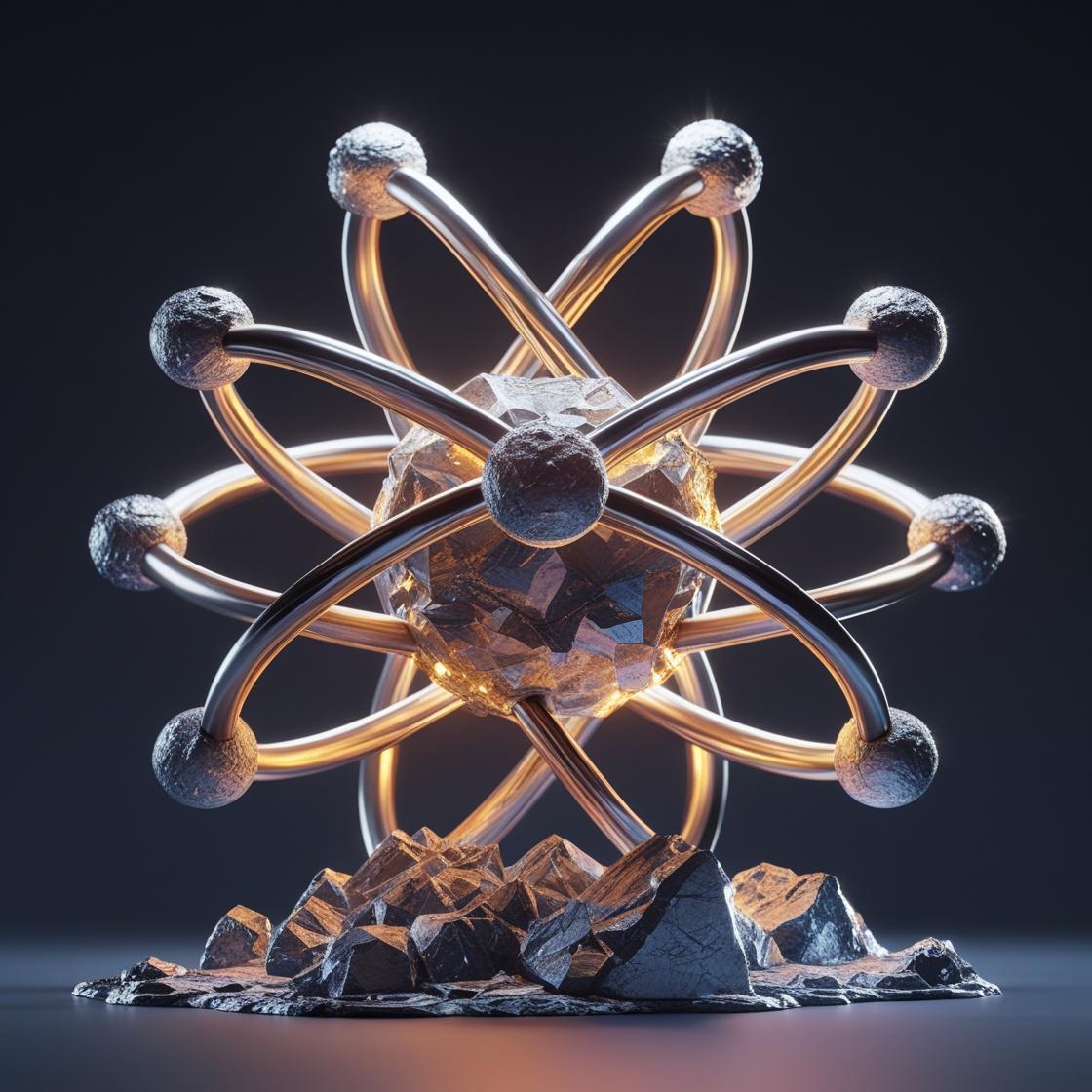
Americium Element (Generated by Artificial Intelligence.)
The element was named in honor of the continent where it was discovered, America. This naming followed the same pattern as europium, a similar element in the lanthanide series named after Europe.
Americium does not occur naturally in the Earth’s crust; it is entirely synthetic. Its primary production method involves successive neutron captures by plutonium, particularly the ²³⁹Pu isotope, in nuclear reactors. It can also be found in trace amounts in the fallout from nuclear weapons tests. Although theoretical predictions suggest that minute quantities may form in uranium ores through natural decay chains and neutron capture reactions, no practically significant natural source exists.
Americium is a bright silvery-white, ductile, and malleable metal. It exists in the solid phase at room temperature. Its atomic weight for the most stable isotope, ²⁴³Am, is approximately 243 g/mol. Its melting point is 1176 °C and its boiling point is 2011 °C. Its atomic radius is known to be approximately 244 pm. Chemically, it is a reactive element; it slowly oxidizes in dry air and corrodes more rapidly in moist air. It dissolves readily in dilute acids. Its most common oxidation states are +3, +4, +5, and +6, with +3 being the most stable and prevalent. In aqueous solutions, Am(III) ions are typically pink in color.
Americium has many known isotopes, all of which are radioactive. The most important and commonly used isotopes are americium-241 (²⁴¹Am) and americium-243 (²⁴³Am).
The best-known application of americium is in ionization-type smoke detectors using the isotope americium-241. In these detectors, ²⁴¹Am emits alpha particles that ionize the air within a chamber, creating a small electric current. When smoke particles enter the chamber, they disrupt the ion flow, triggering the alarm. Other applications include:
Americium has no known biological role. All its isotopes are radioactive and therefore toxic to living organisms. When introduced into the body, it tends to accumulate in bones, the liver, and muscles. Due to its alpha emission, internal exposure through ingestion or inhalation poses serious health risks and can cause cancer. Therefore, when working with americium, special protective equipment, work in ventilated environments, and strict safety protocols to prevent contamination are essential. Radioactive waste management is also a critical aspect of handling americium safely.
National Center for Biotechnology Information. "Americium." *PubChem Compound Database CID 23966*. Accessed May 31, 2025.
TÜBİTAK Bilim Genç. "Amerikyum." *Bilim Genç*. Accessed May 31, 2025. https://bilimgenc.tubitak.gov.tr/periyodik-tablo/amerikyum

Americium
Periodic Table | 7 | ||||||||
|---|---|---|---|---|---|---|---|---|---|
Chemical Symbol | Am | ||||||||
Atomic Number | 95 | ||||||||
Group | Actinides | ||||||||
Atomic Weight | (243) g/mol (most stable isotope) | ||||||||
Electron Configuration | [Rn] 5f⁷ 7s² | ||||||||
Density | ~12 g/cm³ | ||||||||
Melting Point | 1176 °C | ||||||||
Boiling Point | 2011 °C | ||||||||
Atomic Radius | ~244 pm | ||||||||
Most Stable Isotope | ²⁴³Am (Half-life: 7370 years) | ||||||||
Most Common Isotope | ²⁴¹Am (Half-life: 432.2 years) | ||||||||
Year of Discovery | 1944 | ||||||||
Etymology(s) | American continent | ||||||||
Discoverer(s) | A. Ghiorso L.O. Morgan R.A. James G.T. Seaborg | ||||||||
Henüz Tartışma Girilmemiştir
"Americium (Am)" maddesi için tartışma başlatın
Classification and Basic Properties
Discovery
Etiology
Natural Occurrence
Physical and Chemical Properties
Isotopes
Applications
Biological Role and Precautions