

+2 Daha

Location | Edremit Balıkesir – 4 km East of Altınoluk | ||||||||
|---|---|---|---|---|---|---|---|---|---|
Foundation | 10th Century BCE | ||||||||
Founder(s) | Pelasgians Aeolians | ||||||||
Strategic Location | On the Adramytteion–Assos Route at the Foothills of Mount Ida | ||||||||
Economy | Timber Trade Shipbuilding | ||||||||
Antandros Ancient City is an ancient city located approximately 4 kilometers east of the Altınoluk town in the Edremit district of Balıkesir Province, on the slopes of Mount Ida. Positioned between Adramytteion (modern Burhaniye-Ören) and Assos (Behramkale), the city occupied a strategic military location in antiquity. According to the geographer Heinrich Kiepert, the acropolis of Antandros was situated on a hill known as Yarmataş (elevation: 215 meters), between Altınoluk and Avcılar, extending eastward.

Antandros Ancient City (Anadolu Ajansı)
Although the city is traditionally dated to the 10th century BCE, surrounding settlements such as Assos suggest that the area might have been inhabited as early as the 2nd millennium BCE. Ancient authors offer varying accounts of Antandros’ origins: Alkaios referred to it as a Leleg settlement, while Demetrios of Skepsis claimed it was founded by people from Cilicia. Herodotus considered it a Pelasgian settlement, and Thucydides identified it as an Aeolian city. According to Aristotle, alternative names like Edonis and Kimmeris reflected the influence of different tribes that once dominated the region.
Antandros was an important strategic target during the Achaemenid Persian Empire. Following the Ionian Revolt (499–494 BCE), it was captured by Persian general Otanes. Herodotus notes that Xerxes' army passed by Antandros during the Persian invasion of Greece. During the Peloponnesian Wars, the city changed hands multiple times and was under Athenian control for a period, during which it was obliged to pay tribute. After the failed Sicilian Expedition, the city again fell under Persian rule. From the latter half of the 4th century BCE, Antandros began minting its own coins, indicating a degree of independence. Coin production continued into the Late Roman period, from the reign of Titus to that of Elagabalus. In the Christian era, Antandros became a bishopric center.
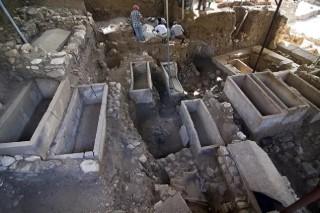
The necropolis of Antandros is located about 2 kilometers west of Yarmataş Hill. It was discovered during modern construction activities, leading to salvage excavations between 1989 and 1996. Systematic archaeological excavations began in 2001 under the direction of the Balıkesir Museum, with scientific supervision by Assoc. Prof. Dr. Gürcan Polat of Ege University. The necropolis was in use from the 7th to the 2nd century BCE and includes a variety of burial practices such as superimposed sarcophagi, cremation, and inhumation. The sloped terrain of the area allowed for vertical layering of tombs. Many of the grave goods recovered are now exhibited in the museums of Balıkesir and Bandırma.

Antandros Ancient City (Anadolu Ajansı)
Systematic excavations were conducted around a Roman mosaic floor that was initially uncovered by illegal diggers. These excavations revealed a Roman villa dating to the 1st century CE, featuring floor mosaics and wall frescoes. This structure provides valuable insights into the residential layout and domestic architecture of Antandros during the Roman period.

Antandros Ancient City (Anadolu Ajansı)
According to ancient sources and numismatic evidence, Antandros played a significant role in the timber trade, particularly with wood sourced from Mount Ida, which was highly valued for shipbuilding. This highlights the city's effective use of local natural resources and its integration into broader regional trade networks.
Anadolu Ajansı. 2021. “Altınoluk Antandros Antik Kenti’ndeki Kazıların Yıl Boyu Süreceği Açıklandı.”Accessed 18 June 2025. https://www.aa.com.tr/tr/kultur-sanat/altinoluk-antandros-antik-kentindeki-kazilarin-yil-boyu-surecegi-aciklandi/2124584.
T.C. Kültür ve Turizm Bakanlığı. 2025. “Antandros Antik Kenti - Balıkesir.” Türkiye Kültür Portalı. Accessed 18 June 2025. https://www.kulturportali.gov.tr/turkiye/balikesir/gezilecekyer/antandros-edremit-altinoluk-antik-kenti.
T.C. Kültür ve Turizm Bakanlığı. 2025. “Antandros Antik Kenti.” Balıkesir İl Kültür ve Turizm Müdürlüğü - Müzeler ve Ören Yerleri. Accessed 18 June 2025. https://balikesir.ktb.gov.tr/TR-65921/muzeler-ve-oren-yerleri.html.
T.C. Kültür ve Turizm Bakanlığı. 2025. “Antik Kentler (Ören Yerleri).” Balıkesir İl Kültür ve Turizm Müdürlüğü. Accessed 18 June 2025. https://balikesir.ktb.gov.tr/TR-90612/antik-kentler-oren-yerleri.html.

Location | Edremit Balıkesir – 4 km East of Altınoluk | ||||||||
|---|---|---|---|---|---|---|---|---|---|
Foundation | 10th Century BCE | ||||||||
Founder(s) | Pelasgians Aeolians | ||||||||
Strategic Location | On the Adramytteion–Assos Route at the Foothills of Mount Ida | ||||||||
Economy | Timber Trade Shipbuilding | ||||||||
Henüz Tartışma Girilmemiştir
"Antandros Ancient City" maddesi için tartışma başlatın
Foundation and Historical Development
Political and Military History
Necropolis and Burial Traditions
Roman Period Remains
Economy and Trade
Bu madde yapay zeka desteği ile üretilmiştir.