

+1 Daha

Ayhan Işık (born Ayhan Işıyan; 5 May 1929, İzmir – 16 June 1979, İstanbul) was an actor, producer, director, screenwriter, voice artist and painter who was active in Turkish cinema particularly during the 1950s and 1960s. Throughout his film career he appeared in numerous productions and developed a acting practice centered on melodrama, crime, adventure and adaptation genres within the Yeşilçam production system. With nearly 200 films to his name, he was among the most prolific actors of his era.
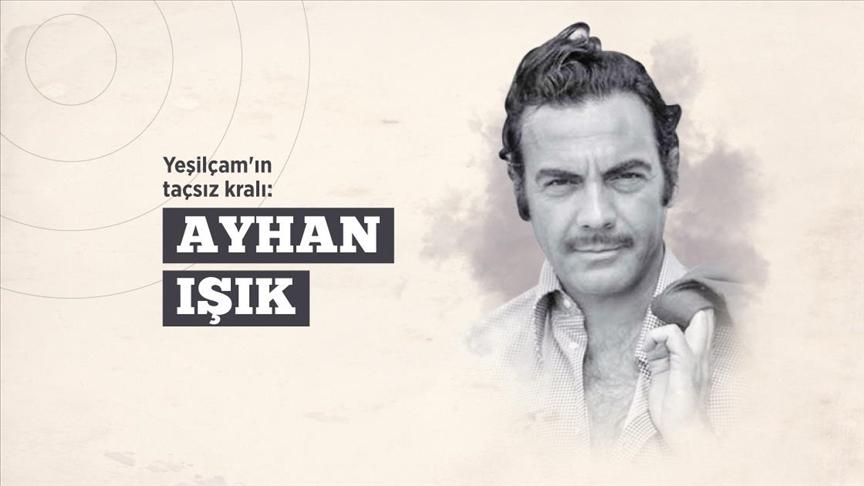
In the 1960s he began to be widely referred to by audiences as the “Crownless King.” This epithet, not an official title, reflects his consistent presence as a leading actor, his broad appeal across multiple genres and his prominent position within the Yeşilçam star system.
Ayhan Işık was born in İzmir to a family of migrants from Thessaloniki. It is noted that his family had many children and that he was raised in this large household. His father’s occupation as a merchant indicates that the family’s economic activities were based on trade. However, his father’s early death created a significant turning point in his childhood; following this event, he continued part of his education in İzmir before moving to İstanbul with his older brother【1】. His move to İstanbul provided him with broader opportunities in education and cultural exposure, significantly influencing the development of his artistic inclinations.

A General View of Ayhan Işık (Anadolu Ajansı)
During his education in İstanbul, he was part of the same artistic circles as Mahir İz, Salah Birsel and Rıfat Ilgaz. He later studied at the Painting Department of the İstanbul State Academy of Fine Arts under Bedri Rahmi Eyüboğlu. During this period he produced works in painting, design and graphic arts, accumulating experience in the visual arts.
In addition to his academy education, he worked as a painter at the İstanbul Darphanesi and later as a graphic designer and illustrator around Babıâli. His role as an illustrator for the magazine “Yıldız” during his student years facilitated his early contact with the film industry. Information indicating his participation in the writing and illustration of the comic strip “Aşka İnanmam” demonstrates that his artistic output extended beyond cinema.
Ayhan Işık’s entry into cinema occurred in 1951 when he won an artist competition organized by the magazine “Yıldız” and İstanbul Film Company【2】. He won first prize alongside Belgin Doruk, and this achievement marked his professional debut in the film industry【3】. After the competition, he began using the surname “Işık” instead of “Işıyan.”
His first film role was in the 1951 production Yavuz Sultan Selim ve Yeniçeri Hasan; his true breakthrough came with the 1952 film Kanun Namına. This was followed by roles in productions such as Katil and Öldüren Şehir. This early period is regarded as the phase in which he became known primarily for crime and dramatic films.
From the mid-1950s onward, Ayhan Işık became one of Yeşilçam’s leading actors. He solidified his position in cinema through roles in films such as Kardeş Kurşunu (1955) and Bir Avuç Toprak (1957).
In the 1960s, his career experienced a marked ascent. He gained attention with Otobüs Yolcuları, a film with a screenplay by Vedat Türkali; he then achieved widespread popularity alongside Belgin Doruk in the Küçük Hanım series【4】. The films he appeared in during this period ranged from popular cinema to socially themed productions.
His emergence as the “Crownless King” in public perception reflects how his star identity was shaped by audience reception.
Among Ayhan Işık’s professional relationships, his friendship with Sadri Alışık holds a significant place. It is noted that they met on a film set in 1951 and maintained both professional and personal ties for many years【5】. Their joint appearances in productions such as the Küçük Hanım series made this friendship visible within the film industry.
This relationship is regarded as one of the exemplary cases of professional solidarity among Yeşilçam actors【6】. Furthermore, the fact that the Sadri Alışık Culture Center later established special awards in Ayhan Işık’s name demonstrates that this friendship continued to hold cultural significance beyond their lifetimes.
In the late 1950s, Ayhan Işık traveled to the United States to observe the Hollywood film industry. During this period he gained knowledge about film production techniques, set design and industrial workflows.
After returning to Türkiye, he advocated for a more systematic approach to cinema, expressing views on working conditions, set organization and professional rights. This demonstrates that he was not merely an actor but also a cinema professional who critically reflected on the structural functioning of the industry.
In the 1970s, alongside his film activities, he turned toward music. In 1972 he took lessons from Münir Nurettin Selçuk, performed on stage and recorded albums. These activities illustrate how he extended his artistic production into other fields.
After 1975, Ayhan Işık also worked as a producer, screenwriter and director in the film industry. During this period he participated in various stages of film production; in 1976 he directed the film Örgüt.
He also engaged in writing and narrative work, authoring a memoir about his life, which was published posthumously. This underscores his multidimensional approach to artistic creation that extended beyond cinema.
In the later stages of his career, he engaged with European cinema and appeared in Italian productions. Films he made with Klaus Kinski were screened in Europe but did not reach Turkish audiences. This period illustrates the international dimension of his career.
Ayhan Işık’s first major achievement was winning the artist competition in 1951【7】. This success is regarded as the pivotal event that launched his career in cinema【8】.
In addition, he was named “Best Male Actor” at the Turkish Films Festival in 1954, in a 1962 evaluation by the magazine Ses, and in a 1965 competition organized by the magazine Artist【9】. These awards demonstrate that he was not only popular with audiences but also recognized and admired by the cinema community of his time.
Moreover, the special awards established in his name after his death by the Sadri Alışık Culture Center confirm that Ayhan Işık’s representational power in cinema continued to resonate in subsequent generations.
Ayhan Işık’s filmography spans a broad period from the 1950s to the 1970s. This body of work was shaped within the serial film structure of Yeşilçam and ensured his continuous presence across multiple genres. His filmography reflects the characteristic features of the era’s cinema in terms of genre diversity, production volume and directorial collaborations.
The 1950s marked the beginning and consolidation phase of Ayhan Işık’s film career. During this period he primarily appeared in crime and dramatic films.
His principal films from this period include:
Among these, Kanun Namına, Katil and Öldüren Şehir stand out for their themes of crime and urban life, establishing his image as an actor closely associated with tough and combative characters.
The 1960s represent the most prolific and diverse period of Ayhan Işık’s filmography. During this time he built a wide repertoire encompassing melodrama, romantic comedy, socially themed productions and adaptations.
His notable films from this period include:
Three main trends are notable during this period:
Additionally, the Küçük Hanım series and similar productions achieved broad appeal within the romantic comedy genre.
The 1970s marked a period in Ayhan Işık’s career when he emerged as both an actor and an active participant in film production.
His principal films from this period include:
During this period he continued his association with child-star films and remained active in family-oriented productions. He also became more actively involved in production and direction. The film Örgüt is a prominent example of this shift.
Ayhan Işık’s filmography was not limited to Türkiye; it also included European productions.
His principal international films include:
These films were screened in Europe but never released in Türkiye. This demonstrates that, albeit to a limited extent, he participated in international cinema circuits.
On 13 June 1979, while at his home in Bebek, İstanbul, Ayhan Işık suffered a cerebral hemorrhage due to heatstroke. He was admitted to hospital and placed in intensive care. After three days of treatment, he died on 16 June 1979.
Some sources suggest that improper medical intervention contributed to the deterioration of his health, linking this to an injection. This claim appears in varying forms across sources but lacks definitive medical evidence【10】.
His funeral prayer was held at Şişli Mosque in İstanbul, after which he was buried at Zincirlikuyu Cemetery.
Anadolu Ajansı. “Türk sinemasının ‘Taçsız Kralı’ Ayhan Işık.” Accessed March 28, 2026. https://www.aa.com.tr/tr/kultur/turk-sinemasinin-tacsiz-krali-ayhan-isik/3599130
Anadolu Ajansı. “Yeşilçam’ın örnek oyuncusu Ayhan Işık.” Accessed March 28, 2026. https://www.aa.com.tr/tr/kultur-sanat/yesilcamin-ornek-oyuncusu-ayhan-isik/2274477
Beyazperde. "Ayhan Işık Filmografi." Accessed March 28, 2026. https://www.beyazperde.com/sanatcilar/sanatci-484372/filmografi/
Biography. "Ayhan Işık." Accessed March 28, 2026. https://www.biyografya.com/tr/biographies/ayhan-isik-65e63bb5#google_vignette
Biyografiler.com. “Ayhan Işık kimdir?” Accessed March 28, 2026. https://www.biyografiler.com/kimdir/ayhan-isik
Sabah. "Ayhan Işık’ın ölüm nedeni…" Accessed March 28, 2026. https://www.sabah.com.tr/pazar/2021/06/13/ayhan-isikin-olum-nedeni-eczacinin-yanlis-ignesi
[1]
Biyografiler.com, “Ayhan Işık kimdir?,” Access date: 28 March 2026,https://www.biyografiler.com/kimdir/ayhan-isik
[2]
Anadolu Ajansı, “Türk sinemasının ‘Taçsız Kralı’ Ayhan Işık,” Access date: 28 March 2026,https://www.aa.com.tr/tr/kultur/turk-sinemasinin-tacsiz-krali-ayhan-isik/3599130
[3]
Anadolu Ajansı, “Türk sinemasının ‘Taçsız Kralı’ Ayhan Işık,” Access date: 28 March 2026,https://www.aa.com.tr/tr/kultur/turk-sinemasinin-tacsiz-krali-ayhan-isik/3599130
[4]
Anadolu Ajansı, “Türk sinemasının ‘Taçsız Kralı’ Ayhan Işık,” Access date: 28 March 2026,https://www.aa.com.tr/tr/kultur/turk-sinemasinin-tacsiz-krali-ayhan-isik/3599130
[5]
Anadolu Ajansı, “Yeşilçam’ın örnek oyuncusu Ayhan Işık,” Access date: 28 March 2026,https://www.aa.com.tr/tr/kultur-sanat/yesilcamin-ornek-oyuncusu-ayhan-isik/2274477
[6]
Anadolu Ajansı, “Yeşilçam’ın örnek oyuncusu Ayhan Işık,” Access date: 28 March 2026,https://www.aa.com.tr/tr/kultur-sanat/yesilcamin-ornek-oyuncusu-ayhan-isik/2274477
[7]
Anadolu Ajansı, “Türk sinemasının ‘Taçsız Kralı’ Ayhan Işık,” Access date: 28 March 2026,https://www.aa.com.tr/tr/kultur/turk-sinemasinin-tacsiz-krali-ayhan-isik/3599130
[8]
Anadolu Ajansı, “Türk sinemasının ‘Taçsız Kralı’ Ayhan Işık,” Access date: 28 March 2026,https://www.aa.com.tr/tr/kultur/turk-sinemasinin-tacsiz-krali-ayhan-isik/3599130
[9]
Anadolu Ajansı, “Türk sinemasının ‘Taçsız Kralı’ Ayhan Işık,” Access date: 28 March 2026,https://www.aa.com.tr/tr/kultur-sanat/turk-sinemasinin-tacsiz-krali-ayhan-isik/1504901
[10]
Sabah, “Ayhan Işık’ın ölüm nedeni…,” Access date: 28 March 2026,https://www.sabah.com.tr/pazar/2021/06/13/ayhan-isikin-olum-nedeni-eczacinin-yanlis-ignesi

Henüz Tartışma Girilmemiştir
"Ayhan Işık" maddesi için tartışma başlatın
Family Origins and Childhood
Education and Artistic Interests
Transition to Cinema and Early Years
Rise During the Yeşilçam Era
Friendship with Sadri Alışık
International Experience and Hollywood
Music and Stage Work
Producing, Screenwriting and Directing Activities
Relationships with European Cinema
Awards
Filmography and Projects
1950s: Entry into Cinema and Crime-Focused Films
1960s: Genre Diversity and Consolidation of the Star System
1970s: Transformation and Involvement in Production Processes
International Productions
Death