

Bu içerik Türkçe olarak yazılmış olup yapay zeka ile otomatik olarak İngilizceye çevrilmiştir.
+2 Daha
Barcelona is one of Spain’s most culturally and economically significant metropolises, located along the northeastern coastline of Spain. The city is home to both Spanish and the local language, Catalan, and serves as the administrative capital and largest center of the Autonomous Community of Catalonia. Within Spain, it is the second most populous city by population density.
According to urban statistics, the population within the city’s official boundaries reaches approximately 1.6 million. The Barcelona metropolitan area, encompassing neighboring municipalities, has a population of about 4.8 million, making it the fifth largest urban agglomeration in the European Union.
Geographically, the city is strategically positioned about 150 kilometers south of the France–Spain national border. As one of the most important commercial and logistical hubs on the Mediterranean coast, Barcelona has become one of Spain’s primary gateways for international trade.
Barcelona is internationally renowned for its unique cultural identity and architectural fabric. Particularly notable is its grid-planned modern district dating from the early 1900s, which bears the imprint of the Modernism movement led by Architect Gaudí. The official and widely used language in the city is Catalan.
Although the origins of the earliest settlements in Barcelona are uncertain, it is traditionally believed that in the 3rd century BCE the Carthaginian general Hamilcar Barca established a settlement there and named it Barcino. The city’s pivotal historical moment came in the 1st century BCE during the reign of Emperor Augustus (around 15 BCE), when it was re-founded as a Roman military camp (castrum). It was officially named Colonia Faventia Julia Augusta Pia Barcino. This core, surrounded by Roman walls, remained the political center throughout the city’s subsequent history; today’s Plaça de Sant Jaume, where the City Hall and the Catalan Government are located, occupies the site of the ancient Roman Forum.
After the fall of the Roman Empire, the city was controlled by the Visigoths in the 5th century and the Moors in the 8th century. In the early 9th century, it was reclaimed by the Carolingian Empire and the County of Barcelona was established. During the Middle Ages, Barcelona increased its political importance and acquired the title Ciutat Comtal (Count’s City). By the 12th century, following the union of Catalonia and Aragon, it became one of the most powerful trading centers in the Mediterranean. This era, known as a “Golden Age,” saw the construction of magnificent Gothic buildings in the Gotik Mahalle (Barri Gòtic), as Barcelona competed with Italian city-states such as Genoa and Venice. One of the city’s earliest forms of government, the Consell de Cent (Council of One Hundred), convened since 1373, played a crucial role in urban governance.
The city experienced political and economic decline following plague outbreaks in the 14th century and the shift of the Aragonese crown’s political center to Naples in the 15th century. The Spanish War of Succession at the end of the 17th century and the beginning of the 18th century was a defining event of this period. After the victory of Philip V in 1714, the city was captured and all of Catalonia’s autonomous institutions were abolished, initiating a period of centralized and repressive rule.
From the mid-19th century onward, Barcelona rapidly industrialized and became the economic engine of Spain. The Ensanche (Expansion) plan, designed by engineer and urban planner Ildefons Cerdà and adopted in 1859, laid the foundation for modern Barcelona by enabling controlled expansion beyond the city’s narrow medieval walls. This period also witnessed the rise of the Catalan Modernism architectural movement and the emergence of the architectural genius of Antoni Gaudí. The city also confronted rapid population growth and social tensions brought about by industrialization.
The Spanish Civil War and the subsequent long dictatorship (1939–1975) were periods of major political and social upheaval for the city. Following the restoration of democracy and the adoption of the 1978 Constitution, Barcelona revived as the capital of the autonomous Catalonia Community. The most significant turning point of the late 20th century was hosting the 1992 Summer Olympics, which accelerated major urban transformation projects and propelled Barcelona to global recognition as a cultural, tourism, and commercial metropolis.
Barcelona’s urban fabric is a unique synthesis of its dense medieval core and the modernist grid plan implemented in the 19th century. The city’s design reflects engineering vision, social equity goals, and recent efforts toward sustainable urban renewal.
Barcelona’s urban structure exemplifies a carefully planned development spanning from its medieval origins to the modern era. The city is defined by its narrow-streeted historic center, the grid-patterned modernist expansion area, and major boulevards that intersect them.
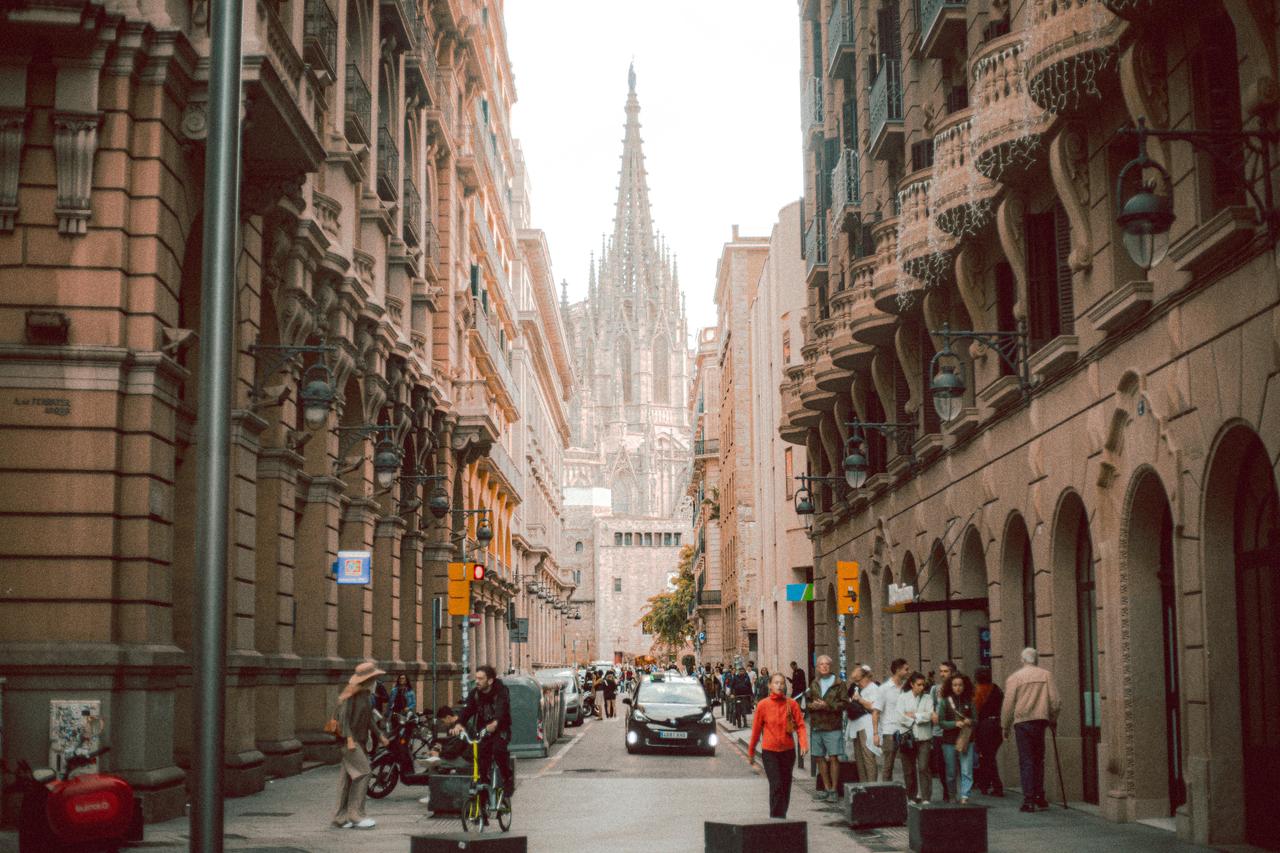
The historic center lies between the port and Plaça de Catalunya (Catalonia Square).
La Rambla Boulevard: Known as the heart of Barcelona, La Rambla is a 1.2-kilometer pedestrian thoroughfare laid out in 1766 following the alignment of the medieval city walls. Long embraced by locals, La Rambla sustains the city’s cultural and social pulse with flower stalls, street performers, and historic buildings such as the Liceu Theatre and La Boqueria Market. At its southern end, the Christopher Columbus Monument symbolizes the boulevard’s historical connection to the port.
The Ensanche (Catalan: L’Eixample) district, located beyond the historic center and responsible for the city’s expansion, is based on a rational grid plan designed by engineer and urban planner Ildefons Cerdà.
Barcelona is situated on the Mediterranean coast and has a typical Mediterranean climate (temperate maritime climate). Summers are short, hot, and dry; winters are mild and relatively humid. Sea breezes moderate summer temperatures. Snowfall is rare.
Barcelona maintains its status as one of the most densely populated urban cores in Spain and Europe. According to Idescat’s 2024 data, the city’s total resident population is 1,686,208. With an area of 101.35 km², this results in an exceptionally high urban density: 16,637.5 inhabitants per km². This density creates continuous pressure on urban services, infrastructure management, and quality of life.
The gender distribution shows a higher female population than male. As of 2024, there are 804,018 men and 882,190 women residing in the city. Women constitute 52.32% of the total population, a disparity commonly attributed to longer life expectancy and specific migration patterns characteristic of urban centers. The age structure reveals that the youth population aged 0 to 14 amounts to 192,624 individuals. This figure is a critical demographic indicator of low birth rates and the city’s long-term trend toward population aging.
Barcelona is the driving force of the Catalan economy. According to 2019 data, Catalonia generated approximately 20.1% of Spain’s total Gross Domestic Product (GDP). That same year, Catalonia’s per capita GDP exceeded the European Union average by 12%. Barcelona closed 2024 with a GDP growth of 3.8%, outperforming both Catalonia (3.6%) and Spain (3.2%). This positive trend has been reflected in favorable labor market indicators.
Barcelona’s economy is largely based on the service sector. The most dynamic areas include trade, transportation, hospitality, and information and communication technologies.
Importance of Tourism: Tourism has become one of the main pillars of Barcelona’s economy. According to 2024 data, tourism contributes approximately 12.6% of the city’s GDP and directly employs 130,000 people. The city generates around 1 billion euros in tourism-related tax revenue annually.
Catalonia has a long industrial tradition and is the autonomous community contributing the largest share to Spain’s total exports. In 2023, Catalan exports surpassed 100 billion euros, setting a record and accounting for 26.2% of Spain’s total exports. The automotive, capital goods, food, and chemical sectors were the primary drivers of this export growth. The majority of these industrial establishments are concentrated in the Barcelona metropolitan region.
Barcelona serves as an academic hub, hosting two major public universities (UB and UAB). This large student population enhances the city’s innovation potential and dynamism.
The combined undergraduate population of over 70,000 students at these two institutions demonstrates Barcelona’s continuous supply of highly qualified labor and its support for the knowledge economy. UAB data also shows that female students outnumber males at both undergraduate and postgraduate levels. Furthermore, at UB’s language courses, 65.8% of students are female, and in the IDP-ICE programs, the figure is 69.1%. This student population indirectly contributes to the city’s ETCA data and continuously influences housing and transportation demand within university areas.
Barcelona possesses a dynamic cultural fabric centered on the Catalan language and identity. It also features a complex linguistic environment where Catalan and Spanish coexist with numerous other languages brought by international migration. 2023 data for Catalonia (aged 15 and over) shows that language use varies significantly depending on context.
Spanish dominates in family and social settings: In household language use, Spanish accounts for the highest proportion at 39.3%, while Catalan is used by 26.7%. Among friends, Spanish leads with 31.3% usage.
In public domains, linguistic asymmetry is observed:
These figures show that despite municipal efforts to prioritize Catalan as the primary language, the population continues to use Spanish more frequently in personal and family contexts, and in functionally critical areas such as healthcare. This linguistic asymmetry, combined with the presence of “Other Languages” spoken in 13.2% of households due to international migration, challenges the social use of Catalan and increases integration pressures.
Barcelona’s architectural heritage is largely defined by the late 19th and early 20th-century local variant of Art Nouveau known as Catalan Modernism (Modernisme Català). The most iconic figure of this era is architect Antoni Gaudí (1852–1926), whose works have globally defined the city’s identity.
The Basilica of the Sagrada Família (Basílica de la Sagrada Família), Barcelona’s most visited and best-known structure, is Gaudí’s most famous and ambitious work.

Antoni Gaudí’s famous work Sagrada Familia (Pexels)
Gaudí is among the few architects whose seven works in and around Barcelona, held under different ownerships, are listed on the UNESCO World Heritage List. These works include:
Barcelona’s architectural heritage extends far beyond Gaudí:

Santa Maria del Mar Basilica, one of the pioneering works of Gothic architecture (Pexels)
Barcelona’s cultural life is vibrant. The Teatre del Liceu is the city’s opera and ballet stage. The city hosts a prestigious symphony orchestra. Catalan folk traditions and festivals such as La Mercè Festival, Castellers (human towers), and Correfoc (fire run) are integral parts of the city’s identity.

Representative image of La Mercè Festival (generated by artificial intelligence).
Barcelona is home to the world-renowned sports club FC Barcelona. The Camp Nou stadium, with a capacity of 99,000, is one of the largest football stadiums in Europe.

FC Barcelona’s home, Camp Nou Stadium (Pexels)
The 1992 Summer Olympics revitalized the city’s sports infrastructure and made it suitable for international sporting events. The post-Olympic development of the coastline, parks, and sports facilities has encouraged public participation in sports.
The 1992 Summer Olympics were more than a sporting event for Barcelona; they served as a catalyst for urban transformation and the renewal of its sports infrastructure. This transformation is frequently cited by the International Olympic Committee (IOC) as a model of “Olympic legacy.”
Barcelona’s public transport network is multi-layered:
The metro system forms the urban backbone, recording 468.67 million annual trips. It spans 125.4 kilometers and includes 165 stations. The bus network covers 813.40 kilometers and operates on 103 routes.
El Prat Airport is one of Europe’s busiest airports. It is directly connected to the city center via metro, bus, and commuter rail.
The Port of Barcelona is one of the Mediterranean’s most important cargo and passenger ports. It serves as a major hub for cruise tourism and commercial shipping.
Agustí, M. F. "Barcelona's Urban Landscape: The Historical Making of a Tourist Product" [Barselona'nın Kentsel Peyzajı: Bir Turizm Ürününün Tarihsel Oluşumu]. ResearchGate. Accessed October 21, 2025. https://www.researchgate.net/publication/249679714_Barcelona's_Urban_Landscape_The_Historical_Making_of_a_Tourist_Product
Ajuntament de Barcelona [Barcelona City Council]. "Recognition for Ildefons Cerdà at the building where he lived in L'Eixample" [L'Eixample'da yaşadığı binada Ildefons Cerdà'ya Onur]. Info Barcelona. Accessed October 21, 2025. https://www.barcelona.cat/infobarcelona/en/tema/democratic-memory/reconeixement-a-ildefons-cerda-a-ledifici-en-que-va-viure-a-leixample_1473851.html
Barcelona City Council [Barselona Belediye Meclisi]. "DATA SHEET 2020 — Main economic indicators for the Barcelona area" [VERİ SAYFASI 2020 — Barselona Bölgesi İçin Temel Ekonomik Göstergeler]. International Welcome. Accessed October 21, 2025. https://www.barcelona.cat/internationalwelcome/sites/default/files/datasheet2020_web_eng_0_5.pdf
Barcelona City Council. "Barcelona's economy consolidated with sustained growth in nearly all sectors." Accessed October 21, 2025. https://barcelonacatalonia.eu/en/barcelonas-economy-consolidated-with-sustained-growth-in-nearly-all-sectors/.
Barcelona City Council. "Barcelona’s economic growth consolidated." Economy, Tax, Economic Promotion and Tourism. Accessed October 21, 2025. https://ajuntament.barcelona.cat/economiatreball/en/news/news/barcelonas-economic-growth-consolidated-1515015.
Barcelona City Council. "Parks of blue and green." Accessed October 21, 2025. https://www.barcelona.cat/en/what-to-do-in-bcn/parks-and-gardens/parks-blue-and-green
Barcelona City Council. "Tech Hubs Overview 2025." International Welcome. Accessed October 21, 2025. https://www.barcelona.cat/internationalwelcome/sites/default/files/TECH%20HUBS%20OVERVIEW_2025_ENG.pdf
Barcelona Economic Promotion [Barselona Ekonomik Kalkınma]. "Barcelona Economic Promotion" [Barselona Ekonomik Kalkınması]. Ajuntament de Barcelona. Accessed October 21, 2025. https://ajuntament.barcelona.cat/economiatreball/sites/default/files/2024-08/Memo%CC%80ria%20Promocio%CC%81%20Econo%CC%80mica%20Barcelona-ENG.pdf
Barcelona Turisme. "BCN Diagonal Route." Meet Barcelona. Accessed October 21, 2025. https://www.meet.barcelona/en/visit-and-love-it/barcelona-diagonal
Barcelona Turisme. "City Hall or Casa de la Ciutat." Accessed October 21, 2025. https://ajuntament.barcelona.cat/en/discover-barcelona-city-council-inside
Busquets, Joan. Barcelona: The Urban Evolution of a Compact City [Barselona: Kompakt Bir Şehrin Kentsel Evrimi]. Cambridge, MA: Harvard Graduate School of Design, 2004. Accessed October 21, 2025. https://www.gsd.harvard.edu/publication/barcelona-the-urban-evolution-of-a-compact-city/.
Catalan Government. "Catalan exports set a new historic record in 2023, surpassing 100 billion euros for the first time." Accessed October 21, 2025. https://catalangovernment.eu/catalangovernment/news/581762/catalan-exports-set-new-historic-record-in-2023-surpassing-100-billion-euros-for-the-first-time?v=.
Emory Economics Review. "The Economics of Tourism in Barcelona" [Barselona'da Turizmin Ekonomisi]. (Based on Barcelona City Council data). Accessed October 21, 2025. https://emoryeconomicsreview.org/articles/2025/2/4/the-economics-of-tourism-in-barcelona
Museu d'Història de Barcelona [Barselona Tarihi Müzesi]. "Cerdà and the First Barcelona Metropolis, 1853 - 1897" [Cerdà ve İlk Barselona Metropolü, 1853-1897]. Accessed October 21, 2025. https://www.barcelona.cat/museuhistoria/sites/default/files/cerda_eng.pdf.
O., J. L. "The Barcelona model: An original formula? From 'reconstruction' to strategic urban projects (1979-2004)" [Barselona Modeli: Özgün Bir Formül mü? 'Yeniden İnşa'dan Stratejik Kentsel Projelere (1979-2004)]. European Planning Studies 14, no. 3 (2006): 403-421. Accessed October 21, 2025. https://www.researchgate.net/publication/233442166_The_Barcelona_model_An_original_formula_From_'reconstruction'_to_strategic_urban_projects_1979-2004.
Pexels. "Futbol Sahasında Duran Bir Kişinin Fotoğrafı" [Photo of a Person Standing on a Football Field].Google Görseller via Pexels. Accessed October 21, 2025. https://www.pexels.com/tr-tr/fotograf/futbol-sahasinda-duran-bir-kisinin-fotografi-2413089/
Pexels. "Gothic Architecture of Santa Maria del Mar, Barcelona" [Santa Maria del Mar'ın Gotik Mimarisi, Barselona]. Accessed October 21, 2025. https://www.pexels.com/photo/gothic-architecture-of-santa-maria-del-mar-barcelona-28648468/.
Pexels. "Kent Şehir Peyzaj Manzara."Google Görseller via Pexels. Accessed October 24, 2025. https://www.pexels.com/tr-tr/fotograf/kent-sehir-peyzaj-manzara-18602897/
Pexels. "Low-Angle Shot of the Sagrada Familia, Barcelona, Catalonia, Spain" Accessed October 21, 2025. https://www.pexels.com/photo/low-angle-shot-of-the-sagrada-familia-barcelona-catalonia-spain-15616255/.
Port de Barcelona. Accessed October 21, 2025. https://www.portdebarcelona.cat/en/business-and-services/cruise-ships/information-passenger/passenger-terminals
TMB (Transports Metropolitans de Barcelona). "Transport Figures" [Ulaşım Rakamları]. Accessed October 21, 2025. https://www.tmb.cat/en/get-to-know-tmb/corporate-information/transport-figures

Henüz Tartışma Girilmemiştir
"Barcelona" maddesi için tartışma başlatın
History
Ancient Period: Rome’s Colony of Bàrcino
Medieval Period and Rise of Trade: Ciutat Comtal
Decline and the War of Succession
Industrialization and Urban Transformation
Democracy and Global Metropolis Status
Urban Layout and Architecture
Historic Center and La Rambla
Ensanche District and the Cerdà Plan
Geography and Climate
Demographics
Economy
GDP Contribution and Overall Growth
Services, Trade, and Tourism
Industry and Export Capacity
Cultural Structure and Education
Education
Cultural Structure
Art and Architectural Heritage
Modernist Masterpieces
Barcelona’s Architectural Heritage: Antoni Gaudí and UNESCO Sites
La Sagrada Família Basilica
Antoni Gaudí’s UNESCO Heritage
Other Architectural Heritage
Museums
Traditions
Sports
Transportation
Public Transport
Airport
Port