


Bu içerik Türkçe olarak yazılmış olup yapay zeka ile otomatik olarak İngilizceye çevrilmiştir.
+1 Daha
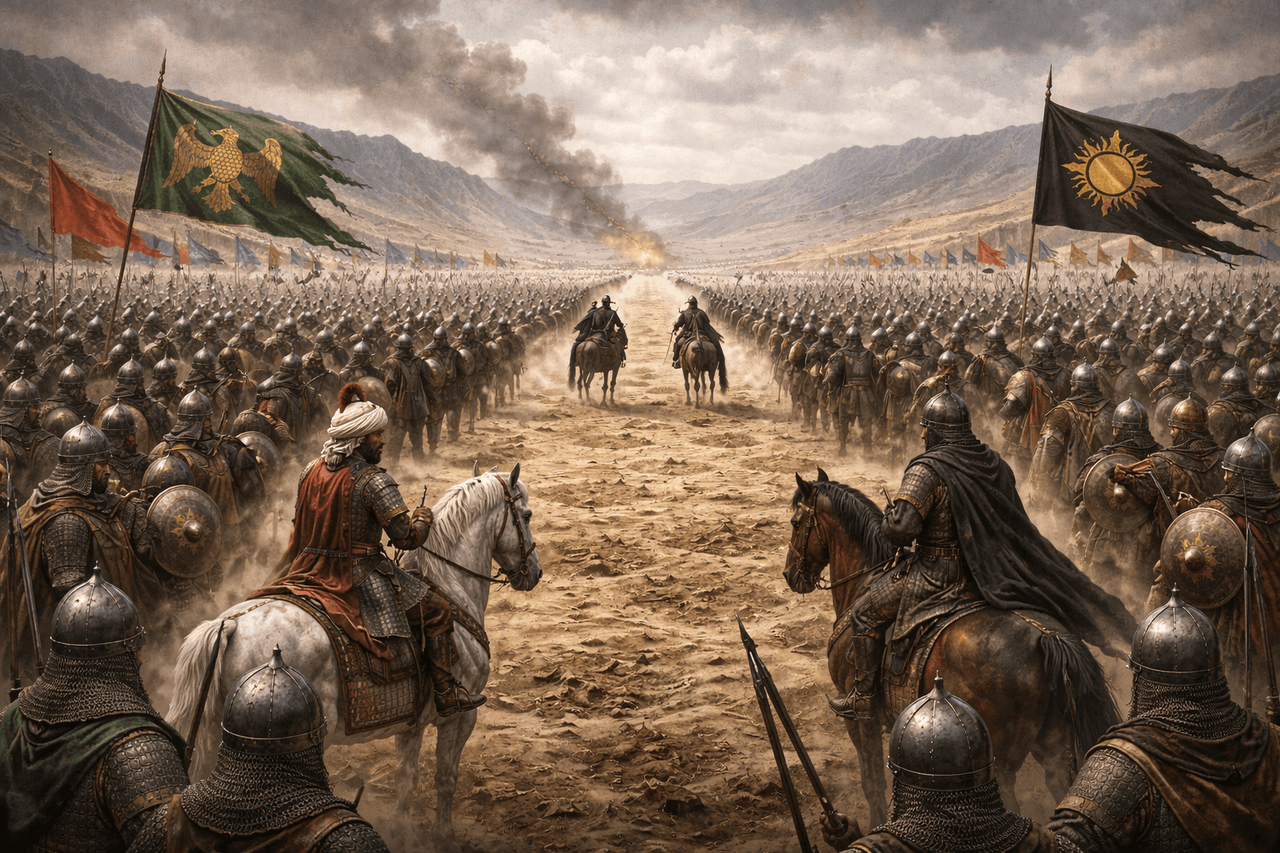
Yapay Zeka Tarafından Oluşturulmuştur
The Battle of Yassıçemen took place on 10 August 1230 (28 Ramadan 627) near Erzincan between the army of the Türkiye Seljuk State under Sultan I. Alâeddin Keykubad and its Ayyubid allies under al-Malik al-Ashraf, against the Khwarazmian forces led by Jalal al-Din Khwarazmshah. This battle fundamentally altered the political map of Eastern Anatolia and the Middle East, effectively leading to the collapse of the Khwarazmian State and leaving Anatolia vulnerable to Mongol invasion.
After losing his territories in Central Asia due to the Mongol invasions under Genghis Khan, Jalal al-Din Khwarazmshah arrived in Azerbaijan in 1225 and became a neighbor to the Seljuk and Ayyubid states. Between 1225 and 1229, intensive diplomatic activity occurred between the parties. Alâaddîn Keykubâd viewed Jalal al-Din as a potential buffer against the Mongol threat and initially sought to establish friendly relations. Ambassadors were exchanged, and an alliance was even arranged through the marriage of Jalal al-Din’s daughter to Keykubâd’s son, Ghiyath al-Din Kaykhusraw. During the same period, the Abbasid Caliph al-Nasir li-Dinillah also sent diplomatic missions to the region to promote Islamic unity against the Mongol threat.
Relations deteriorated in 1229 due to provocations by regional emirs (of Ahlat, Erzurum, and Amid-Mardin) and Jalal al-Din’s expansionist policies. In 1224, Jalal al-Din had raided Abbasid territories and subsequently laid siege to the strategically vital city of Ahlat, which belonged to the Ayyubids. After an eight-month siege, the capture of Ahlat in 1230 and the extensive destruction inflicted upon the city completely shattered Alâaddîn Keykubâd’s trust in Jalal al-Din. When Jalal al-Din’s letters of conquest explicitly revealed his ambitions toward Anatolia and Syria, the Seljuk sultan formed a military alliance with the Ayyubid ruler al-Malik al-Kamil.
On 10 August 1230, the allied Seljuk-Ayyubid army confronted the Khwarazmian forces at the Yassıçemen position near Erzincan. Jalal al-Din Khwarazmshah’s side included his ally, the Erzurum Emir Rukn al-Din Cihanşah. The battle ended in a decisive defeat for the Khwarazmian army, which disintegrated. Jalal al-Din Khwarazmshah fled the battlefield, first to Harput and then to Azerbaijan; his ally Cihanşah was captured.

Battle map. (Generated by Artificial Intelligence.)
After the battle, Jalal al-Din Khwarazmshah’s power was broken, and he was killed in 1231 near Mayyafariqin (Silvan) in a mountain village. With his death, the Khwarazmian State vanished from history.
The most critical strategic consequence of the battle was the elimination of the buffer zone between the Seljuk State and the Mongols. This left Anatolia directly exposed to Mongol attacks and paved the way for the Battle of Köse Dağ in 1243, triggering the decline of the Seljuk State.
Following the battle, the leaderless Khwarazmian emirs (Kayir Khan, Barakat Khan, Saru Khan, etc.) and soldiers entered the service of the Seljuks and Ayyubids as mercenaries. These groups later played a leading role in the recapture of Jerusalem from the Franks in 1244 and in the decisive victory over the Crusader-Ayyubid coalition at the Battle of La Forbie (Harbiye).
After the victory, the Türkiye Seljuks took direct control of Erzurum, while the Ayyubids assumed control of Ahlat, thereby strengthening their influence in Eastern Anatolia.
Although the Battle of Yassıçemen was a short-term military success for the Seljuks, in the long term it accelerated the process that weakened the eastern defensive line of the Islamic world and facilitated the expansion of Mongol dominance into the region.
Baykara, Tuncer. “Yassıçemen Nerededir?” *Selçuklu Medeniyeti Araştırmaları Dergisi* 2 (2017): 11–17. Accessed February 21, 2026. https://dergipark.org.tr/tr/pub/sema/article/344859
Demirci, Mustafa. “Yassıçemen Savaşına Giden Süreçte Alâeddin Keykubad ile Celâleddin Harzemşah Arasındaki Diplomatik Münasebetler, Elçiler ve Mektuplar.” *Selçuklu Medeniyeti Araştırmaları Dergisi* 7 (2022): 18–36. Accessed February 21, 2026. https://dergipark.org.tr/tr/pub/sema/article/1225938
Dicle Üniversitesi. "Uluslararası Harezmişahlar Devleti ve Celaleddin Manguberdi Sempozyumu Duyurusu," 28–29 November 2023, Diyarbakır. Accessed February 21, 2026. https://www.dicle.edu.tr/Contents/Events/Files/b7b681ba-36f6-4125-897b-b1d9ad1487ec/4be28d0d0905434f96335333220f9ed2_Sempozyum-Duyuru.pdf
Erdoğan, Coşkun, E. Göksu, İ. Üngör, P. Polat, M. A. Yılmaz, and K. Altuğ Kaya. *Yassı Çemen Savaşı’nın Yerinin Tespiti ve Yol Güzergâhları*. TÜBİTAK 3005 Sosyal ve Beşeri Bilimlerde Yenilikçi Çözümler Araştırma Projesi, 2023–2025. Accessed February 21, 2026. https://avesis.atauni.edu.tr/proje/84adb9f7-1a04-493f-a8a0-b781ed87f469/yassi-cemen-savasinin-yerinin-tespiti-ve-yol-guzergahlari
Gül, Muammer. “Harezmli Türklerin Anadolu ve Yakındoğu’daki Rolleri ve Tesirleri.” *Belleten* 70, no. 257 (2006). Accessed February 21, 2026. https://belleten.gov.tr/tam-metin/42/tur
Karakuş, Nadir, and Mustafa Demirci. “Harizm Türklerinin 1244 Yılında Kudüs’ü Ele Geçirmeleri ve La Forbie Zaferi.” *Diyanet İlmi Dergi* 60, no. 4 (2024). Accessed February 21, 2026. https://ilmidergi.diyanet.gov.tr/makaledetay.php?ID=38431
T.C. Northeastern Anatolia Development Agency. “Erzincan Tarihçesi.” KUDAKA. Accessed February 21, 2026. https://kudaka.gov.tr/bolgemiz/erzincan/tarihce
Özbek, Süleyman. “Türkiye Selçuklularının Çöküşünde Sebep Sonuç İlişkisi Yassıçemen’den Kösedağ’a.” *Çeşm-i Cihan: Tarih Kültür ve Sanat Araştırmaları Dergisi* 5, no. 1 (2018): 2–17. Accessed February 21, 2026. https://dergipark.org.tr/tr/pub/cesmicihan/article/434292

Yapay Zeka Tarafından Oluşturulmuştur
Henüz Tartışma Girilmemiştir
"Battle of Yassıçemen" maddesi için tartışma başlatın
Political Background and Diplomatic Relations (1225–1229)
Breakdown of the Alliance and the Ahlat Crisis
Course of the Battle
Consequences and Historical Impact
Collapse of the Khwarazmian State
Disappearance of the Buffer Zone
Role of the Khwarazmian Survivors
Regional Shifts in Power