


Bu içerik Türkçe olarak yazılmış olup yapay zeka ile otomatik olarak İngilizceye çevrilmiştir.
In the field of image processing and computer vision, establishing a balance between noise reduction and detail preservation has always been a challenging problem. In this context, the bilateral filter stands out as an effective method that simultaneously reduces noise while preserving edges and important details in images. First introduced by Tomasi and Manduchi in 1998, this filter differs from traditional filtering techniques by considering not only spatial proximity but also the similarity of pixel intensities.
The bilateral filter is a nonlinear filtering technique used in image processing. Its primary objective is to reduce noise in an image while preserving its edges and fine details. Traditional filters such as Gaussian blur apply uniform weighting to all pixels in a neighborhood, resulting in the smoothing of edges along with noise. The bilateral filter addresses this issue by combining two distinct weighting functions:
This dual approach enables the filter to consider not only pixels that are spatially close but also those with similar intensity values. For example, if two pixels on either side of an edge have significantly different intensities, the filter distinguishes between them and preserves the edge.
The bilateral filter was introduced by Carlo Tomasi and Roberto Manduchi in 1998 in their paper titled “Bilateral Filtering for Gray and Color Images.” This method was developed to overcome the limitations of then-popular linear filtering techniques such as Gaussian filtering. Subsequently, Sylvain Paris and other researchers further refined its theoretical and practical aspects during the 2000s.
To illustrate the logic of the bilateral filter with an example, consider the task of computing the filtered value of a specific pixel in a noisy grayscale image.
Step 1: Neighborhood Definition: A window around the pixel is selected (e.g., 5x5).
Step 2: Spatial Weight Calculation: For each pixel, the Gaussian weight Gσs is computed based on its distance from the center pixel.
Step 3: Intensity Weight Calculation: For each neighboring pixel, the Gaussian weight Gσr is computed based on the difference in intensity with the center pixel.
Step 4: Weight Multiplication: The spatial and intensity weights are multiplied to obtain a combined weight for each pixel.
Step 5: Weighted Average: The values of neighboring pixels are multiplied by their respective weights, summed, and normalized.
This process mechanism ensures edge preservation. For instance, if the intensity values of pixels near an edge differ significantly, the Gσr weight becomes very small, reducing the influence of those pixels.
To understand the working principle of the bilateral filter, its mathematical formulation must be examined. For each pixel in an image, the filtered value is computed using the following formula:
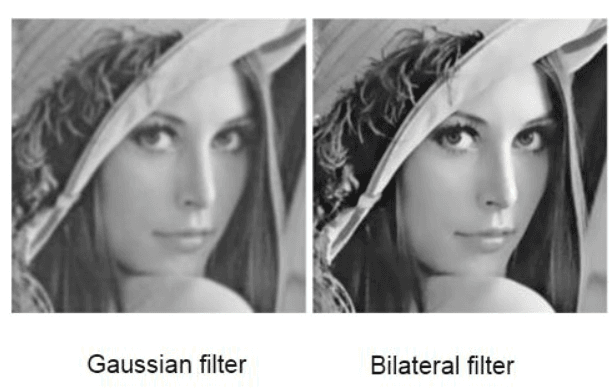
Comparison of Gaussian Filter and Bilateral Filter (Credit: AI Learning Centre)
The bilateral filter is used in numerous applications:
To translate the theoretical foundations of the bilateral filter into executable code, the following steps are required: scanning the image pixel by pixel, defining a window around each pixel, computing spatial and intensity weights, calculating the weighted average, and applying normalization.
Erkut, Erdem. "Bilateral Filtering, and Non-local Means Denoising". Hacettepe Üniversitesi. Accessed March 16, 2025. Accessed Adresi.
Geeksforgeeks. "Bilateral Filtering." Geeksforgeeks Web Sitesi. Accessed March 16, 2025. Accessed Adresi.
MathWorks. "Bilateral Filter." MathWorks Web Sitesi. Accessed March 16, 2025. Accessed Adresi.
Paris, S., Kornprobst, P., Tumblin, J., & Durand, F. Bilateral filtering: Theory and applications. Foundations and Trends® in Computer Graphics and Vision 4, no. 1 (2009): 1-73.
Tompkin, J. et al. "Lab 3: Bilateral Filtering". Accessed March 16, 2025. Accessed Adresi.
Universiteit van Amsterdam. "Bilateral Filtering." Image Processing, Lecture Notes Image Processing and Computer Vision. Accessed March 16, 2025. Accessed Adresi.

Henüz Tartışma Girilmemiştir
"Bilateral Filter" maddesi için tartışma başlatın
Bilateral Filter
Historical Context
Working Mechanism of the Bilateral Filter
Mathematical Foundations of the Bilateral Filter
Advantages and Disadvantages of the Bilateral Filter
Advantages
Disadvantages
Applications
Implementation Code for the Bilateral Filter