

Bu içerik Türkçe olarak yazılmış olup yapay zeka ile otomatik olarak İngilizceye çevrilmiştir.
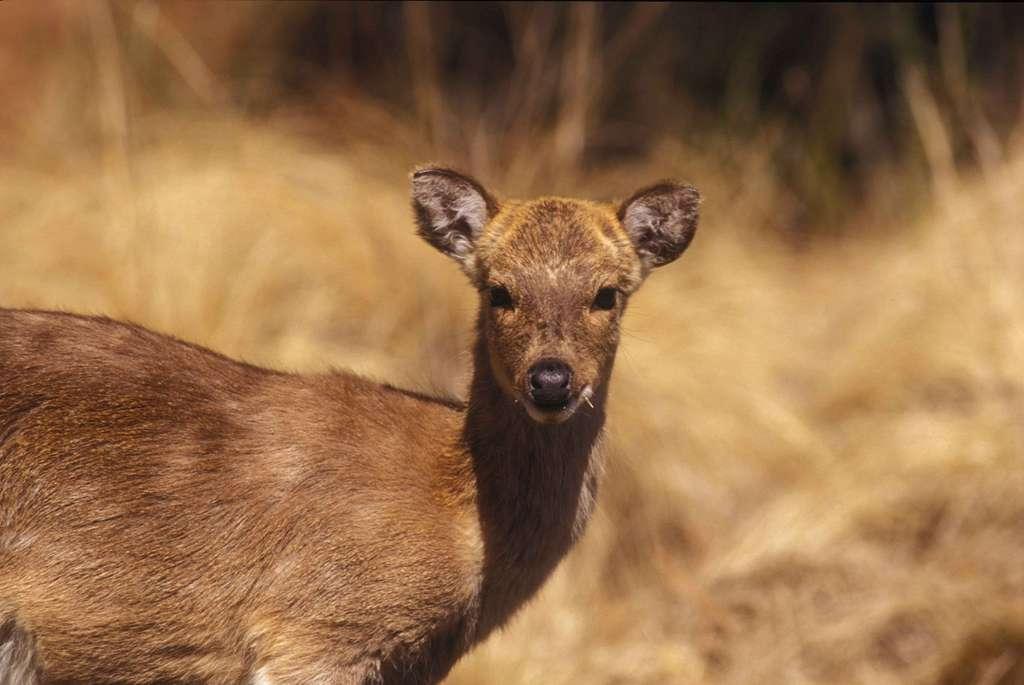
Chinese water deer (Hydropotes inermis) is a small mammal belonging to the family Cervidae within the order Artiodactyla and represents the only living species of the genus Hydropotes. Although it lacks antlers and possesses prominent, elongated upper canine teeth in males—giving it a superficial resemblance to musk deer (Moschidae)—morphological and genetic data confirm its classification within Cervidae.
This species is native to the lower Yangtze River basin of eastern China and the Korean Peninsula and is assessed by the IUCN as Vulnerable, facing threats such as habitat loss and illegal hunting. Two subspecies have been formally recognized:
Image of the Chinese water deer (YaangJee Birds&Nature)
Chinese water deer are small-sized mammals. Adult body length ranges from 775 to 1000 mm, with tail length measuring 60 to 75 mm. Their dense, coarse fur can extend up to 40 mm in length, particularly along the flanks and rump during winter months. Coat patterns vary with season and age, but typically the back is grayish or reddish-brown while the underparts are entirely white.
Neither sex possesses antlers. The most distinctive morphological feature in males is a pair of curved, ivory-like upper canine teeth that can grow up to 52 mm in length. In females, these teeth are typically around 5 mm. Additionally, both sexes have a pair of scent glands located just in front of the eyes, associated with chemical communication.
This species is endemic to East Asia, with its natural range restricted primarily to eastern and central China and the Korean Peninsula. In China, it is found especially in the lower Yangtze River basin and in eastern provinces such as Anhui, Jiangsu, Jiangxi, and Zhejiang. In Korea, it inhabits western coastal areas and regions near the Demilitarized Zone (DMZ). The species was introduced to England and France in the late 19th century, where limited populations have become established in areas such as Woburn Abbey and Whipsnade in England.
The species inhabits moist and sheltered habitats such as riverbanks, marshes, tall reed beds, open grasslands, and the overgrown edges of cultivated fields. It has well-developed concealment abilities and prefers coastal plains, salt marshes, shrublands, and riverbanks. It is capable of swimming and has strong aquatic mobility. Generally solitary, it may occasionally be observed in small groups under conditions of high population density.

A Chinese water deer in the wild (Flickr)
The mating season in China occurs between November and January, with births taking place from late May to early June. In European zoos, mating is typically observed in May. Gestation lasts approximately 170 to 210 days. Controlled studies indicate that females give birth to an average of 2 to 3 young, with a mean of 2.7 per litter. Prior to giving birth, females withdraw from social groups to isolated areas. Newborn fawns have a light, spotted coat that provides effective camouflage. Lactation lasts several months. Males do not participate in parental care; instead, they compete for access to females during the mating season. Males reach sexual maturity at around 5 to 6 months, while females mature at 7 to 8 months. The average lifespan in the wild is approximately 10 to 12 years.
The Chinese water deer (Hydropotes inermis) is a herbivorous mammal whose diet consists primarily of soft vegetation. It feeds on young leaves, grasses, reeds, aquatic plants, shoots, and herbaceous species from shrublands. Due to its preference for wetland habitats, reed and marsh plants constitute a major food source. In areas near agricultural land, it also consumes cereal seedlings and cultivated crops. This non-selective grazer utilizes readily available plant resources in its environment. Dietary preferences vary according to seasonal changes in vegetation. Its dental structure and digestive system are adapted to efficiently process low-fiber, moisture-rich plant material.
The Chinese water deer is classified by the International Union for Conservation of Nature (IUCN) as Vulnerable. This status indicates that its wild populations are under threat and may move to higher risk categories if conservation measures are not implemented. Population declines are driven by hunting, habitat loss, agricultural expansion, and urbanization. In China, the destruction of wetlands for agricultural development poses a particularly severe threat.
Partially digested milk obtained from the stomachs of young individuals is traditionally used in folk medicine to treat digestive ailments, contributing additional pressure on the species.
Populations are protected within the Yancheng and Poyang Lake Nature Reserves. However, existing conservation efforts remain inadequate, and illegal hunting and habitat fragmentation continue even within these areas. Although genetic diversity remains relatively high within Chinese populations, subpopulations are geographically isolated.
Animal Diversity Web. "Hydropotes inermis." ADW. Accessed July 29, 2025. ttps://animaldiversity.org/accounts/Hydropotes_inermis/
Get Archive. “Chinese water deer animal mammal JPG.” Accessed July 10, 2025. https://itoldya420.getarchive.net/amp/media/chinese-water-deer-animal-mammal-493f5d
Harris, Richard B., and John W. Duckworth. "Hydropotes inermis." *The IUCN Red List of Threatened Species*. Accessed July 29, 2025. https://dx.doi.org/10.2305/IUCN.UK.2015-2.RLTS.T10329A22163569.en
Sway, Mick. “Chinese water deer (Hydropotes inermis) Titchwell Norfolk 18/04/15 JPG.” Flickr. Accessed July 10, 2025. https://flic.kr/p/rYy9Ck
YangJee Birds & Nature. "Running Water Deer | Hydropotes inermis." YouTube. Accessed July 29, 2025. https://www.youtube.com/watch?v=jvVpbqtqxHE

Henüz Tartışma Girilmemiştir
"Chinese Water Deer (Hydropotes inermis)" maddesi için tartışma başlatın
Morphological Characteristics
Distribution and Habitat
Behavior and Ecology
Reproduction
Diet
Conservation Status and Threats
Conservation Recommendations