


Bu içerik Türkçe olarak yazılmış olup yapay zeka ile otomatik olarak İngilizceye çevrilmiştir.
+2 Daha
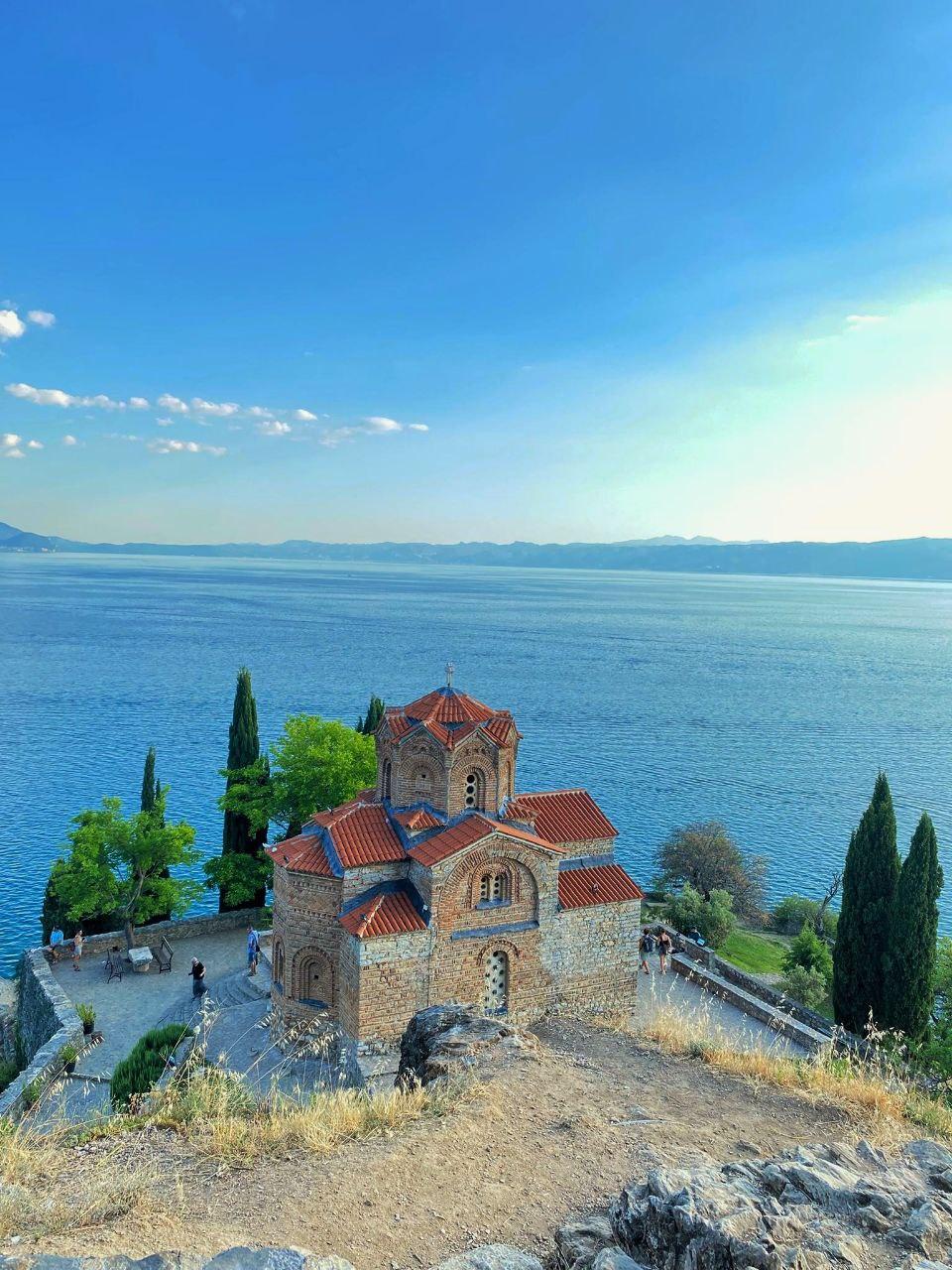
Saint John Kaneo Church (Photo: İlayda Seray Canbaz)
Location | North Macedonia Ohrid | ||||||||
|---|---|---|---|---|---|---|---|---|---|
Dedication | Saint John of Patmos (John the Theologian) | ||||||||
Construction Date(s) | Not certain estimated 13th century | ||||||||
Architectural Plan | octagonal dome three-apsed Cruciform plan on a rectangular base | ||||||||
Saint Portraits | Archbishop Konstantin Kabasilas Saint Erasmus Saint Clement | ||||||||
The Church of Saint John Kaneo is a medieval Orthodox structure located on a rocky promontory overlooking Lake Ohrid in the city of Ohrid, North Macedonia. Dedicated to Saint John of Patmos, the church reflects a synthesis of Byzantine and regional Armenian architectural and iconographic influences. Although its exact date of construction is uncertain, it is generally accepted to have been built in the 13th century and is considered one of the region’s most significant religious and cultural heritage sites due to its frescoes, wooden iconostasis, and local saint portraits.
The Church of Saint John Kaneo (Macedonian: Свети Јован Канео) is situated on a rocky outcrop above Kaneo Beach, within the historic urban fabric of Ohrid in southwestern North Macedonia. Its position defines it as a dominant natural terrace overlooking the lakeshore, with its silhouette sharply outlined against the surrounding steep rock formations. The name “Kaneo” derives from the old local designation of the coastal area where it stands. The church is dedicated to Saint John the Theologian, also known as Saint John of Patmos.

The Church of Saint John Kaneo (qiv)
The exact date of the church’s construction has not been definitively documented. Archaeological evidence, written records, and stylistic analysis suggest that the structure took shape in the 13th century. The earliest layer of frescoes is dated to approximately 1290. A record from 1447, mentioned in an inscription at the Church of Saints Constantine and Helena, confirms the existence of the building prior to that date.
Before the arrival of Ottoman administration, renovations and restoration works were carried out on the building during the 14th century. These interventions are interpreted as efforts to preserve and reinforce the existing wall paintings and structural framework.
During the Ottoman period, the building continued to function for a time as part of a monastic complex; however, as monastic life gradually declined, the structure fell into partial ruin and experienced intermittent periods of abandonment and neglect between the 17th and 19th centuries. In the 19th century, a new wooden iconostasis was installed inside the interior space, and some damaged fresco areas were repainted during this period. In 1844, Dicho, a prolific local wall and icon painter from the region, created the icon of “Theotokos Pantochora”; further modifications were made to the apse conch to depict the Theotokos in the Platytera schema, with Christ held in her arms.
During conservation works carried out between 1963 and 1964, previously hidden frescoes on the dome were uncovered. Certain later additions that compromised the original massing and facade composition were removed, restoring the building’s historical character.

The Church of Saint John Kaneo (Photo: İlayda Seray Canbaz)
The building is based on a rectangular plan with a cruciform layout. On the eastern side, a three-sided apse is flanked by an octagonal dome at the center. The identity of the architect remains unknown. The church is regarded as a synthesis of Byzantine and Armenian architectural elements; in particular, the zigzag ornamentation along the dome’s base reflects Armenian influence.
The interior contains frescoes dating to the 13th century. Key scenes on the dome and in the apse include the Pantocrator Christ, the Theotokos Platytera, and liturgical compositions. The depictions of Saints Clement of Ohrid, Saint Erasmus, and Archbishop Konstantin Kabasilas are also notable from an iconographic perspective.
Thanks to the removal of later additions and conservation efforts undertaken in the 1960s, the church’s original plan and decorative scheme are largely legible. Today, the building functions both as a place of worship and as a site for visitors. The interior preserves fragments of the 13th-century fresco layer alongside 19th-century interventions, presenting a layered visual history. The church is now recognized as one of the symbolic monuments of Ohrid, serving both religious and tourist purposes.
The Church of Saint John Kaneo exemplifies the iconographic and architectural diversity of Late Byzantine and Balkan art as part of Ohrid’s medieval Christian heritage. Its depiction of local saints and spiritual leaders documents the Ohrid ecclesiastical tradition, while its stylistic fusion of Byzantine and Armenian elements in plan and dome details provides valuable material for comparative studies among medieval Balkan monuments. These aspects constitute the primary sources of its academic importance.
Macedonia Timeless (Sırpça). "Crkvi Bogoslov / St Jovan Kaneo." Accessed September 29, 2025. https://macedonia-timeless.com/srb/stvari_koje_treba_uraditi/osetite/Dodir/kulturaistorija/crkvi/bogoslov/
Macedonia Timeless (Türkçe). "Aziz John (Kaneo)." Accessed September 29, 2025. https://macedonia-timeless.com/tur/yaplacakeyler/duyulararaclylamakedonyayahissetmek/dokunmaparkeoloji_tarihvekltrp/tarih_vekltr/kiliseler/aziz_johnkaneo
Macedonia Timeless. "St. John Kaneo." Accessed September 29, 2025. https://macedonia-timeless.com/eng/things_to_do/senses/touch/culture-history/churches/st-john-kaneo/
Makturk. “Sveti Jovan (Aziz Yovan) Kaneo Kilisesi.” Accessed September 29, 2025. https://makturk.com/sveti-jovan-aziz-yovan-kaneo-kilisesi/
Qiv. “Photo of St. John at Kaneo.” Flickr. Accessed September 29, 2025. https://www.flickr.com/photos/qiv/2808349550
SV Petka. “Црква Св. Јован Канео” [Church of St. John Kaneo]. Accessed September 29, 2025. https://svpetka.de/%d1%86%d1%80%d0%ba%d0%b2%d0%b0-%d1%81%d0%b2-%d1%98%d0%be%d0%b2%d0%b0%d0%bd-%d0%ba%d0%b0%d0%bd%d0%b5%d0%be-%d0%be%d1%85%d1%80%d0%b8%d0%b4/
Spotting History. "Church of St. John at Kaneo." Accessed September 29, 2025. https://www.spottinghistory.com/view/11254/church-of-st-john-at-kaneo/
VISPOJ. “St Jovan Kaneo.” Accessed September 29, 2025. https://vispoj.com.mk/st-jovan-kaneo

Saint John Kaneo Church (Photo: İlayda Seray Canbaz)
Location | North Macedonia Ohrid | ||||||||
|---|---|---|---|---|---|---|---|---|---|
Dedication | Saint John of Patmos (John the Theologian) | ||||||||
Construction Date(s) | Not certain estimated 13th century | ||||||||
Architectural Plan | octagonal dome three-apsed Cruciform plan on a rectangular base | ||||||||
Saint Portraits | Archbishop Konstantin Kabasilas Saint Erasmus Saint Clement | ||||||||
Henüz Tartışma Girilmemiştir
"Church of Saint John Kaneo" maddesi için tartışma başlatın
Location and Nomenclature
History
Founding and Early Period
14th-Century Interventions
Ottoman Period, Abandonment Phases, and 19th-Century Additions
20th-Century Conservation Efforts
Architectural Features
Current Condition
Cultural and Religious Significance