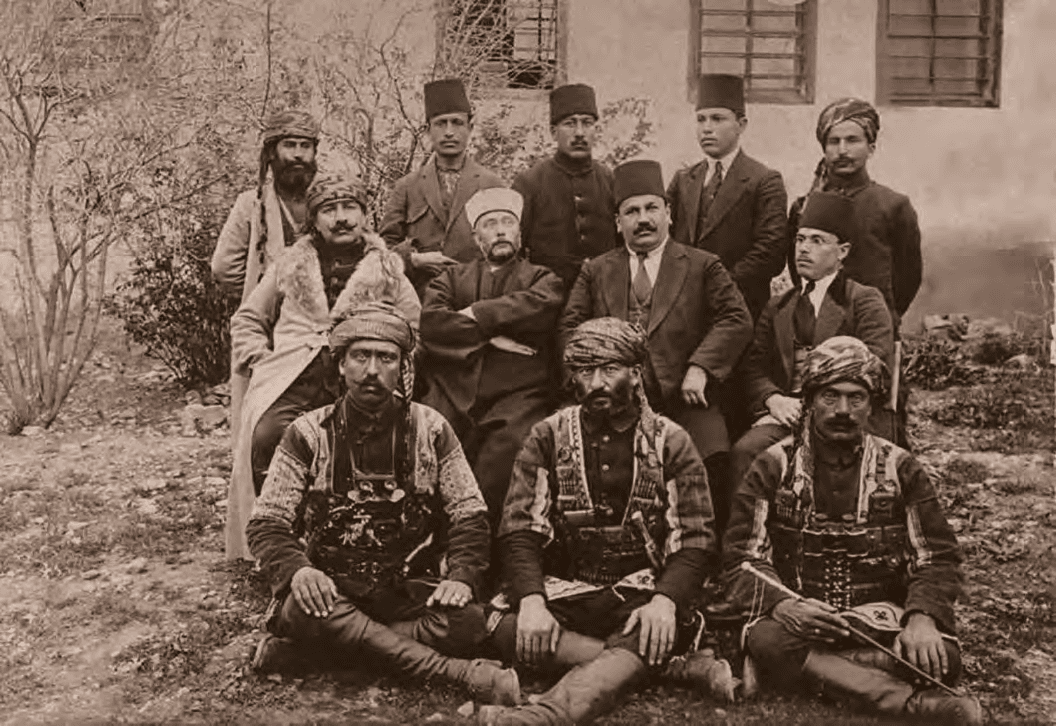


Bu içerik Türkçe olarak yazılmış olup yapay zeka ile otomatik olarak İngilizceye çevrilmiştir.
Place | Antep (present-day Gaziantep) | ||||||||
|---|---|---|---|---|---|---|---|---|---|
Event | Armed resistance and siege | ||||||||
Type | Armed resistance and siege. | ||||||||
Date | 1 April 1920 – 9 February 1921 | ||||||||
Parties | Antep National Forces Cemiyet-i İslamiye Central Committee and 2nd Army units (5th and 9th Divisions) French occupation forces Armenian units in French ranks | ||||||||
Commanders | National forces: Şahin Bey, Kılıç Ali Bey, Yarbay İrfan Bey, Ali Şefik Özdemir Bey, Albay Selahattin Adil Bey French: Albay Flye Sainte Marie; Yarbay Abadie; Albay Andrea; Albay Normand; Albay Debieuvre; General Goubeau; General Gouraud (High Commissioner): French forces: Albay Flye Sainte Marie, Yarbay Abadie, Albay Andrea, Albay Normand, Albay Debieuvre, General Goubeau, General Gouraud | ||||||||
Forces | National: Planned cadre of 2,700 personnel from 27 neighborhoods (not number of armed fighters); Yıldırım and Şimşek battalions (each with four hundred men; each battalion composed of four companies of fifteen armed soldiers each, Can); approximately 2,000 combatants in the city by end of August 1920 (Can); 2,920 personnel listed in needs report of 20–21 November 1920 (Çabuk–Ayata); 22,000 civilians and 3,000 soldiers accounted for in supply records of 1 December 1920 (Sevim–Saygılı). French: Approximately 12,000 including Goubeau's 7,500-strong force and garrison together in November 1920 (Can). French: Approximately 12,000 including Goubeau's 7,500-strong force and garrison together in November 1920 (Can). | ||||||||
Outcome | Surrender of the city to French forces via the surrender protocol of 9 February 1921 | ||||||||
Casualties | Destruction of approximately 8,000 of 10,000 homes; approximately 6,000 dead and as many wounded | ||||||||
Subsequent Developments | Bestowal of the name Gaziayntab by Law No. 93 dated 8 February 1921, Ankara Treaty of 20 October 1921, French withdrawal on 25 December 1921 | ||||||||
Defense of Antep (Antep Resistance) is the armed resistance and defense campaign conducted in Antep (modern-day Gaziantep), which was first occupied by British and later by French forces after the Armistice of Mudros. The resistance began outside the city in January 1920 and moved inside the city on April 1, 1920, concluding with the signing of the surrender protocol on February 9, 1921.【1】 The resistance, directed by Cemiyet-i İslamiye and Heyet-i Merkeziye, started with clashes outside the city along the Maraş route from January 1920 and along the Kilis route from February 1920. On April 1, 1920, armed struggle shifted inside the city, where it continued under siege.【2】 The city signed a surrender protocol on February 9, 1921, due to French siege and starvation; one day earlier, on February 8, 1921, the TBMM enacted Law No. 93 renaming Ayıntab as Gaziayntab.【3】 French forces departed from the city on December 25, 1921, following the Ankara Agreement signed on October 20, 1921.【4】
Antep (Ayıntab), located approximately 80 kilometers from Katma station, stood at a strategic junction connecting the Kilis–Antep highway, the Akçakoyunlu–Nafak Boğazı–İkizkuyu route, the Maraş route via Pazarcık–Araptar, and the Nizip route. During the National Struggle, it held critical importance for both French supply lines and the main routes of national forces.【5】 Aleppo was occupied by the British on October 26, 1918, and Turkish units withdrew to Katma; Antep lay at the point linking Aleppo with Anatolia.【6】
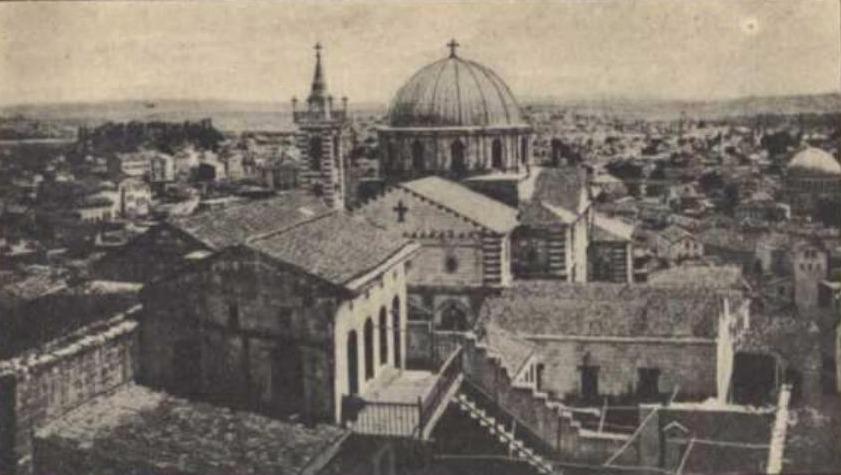
The Eastern Section of Antep and the Gregorian Church, 1919 (Webaram)
The occupation process began as British troops shifted from Aleppo toward Antep starting December 17, 1918; the population of Antep city at that time was approximately 80,000.【7】 The British justified their arrival by citing Articles 10 and 16 of the Mudros Armistice; advance units and colonial troops entered the city and established their headquarters at the American College.【8】 British officials informed Mutasarrıf Celal Bey that they had come only to spend the winter and that their presence did not constitute an occupation.【9】
On January 14, 1919, the British commander gathered the city’s prominent figures and declared that any disturbance of public order would not be tolerated; the next day, January 15, 1919, the formal occupation of Antep was announced based on Article 7 of the Mudros Armistice.【10】 This announcement was the official confirmation of military movements that had begun on December 17, 1918; Can considers this announcement as the beginning of the British occupation. The British took control of the telegraph office and nearby train stations and converted the American College and some Armenian houses into headquarters.【11】 On January 23, 1919, the government building was stormed; a group including officials and prominent citizens was arrested on grounds of involvement in the Armenian deportation and sent first to Aleppo and then to prisoner camps in Egypt.【12】
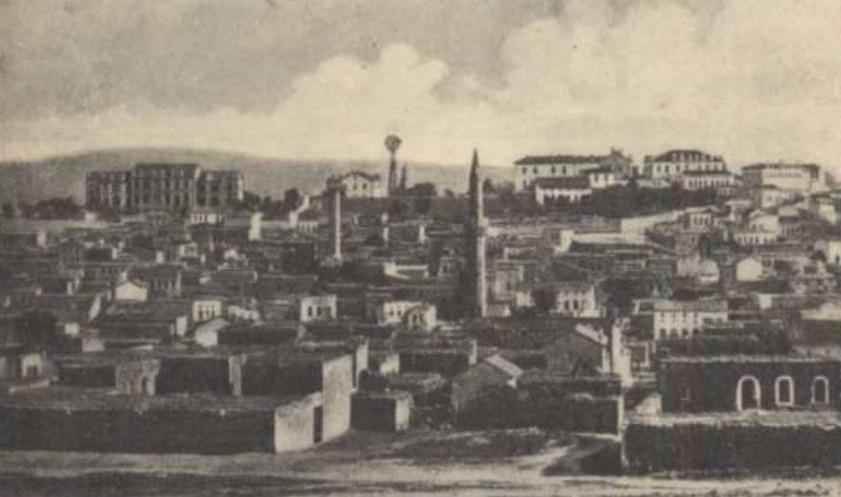
The Western Part of Antep and the American Hospital, 1919 (Webaram)
Martial law was declared on March 8, 1919 (one source gives the date as March 12); the population was ordered to surrender their weapons, and by evening of that day approximately fourteen carts of arms and ammunition were handed over.【13】 On March 13, the British demanded that military units also surrender their weapons; the Chief of the Antep Military Branch, Yarbay İrfan Bey, refused, arguing that no such provision existed in the armistice terms.【14】
According to İrfan Bey’s memoirs, the military branch depot contained more than four hundred mavzer rifles and about sixty crates of ammunition; the British intelligence officer, Binbaşı Mils, who inspected the depot, did not seize the weapons but recorded their inventory; the weapons were later removed from the city during one night by animals brought from surrounding villages.【15】 From March 17, the British decided to close shops and impose a curfew; the ban was lifted on March 30.【16】 In the following period, the British did not interfere with local administration, police, or gendarmerie, and no significant clashes occurred until the city’s transfer to the French.【17】
Under the Syria Agreement signed on September 15, 1919, British forces were to transfer Antep, Maraş, and Urfa to France.【18】 The arrival of French forces occurred in stages: on October 25, 1919, two French officers arrived in the city; on October 27, Colonel Flye Sainte Marie arrived with a contingent of troops; on October 29, two cavalry squadrons entered the city.【19】 Following negotiations on October 30 involving Turkish, British, and French authorities, a declaration was issued on November 1, 1919, confirming the city’s transfer to French control; Antep was placed under the command in Adana, and the last British unit departed on November 5.【20】
The local administration and population resisted the occupation in various ways: on November 5, 1919, after a French officer removed the Turkish flag from the Akyol Police Station, the public demanded the officer’s dismissal and the flag’s re-hanging; on November 23, a large-scale meeting was held at the call of Cemiyet-i İslamiye; prior to this, a report of a meeting held on October 25 appeared in the İrâde-i Milliye newspaper on October 27, 1919.【21】 Mustafa Kemal Paşa informed administrative officials and defense of rights centers on November 9 that the occupation of Antep must be protested before world public opinion and the American government.【22】
In December 1919, the French reinforced their garrison; on December 9, General Querette, commander of the French 315th Infantry Brigade, arrived in Antep and assumed command of the Eastern Region; on December 13, he issued a declaration announcing the region’s placement under French protection.【23】 During this period, the city was effectively divided: Turks gathered east of Maarif Avenue, Armenians west of it.【24】 It is reported that over ten thousand people attended the İstiklal-i Osmanî Day celebration organized by Heyet-i Merkeziye on December 30, 1919.【25】
On January 21, 1920, twelve-year-old Mehmet Kâmil was stabbed to death by French soldiers after throwing stones at them for harassing his mother; upon the crowd rushing to the scene, French soldiers took refuge in a bakery.【26】 The next day, a large funeral procession was held; Colonel Sainte Marie visited the Nakşibendi Tekke where Cemiyet-i İslamiye had gathered, offered condolences, and proposed compensation to the boy’s father, which was rejected.【27】 Can regards this incident as the first active resistance against the French in the city.【28】
The ideological foundation of Cemiyet-i İslamiye emerged during the British occupation; the society became openly active and began organizing the public following the French occupation.【29】 At a meeting organized by Cemiyet-i İslamiye on November 23, 1919, a proclamation was issued, signed by Mayor Mehmet Lütfi Bey, declaring that an occupation contrary to Wilson’s principles would not be accepted.【30】 Cemiyet-i İslamiye was separately organized in Antep, Kilis, and Nizip.【31】
After the Sivas Congress, a letter was sent requesting the establishment of a national organization in the Antep Mutasarrıflığı; Mutasarrıf Celal Bey concealed the letter, while Tahrirat Director Ragıp Bey convened the city’s prominent figures and founded the Antep Heyet-i Merkeziye.【32】 The secret organization’s formation was reported to Mustafa Kemal Paşa on October 23, 1919; it was formally established on November 23, 1919, after Sabri Bey became acting Mutasarrıf. Thus, Cemiyet-i İslamiye was the structure that openly organized the public and called for demonstrations, while Heyet-i Merkeziye was initially a secret body that acquired official status after November 23.【33】
The formation of Kuvâ-yı Milliye occurred under the supervision of Heyet-i Merkeziye; the city was divided into 27 neighborhoods, each assigned a contingent of one hundred people, creating a planned force of 2,700; this number does not represent armed fighters; armed members would fight, while unarmed members would remain in reserve to replace the wounded or deceased.【34】 To assist Heyet-i Merkeziye, Heyet-i İdare was established; under it, units for finance and procurement, food supply, soldiers’ families, health, fortifications, ammunition, and repair workshops were created.【35】
Maps were prepared for Yarbay İrfan Bey and Yüzbaşı Esad Bey to identify resistance fronts; Heyet-i Merkeziye was not in favor of fighting inside the city.【36】 The committee argued that raids on French convoys outside the city would cut off supply lines and force the French to withdraw, thereby minimizing harm to the city and civilians; proponents of urban warfare claimed that operations outside the city could not go beyond harassment.【37】 The initial phase of the resistance was conducted outside the city, in accordance with İrfan Bey’s views.【38】 In his memoirs, İrfan Bey writes that this strategy was decided at a meeting held at the house of Körükçüzâde Ahmet; he argued that since Armenian neighborhoods were located on the French military side, firing weapons inside the city would give the French an advantage, and therefore recommended maintaining calm within the city while launching raids on supply routes outside.【39】
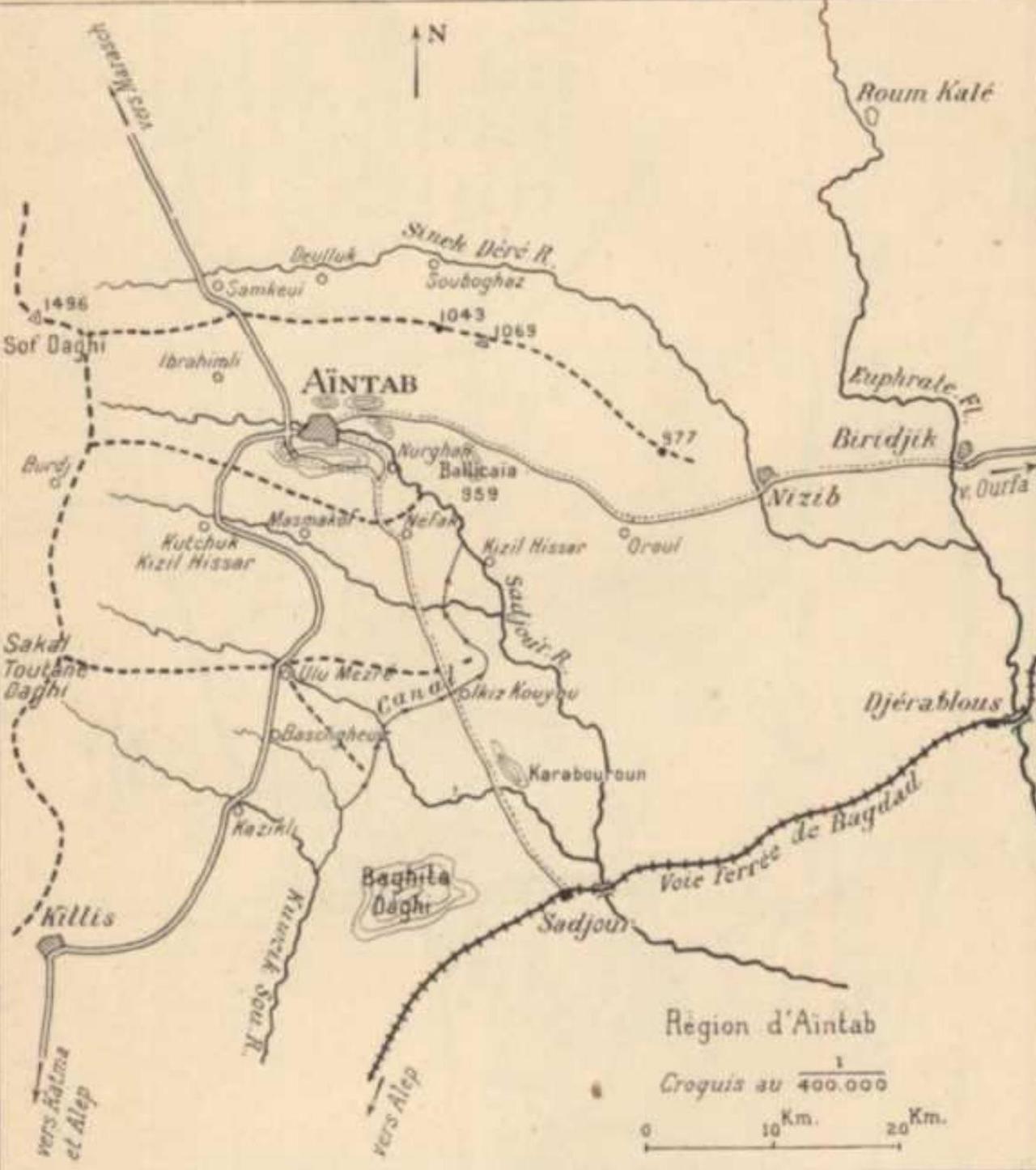
Antep ve Çevresi Krokisi, 1922 (Webaram)
On January 7, 1920, a French Senegalese battalion traveling from İslâhiye to Maraş encountered armed resistance from national forces at Türkoğlu position; after two days of fighting, the French reached Maraş with heavy casualties.【40】 On January 12, a French force of 400 infantry, two mountain guns, and cavalry departed from Antep toward Sakçagözü; it is reported that during the night spent in Araptar Village, the unit mistreated villagers and opened fire on those fleeing.【41】 On January 13, militia forces under Memik Ağa, son of Boyno, and Karayılan launched a raid on the French column moving from Araptar to Maraş at Çatal Mazı position; Can writes that in this clash, the French lost sixty men and the Turks lost ten.【42】
According to Can, a joint commission of Turkish and French representatives investigated the incident at the request of the French and determined that the French were responsible; it is not specified whether the commission confirmed the casualty figures.【43】 The damage suffered by villagers in the Araptar raid was calculated at 301,255 kuruş.【44】 On January 20, 1920, Karayılan launched a raid near Karabıyıklı Village against a French cavalry detachment; some soldiers were killed, others captured, and approximately one hundred mules and horses, one hundred sixty rifles, one hundred bombs, and twenty crates of ammunition were seized; it is unclear whether this equipment belonged to the cavalry detachment or to a related unit and ammunition convoy.【45】 In İrfan Bey’s memoirs, he writes that communication between Maraş and Antep was severed by these events in January 1920.【46】
Heyet-i Merkeziye took defensive measures along the Antep–Kilis route using village militias to prevent French reinforcements from arriving via Kilis and Katma.【47】 Şahin Bey, appointed by Minister of War Cemal Paşa to head the Birecik Military Branch, became Commander of the Kilis Route Kuvâ-yı Milliye; his responsibility was limited to defending the Kilis road, not overall regional command. Şahin Bey established his headquarters in Ulumasere Village and designated three defensive lines along the highway.【48】 Şahin Bey’s real name is Mehmet Sait.【49】 On February 3, 1920, a French food convoy of 150 wagons traveling from Kilis to Antep was ambushed at Kertil and forced to return to Kilis; on February 18, a French infantry force of approximately one thousand men, departing again from Kilis, was also forced to retreat after two days of fighting.【50】 On February 28, 1920, the French occupation command sent a letter to the Antep Mutasarrıflığı requesting the withdrawal of Şahin Bey’s forces; Antep’s prominent figures responded with four conditions: removal of Armenian detachments from the city, non-interference by the French in administration, and no reinforcement; the French rejected these conditions.【51】
On March 26, 1920, it was reported that a French force under Binbaşı Andrea, reinforced with artillery and tanks, departed from Kilis; after three days of resistance, national forces withdrew; Şahin Bey was killed on March 28 at Elmalı Bridge, and French forces entered Antep the same day; some sources list his death date as March 26 or 27.【52】 After Şahin Bey’s death, raids along the route were continued under Mahmut (Söylemez) Bey; Mustafa Kemal Paşa appointed Kılıç Ali Bey as Commander of the Antep–Maraş Kuvâ-yı Milliye.【53】 Kılıç Ali met a group from Heyet-i Merkeziye in Burç Village; the society changed its previous decision and resolved to organize for fighting both inside and outside the city.【54】
On March 31, 1920, Colonel Andrea gathered his troops to leave Antep; on April 1, while preparing to depart for Kilis, his forces clashed with Kılıç Ali’s troops at Balaban position.【55】 Accounts of the urban resistance vary. Based on Can, Saral, and Lohânizade, the sound of artillery from outside the city prompted Armenians to open fire on Turkish neighborhoods; at the same time, convicts escaping from prison triggered a gendarme to fire, which mobilized the youth; the first bullet inside the city was fired when Körükçüzâde Ahmed Efendi shot an Armenian. In İrfan Bey’s memoirs, it is written that guards fired at prisoners attempting to escape, and the sound echoed outside; since Armenians could not be calmed, the incident could not be prevented.【56】
On the first day, two French soldiers were killed; supply officer Grelom and twenty accompanying soldiers were captured; Turkish forces held key hills and some buildings in the city.【57】 Colonel Sainte Marie visited the Mutasarrıf and requested the evacuation of certain positions held by national forces, threatening to bombard the city otherwise; positions within artillery range deemed unsuitable for defense were abandoned.【58】
Kılıç Ali, Commander of the Antep–Maraş Kuvâ-yı Milliye, arrived in Antep on April 4, 1920, and appointed Kilisli Arslan Bey as his deputy; he requested machine guns and artillery from the 13th Corps in Diyarbakır but received no positive response.【59】 Seven fronts were established for urban warfare: Tabakhane, Şeyh Camii, Mağarabaşı, Şehreküstü, Aydınbaba, Musullu, and Çınarlı Camii.【60】 Alongside neighborhood organizations, volunteer battalions named Yıldırım and Şimşek were formed from the public and trained; each battalion had a strength of four hundred, but each contained only four companies of fifteen armed fighters each; thus, the total roster did not equal the number of armed fighters. The Yıldırım Battalion remained active until the end of the conflict.【61】
Kılıç Ali sought to distinguish Armenians from the French and prepared a proclamation urging Armenians not to be provoked by the French; he attempted to establish contact with Armenian leaders; a delegation composed of Turkish and Armenian leaders met in a setting that included the American College director Merrill, but no desired outcome was achieved. According to Çabuk and Ayata, older members of the Armenian council wished to reach an agreement with the Turks, while younger members opposed it; this detail indicates that the Armenians in the city did not act uniformly.【62】
Kılıç Ali’s regional command was the Antep–Maraş Kuvâ-yı Milliye command; according to Can, his actual presence in the city lasted 39 days between April 4 and May 12, 1920. During this period, on April 16–17, he and most of the neighborhood fighters were outside the city; first Kilisli Arslan Bey acted as deputy, then Hamdi Bey assumed command, followed by Binbaşı Recep Bey.【63】 Kılıç Ali’s departure was based on a coded order from Mustafa Kemal Paşa dated May 10, requesting suppression of the Yozgat uprising; the order was dated May 10, but his departure occurred on May 12.【64】
The French Divisional Command created a detachment called “Şark Kolu” under Colonel Andrea to deliver food and ammunition to units in Urfa, Cerablus, Arappınar, and Akçakale.【65】 Upon learning that the French garrison in Urfa had surrendered, Şark Kolu, now under Colonel Normand, advanced toward Antep via the Nizip route; Kılıç Ali confronted Normand on April 16 at Babilge Ridge and forced him to retreat.【66】 The reinforcement force suffered heavy losses in open terrain near Göllüce.【67】 Normand’s forces occupied Sarımsaktepe and, together with French artillery in Antep, began bombarding the city; during this bombardment, 34 houses, one mosque, one school, three caravanserais, one bakery, and one café were destroyed.【68】 On April 17, troops under Colonel Debieuvre attempted to enter the city from Kilis; the French occupied Sarımsaktepe, Mardin Building, Düztepe, Salavat Slope, and Kurbanbaba, thus encircling the city.【69】 Two companies of the Yıldırım Battalion and most of Kılıç Ali’s neighborhood fighters remained outside the city; the Şimşek Battalion disbanded.【70】
Colonel Sainte Marie sent a note to the Antep Mutasarrıflığı demanding the city’s and weapons’ surrender, threatening to destroy the city otherwise, and requested food for his troops; the requested food supplies were provided to buy time.【71】 On April 19, reinforcements from Halfeti and Birecik entered the city through the siege lines; on April 23, during Friday prayers, the Boyacı, Hacı Nasır, and Musullu mosques were shelled by French forces.【72】 On April 25, a change occurred in the French command: Yarbay Abadie replaced Colonel Sainte Marie as Antep Regional Commander.【73】
On April 26, 1920, French forces launched a three-hour bombardment on the Mağarabaşı neighborhood from the east, then entered the city with a force of 400 men and tanks along the Nizip route.【74】 Turkish forces inflicted casualties on the French through loopholes in houses; a tank was rendered immobile using specially manufactured armor-piercing shells; the French withdrew after this assault.【75】 General Gouraud, concerned by the situation in Urfa, ordered Colonel Normand’s forces to immediately head to Urfa; during the night of April 27–28, Normand’s troops moved to Cerablus and Debieuvre’s forces headed toward the Kilis–Katma route; national forces captured Sarımsaktepe, abandoned by Normand, and on April 30 seized all hills except Mardintepe and Kurbanbaba.【76】
On May 2, 1920, at dawn, an assault was launched on Kurbanbaba Hill, the most critical position under French occupation; by evening, after entering trenches, the French withdrew toward Mardin Ridge.【77】 With the capture of Düztepe and then Kurbanbaba Hill, the ridges east and south of Antep came under national forces’ control; the Akçakoyunlu and Kilis routes were reopened.【78】 On May 8, a leaflet dropped from an aircraft announced that French reinforcements would depart from Kilis on May 9; thanks to intelligence from Kilis Kuvâ-yı Milliye, an ambush was set up in the Akbaba and Elmalı region, forcing the reinforcements to retreat.【79】
On May 21, 1920, it was reported that Colonel Debieuvre, commanding five infantry battalions and ten artillery pieces, led a large food convoy from Kilis.【80】 On May 22, the Kilis Kuvâ-yı Milliye’s attack on Kızılburun and Kertil Ridge ended in retreat by evening due to French numerical superiority and insufficient ammunition; Debieuvre’s forces occupied Akbaba Hill and reached Antep.【81】 On the night of May 23–24, a raid was conducted against French units that had moved to Sarımsaktepe; on May 24, Karayılan (Molla Mehmed), one of the leaders, was shot and killed by a bullet, and the hill could not be captured due to poor coordination between regular troops and irregular units.【82】 Sarımsaktepe was later renamed “Karayılan” in memory of Karayılan.【83】
Following negotiations between Robert de Caix and Mustafa Kemal Paşa in Ankara, a 20-day armistice was declared on May 28, 1920, effective from May 30; French units in Antep were to withdraw to their barracks, and no new attacks on Armenian neighborhoods were to be launched.【84】 Mustafa Kemal Paşa authorized Yarbay İrfan Bey to negotiate the armistice details, and talks were held in Kilis.【85】 The French evacuated Armenian neighborhoods, Sarımsaktepe, Mardin Building, and Kurbanbaba, withdrawing to the American College and surrounding areas.【86】 As a local arrangement specific to Antep, İrfan Bey’s memoirs state that an agreement was signed on June 17, 1920, stipulating that Kurbanbaba would be evacuated on June 17 and the Mardin Orphanage on June 18.【87】 The general armistice began on May 30; Mustafa Kemal Paşa rejected the French proposal to extend the armistice and ordered the resumption of hostilities across all French fronts from midnight of June 18–19; in Antep, however, local peace continued until July 29, 1920, at the request of both sides.【88】
On June 26, 1920, the Ankara Government appointed Albay Selahattin Adil Bey as Commander of the Adana and Antep Fronts.【89】 On July 28, Selahattin Adil Bey met with commanders in Antep and city leaders in Sam Village; it was decided to launch a raid on the French in the College area; when the raid on the morning of July 29 failed to achieve its objective, fighting resumed.【90】
In accordance with Selahattin Adil Bey’s plans, on August 8, 1920, the French sent a reinforcement force of 5,000 soldiers and 3,000 animals under Colonel Andrea to Antep.【91】 Under Selahattin Adil Bey’s orders, İrfan Bey organized a unit comprising one infantry battalion, one militia battalion, and three Kuvâ-yı Milliye detachments to defend and conduct raids at Nafak Pass.【92】 On August 9, Andrea’s forces, attacked by Turkish troops near Körkün, were supported by Abadie’s troops from the Antep garrison, placing Turkish forces between two lines of fire; as Turkish forces withdrew, İrfan Bey and national forces remained outside the city; Andrea’s troops entered Antep, seized part of the southeastern region, and re-encircled the city.【93】
Unable to enter the city, İrfan Bey’s absence prompted Heyet-i Merkeziye, chaired by Mutasarrıf Sabri Bey, along with neighborhood leaders and city notables, to discuss command; it was decided to appoint Özdemir Bey, who had been active in Kuvâ-yı Milliye operations in Syria and had arrived in Antep, as Commander of the Surroundings of the City; this decision was made before the August 11 ultimatum, though the exact date is inconsistently recorded in sources.【94】 Ali Şefik Özdemir, born in Cairo in 1885, fought against the British on the Palestine and Syria fronts during World War I; after Mudros, he served in Hatay and Antep with the rank of Milis Yarbayı.【95】 Özdemir Bey reorganized the forces, established communication between fronts, divided the city into six regions, appointed a commander for each, and made Arslan Bey the central commander.【96】
On August 11, 1920, the French sent a proclamation to the people of Antep demanding unconditional surrender within two hours, the immediate appearance of all officials, Kuvâ-yı Milliye commanders, and Heyet-i Merkeziye members at the French headquarters, the surrender of all weapons, and payment of 1.5 million gold liras in compensation; the document bore the signatures of Yarbay Abadie and Albay Andrea.【97】 Özdemir Bey’s reply stated that no Antep resident would submit under the French flag and that French soldiers would not be permitted to enter the city.【98】
Two hours later, a second note delivered to the Mutasarrıflık demanded immediate surrender and the raising of a white flag on one of the southern bastions of the citadel; upon refusal, French infantry entered the city but were driven back by a sudden Kuvâ-yı Milliye raid; the raid could not be sustained due to lack of ammunition, and the French subjected the city to artillery fire.【99】 Çabuk and Ayata note that the bombardment began at 6:00 p.m. and included 155 mm howitzers.【100】 Following a call issued by Heyet-i Merkeziye on August 31–September 1, 1920, city leaders appealed to the Grand National Assembly, Mustafa Kemal Paşa, division and regional commands, and Antep deputies for assistance; the response stated that Antep must defend itself with available means.【101】
On August 20, 1920, the French launched a two-pronged attack to drive Turkish forces away from the city; Turkish forces withdrew as far as Maraş and east of the Euphrates.【102】 From August 23 to 25, the city was heavily bombarded; Heyet-i Merkeziye permitted civilians wishing to leave to exit via Debbağhane Mahallesi.【103】 Can writes that by the end of August 1920, over 40,000 people had migrated, leaving approximately 20,000 in the city, of whom about 2,000 were combatants.【104】 On September 4–5, a raid was conducted against the French in Nizip; on September 10, the French attacked Çınarlı Mosque, but the assault was repelled by Kuvâ-yı Milliye resistance.【105】 On September 19 and 27, 1920, raids were launched against French reinforcement convoys sent from Akçakoyunlu Station and İkizkuyu, but the reinforcements reached the city.【106】 It was decided that the 5th Division in Urfa would move to assist Antep on November 3, 1920; during a clash on November 16 in the Akçakoyunlu region between the division and French forces, Turkish troops withdrew.【107】
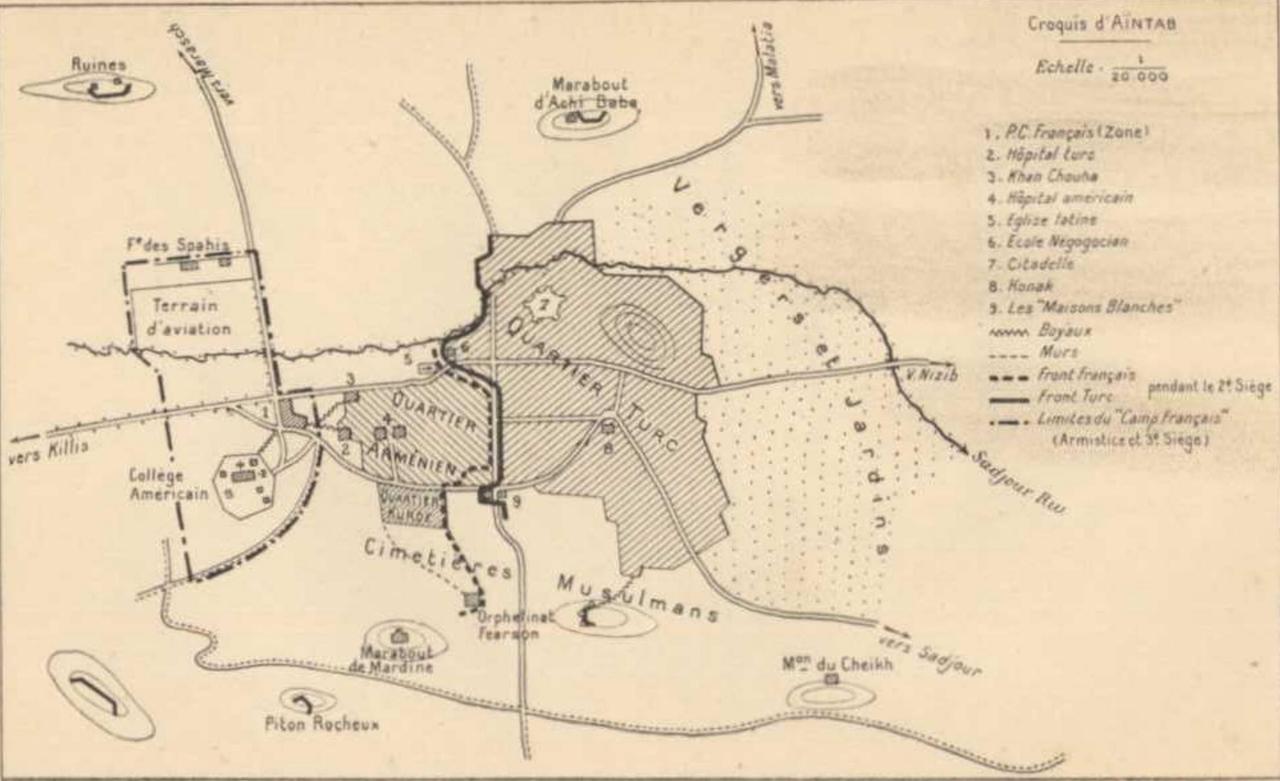
Antep Şehir Krokisi ve Kuşatma Cepheleri, 1922 (Webaram)
It was decided to bring General Goubeau’s Istanbul-based forces to Antep; a force of 7,500 men departed from Kilis on November 19, 1920, and reached Antep on November 21.【108】 The French occupied Hacıbaba, Çıksorut, and Kuşçudağı, cut telephone lines, dug trenches and laid barbed wire around the city, severing its external connections; this phase is referred to in sources as the “second siege.”【109】
According to Güner, on December 1, 1920, Goubeau sent Özdemir Bey a letter demanding acceptance of the French mandate, surrender of weapons and war materials, destruction of fortifications, and handover of specified individuals; Özdemir Bey rejected the proposal, stating that soldiers could not be considered prisoners of war, and Goubeau ordered the city’s bombardment on December 5.【110】
Under siege, the Antep Kuvâ-yı Milliye established its own arsenal on December 10 under the leadership of Lohânizade Mustafa Nureddin to address ammunition shortages.【111】 Goubeau’s forces departed Antep on December 18, 1920, to suppress the uprising in Aleppo; remaining French units continued the siege.【112】 On December 19–23, the 2nd Corps conducted a joint operation with the 5th and 9th Divisions without success; on December 27, at 6:00 a.m., a second operation brought troops within 200–300 meters of French positions, but heavy fire forced them to retreat, and no corridor for food delivery was opened.【113】
After the corps’ offensives failed, famine in Antep intensified from January 1, 1921; Can writes that in the city, where temperatures dropped to minus 13 degrees Celsius and snow reached 50–60 cm, food had nearly vanished for a population of 25,000; a telegram dated January 27, 1921, cited by Sevim and Saygılı, reported that the city had been cut off for seventy days and that sixteen thousand Muslims had even eaten dog meat.【114】 People wandered the streets searching for food; in some neighborhoods, cat meat was eaten, and dead horses and donkeys were immediately shared.【115】 Bread made from a mixture of bitter almond kernels was consumed for months; some people were poisoned from stored kernels, and the chief physician issued a report advising against its consumption.【116】
Heyet-i Merkeziye published a famine proclamation and sent postal pigeons to request aid from forces outside; the proclamation stated that aid must be delivered within three days.【117】 A needs list submitted to the Regional Command on November 20–21, 1920, indicated that 9,984 kilograms of wheat and 2,880 kilograms of barley were required daily for the civilian population; the list shows daily requirements, not existing stocks.【118】 On December 1, 1920, it was decided to collect all food in the city’s supply warehouses.【119】 On January 1, 1921, General Gouraud issued a call demanding implementation of the Sèvres Treaty, recognition of French administration, and handover of specified persons; the call was rejected.【120】
On January 18, 1921, the French marched from Akçakoyunlu to İkizkuyu; on January 19, a joint offensive by the 5th and 9th Divisions failed to achieve its goal, and on January 20, French reinforcement and supply units reached the existing French garrison in Antep.【121】 On January 25, the 2nd Corps Command launched its final offensive to deliver food to the city, but failed due to lack of full coordination between forces inside and outside.【122】 On the morning of January 30, 1921, the French attacked the Musullu front with three tanks; resistance with hand grenades was successful; when the detachment commander and tank operators were wounded, the tanks withdrew.【123】
That same night, a joint operation by the corps and Kuvâ-yı Milliye was thwarted when the French learned of the plan.【124】 Sevim and Saygılı write that during the January 30 night attack on Çıksorut, disagreement and lack of coordination occurred between the corps and resistance fighters; Selahattin Adil Bey sought to help the militias exit the city without risking them, while the resistance fighters aimed to break the siege and deliver food and ammunition.【125】 When bitter almond kernels used for bread production ran out, bakeries closed on February 2, 1921.【126】
Following correspondence between Heyet-i Merkeziye and the corps, it was decided that due to bombardment making the evacuation of the entire population impossible, priority would be given to evacuating Heyet-i Merkeziye members, police, gendarmerie, government officials, and prominent citizens.【127】 The planned evacuation for the night of February 4–5 could not be completed; in an order sent by Selahattin Adil Bey on the night of February 6–7, it was stated that if the siege line was not broken that night, no further aid from outside forces would be possible.【128】
A force composed of three companies of the Yıldırım Battalion and neighborhood fighters under Mustafa Fevzi Bey participated in the operation prepared along the Büyük Salavat and Perilikaya routes; on February 6, the first group of five officers and 450 soldiers successfully exited; on the night of February 7–8, approximately fifty soldiers escaped.【129】 Güner, in his account of the exodus beginning on February 6, writes that Şefik Özdemir Bey and government officials, led by Mehmet Çavuş and Elbistanlı Hoca, exited the city with a force of two hundred.【130】
After Özdemir Bey and government officials left the city, Heyet-i Merkeziye President Ferit Bey and city notables gathered at Şeyh Camii and concluded that surrender was the only option.【131】 On February 9, 1921, a delegation led by Interim Government President Dr. Mecid Bey went to the French headquarters and signed an 11-article surrender protocol with French forces represented by Colonel Abadie and Colonel Andrea; the protocol’s terms included Antep’s incorporation into the French mandate, classification of military units as prisoners of war, surrender of all weapons and war materials, and equal treatment of the population; the French mandate, first demanded by Goubeau in his December 1, 1920 letter, was the condition signed that day; it was not an independent provision regarding the region’s future international status.【132】 Çabuk and Ayata state that the surrender terms were signed at 10:00 a.m. on Wednesday, February 9, 1921, at the French headquarters.【133】 This date is taken as the official surrender date; whether February 8 was the actual day of the city’s fall remains debated among sources. Güner and Efe write that the city was captured by the French on February 8, 1921, while the surrender agreement was signed on February 9; Efe’s footnote cites a French document in the Ottoman Archives stating that the city fell on February 9.【134】 It is reported that during the resistance, approximately 8,000 of the city’s 10,000 homes were destroyed, around 6,000 people were killed, and an equal number were wounded.【135】
After the protocol, the French entered the city; the population surrendered 1,400 rifles, 10 machine guns, and approximately 70,000 rounds of ammunition to the French headquarters.【136】 A provisional government was established for the city, and Dr. Mecid Bey was appointed Mutasarrıf; the Yıldırım Battalion’s register was examined, and those identified as soldiers were imprisoned at Elbeylioğlu Hanı as prisoners of war; civilians were released after receiving identity cards.【137】 Heyet-i Merkeziye President Ferid Bey and some members, along with official personnel, were illegally arrested and imprisoned at the American College in violation of the surrender protocol.【138】
During the London Conference, on March 11, 1921, an agreement was signed between Foreign Minister Bekir Sami Bey and French Prime Minister Briand, deciding that Antep, Kilis, and Çukurova would be ceded to the Turks; the agreement was not ratified by the Ankara Government due to certain economic conditions.【139】 After the rejection of the London agreement, the Ankara Agreement signed on October 20, 1921, formally incorporated Antep into the Misak-ı Millî borders; the majority of French forces departed in November, and the last soldiers left the city on December 25, 1921; on the same day, the 59th Regiment under the Antep Regional Command entered the city.【140】
On February 8, 1921, the TBMM enacted Law No. 93 renaming the central town of Ayıntab livası as Gaziayntab; the law consisted of three articles, with the third making it effective upon publication.【141】 The bill (lâyihası) was dated February 3, 1921, and submitted by Minister of National Defense Fevzi Çakmak; the TBMM unanimously approved the title during its 147th session on February 8, 1921; the approval date differs from the effective date: the law became effective upon publication, not on February 8; according to TBMM records, it was published in the Official Gazette No. 5 dated March 7, 1921.【142】 Çabuk and Ayata also state that the title was granted by Law No. 93 on the February 8, 1921 meeting.【143】
The national press, supportive of the National Struggle, publicized events in Antep throughout the country and aimed to generate public opinion against the occupations.【144】 Only one copy each of the local newspapers Ayıntab Haberleri and Teminat have been identified; the February 11, 1919 issue of Rehnüma, published by the American College, was utilized; the December 26, 1918 issue of Ayıntab Haberleri reported the British arrival in the city, while Rehnüma published the British commander’s declaration announcing the occupation of Antep.【145】
Before the French occupation, the press played a role in announcing protests and rallies: the first news about Antep in İrâde-i Milliye was dated October 27, 1919, under the headline “A Grand Meeting in Ayıntab,” reporting that a meeting held on October 25, 1919, was attended by thirty thousand people; the attendance figure is the newspaper’s claim; this meeting was distinct from the November 23, 1919 Cemiyet-i İslamiye rally and the December 30, 1919 İstiklâl-i Osmanî Day demonstration.【146】
The Mehmet Kâmil incident was reported in newspapers without naming the victim, describing how a French soldier killed a young Muslim who tried to stop him from assaulting a Muslim woman; the outbreak of urban warfare was announced in the İrâde-i Milliye issue of April 22, 1920, reporting clashes within the city.【147】 In the post-August 1920 phase of the war, bombardments, December 1920 clashes, and the January 1921 raid on a French food convoy near İkizkuyu were covered in the press; Açıksöz published a telegram on January 10, 1921, stating that the Antep Mayor and representatives firmly rejected the mandate idea.【148】
Hâkimiyet-i Milliye published on February 7, 1921, one day before the law, Müfide Ferit’s article titled “Gazi Ayıntab,” comparing the resistance to the heroism of Plevna and Çanakkale; the huruç news was officially announced on February 9, 1921.【149】 After the surrender, the press reported on Antep’s situation under French administration, parliamentary speeches (March 6, 1921), the October–November 1921 Turkish–French agreement, and the entry of the Turkish army into the city on December 25, 1921 (İkdam, January 20, 1922).【150】
Başarır, Mehtap. “1921 Türk-Fransız Anlaşması ve Anadolu’da Barış Beklentileri.” *Selçuk Üniversitesi Türkiyat Araştırmaları Dergisi*, no. 57 (2023): 185–213.https://doi.org/10.21563/sutad.1285152.
Can, Mustafa. “Antep’in İşgali ve Kurtuluşu.” In *Millî Mücadele’nin Yerel Tarihi 1918–1923*, Volume 4, *Kahramanmaraş, Şanlıurfa, Kilis, Gaziantep, Hatay, Mersin, Osmaniye, Adana*, edited by Mustafa Göleç, Zeynep Kevser Şerefoğlu, and İlhami Danış, pp. 139–84. Ankara: Türkiye Bilimler Akademisi, 2024.https://doi.org/10.53478/TUBA.978-625-8352-66-5.ch05
Efe, Aydın. “Antep Savunması: Bir Albayın Hatıratı.” *Atatürk Üniversitesi Türkiyat Araştırmaları Enstitüsü Dergisi*, no. 53 (2015): 221–53.https://dergipark.org.tr/en/pub/ataunitaed/article/40146.
Güner, Zekai. “Antep Savunması ve Ali Şefik Özdemir Bey’in Faaliyetleri.” *ZKÜ Sosyal Bilimler Dergisi* 3, no. 6 (2007): 49–65.https://dergipark.org.tr/tr/pub/ijmeb/article/750762.
Sevim, Furkan Ali, and Hasip Saygılı. “Antep Savunmasında Şehrin Düşüşünde Albay Selahattin Adil Bey’in Rolü.” *Yedi Aralık Sosyal Araştırmalar Dergisi* 4, no. 2 (2025): 128–44.https://dergipark.org.tr/tr/pub/yasader/article/1770049.
Çabuk, Mustafa, and Deniz Ayata. “Antep Savunması ve Açlık.” *Hatay Mustafa Kemal Üniversitesi Sosyal Bilimler Enstitüsü Dergisi* 21, no. 53 (2024): 110–25.https://dergipark.org.tr/tr/pub/hmkusbed/article/1452993.
Çelebi, Onur. “Milli Mücadele Dönemi Basınına Göre Bekir Sami Bey’in İstifası ve Hükümet Değişikliği Meselesi.” *Avrasya Uluslararası Araştırmalar Dergisi* 11, no. 35 (2023): 906–30.https://doi.org/10.33692/avrasyad.1276173.
Üzüm, İsmail Hakkı. “Antep Savunmasının Millî Mücadele Dönemi Ulusal ve Yerel Basındaki Yansımaları Üzerine Bir Değerlendirme.” In *Millî Mücadele’nin Yerel Tarihi 1918–1923*, Volume 4, *Kahramanmaraş, Şanlıurfa, Kilis, Gaziantep, Hatay, Mersin, Osmaniye, Adana*, edited by Mustafa Göleç, Zeynep Kevser Şerefoğlu, and İlhami Danış, pp. 403–27. Ankara: Türkiye Bilimler Akademisi, 2024.
[1]
Mustafa Can, "Antep's Occupation and Liberation," in Local History of the National Struggle 1918–1923, Volume 4, Kahramanmaraş, Şanlıurfa, Kilis, Gaziantep, Hatay, Mersin, Osmaniye, Adana, ed. Mustafa Göleç, Zeynep Kevser Şerefoğlu, and İlhami Danış (Ankara: Türkiye Bilimler Akademisi, 2024), 155, 172. See also Aydın Efe, "The Defense of Antep: Memoirs of a Colonel," Atatürk University Journal of Turkish Studies, no. 53 (2015): 226; Mustafa Çabuk and Deniz Ayata, "The Defense of Antep and Famine," Journal of the Institute of Social Sciences, Hatay Mustafa Kemal University 21, no. 53 (2024): 110, 112.
[2]
Can, "Antep's Occupation," 149–55. For the beginning of urban warfare on April 1, 1920, see also İsmail Hakkı Üzüm, "Antep Savunmasının Millî Mücadele Dönemi Ulusal ve Yerel Basındaki Yansımaları Üzerine Bir Değerlendirme," Millî Mücadele'nin Yerel Tarihi 1918–1923, Volume 4, Kahramanmaraş, Şanlıurfa, Kilis, Gaziantep, Hatay, Mersin, Osmaniye, Adana, ed. Mustafa Göleç, Zeynep Kevser Şerefoğlu, and İlhami Danış (Ankara: Türkiye Bilimler Akademisi, 2024), 408; Zekai Güner, "Antep Savunması ve Ali Şefik Özdemir Bey'in Faaliyetleri," ZKÜ Sosyal Bilimler Dergisi 3, no. 6 (2007): 57.
[3]
Can, "The Occupation of Antep," 172. Also see Çabuk and Ayata, "The Defense of Antep and Famine," 121.
[4]
Can, "The Occupation of Antep," 174. Also see Efe, "Memoirs of a Colonel," 227; Çabuk and Ayata, "The Defense of Antep and Hunger," 121.
[5]
Can, "The Occupation of Antep," for distance to the 141st Katma, see Efe, "Memoirs of a Colonel," 223; for the Kilis–Antep highway, see Can, "The Occupation of Antep," 152, 173; for the Akçakoyunlu–Nafak Pass–İkizkuyu route, see Can, "The Occupation of Antep," 165, 170 and Çabuk and Ayata, "The Defense of Antep and Famine," 118; for the Maraş route (Pazarcık–Araptar), see Can, "The Occupation of Antep," 151–52; for the Nizip route, see Can, "The Occupation of Antep," 156–60. The characterization "Silk and Spice Routes" appears only in Can (Can, "The Occupation of Antep," 141) and is not used here to denote the routes.
[6]
Can, "Antep'in İşgali," 141.
[7]
Çabuk and Ayata, "Antep Savunması ve Açlık," 112. The authors provide the figure as the "city" population, based on Atay (2011); the scope of the figure is not specified, and it does not form a single series with the population figures in subsequent sections (August 1920 migration, January 1921).
[8]
Can, "The Occupation of Antep," see Efe, "Memoirs of a Colonel," 223; Çabuk and Ayata, "The Defense of Antep and Famine," 112; Sevim and Saygılı, "The Role of Selahattin Adil Bey," 132; Üzüm, "Its Reflections in the Press," 406.
[9]
Can, "Antep'in İşgali," 141.
[10]
Can, “Antep’s Occupation,” 141–42, 145. Three distinct events are mentioned in the passage: On December 17, 1918, British forces began moving from Aleppo toward Antep (Can, “Antep’s Occupation,” 141); Efe, Çabuk and Ayata, Sevim and Saygılı, and Üzüm also cite this date as the occupation date (Efe, “Memoirs of a Colonel,” 223; Çabuk and Ayata, “The Defense of Antep and Famine,” 112; Sevim and Saygılı, “The Role of Selahattin Adil Bey,” 132; Üzüm, “Reflections in the Press,” 406). January 1, 1919, marks the arrival in the city of approximately one hundred cavalrymen under Mac Donald’s command (Can, “Antep’s Occupation,” 142); Güner, however, writes in his text that the British detachment arriving from Aleppo to Kilis occupied Antep on January 1, 1919 (Güner, “The Activities of Ali Şefik Özdemir Bey,” 51). January 15, 1919, is the official announcement of occupation following the meeting on January 14 (Can, “Antep’s Occupation,” 142, 145); Güner also cites this date as the occupation date in his summary (Güner, “The Activities of Ali Şefik Özdemir Bey,” 49). Üzüm, relying on Rehnüma, reports the proclamation sent by General MacAndrew to the Mutasarrıflık on January 23, 1919 (Üzüm, “Reflections in the Press,” 410). Güner also notes on the same page that the Turkish War of Independence records the occupation date as December 17, 1918 (Güner, “The Activities of Ali Şefik Özdemir Bey,” 51).
[11]
Can, "Antep'in İşgali," 143.
[12]
Can, "Antep'in İşgali," 143.
[13]
Can, "Antep's Occupation," 144n24. Güner writes that martial law was declared on March 12. Güner, "The Activities of Ali Şefik Özdemir Bey," 51.
[14]
Can, "The Occupation of Antep," 144. Also see Çabuk and Ayata, "The Defense of Antep and Famine," 113.
[15]
Efe, "Bir Albayın Hatıratı," 232. İrfan Bey provides these figures with the phrase "as I recall." Efe, "Bir Albayın Hatıratı," 232. It is reported that John E. Merrill, director of the American College, informed the British that there were 26,000 weapons in Antep. Can, "Antep'in İşgali," 144.
[16]
Can, "Antep'in İşgali," 144.
[17]
Can, "Antep'in İşgali," 144–45.
[18]
Can writes that the occupation of Antep was carried out by the British for negotiations regarding Mosul (Efe, "Bir Albayın Hatıratı," 224); Sevim and Saygılı interpret the agreement as the implementation of the Sykes–Picot arrangement (Sevim and Saygılı, "Selahattin Adil Bey'in Rolü," 132–33); Çabuk and Ayata link the period to Mosul (Çabuk and Ayata, "Antep Savunması ve Açlık," 113); Güner does not mention any connection to Mosul. Since the sources offer different justifications for the period, this entry does not present the period as a singular, unilateral exchange.
[19]
Can, "The Occupation of Antep," 145. Also see Çabuk and Ayata, "The Defense of Antep and Famine," 113; Efe, "Memoirs of a Colonel," 227; Güner, "The Activities of Ali Şefik Özdemir Bey," 52.
[20]
Can, "The Occupation of Antep," 145; see Efe, "Memoirs of a Colonel," 225. The declaration of the period being effective from November 1 is also noted in Efe (Efe, "Memoirs of a Colonel," 225).
[21]
Can, "The Occupation of Antep," 146–47. For the October 25 rally, see Üzüm, "Its Reflections in the Press," 411 (İrâde-i Milliye, "A Grand Rally in Ayıntab," October 27, 1919, p. 2).
[22]
Can, "The Occupation of Antep," 146. Also see Üzüm, "Its Reflections in the Press," 411.
[23]
Can, "Antep'in İşgali," 147.
[24]
Can, "Antep'in İşgali," 148.
[25]
Can, "The Occupation of Antep," for the local press coverage of the 148th performance, see Üzüm, "Reflections in the Press," 412 (Rehnüma, January 1, 1920; Hâkimiyet-i Milliye, January 20, 1920).
[26]
Can, "Antep's Occupation," 148–49 (event, January 21, 1920, and child’s age). The event is also recounted by Güner and Üzüm; however, in these works, the father’s name is not provided (Güner, "Ali Şefik Özdemir Bey's Activities," 56; Üzüm, "Reflections in the Press," 407). The identity of the child’s father remains inconsistent across sources, and this entry does not present the father’s name as fact: Can identifies the child’s father as Ökkeş Ağa, citing only one footnote for this information (Can, "Antep's Occupation," 149n54). In Efe’s published memoirs, the event is described as "the spearing of my twelve-year-old son," and it is noted that Colonel Sainte Marie attended the condolence visit (Efe, "Memoirs of a Colonel," 233). The biography section of the same article states that İrfan Bey’s son, Ahmet Nüzhet, was born on July 1, 1917 (Efe, "Memoirs of a Colonel," 227); this record contradicts the memoir’s reference to "my twelve-year-old son." Efe does not explain this discrepancy and claims to have faithfully reproduced the memoirs "as they are" (Efe, "Memoirs of a Colonel," 223). The issue of the father’s identity has been treated separately and has been omitted from this entry due to unresolved ambiguity.
[27]
Can, "Antep'in İşgali," 149.
[28]
Can, "The Occupation of Antep," 149. The characterization "first actual resistance" is attributed to Can (Can, "The Occupation of Antep," 149).
[29]
Can links the origin of the 149th Güner Society to Maarif-i Mahalliye of 1895 (Güner, "Ali Şefik Özdemir Bey'in Faaliyetleri," 56).
[30]
Can, "Antep'in İşgali," 149.
[31]
Can, "Antep'in İşgali," 149.
[32]
Can, "Antep'in İşgali," 149–50.
[33]
Can notes that between the announcement date (October 23) and the official founding date (November 23), the organization operated “secretly,” and was formally established on November 23 with Sabri Bey’s appointment as Acting Mutasarrıf; in Can’s account, the subject is the “society,” and Sabri Bey is already referred to as Acting Mutasarrıf in the October 30 meeting (Can, "Antep'in İşgali," 145, 150). Güner writes that a small Heyet-i Merkeziye was formed to avoid exposure (Güner, "Ali Şefik Özdemir Bey'in Faaliyetleri," 56); Efe mentions a secret society and a committee that met at night (Efe, "Bir Albayın Hatıratı," 231). The November 23 rally is described as organized by Cemiyet-i İslamiye, while the December 30 demonstration is attributed to Heyet-i Merkeziye (Can, "Antep'in İşgali," 147–49).
[34]
Can writes that in the defense of Antep, each neighborhood’s roster consisted of one hundred people; those armed would fight, while the unarmed would remain in reserve to replace the wounded or dead; however, he does not provide separate figures for the number of armed and unarmed members (Can, "Antep'in İşgali," 150).
[35]
Can, "Antep'in İşgali," 150.
[36]
Can, "Antep'in İşgali," 150.
[37]
Can, "Antep'in İşgali," 150–51.
[38]
Can, "Antep'in İşgali," 151.
[39]
Efe, "Bir Albayın Hatıratı," 232–33.
[40]
Can, "Antep'in İşgali," 151.
[41]
Can, "Antep'in İşgali," 151.
[42]
Can, "The Occupation of Antep," 151. Can does not add a separate footnote to this sentence; the Üzüm incident is described as morning mist (Üzüm, "Reflections of the Press," 415), while Efe links it to January 13 under the name "The Great Arab Incident" (Efe, "Memoirs of a Colonel," 233).
[43]
Can, "The Occupation of Antep," is described as being established in response to the French demand (Can, "The Occupation of Antep," 151).
[44]
Can, "The Occupation of Antep," 151n71. Can bases his account on a document from the Ottoman Archives (BOA, HR.SYS 2544-17) (Can, "Antep'in İşgali," 151n71).
[45]
Can, "Antep'in İşgali," 151–52. In the same section, Can also mentions a unit under the command of Lieutenant Fenis and a munitions convoy (Can, "Antep'in İşgali," 151); the raid on the cavalry unit is related to a detachment sent to disperse the militias in Pazarcık (Can, "Antep'in İşgali," 152). Efe writes that an entire "supply column" traveling from Antep to Maraş was completely destroyed (Efe, "Bir Albayın Hatıratı," 233), and that a transport column was destroyed with 14 guards killed (Üzüm, "Basındaki Yansımaları," 408, 415). Can does not clarify which unit the numbers refer to.
[46]
Efe, "Bir Albayın Hatıratı," 233.
[47]
Can, "The Occupation of Antep," 152. Also see Güner, "The Activities of Ali Şefik Özdemir Bey," 56; Üzüm, "Its Reflections in the Press," 408; Efe, "Memoirs of a Colonel," 233n45.
[48]
Can, "Antep's Occupation," 152. Güner writes that upon Üzüm and Efe’s submission to the Central Committee of Şahin Bey, he became the Commander of the Kilis Road National Forces (Güner, "Ali Şefik Özdemir Bey's Activities," 56; Üzüm, "Reflections in the Press," 408; Efe, "Memoirs of a Colonel," 233n45). The date of appointment is not provided in the sources.
[49]
Efe notes that Şahin was a pseudonym used during the Kilis Road battles, gives his birth year as 1877 (H. 1293), and states that it appears as 1871 in Pamuk. Efe, "Bir Albayın Hatıratı," 233n45.
[50]
Can, "Antep'in İşgali," 153.
[51]
Can, "Antep'in İşgali," 153.
[52]
Can writes that Efe, “Antep’s Occupation,” p. 153, states that Şahin Bey held the Kilis–Antep road until March 28, 1920. Efe, “Memoirs of a Colonel,” p. 233n45. Can refers to Andrea as a Major during the events of March 26, but as a Colonel in the subsequent narrative; both Çabuk and Ayata, as well as Efe, refer to him as Colonel (Kolonel). Can, “Antep’s Occupation,” pp. 153–54; Çabuk and Ayata, “The Defense of Antep and Hunger,” p. 114; Efe, “Memoirs of a Colonel,” p. 245. The date of Şahin Bey’s death is recorded as March 27 in Üzüm (“Reflections in the Press,” p. 408) and as March 26 in Güner (“he had been shot for three days”) (Güner, “Activities of Ali Şefik Özdemir Bey,” p. 57).
[53]
Can, "Antep'in İşgali," 154. Can also notes that Kılıç Ali was in the vicinity of Burç and Küçük Kızılhisar before April 4 (Can, "Antep'in İşgali," 154).
[54]
Can, "Antep'in İşgali," 154.
[55]
Can, "Antep'in İşgali," 154.
[56]
Can, "Antep's Occupation," 154–55 (Can recounts this account from Saral and Lohânizade). For İrfan Bey’s account, see Efe, "Memoirs of a Colonel," 235; Güner does not specify who initiated the beginning (Güner, "Activities of Ali Şefik Özdemir Bey," 57); Üzüm states, "War officially began within the city" (Üzüm, "Reflections in the Press," 408). The phrase "The Armenians opened fire" in Çabuk and Ayata refers to April 9 (Çabuk and Ayata, "The Defense of Antep and Hunger," 114).
[57]
Can, "Antep'in İşgali," 155.
[58]
Can, "Antep'in İşgali," 155.
[59]
Can, "The Occupation of Antep," 155. Also see Güner, "The Activities of Ali Şefik Özdemir Bey," 57; Çabuk and Ayata, "The Defense of Antep and Famine," 113–14.
[60]
Can, "The Occupation of Antep," 155. Also see Güner, "The Activities of Ali Şefik Özdemir Bey," 57; Çabuk and Ayata, "The Defense of Antep and Famine," 114.
[61]
Can writes that each of the four battalions, consisting of fifteen armed soldiers per “four hundred strong” battalion, was present (Can, "Antep'in İşgali," 156). This amounts to sixty armed men per battalion; however, Can does not provide the total, and this number should not be equated with the actual forces engaged in combat.
[62]
Can, "The Occupation of Antep," 156 (interview where Merrill was present); for Kılıç Ali’s statement to the Armenians, see Can, "The Occupation of Antep," 154. For elderly and young members of the Armenian council, see Çabuk and Ayata, "The Defense of Antep and Hunger," 114. Can also reports that in June, the Armenian community council decided to get along with the Turks and not assist the French (Can, "The Occupation of Antep," 163).
[63]
Can, “Antep’s Occupation,” 161 (“4 April–12 May: 39 days” duration of participation in the defense of Antep); for Kılıç Ali’s arrival in the city on April 4, see Can, “Antep’s Occupation,” 155; for his absence outside the city on April 16–17, see Can, “Antep’s Occupation,” 157–58. The expressions “took over as代理” for Kilisli Arslan Bey, “assumed command” for Hamdi Bey, and “became commander” for Recep Bey are used (Can, “Antep’s Occupation,” 161). Efe writes that Hamdi Bey fell ill and departed (Efe, “Memoirs of a Colonel,” 235). Çabuk and Ayata provide conflicting dates for Kılıç Ali’s departure—sometimes as April 11, elsewhere as May 12 or May 11—thus these dates are not adopted as authoritative. Çabuk and Ayata, “The Defense of Antep and Famine,” 114–15.
[64]
Can, "The Occupation of Antep," 161. For Emir, "The Occupation of Antep," 161.
[65]
Can, "Antep'in İşgali," 156.
[66]
Can, "Antep'in İşgali," 156–57.
[67]
Can, "Antep'in İşgali," 157.
[68]
Can, "Antep'in İşgali," 157.
[69]
Can, "Antep's Occupation," 157. It is also noted that Debieuvre’s forces numbered around 800. Can, "Antep's Occupation," 157n102. See also Çabuk and Ayata, "The Defense of Antep and Famine," 114; Güner, "The Activities of Ali Şefik Özdemir Bey," 57.
[70]
Can, "Antep'in İşgali," 157–58.
[71]
Can, "Antep'in İşgali," 158.
[72]
Can, "Antep'in İşgali," 158.
[73]
Can, "The Occupation of Antep," 158. Also see Çabuk and Ayata, "The Defense of Antep and Famine," 114.
[74]
Can, "Antep's Occupation," 158–59. Also see Çabuk and Ayata, "The Defense of Antep and Famine," 114; Güner, "The Activities of Ali Şefik Özdemir Bey," 57.
[75]
Can, "The Occupation of Antep," 159. Also see Çabuk and Ayata, "The Defense of Antep and Famine," 114; Güner, "The Activities of Ali Şefik Özdemir Bey," 57.
[76]
Can, "Antep'in İşgali," 159–60.
[77]
Can, "The Occupation of Antep," 160. Güner writes that attacks occurred against Kurbanbaba on April 30 and May 1, that direct clashes took place on May 2, and that no victory was achieved in the attack on May 3. Güner, "The Activities of Ali Şefik Özdemir Bey," 58. Also see Çabuk and Ayata, "The Defense of Antep and Famine," 114.
[78]
Can, "Antep'in İşgali," 160.
[79]
Can, "Antep'in İşgali," 160.
[80]
Can, "Antep'in İşgali," 161.
[81]
Can, "Antep'in İşgali," 161–62. Also see Efe, "Bir Albayın Hatıratı," 235; Çabuk and Ayata, "Antep Savunması ve Açlık," 115.
[82]
Can, "The Occupation of Antep," 162. Also see Çabuk and Ayata, "The Defense of Antep and Famine," 115.
[83]
Can, "Antep'in İşgali," 162n129.
[84]
Can, "The Occupation of Antep," 163. Also see Çabuk and Ayata, "The Defense of Antep and Famine," 116; Efe, "Memoirs of a Colonel," 236.
[85]
Can, "The Occupation of Antep," 163. Also see Efe, "Memoirs of a Colonel," 236.
[86]
Can, "The Occupation of Antep," 163. According to İrfan Bey, the evacuation of Kurbanbaba and Mardin Orphanage did not occur immediately after the announcement of the ceasefire, but on June 17–18 (Efe, "A Colonel's Memoirs," 242).
[87]
Efe, "Bir Albayın Hatıratı," 242–43. The telegram from the Presidency of the Grand National Assembly dated June 17 is also mentioned in the same section (Efe, "Bir Albayın Hatıratı," 243).
[88]
Can, "Antep's Occupation," 163–64: On May 28, the meeting between de Caix and Mustafa Kemal; for twenty days beginning May 30; General Gouraud’s proposal to extend the armistice until July 10; Mustafa Kemal Pasha’s order on June 17 to resume hostilities beginning June 18–19; the continuation of the armistice in Antep "by mutual consent until July 29." İrfan Bey also writes in his memoirs that despite the end of the truce period, peace in Antep remained undisturbed until the end of July (Efe, "Memoirs of a Colonel," 243–44). Çabuk and Ayata note that the armistice lasted between May 30 and June 18, and mention an attack on Akçakoyunlu on July 18 (Çabuk and Ayata, "The Defense of Antep and Famine," 116). Üzüm writes that the armistice was "extended until the end of July" (Üzüm, "Reflections in the Press," 417).
[89]
Can, "The Occupation of Antep," is based on the Council of Ministers decision dated June 26, 1920, assigning Selahattin Adil Bey; the appointment letter states that he was given command of the Adana Front "with the authority of Corps Commander." The unit, initially established as the Adana Corps, was later renamed the Second Corps after receiving support from two additional divisions. Sevim and Saygılı, "The Role of Selahattin Adil Bey," 134–35. Çabuk and Ayata date Selahattin Adil Bey’s arrival in Antep to July 27 (Çabuk and Ayata, "The Defense of Antep and Famine," 116).
[90]
Can, "Antep'in İşgali," 164.
[91]
Can, "Antep'in İşgali," 164–65.
[92]
Can, "Antep'in İşgali," 165.
[93]
Can, "The Occupation of Antep," 165. Çabuk and Ayata link the battle at Nafak Boğazı to August 10 and the complete siege of the city to August 11 (Çabuk and Ayata, "Antep Defense and Famine," 116).
[94]
Can links the command meeting to Irfan Bey’s absence from the city on August 9, and assigns Özdemir Bey’s appointment to the date “August 8, 1920” (Can, "Antep'in İşgali," 165n148); these two statements are inconsistent. Güner also gives the date of August 8 and writes that Özdemir arrived in Antep on June 2, 1920, by order of Mustafa Kemal Paşa (Güner, "Ali Şefik Özdemir Bey'in Faaliyetleri," 58). Çabuk and Ayata state that Özdemir Bey was elected by neighborhood heads and the Heyet-i Merkeziye; Andrea writes that Özdemir left on August 9 and that Irfan Bey met him on August 10, but provides no date for the election (Çabuk and Ayata, "Antep Savunması ve Açlık," 116–17). Therefore, the date of the command decision is inconsistent in the sources, and while no specific date is given in this section, it is stated that the decision was made before the August 11 ultimatum.
[95]
Güner, "Ali Şefik Özdemir Bey'in Faaliyetleri," 64.
[96]
Can, "Antep'in İşgali," 165–66.
[97]
Can, "Antep's Occupation," 166. Also see Güner, "Ali Şefik Özdemir Bey's Activities," 59; Çabuk and Ayata, "The Defense of Antep and Famine," 117.
[98]
Can, "The Occupation of Antep," 166. The text of the response is conveyed in sources with different wording: Çabuk and Ayata quote Özdemir as saying, "I cannot imagine any Turk entering under your flag. The people of Antep have accepted either death or saving their homeland as their guiding principle"; Güner, however, adds to this same phrase: "As long as a living human remains in Antep and the homeland is not utterly destroyed, the French army will not enter here under any circumstances." Çabuk and Ayata, "The Defense of Antep and Famine," 117; Güner, "The Activities of Ali Şefik Özdemir Bey," 59.
[99]
Can, "Antep'in İşgali," 166.
[100]
Çabuk ve Ayata, "Antep Savunması ve Açlık," 117.
[101]
Çabuk ve Ayata, "Antep Savunması ve Açlık," 117.
[102]
Can, "Antep'in İşgali," 167.
[103]
Can, "The Occupation of Antep," 167. Also see Güner, "The Activities of Ali Şefik Özdemir Bey," 59.
[104]
Can, "The Occupation of Antep," 167 (based on Can, Lohânizade, and Yakar–Pusat). These figures pertain to different dates and scopes and do not form a single population series: Çabuk and Ayata report approximately 80,000 for December 1918 (Çabuk and Ayata, "The Defense of Antep and Famine," 112); Can reports over 40,000 displaced and approximately 20,000 remaining residents by the end of August 1920 (Can, "The Occupation of Antep," 167); Sevim and Saygılı cite 22,000 civilians and 3,000 soldiers in a supply decision dated December 1, 1920 (Sevim and Saygılı, "The Role of Selahattin Adil Bey," 136); Can gives a population of 25,000 for January 1921 (Can, "The Occupation of Antep," 169), a figure corroborated by Güner (Güner, "The Activities of Ali Şefik Özdemir Bey," 61); while Çabuk and Ayata note in an undated study that provisions for 15,000 people were sufficient for only 15 days (Çabuk and Ayata, "The Defense of Antep and Famine," 119).
[105]
Can, "The Occupation of Antep," 167. Also see Güner, "The Activities of Ali Şefik Özdemir Bey," 60.
[106]
Can, "Antep'in İşgali," 167.
[107]
Can, "Antep'in İşgali," 167–68.
[108]
Can, "Antep's Occupation," 168. Can writes that when Goubeau’s forces joined the Antep garrison, their strength reached approximately 12,000. Can, "Antep's Occupation," 168n162. Güner, however, notes that the French forces surrounding Antep consisted of 13 infantry regiments, 4 field batteries, 5 mountain batteries, one each of 15.5-inch and 10.5-inch batteries, one aircraft, and some cavalry. Güner, "Activities of Ali Şefik Özdemir Bey," 60n2.
[109]
Can, in "The Occupation of Antep," describes this phase under the title "The French Second Siege of Antep," noting that by November 21, Antep had become "completely surrounded" (Can, "Antep'in İşgali," 168); Güner also states that the city was besieged "for the second time" (Güner, "Ali Şefik Özdemir Bey'in Faaliyetleri," 60); Çabuk and Ayata write that the siege ended on November 22 (Çabuk and Ayata, "Antep Savunması ve Açlık," 118). These sources do not regard the August encirclement as a separate siege; the three phases are listed separately in this section.
[110]
Güner, "Ali Şefik Özdemir Bey'in Faaliyetleri," 60–61.
[111]
Can, "Antep'in İşgali," 169.
[112]
Can, "The Occupation of Antep," see Güner, "Ali Şefik Özdemir Bey's Activities," 61; Çabuk and Ayata, "The Defense of Antep and Famine," 119.
[113]
Can, "Antep'in İşgali," 169.
[114]
Can writes, “Antep’s Occupation,” 169. Can states, “For a population of 25,000, there remained nothing left as food except about 25 kilograms,” while Güner writes, “For a population of 25,000, there remained 25 kilograms of rations” (Güner, “Ali Şefik Özdemir Bey’s Activities,” 61). The two sentences are nearly identical and cannot be considered independent corroboration; neither specifies what the number 25 kilograms measures (city-wide stock, a specific warehouse, or daily ration). Therefore, the figure “25 kilograms” has not been incorporated into the text; instead, starvation is described through concrete food supply records. Çabuk and Ayata mention nights with temperatures dropping to nearly 10 degrees below zero and snowfall of 40 cm, beginning on December 20 (Çabuk and Ayata, “The Defense of Antep and Famine,” 120); the figures of 13 degrees below zero and 50–60 cm of snow appear only in Can’s account. For the telegram dated January 27, 1921, see Sevim and Saygılı, “The Role of Selahattin Adil Bey,” 137.
[115]
Can, "The Occupation of Antep," 169. Also see Güner, "The Activities of Ali Şefik Özdemir Bey," 61; Çabuk and Ayata, "The Defense of Antep and Famine," 120.
[116]
Çabuk and Ayata, "Antep Savunması ve Açlık," 120. Also see Güner, "Ali Şefik Özdemir Bey'in Faaliyetleri," 61.
[117]
Can, "Antep's Occupation," 169–70. Also see Güner, "Activities of Ali Şefik Özdemir Bey," 61; Çabuk and Ayata, "The Defense of Antep and Famine," 120.
[118]
Çabuk ve Ayata, "Antep Savunması ve Açlık," 118. Aynı bölümde 2.920 personelin ihtiyacı da yazılıdır (Çabuk ve Ayata, "Antep Savunması ve Açlık," 118); liste günlük ihtiyaç kaydıdır, mevcut stok değildir.
[119]
Sevim and Saygılı, "The Role of Selahattin Adil Bey," 136. Çabuk and Ayata write that the military conscription quota was halved (Çabuk and Ayata, "The Defense of Antep and Famine," 119); Sevim and Saygılı, "The Role of Selahattin Adil Bey," 136, note that food from homes was collected in supply depots for a population of 22,000 civilians/3,000 soldiers. For the closure of bakeries on February 2, see Can, "The Occupation of Antep," 171; Çabuk and Ayata, "The Defense of Antep and Famine," 121.
[120]
Can, "Antep'in İşgali," 170.
[121]
Can, "The Occupation of Antep," 170. Can’s phrase “entered Antep” does not mean the city was captured; the Üzüm incident is described as an attack on a “food convoy” (Üzüm, "Reflections of the Press," 419). Çabuk and Ayata refer to the 5th Division’s assault at İkizkuyu on January 18 (Çabuk and Ayata, "The Defense of Antep and Hunger," 120–21).
[122]
Can, "Antep'in İşgali," 170.
[123]
Can, "The Occupation of Antep," 171. Also see Çabuk and Ayata, "The Defense of Antep and Famine," 121.
[124]
Can, "Antep'in İşgali," 171.
[125]
Sevim and Saygılı, "Selahattin Adil Bey'in Rolü," 135–36.
[126]
Can, "The Occupation of Antep," 171. Also see Çabuk and Ayata, "The Defense of Antep and Famine," 121.
[127]
Can, "The Occupation of Antep," 171. Also see Güner, "The Activities of Ali Şefik Özdemir Bey," 61; Çabuk and Ayata, "The Defense of Antep and Famine," 121.
[128]
Can, "The Occupation of Antep," 171. Also see Üzüm, "Reflections in the Press," 420.
[129]
Can, "Antep's Occupation," 171–72. Also see Güner, "The Activities of Ali Şefik Özdemir Bey," 61 (on February 6, five officers and 450 soldiers).
[130]
Güner, "Ali Şefik Özdemir Bey's Activities," 61; Can, "The Occupation of Antep," 172. Güner does not specify Özdemir's departure date.
[131]
Can, "Antep'in İşgali," 172.
[132]
Can does not provide the article numbers of Protocol 172; for the “French mandate” condition, see also Güner, "Ali Şefik Özdemir Bey's Activities," 59–60 (first condition in letter dated December 1, 1920). See also Efe, "Memoirs of a Colonel," 226; Güner, "Ali Şefik Özdemir Bey's Activities," 61; Çabuk and Ayata, "The Defense of Antep and Hunger," 121.
[133]
Çabuk ve Ayata, "Antep Savunması ve Açlık," 121.
[134]
Güner notes that Ali Şefik Özdemir Bey reported that Aintab was taken on February 8 and that the eleven-article surrender agreement was signed on February 9; additionally, in a footnote, he cites a French document from the Ottoman Archives (BOA, HR.SYS 2465/63) stating that Aintab fell on February 9, 1921 (Efe, "Bir Albayın Hatıratı," 226n21). Sevim and Saygılı designate February 8 as the date of occupation and February 9 as the official date of occupation (Sevim and Saygılı, "Selahattin Adil Bey'in Rolü," 138). Can, however, writes that it was only learned on February 8 that Özdemir Bey and government officials had left the city, and he dates the protocol to February 9 (Can, "Antep'in İşgali," 172).
[135]
Can, "Antep'in İşgali," 172. Can bases these figures on Hulusi Yetkin’s work *Gaziantep Tarihi ve Davaları*; no comparable total loss figure appears in other articles referenced in this study. Can, "Antep'in İşgali," 172n183.
[136]
Can, "Antep'in İşgali," 173.
[137]
Can, "Antep'in İşgali," 173.
[138]
Can, "Antep'in İşgali," 173.
[139]
Onur Çelebi, "The Resignation of Bekir Sami Bey and the Issue of Government Change According to the Press of the National Struggle Period," Avrasya Uluslararası Araştırma Dergisi 11, no. 35 (2023): 909; Mehtap Başarır, "The 1921 Turkish-French Agreement and Peace Expectations in Anatolia," Selçuk Türkiyat, no. 57 (2023): 188. Can links the agreement to the "London Conference of March 15, 1921" (Can, "Antep's Occupation," 174); this date has not been adopted. The Bekir Sami Bey–Briand agreement is dated March 11, 1921; the London Conference convened between February 21 and March 12, 1921. For the content of the agreement and its rejection in Ankara, see Başarır, 188; Çelebi, 909. The cession of Antep, Kilis, and Çukurova and the economic conditions are according to Can’s account.
[140]
Can, "The Occupation of Antep," 174; the rejection of the London Agreement by Ankara (see n. 148) and the Ankara Agreement of October 20, 1921 are separate diplomatic stages. Also see Efe, "Memoirs of a Colonel," 227; Çabuk and Ayata, "The Defense of Antep and Hunger," 121–22; Üzüm, "Its Reflections in the Press," 420–21.
[141]
Can, "The Occupation of Antep," 172. Also see Çabuk and Ayata, "The Defense of Antep and Famine," 121. Third article: "This law shall be effective from the date of its publication" (Can, "The Occupation of Antep," 172; Kavanin Mecmuası, vol. 1, p. 99).
[142]
The Grand National Assembly of Turkey Minutes, Session 1, Volume 8, 147th Session, February 8, 1337 (1921). The bill is dated February 3, 1337; the Council of Ministers approved it on February 2, and the Assembly accepted it “bilittifak” on February 8. The 145th Session was on February 5, and the 146th Session on February 7; February 6, 1921, was a Sunday, and no session was held that day. Efe writes that the proposal was submitted on February 6, accepted at the 147th meeting, and came into effect upon publication in the Official Gazette on February 8, 1921; he also notes that the name requested in the proposal was “Gaziantep” (Efe, “Bir Albayın Hatıratı,” 226–27). These dates contradict the official TBMM records. In the law text as reported by Can, the name is “Gaziayıntab” (Can, “Antep'in İşgali,” 172). According to its third article, the law’s entry into force depends on its publication date; the TBMM’s official record of the law lists its publication in Official Gazette No. 5, dated March 7, 1921.
[143]
Çabuk ve Ayata, "Antep Savunması ve Açlık," 121.
[144]
Üzüm, "Basındaki Yansımaları," 403.
[145]
Üzüm, "Basındaki Yansımaları," 410–11 (Ayıntab Haberleri, December 26, 1918; Rehnüma, p. 2, February 11, 1919, p. 1; sole copy of Teminat). Rehnüma also reported on the December 30 performance in its issue dated January 1, 1920 (p. 91) (Üzüm, "Basındaki Yansımaları," 412).
[146]
Üzüm, "Basındaki Yansımaları," 411 (İrâde-i Milliye, "Ayıntab'da Muazzam Bir Miting," p. 9, October 27, 1919, p. 2; the figure "30,000" appears at the bottom of the article). For the November 23 meeting, see Can, "Antep'in İşgali," 147, 149; for the December 30 demonstration, see Can, "Antep'in İşgali," 148 and Üzüm, "Basındaki Yansımaları," 412. Çabuk and Ayata present the statement signed by Mehmet Lütfi as having been issued "on behalf of the thirty-thousand-person meeting delegation" (Çabuk and Ayata, "Antep Savunması ve Açlık," 113); this indicates that the meetings were sometimes conflated in the sources.
[147]
Üzüm, "Basındaki Yansımaları," 416 (İrâde-i Milliye, 9 Şubat 1920, s. 4; Hâkimiyet-i Milliye, 11 Şubat 1920; İrâde-i Milliye, 22 Nisan 1920, s. 4).
[148]
Üzüm, "Basındaki Yansımaları," 417–19 (Açıksöz, "Kahraman Gazi Ayıntablıların Müracaatı," 10 Ocak 1921, s. 1; İkizkuyu haberi için Açıksöz, 24 ve 27 Ocak 1921). Üzüm, İkizkuyu olayını iki tabur komutasındaki bir erzak kafilesine yönelik taarruz olarak anar (Üzüm, "Basındaki Yansımaları," 419).
[149]
Üzüm, "Basındaki Yansımaları," 420 (Hâkimiyet-i Milliye, "Gazi Ayıntab," 7 Şubat 1921, s. 1; Hâkimiyet-i Milliye, "Tebliğ-i Resmi," 9 Şubat 1921, s. 2).
[150]
Üzüm, "Basındaki Yansımaları," 420–21 (Hâkimiyet-i Milliye, 6 Mart 1921 ve 2 Haziran 1921; Ekim–Kasım 1921 itilafname haberleri; İkdam, "Ayıntab Anavatana Kavuşurken," 20 Ocak 1922, s. 3).
Place | Antep (present-day Gaziantep) | ||||||||
|---|---|---|---|---|---|---|---|---|---|
Event | Armed resistance and siege | ||||||||
Type | Armed resistance and siege. | ||||||||
Date | 1 April 1920 – 9 February 1921 | ||||||||
Parties | Antep National Forces Cemiyet-i İslamiye Central Committee and 2nd Army units (5th and 9th Divisions) French occupation forces Armenian units in French ranks | ||||||||
Commanders | National forces: Şahin Bey, Kılıç Ali Bey, Yarbay İrfan Bey, Ali Şefik Özdemir Bey, Albay Selahattin Adil Bey French: Albay Flye Sainte Marie; Yarbay Abadie; Albay Andrea; Albay Normand; Albay Debieuvre; General Goubeau; General Gouraud (High Commissioner): French forces: Albay Flye Sainte Marie, Yarbay Abadie, Albay Andrea, Albay Normand, Albay Debieuvre, General Goubeau, General Gouraud | ||||||||
Forces | National: Planned cadre of 2,700 personnel from 27 neighborhoods (not number of armed fighters); Yıldırım and Şimşek battalions (each with four hundred men; each battalion composed of four companies of fifteen armed soldiers each, Can); approximately 2,000 combatants in the city by end of August 1920 (Can); 2,920 personnel listed in needs report of 20–21 November 1920 (Çabuk–Ayata); 22,000 civilians and 3,000 soldiers accounted for in supply records of 1 December 1920 (Sevim–Saygılı). French: Approximately 12,000 including Goubeau's 7,500-strong force and garrison together in November 1920 (Can). French: Approximately 12,000 including Goubeau's 7,500-strong force and garrison together in November 1920 (Can). | ||||||||
Outcome | Surrender of the city to French forces via the surrender protocol of 9 February 1921 | ||||||||
Casualties | Destruction of approximately 8,000 of 10,000 homes; approximately 6,000 dead and as many wounded | ||||||||
Subsequent Developments | Bestowal of the name Gaziayntab by Law No. 93 dated 8 February 1921, Ankara Treaty of 20 October 1921, French withdrawal on 25 December 1921 | ||||||||
Henüz Tartışma Girilmemiştir
"Defense of Antep" maddesi için tartışma başlatın
Background
British Occupation
French Occupation
The Mehmet Kâmil Incident
Organization of the Resistance
Cemiyet-i İslamiye
Heyet-i Merkeziye
Strategic Debate
Resistance Outside the City
Maraş Route
Kilis Route
Defense Inside the City
April 1
Kılıç Ali
First Siege (April 1920)
Mağarabaşı and Kurbanbaba
Akbaba and Sarımsaktepe
Armistice
Reestablishment of the Siege (August 1920–February 1921)
Nafak Pass
Özdemir Bey
Ultimatum
Bombardment and Migration
November Siege (Goubeau)
Famine
İkizkuyu and Final Offensives
Huruç
Surrender
Subsequent Developments
French Administration
Ankara Agreement
Gazi Title
Media Coverage