



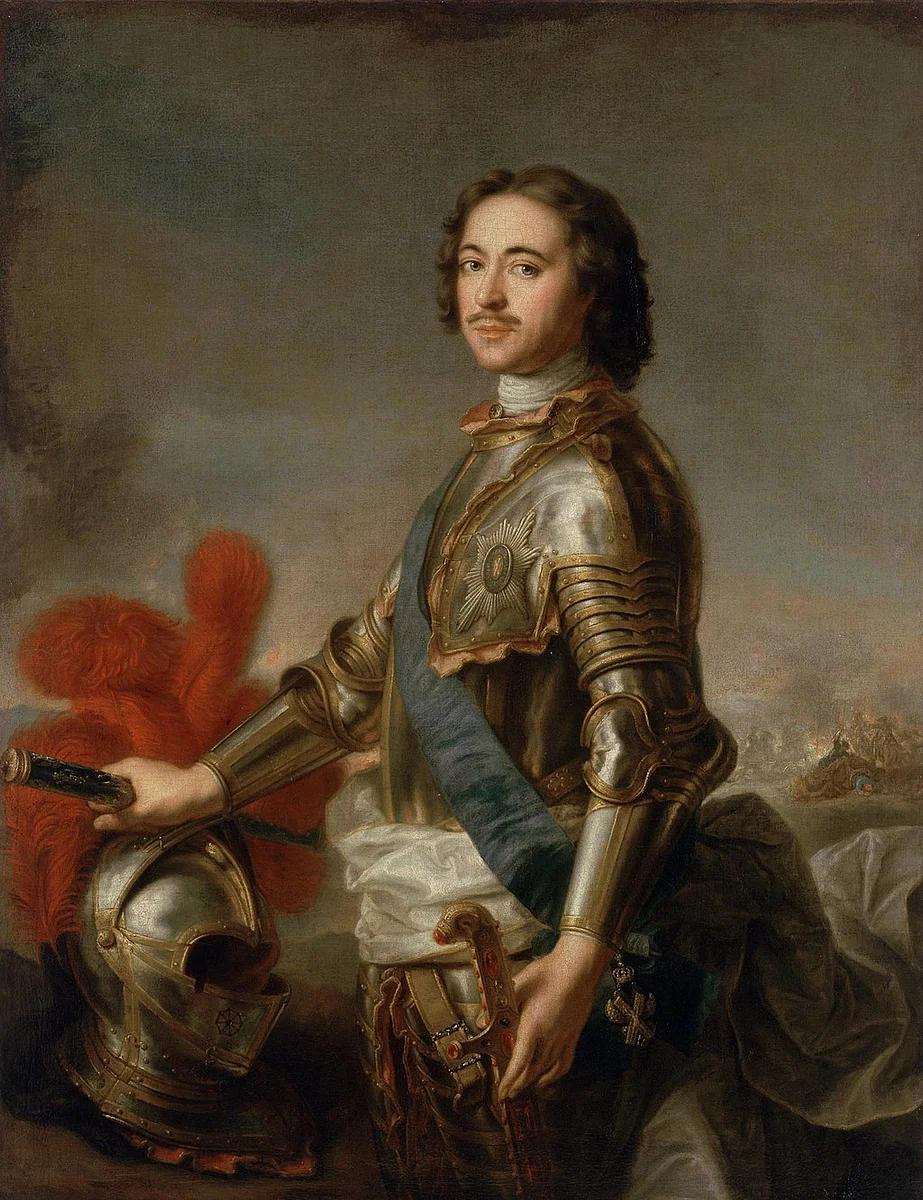
Peter, born on 9 June 1672, was a member of the Romanov dynasty, the son of Tsar Alexis II and the grandson of Alexis Mikhailovich. Peter’s childhood coincided with a turbulent period in Russian political history. After his father’s death, a struggle for the throne began, and although he was officially crowned in 1682, he was forced to share power for many years. In the early years, he was proclaimed tsar alongside his elder brother Ivan V, but real authority rested with his half-sister Sophia Alekseyevna, who acted as regent.
1689 marked a turning point for Peter. That year, he ended Sophia’s regency and seized real power. After the death of his brother Ivan V in 1696, he became the sole ruler of Russia, thereby opening the path for his ambitious program of Western-style reform and modernization.
Peter I, known as Peter the Great, is regarded as one of the most influential and transformative tsars in Russian history. His path to the throne was shaped by both family rivalries and the shifting power balances within Russia’s political structure. This process must be understood within the context of complex power struggles within the Romanov dynasty and the socio-political environment of the time.
With the death of Peter’s father, Tsar Alexis Mikhailovich, in 1676, a struggle for the throne began. Alexis’s eldest son by his first wife, Maria Miloslavskaya, Feodor III, ascended the throne. During Feodor’s brief reign (1676–1682), Peter had no direct political influence. However, Feodor’s death in 1682 without a direct heir thrust the young Peter into the center of political attention.
After Feodor’s death, the Miloslavsky family supported Peter’s elder half-brother, the frail and sickly Ivan V (Ivan Alekseyevich), while the Naryshkin family, Peter’s maternal kin, sought to place Peter on the throne. This rivalry intensified with the intervention of the Streltsy, Moscow’s elite guard units. In the uprising of 1682, the Streltsy attacked the Naryshkin family, killing many of its members. A compromise was eventually reached: Peter and Ivan were proclaimed co-tsars. However, real power remained in the hands of their sister Sophia Alekseyevna, Peter’s half-sister and regent.
Between 1682 and 1689, although Peter and Ivan held the title of tsar, state affairs were effectively managed by Sophia. Peter was removed from the Kremlin and lived with his mother in the village of Preobrazhenskoe. This distance shielded him from the intrigues of the traditional court and allowed him to build his own circle. Here, he formed his “play regiments,” which later became the foundation for the modernization of the Russian army.
In 1689, at the age of 17, Peter moved against the regency. A new conflict erupted between Sophia’s loyal Streltsy and Peter’s supporters. However, Peter succeeded in winning over the church hierarchy and the nobility, shifting the balance of power. Sophia was deposed and confined to a convent. Although Peter continued to share the title of tsar with Ivan, he became the de facto ruler of Russia. Upon Ivan’s death in 1696, Peter became the sole tsar of Russia.
Peter’s accession was far from a conventional dynastic succession. It involved a complex process in which two children ruled simultaneously, state administration was conducted by a regent, and military power played a decisive role. Peter secured his authority not through direct warfare but through patient accumulation of power and strategic maneuvers, offering early examples of his personality and political acumen.
Peter the Great (Peter I), who reigned from 1689 to 1725, played a foundational role in shaping modern Russia. His reforms brought profound changes not only in politics and the military but also in social, cultural, and economic spheres. His efforts lifted Russia out of its backwardness and transformed it into a power capable of competing with Western Europe.
Peter sought to free Russia from its old “Moscow mindset” and turn it into a European state. He imposed European techniques and lifestyles on Russian society. These reforms were implemented top-down and largely by force. Nevertheless, they proved influential in Russia’s long-term integration with the West. Symbolic practices such as the adoption of Western clothing and the mandatory shaving of beards formed part of the cultural dimension of these reforms.
Peter prioritized the army and navy above all else. He waged wars against the Ottoman Empire in 1695 and against Sweden in 1700. These conflicts heightened his need for a modern army and a strong navy. In response:
- Military academies were established to train professional officers.
- A new conscription system replaced the old feudal levies.
- A Baltic fleet was created: by the end of his reign, Russia had 48 warships and 787 rowing vessels.
Peter’s reforms were revolutionary in the economic sphere. Experts were brought from Europe to reorganize Russian industry and trade. During this period:
- State-owned factories were established.
- Mercantilist policies were adopted to protect domestic industry.
- Export of precious metals was banned.
- State loans were granted to private entrepreneurs.
Peter’s reforms extended into everyday life:
- Nobles were forced to adopt Western dress.
- Women were encouraged to participate more actively in social life.
- Education became compulsory; Western sciences and technologies were introduced.
- The calendar was reformed, and the New Year was moved to 1 January.
Peter undertook major changes to strengthen central authority:
- The Senate was established to modernize the decision-making process.
- Administrative units were reorganized, and colleges (ministry-like institutions) were created.
- Corruption was combated, and promotions based on merit were introduced.
One of Peter’s most distinctive traits was his determination to apply knowledge and observations gained from his European travels to Russia. His “Grand Embassy” (Velikoye Posolstvo) from 1697 to 1698 caused a fundamental shift in his worldview, giving him the opportunity to closely examine advanced technologies, administrative systems, and military structures in countries such as Holland, England, Austria, and Prussia.
Guided by these observations, Peter launched radical reforms aimed at transforming Russia into a Western-style state. His main reform areas were as follows:
1. Military and Naval Reforms: Peter dismantled the feudal-based irregular forces and established a modern regular army and a powerful navy. He was particularly influenced by British and Dutch models, aiming to secure Russian dominance in the Baltic Sea.
2. Administrative Reforms: He created a centralized bureaucracy, reorganized the provincial system, and established a consultative body modeled on the Senate. He also subordinated the church to state control, abolishing the patriarchate and replacing it with the Holy Synod, a state-supervised ecclesiastical council.
3. Social and Cultural Changes: Peter encouraged the adoption of Western clothing, banned the wearing of beards, and forcibly promoted European customs. The calendar was changed, balls and festivities were encouraged, and women’s participation in public life was promoted.
4. Economic and Industrial Development: Peter supported domestic industry, increased state-funded investments in mining and manufacturing, opened new mining facilities in the Ural Mountains, and implemented mercantilist policies to reduce imports and stimulate exports.
5. Educational Reforms: Students were sent abroad, and schools focused on science and technical education were established. During Peter’s reign, printing became widespread, and secular education was promoted.
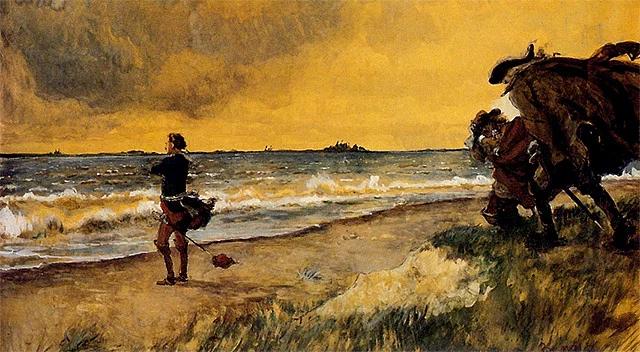
Peter contemplating the construction of St. Petersburg (World History Encyclopedia)
Peter’s relationship with the city of St. Petersburg was directly tied to his political and military objectives and represents one of the most significant urban initiatives in Russian history. Taking advantage of Sweden’s preoccupation with Poland and Livonia, Peter decided in 1703 to establish a strategic settlement at the mouth of the Neva River where it flows into the Baltic Sea. This area had previously been under Swedish control, centered on the fortress of Nöteborg. Peter captured the fortress, renamed it Schlüsselburg, and then resolved to build a new city at the river’s estuary.
Construction of the city began around the Petropavlovsk Fortress, whose foundation was laid on 16 May 1703. The new city was named St. Petersburg and quickly became one of Russia’s most important urban centers. To defend the city, the Kronstadt Fortress was built on Kotlin Island. With the founding of Petersburg, Peter aimed to integrate Russia more closely with the West through a port city that would serve as a gateway to Europe, implementing Western-style architecture and administrative systems there.
During the construction of Petersburg, hundreds of thousands of peasants were forcibly conscripted into labor, and many lost their lives. Yet Peter viewed these losses as a natural and unavoidable cost of creating a “New Russia.” The city became not only a military base but also a center of cultural reform, where architects, engineers, and administrators imported from the West were stationed.
Petersburg held economic, strategic, and ideological significance as Russia’s gateway to the Baltic Sea. Peter did not merely establish a new capital; he presented the Russian people with a vision of a future oriented toward Western civilization. In 1712, St. Petersburg was officially declared the capital of Russia, marking a decisive break from the traditional Moscow-centered structure.
Peter’s connection to Petersburg extended far beyond founding a city; it embodied his reformist identity, his desire to open Russia to the West, and his absolutist vision. Petersburg became the physical symbol of Peter the Great’s ideological and political legacy.
Peter the Great’s military career and wars were inseparable from his goal of transforming Russia from a backward land empire into a maritime power among the great European states.
Shortly after seizing power in 1689, Peter’s first major military initiative was the Azov Campaigns against the Ottoman Empire. The capture of the strategically located Azov Fortress, where the Don River meets the sea, marked the first step in Peter’s strategy to gain access to warm-water ports. The first campaign failed, but in 1696 Peter succeeded in capturing the fortress. This victory triggered the establishment of Russia’s first navy and became a turning point in the development of its naval power.
The most challenging phase of Peter’s military career was the Great Northern War against King Charles XII of Sweden. Beginning in 1700, this war ended Sweden’s status as a major European power and established Russia as the new dominant force in the Baltic region. Peter suffered a heavy defeat at the Battle of Narva. However, he quickly modernized his army, established disciplined units, and compensated for this loss through strategic victories. The decisive triumph came at the Battle of Poltava in 1709, where the Swedish army was decisively defeated, forcing Charles XII to seek refuge in Ottoman territory.
Following his successes in the Great Northern War, Peter demanded the return of Charles XII from Ottoman territory. When this demand was rejected, it led to the Pruth Campaign of 1711. However, this campaign turned into a disaster for Peter. Surrounded by the Ottoman army on the banks of the Pruth River, Peter and his forces faced grave danger. A peace treaty was eventually signed, forcing Peter to return Azov Fortress and abandon his dream of access to the Black Sea.
Peter developed his military skills through the “play regiments” he formed in his youth. These units gradually evolved into serious training centers for military maneuvers. With the help of advisors such as the Scotsman Gordon and the Swiss Lefort, Peter introduced modern Western military practices into the Russian army. He replaced the outdated Streltsy units with modern musket-armed infantry and strengthened military discipline.
Peter understood the central role of naval power in international power dynamics. After the Azov campaigns, naval construction became state policy. With the founding of St. Petersburg, a permanent and powerful naval base was established on the Baltic coast. The Kronstadt Harbor was built, and from there, Russian expeditions secured dominance over the Baltic Sea. This was the cornerstone of Peter’s policy to gain access to warm-water seas.
Peter applied brutal methods against rebellions. His harsh suppression of the Streltsy uprising strengthened his authority. His interventions in Poland further increased Russian influence, eventually positioning him as one of the central figures in European power politics.
Peter’s military career highlighted not only his role as a warrior but also as a strategist and statesman who transformed military institutions. His victories over Sweden, defeats against the Ottomans, and successes in building a navy defined his place not only in Russian but also in European history. His military effectiveness laid the foundation for his political reforms and elevated Russia to the status of an empire.
The core of Peter’s personality was his ideal of Westernization. After his travels to Europe, Peter became intimately familiar with European lifestyles and technological advances and believed that Russia’s backwardness could only be overcome through comprehensive social, administrative, and military reforms. He advocated a radical departure from traditional Russian customs. His strong interest in technical sciences and maritime knowledge reflected his intellectual curiosity and practical intelligence.
When implementing reforms, Peter favored harsh and authoritarian methods over gentle persuasion. His governance style was shaped by the belief that any means were justified to achieve his goals.
One of Peter’s most prominent personality traits was his high energy and determination. He was a leader who clearly articulated his objectives. He gathered around him individuals who shared his energy and innovative spirit, enabling him to implement his reforms more rapidly.
Peter’s close relationships with Europeans during his childhood enabled him to acquire military technical knowledge. This expertise laid the foundation for the modern Russian army he later created. His interest in mathematics, fortification, and navigation transformed him into a military technician and a hands-on leader.
Peter’s Westernization policy was a transformation aimed not at the broader population but at a small administrative elite. He sought to implement Westernization not as a popular demand but through top-down coercion.
Peter’s personality and governance style showed similarities to Ivan the Terrible. Both leaders pursued expansionist foreign policies and employed punitive, centralized, and repressive measures in domestic administration.
Peter’s image among the people also shaped his legacy. His enthusiasm for Western lifestyles, dress, and customs was viewed by the populace as strange and repulsive. Even Ottoman sources referred to him as “Mad Peter,” reflecting his unconventional and harsh approach to governance.
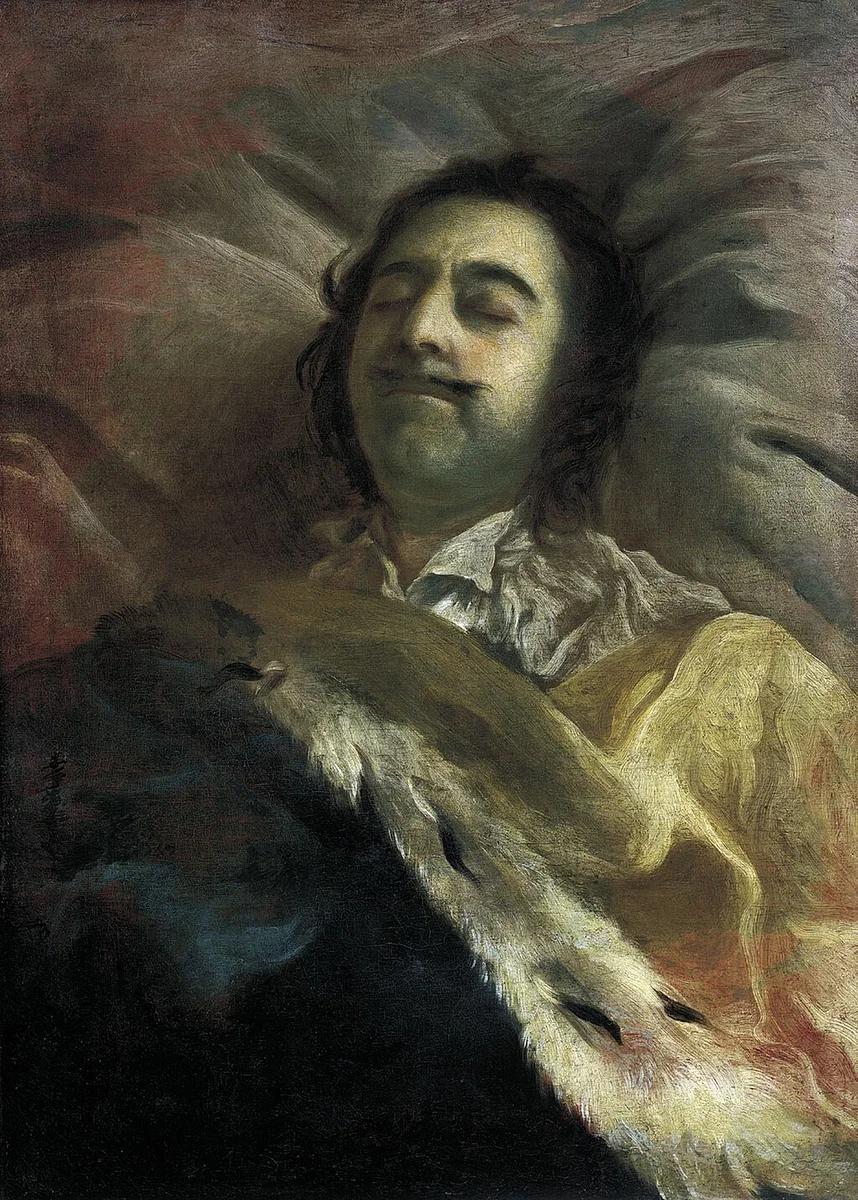
Peter on his deathbed
Known for his robust constitution and energetic nature, Peter used his physical strength to the very end of his life. However, his lifestyle—marked by excessive work, alcohol consumption, and a turbulent personal life—gradually took its toll. In the autumn of 1724, while rescuing several sailors from a sinking ship, Peter entered the cold waters of the Neva River in Petersburg and suffered severe hypothermia. He struggled with illness throughout the autumn and winter of 1725 and died on 28 January (8 February) 1725 at the age of only 53.
Before his death, Peter’s designated heir, his son Alexei, had died in 1718. Consequently, Peter enacted a new succession law stipulating that the monarch could choose his successor rather than automatically passing the throne to the eldest male heir. However, Peter died without naming a successor, triggering a serious succession crisis and weakening the stability of the succession system.
Peter’s later wife, Catherine Alekseyevna, had been formally proclaimed Empress in a coronation ceremony in 1724. After Peter’s death, she succeeded him as Russia’s first female ruler. This transition reflected Peter’s centralized, individual-based concept of power and demonstrated that women could also hold absolute authority in Russia.
Although Peter’s “path of European modernization” faced temporary setbacks after his death, its influence was never entirely erased. Peter had freed Russia from its old Moscow mindset and transformed it into a European-style state, implementing major reforms in industry, the military, administration, and culture. His transformation efforts were closely observed by many European monarchs, some of whom even emulated them.
Peter is remembered as a stern yet forward-looking leader who brought Western technological and cultural achievements to his country and forcibly modernized his people to achieve this goal. The impact of Peter’s policies extended beyond military and bureaucratic spheres into the daily lives of ordinary Russians. He imposed European practices in areas ranging from clothing and education to gender relations and urban architecture.
Peter’s death was not merely the end of a great monarch; it marked the closing of an era. Those who followed either continued or distorted his reforms, but none left a mark as deep as his. Peter became a pivotal figure not only in Russian but also in the broader European process of modernization; even after his death, his ideas and practices continued to shape history.

Henüz Tartışma Girilmemiştir
"Deli Petro" maddesi için tartışma başlatın
The Accession of Peter the Great
The Death of Alexis Mikhailovich and the Succession Crisis
Double Tsardom and the Streltsy Uprising
The Regency Period: Childhood Tsardom Under Sophia’s Shadow
The 1689 Coup and Peter’s Sole Rule
Peter the Great’s Reform Era
Westernization Measures
Military Reforms
Economic Reforms
Social and Cultural Reforms
State and Bureaucratic Reforms
Modernization Efforts
The New Capital: St. Petersburg
Peter’s Military Life and Wars
Accession and Early Campaigns: The Azov Campaigns (1695–1696)
The Great Northern War (1700–1721): A Prolonged Struggle Against Sweden
The Pruth Campaign Against the Ottoman Empire (1711)
Military Reforms and the “Play Regiments”
Establishment of the Navy and Naval Power
Military Policy and Peter’s Reputation
Peter’s Personality Traits and Governance Style
Innovative and Reformist Mindset
Authoritarian and Harsh Governance
Dynamic and Determined Character
A Practical Leader with Military Technical Expertise
Imposing Westernization from Above
Similarities to Ivan the Terrible
Relationship with the People and Public Perception
Peter’s Death and His Global Impact
The Process of Peter’s Death
Succession Crisis
Catherine’s Accession
Impact in Russia and the World After His Death
Peter’s Historical Legacy