

Bu içerik Türkçe olarak yazılmış olup yapay zeka ile otomatik olarak İngilizceye çevrilmiştir.
+2 Daha
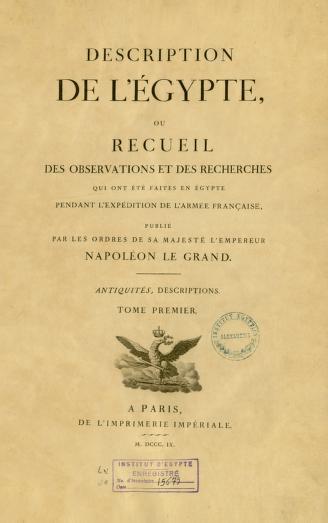
Description of Egypt
Preparing Institution | Institut d'Égypte (founded in Cairo in 1798 by order of Napoleon) | ||||||||
|---|---|---|---|---|---|---|---|---|---|
Preparers | Approximately 160 French scientists engineers artists and naturalists (savants) | ||||||||
Publication Period | 1809–1829 Paris | ||||||||
Purpose(s) | Scientific documentation of ancient and modern Egyptian culture nature and society | ||||||||
Scientific Importance | A foundational source for modern Egyptology and one of the principal works that fueled the 'Egyptomania' craze in Europe | ||||||||
Description de l’Égypte, is a multi-volume work that emerged during Napoleon Bonaparte’s 1798 expedition to Egypt and is regarded both as a monumental scientific discovery and as an instrument of Enlightenment-era imperialism. Published between 1809 and 1829, this work compiled extensive observations and drawings on ancient and modern Egyptian society, nature, and geography. Its full title, Description de l’Égypte, ou Recueil des observations et des recherches qui ont été faites en Égypte pendant l’expédition de l’Armée française, marks it as the West’s first systematic and comprehensive scientific inventory of Egypt.
The creation of the work was critically shaped by over 160 scientists, engineers, and artists who accompanied Napoleon to Egypt and were known as the “Commission des Sciences et des Arts.” Under the umbrella of the Institut d’Égypte, this team conducted systematic research on the country’s archaeology, geography, topography, fauna, and flora. The collected observations, notes, and drawings were prepared for publication after their return to France. Even after Napoleon’s fall from power, the project continued to receive support from the French state, and its first edition was published in 1809.
The first edition comprised 10 volumes of text, 885 plates, three geographical maps, and 47 topographical maps. A second edition, known as the “Royal Edition,” was produced during the Bourbon Restoration between 1821 and 1829. The visual dimension of the work encompasses a vast range of material—from cross-sections of pyramids to depictions of animal species along the Nile—and serves not only a scientific purpose but also functions as an aesthetic archive.
The work is structured into three main sections: “Antiquités” (Antiquities), “État moderne” (Modern State), and “Histoire naturelle” (Natural History). The “Antiquités” section systematically documents the architectural and epigraphic heritage of ancient Egypt. Pyramids, temple complexes, tomb chapels, and monumental statues are presented with plans, sections, and elevations, following principles of scaled measurement. Hieroglyphic and demotic inscriptions are reproduced in exact facsimile on the margins of the plates. This section includes detailed descriptions not only of the idealized appearances of monuments but also of wall construction techniques, block joints, column arrangements, and relief depths.
Sketches and measured drawings made in the field were standardized when transferred to copper plates in Paris, ensuring that many structures later damaged, altered, or rendered inaccessible retained their status as comparative “baseline data” for subsequent research. The environmental contexts of monumental buildings—their relationships with the Nile riverbanks and the placement of sacred spaces within the topography—are traceable in the sequence of plans. In this sense, “Antiquités” does not merely present Egyptian architecture as a formal catalog but claims to document it as part of a spatial network.

A Plate from Description de l’Égypte Library of Congress
The “État moderne” focuses on the material and spiritual culture of Egyptian society during the expedition years, shaped at the intersection of contemporary ethnographic sensitivities and colonial administrative needs. Drawings of urban fabric—street layouts, neighborhood typologies, relationships between bazaars, caravanserais, and külliyes, and interior domestic spaces—are read alongside clothing typologies and occupational descriptions. Economic processes such as the agricultural calendar, irrigation techniques, and craft production are linked in the texts to measurements, quantities, and seasonal cycles.
The impact of Nile floods on the economy and daily life is presented alongside proposals for administrative reforms, transforming description into a justification for regulation and “improvement.” Scenes of modern Egypt—from cafés and markets to rural weddings and handicrafts—reveal a broad visual repertoire, yet the narrative often reflects the European gaze’s desire for “ordering.” Local practices are dissected into observable and measurable elements compatible with French scientific rationality. Thus, the section provides both a social history archive and a discursive and visual reproduction of the era’s “civilizing mission.”

A Plate from Description de l’Égypte Library of Congress
The “Histoire naturelle” section covers flora, fauna, geology, and climate, exemplifying the Enlightenment language of classification and taxonomy. Plants are described using morphological criteria aligned with the Linnaean tradition; details of roots, stems, flowers, and fruits are presented with cross-sections and scale lines. The characteristic habitats of the Nile Delta and valley region, migratory bird routes, and wetland ecologies are staged in zoological plates to highlight species’ postures, plumage, and skeletal features.

A Plate from Description de l’Égypte Library of Congress
Critical perspectives emphasize that Description de l’Égypte was not merely a scientific achievement but also an imperialist project. According to Godlewska, the work constitutes “a constructed Egypt designed to replace Egypt itself.” Through engravings, maps, and texts, this fictional Egypt became detachable from the complexities of colonial relations, allowing it to be studied, appropriated, and reinterpreted within French libraries and laboratories.
Modern Islamic Egypt was largely excluded; the Ottoman and Mamluk periods were portrayed as a “barbaric interlude.” Modern Egyptians frequently appear as passive figures in the engravings, serving merely as background to the French scholars’ activities. This approach created a historical continuity that equated ancient Egypt with French civilization, thereby legitimizing French conquests on the grounds of cultural and scientific superiority.
Cartography and representation are among the work’s most significant dimensions. The maps were not merely tools for asserting geographical accuracy but were also used as primary instruments for the political and economic reconfiguration of Egypt. The excavation of the Suez Canal, the reconstruction of irrigation systems, and new dam projects were all grounded in these cartographic efforts. The adoption of Volney’s proposed transcription system, which replaced the Arabic alphabet with Latin letters, is interpreted as an intervention aimed at transforming language and identity.
This linguistic strategy is a concrete manifestation of radical orientalist thought that associated Arab culture with “backwardness.” The artists’ self-portrayal within sketches of ancient monuments further reflects this process of appropriation. French scholars are depicted in the engravings working directly on ancient ruins, visibly asserting their scientific and cultural authority over Egypt. Such scenes reinforced the impression that Europeans had a direct connection to ancient Egypt and had reappropriated this civilization as their own intellectual heritage.
Ultimately, Description de l’Égypte must be understood both as a meticulously compiled scientific record and as the product of an ideological construction. The work not only introduced ancient Egypt’s heritage to the West but also reimagined modern Egypt through a perspective that obscured its contemporary reality and emphasized French cultural superiority. Therefore, while its scientific contributions are significant, its colonial and ideological dimensions must also be acknowledged. This “invented Egypt” laid the foundation for the Western perception of ancient Egypt and has profoundly influenced Egypt’s modern historical identity.
Godlewska, Anne. “Map, Text and Image. The Mentality of Enlightened Conquerors: A New Look at the Description de l’Egypte.” *Transactions of the Institute of British Geographers* 20, no. 1 (1995): 5–28. Accessed August 16, 2025. https://doi.org/10.2307/622722
Library of Congress. Description de l’Égypte: ou, Recueil des observations et des recherches qui ont été faites en Égypte pendant l’expédition de l’armée française. Washington, D.C. Accessed August 16, 2025. https://www.loc.gov/item/2021666108/.
Linda Hall Library. “The Institute of Egypt.” Napoleon and the Scientific Expedition to Egypt. Accessed August 16, 2025. https://www.lindahall.org/experience/digital-exhibitions/napoleon-and-the-scientific-expedition-to-egypt/03-the-institute-of-egypt/
“The Institut d’Égypte and the Description de l’Égypte.” *Napoleon.org. History of the Two Empires – Articles. Fondation Napoléon.* Accessed August 16, 2025. https://www.napoleon.org/en/history-of-the-two-empires/articles/the-institut-degypte-and-the-description-de-legypte/.

Description of Egypt
Preparing Institution | Institut d'Égypte (founded in Cairo in 1798 by order of Napoleon) | ||||||||
|---|---|---|---|---|---|---|---|---|---|
Preparers | Approximately 160 French scientists engineers artists and naturalists (savants) | ||||||||
Publication Period | 1809–1829 Paris | ||||||||
Purpose(s) | Scientific documentation of ancient and modern Egyptian culture nature and society | ||||||||
Scientific Importance | A foundational source for modern Egyptology and one of the principal works that fueled the 'Egyptomania' craze in Europe | ||||||||
Henüz Tartışma Girilmemiştir
"Description of Egypt" maddesi için tartışma başlatın
Formation and Publication Process
Content and Sections
Place in the Scientific World and Critiques