


This article was automatically translated from the original Turkish version.
+2 More
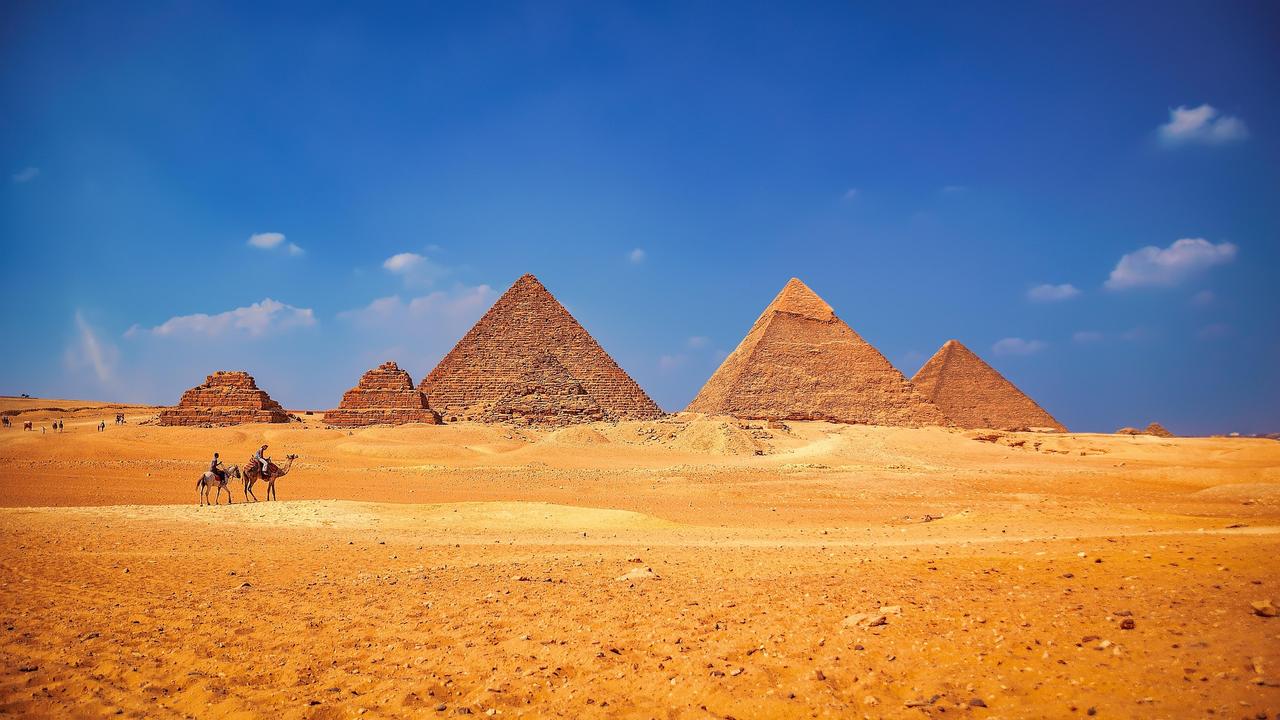
Egyptian Pyramids are monumental burial structures of ancient Egyptian civilization, constructed primarily during the Old Kingdom period (2686–2181 BCE) as sacred edifices prepared for pharaohs after death to ensure their passage to the afterlife. These structures evolved from earlier step-like tombs known as mastabas, progressing through stepped pyramids to the final form of smooth-sided geometric pyramids. One of the earliest and most complete examples is the Step Pyramid at Saqqara, built by Imhotep, the vizier of Pharaoh Djoser. The subsequent Pyramid of Khufu on the Giza plateau is among the largest stone structures in history, standing approximately 147 meters tall.
Pyramids were not merely tombs for rulers but also symbolic structures within the cosmic order. The three great pyramids at Giza (Khufu, Khafre, Menkaure) attract attention for both their structural complexity and astronomical alignments. Various theories have been proposed regarding their construction techniques, including hypotheses involving inclined ramps, crane systems, or in-situ casting methods. These pyramids are archaeological monuments reflecting the technological knowledge, religious beliefs, and political authority of ancient Egypt.

Egyptian Pyramids, Giza Plateau ()
The history of Egyptian pyramids extends back to the early 3rd millennium BCE. The tradition of pyramid construction began with mastaba-type tombs observed during the Early Dynastic Period (3100–2686 BCE) and reached its peak during the Old Kingdom (2686–2181 BCE). The Step Pyramid, recognized as the first large-scale stone structure, was built in the 27th century BCE for Pharaoh Djoser of the Third Dynasty. Designed by the architect Imhotep, it evolved from stacked mastabas and became the earliest representative of the pyramid form.
During the Fourth Dynasty (2613–2494 BCE), pyramid construction advanced technically and aesthetically, exemplified by the pyramids of Khufu, Khafre, and Menkaure. The Pyramid of Khufu, constructed approximately between 2551 and 2528 BCE, is a colossal structure estimated to consist of 2.3 million stone blocks and a volume exceeding 2.6 million cubic meters.
During the Middle and New Kingdom periods, the size of pyramids diminished, giving way to rock-cut tombs in the Theban region. This shift was influenced by security concerns and evolving religious practices. Although the pyramid-building tradition retained symbolic significance from the Late Period onward, large-scale constructions were replaced by more modest burial architectures.
Egyptian pyramids represent one of the architectural expressions of ancient Egyptian burial practices. These structures were typically built as tombs for pharaohs and high-ranking state officials.
The Pyramid of Saqqara is one of the first major architectural structures in ancient Egypt constructed from stone. Built in the 27th century BCE for Pharaoh Djoser of the Third Dynasty by the architect Imhotep, it is located in the Saqqara necropolis southwest of modern-day Cairo. Saqqara served as the burial ground for the city of Memphis and is rich in tomb structures from both early and late periods.
The pyramid’s original design was conceived as a single-level mastaba but evolved over time into a six-step structure through successive additions. It stands approximately 60 meters high with a base measuring 109 by 121 meters. The Saqqara Pyramid is regarded as the precursor to the smooth-sided pyramids that would follow in ancient Egypt, representing a new conceptual approach to burial both technically and ritually.
The Pyramid of Saqqara was not merely the tomb of the pharaoh but also the central structure of a complex where funeral rites and rituals related to the afterlife were performed. The pyramid was surrounded by high stone walls enclosing courtyards, ceremonial platforms, symbolic buildings, and temples. Beneath the surface lies a 5-kilometer-long network of corridors and a burial chamber. This architectural arrangement reflects the belief in the pharaoh’s continued existence in the afterlife.

Pyramid of Saqqara, Also Known as the Djoser Pyramid ()
Pharaoh Snefru of the Fourth Dynasty (26th century BCE) is regarded as a turning point in the development of pyramid architecture in ancient Egypt. During his reign, the first successful attempts at constructing smooth-sided pyramids were made, accompanied by various experimental building techniques. Three main pyramids commissioned by Snefru are located in the Dahshur and Meidum regions: the Meidum Pyramid, the Bent Pyramid, and the Red Pyramid.
Meidum Pyramid was likely initiated before Snefru’s reign but completed during his rule. Originally designed as a seven-step structure, it was later intended to be transformed into a smooth-sided pyramid. However, much of the structure has been damaged over time due to the collapse of its outer casing stones.
Bent Pyramid, located in Dahshur, represents the first full-scale attempt at a smooth-sided pyramid. However, the angle of inclination was reduced from approximately 54 degrees at the base to 43 degrees in the upper section, likely due to structural instability caused by the weight of the structure. This change resulted in the pyramid’s distinctive “bent” appearance. The structure reflects an intermediate form between stepped and smooth-sided pyramid concepts.

Bent Pyramid ()
Red Pyramid is considered the first successfully completed true smooth-sided pyramid built by Snefru. Standing approximately 105 meters tall, its name derives from the reddish limestone used in its outer casing. The construction of the Red Pyramid incorporated lessons learned from the structural problems encountered during the building of the Bent Pyramid. It served as a direct precursor to the Great Pyramid of Giza, commissioned by Khufu.
Snefru’s pyramids played a foundational role in the evolution of Egyptian pyramid construction, particularly in terms of architectural techniques and stonework. Each structure reflects distinct experimental approaches in the arrangement of stone blocks, slope calculations, and internal spatial design.
The Pyramid of Khufu (known in ancient Egypt as “Akhet Khufu”) was constructed during the Old Kingdom for Pharaoh Khufu of the Fourth Dynasty. Located on the Giza plateau, it is the largest of the ancient Egyptian pyramids and dates to approximately 2551–2528 BCE. Its original height was about 147 meters, with a base side length of 230 meters. Today it stands at 138 meters due to the removal of its outer casing stones over time.
The Pyramid of Khufu consists of approximately 2.3 million stone blocks. Most of these blocks are made of limestone quarried near Giza, while some larger stones used in interior chambers are granite brought from Aswan. The internal architecture includes three main chambers arranged around a central corridor: the King’s Chamber, the Queen’s Chamber, and the Subterranean Chamber. The King’s Chamber contains a granite sarcophagus with no lid. Additionally, two narrow, elongated ventilation shafts are present, believed to have both structural and symbolic functions.
The pyramid’s astronomical precision is remarkable. Its sides are aligned almost exactly with the cardinal directions of north, south, east, and west. The east and west sides deviate from true north by only three arcminutes, indicating a sophisticated knowledge of astronomy in ancient Egypt.
Many theories have been proposed regarding the construction techniques of the Pyramid of Khufu. The most widely accepted theory suggests that stone blocks were transported up inclined ramps. Alternative hypotheses propose spiral ramps, crane systems, or in-situ casting (geopolymer) methods. However, none of these hypotheses have been fully supported by archaeological evidence capable of explaining the entire construction process.

Pyramid of Khufu ()
The Pyramid of Khafre is the second-largest pyramid on the Giza plateau in Egypt and dates to the Old Kingdom period (2575–2150 BCE). Built for Pharaoh Khafre (also known as Chephren), it stands beside the Great Pyramid of his father Khufu. The pyramid has a base width of 215 meters and a height of 143.5 meters. Its subterranean King’s Chamber and above-ground Queen’s Chamber are accessed via a northern entrance containing two main passageways.
Remnants of the original limestone casing stones are still visible on the upper portion of the pyramid, indicating that it once had a bright, polished appearance. The base is constructed with red granite blocks. The pyramid’s foundation rests directly on the bedrock for stability. The northwestern corner was carved down by about 10 meters to create a flat surface, while the southeastern corner was reinforced with additional blocks.
The Pyramid of Khafre was deliberately positioned so that the pharaoh’s spirit could observe the rising and setting of the sun throughout the year. It is suggested that Khafre’s architects carefully selected its location to avoid casting shadows that would obstruct solar observations made from Khufu’s pyramid.

Pyramid of Khafre on the Left (Pexels)
The Pyramid of Menkaure (also known as Mykerinos) is the smallest of the three great pyramids on the Giza plateau. It was commissioned by Pharaoh Menkaure during the Fourth Dynasty of the Old Kingdom (2539–2511 BCE). It is situated close to the Great Pyramid (Pyramid of Khufu) and the Pyramid of Khafre. With a base width of 108 meters and a height of 65.5 meters, its internal King’s Chamber is smaller than those of the other pyramids.
The lower portion of the pyramid, approximately 15 meters high, is clad in red granite blocks sourced from quarries in Aswan. The upper sections were covered with fine white limestone, believed to have been quarried from Tura. An entrance is located on the north face at a height of about 4 meters above ground level, connected by a 30-meter-long inclined corridor leading to subterranean chambers. The burial chamber is entirely constructed from granite blocks and contains a dark gray sarcophagus.
Surrounding the pyramid are temples and monuments dedicated to Pharaoh Menkaure. Numerous small pyramids located near the main structure served as burial sites for Menkaure’s queens and close relatives.

Pyramid of Menkaure (Pexels)
Several theories exist regarding how the massive stone blocks were transported and positioned during pyramid construction. These theories help us understand the methods, engineering technologies, and labor organization employed by the ancient Egyptians. To lift multi-ton stone blocks hundreds of meters high, the Egyptians developed various inclined ramp systems essential for the efficient use of human labor.
Long earthen ramps extending perpendicularly from one face of the pyramid. Slope ratios cited in sources are typically 1:10 or 1:8. This was the classical theory proposed in the 19th century. Its advantages include simplicity and straightforward progression. However, as the pyramid rose, the ramp had to be continuously extended, leading to material and time waste. Such ramps could require lengths exceeding one kilometer.
Ramps ascending step by step parallel to the pyramid’s outer surfaces. According to Müller-Römer, these types of ramps were used especially from the time of Menkaure onward. These ramps could be constructed on one or several sides of the pyramid. Stone blocks were pulled upward on sledges, aided by cylinder winch systems—combinations of ropes, pulley cylinders, and cranks used to hoist blocks.
Ramps that were dismantled and rebuilt as each layer of the pyramid progressed. Once a level was completed, the ramp was removed and reconstructed on the next higher level. This approach reduced material waste and required less permanent space, but it caused time delays and posed structural stability challenges.
Ramps served not only for transporting stones but also as platforms and transit areas. For example, areas around ramps were used as sites for separating and processing stones before the completion of structures such as the Mortuary Temple.

Main Ramp Types (Generated by Artificial Intelligence.)
The materials used in the construction of ancient Egyptian pyramids varied according to their purpose, layer, and architectural position. Primary building materials include limestone, granite, basalt, mud mortar, wood, and, according to some alternative theories, geopolymer mixtures. The selection of materials in Egyptian pyramids was guided not only by durability and aesthetics but also by logistical and engineering considerations. Proximity to local sources, transportability, and workability were decisive factors.
Core blocks, quarried from nearby sites on the Giza plateau, have a coarse texture and medium density. They form the inner core of the pyramid structure. These stones are less refined and more irregular, with an average volume of 1–1.3 cubic meters and weights of approximately 2.5–3 tons.
Casing stones, sourced from the Tura quarries on the east bank of the Nile, are made of fine-grained, high-density limestone suitable for polishing. These smooth stones formed the outer surface of the pyramid. After placement, they were chiseled from top to bottom to achieve a seamless finish.
Granite was quarried from sites in Aswan in Upper Egypt. It was used for the burial chamber, passageways, plug blocks, and other specialized architectural elements. Granite is extremely hard and durable, with a reddish hue. Experimental studies indicate that granite was cut using copper saws combined with quartz sand.
Basalt was used for flooring, pathways, and some temple areas. It is believed to have been transported from volcanic regions near fault lines. It is dense, dark-colored, and resistant to cracking.
Wood was used in various applications, including sledges for transporting stones, platforms for ramps, and components for cranks and winches. The wood used was primarily Lebanese cedar, imported via the Nile Delta. Its straight grain provided high tensile strength, making it highly suitable for these purposes.
Mud mortar (Tafia) was used to fill gaps between stone blocks. Gypsum-based mortar was employed for more precise joints. In some areas, additives such as crushed seashells, stone dust, and natural cement components have been identified.

Materials Used in Pyramid Construction (Generated by Artificial Intelligence.)
The labor force used in pyramid construction was a highly organized, meticulously scheduled, and multi-layered system. Contrary to popular belief, pyramids were not built by slaves but by seasonal and skilled workers. This workforce was divided into specialized teams handling every stage of construction, from stone cutting and transport to placement.

Workers in Egyptian Pyramids (Generated by Artificial Intelligence.)
Modern archaeological findings have invalidated the traditional view that pyramids were built by slaves. The “Worker’s Village” discovered on the Giza plateau demonstrates that these structures were constructed by organized groups of laborers. These groups included farmers working during the Nile flood season, stone carvers, carpenters, metalworkers, and artisans, alongside master builders overseeing specific sections and scribes responsible for material tracking and labor coordination. As in other pyramid sites, construction on Giza was carried out by small, specialized teams.
The area known as Memphis and its Necropolis – the Pyramid Fields from Giza to Dahshur, located southwest of Egypt’s capital Cairo, was inscribed on the UNESCO World Heritage List in 1979. This area encompasses the regions of Giza, Abu Rawash, Abusir, Saqqara, Zawyet el-Aryan, and Dahshur.
According to UNESCO, this area contains “the earliest large-scale stone architecture in the world.” Over thirty-eight pyramids, more than 9,000 rock-cut tombs, temples, palace ruins, and mastabas in the region present an archaeological unity reflecting the social structure, religious beliefs, and royal cult of ancient Egypt. The pyramids of Khufu, Khafre, and Menkaure on the Giza plateau, along with the Great Sphinx, are the most renowned among these structures.
The ancient capital of Memphis and its surrounding necropolis demonstrate the political and religious center of ancient Egypt in terms of both architecture and urban planning. This area documents the evolution of burial architecture from the Old Kingdom through the Late Period. UNESCO has designated it as a cultural heritage of “outstanding universal value” and has placed it under protection as part of humanity’s shared heritage.
The pyramids inscribed on UNESCO’s World Heritage List are among the most important tourist attractions in Egypt. The pyramids of Khufu, Khafre, and Menkaure on the Giza plateau are visited by millions of tourists each year.
The Giza pyramid complex is open daily from 07:00 to 17:00. The Pyramid of Khufu is closed to visitors between 12:00 and 13:00, but the site can still be explored via horse-drawn carriages and camel rides.

Pyramid plateau tour by horse-drawn carriage (AA)
2H Media. “The pyramids of Giza, just outside Cairo JPG.” Unsplash. Accessed May 13, 2025. https://unsplash.com/photos/a-group-of-people-walking-around-a-pyramid-7_VPfRa073s
Aber, Jens. “Bent Pyramid, Badrshein, Egypt JPG.” Unsplash. Accessed May 13, 2025. https://unsplash.com/photos/a-large-pyramid-in-the-middle-of-a-desert-9z4u0boysOc
Accessed November 26, 2025.
Amelia Carolina Sparavigna. "Khufu, Khafre and Menkaure Pyramids and the Sun." Department of Applied Science and Technology, Politecnico di Torino, Italy. Accessed April 24, 2025. https://arxiv.org/pdf/1604.05963
Anadolu Ajansı. "Mısırda Turistlerin Çekim Noktası: Giza Piramitleri." Anadolu Ajansı. Accessed April 24, 2025.
Andrawes, Chris. “Cairo, Egypt JPG.” Unsplash. Accessed May 13, 2025. https://unsplash.com/photos/a-group-of-people-riding-horses-in-front-of-a-pyramid-75q9AxjIUr8
Ağaoğlu, Mert. "Mısır Mezar Mimarîsinin Kronolojik Olarak Geçirdiği Aşamalar." *Akademik Sosyal Araştırmalar Dergisi / The Journal of Social Sciences* 7, no. 47 (2020): 295–305. https://dx.doi.org/10.29228/SOBIDER.45497
B. Alekhya, J. Sree Naga Chaitanya, and Dr. K. Chandramouli. “A Study on Pyramids in Egypt.” *International Journal for Modern Trends in Science and Technology* 7, (2021): 267-273. https://www.researchgate.net/publication/353656168_A_Study_on_Pyramids_in_Egypt
Catherine BERGER and Bernard MATHIEU. l'Ancien Empire et la necropole de Saqqara. Paul Valery University, 1997. Accessed May 13, 2025.
Demortier, Guy. "Revisiting the Construction of the Egyptian Pyramids." *Europhysics News* 40, no. 1 (2009): 27–31. https://www.europhysicsnews.org/articles/epn/pdf/2009/01/epn20091p27.pdf
Dunham, Dows. "A New Consideration of the Construction Methods of the Ancient Egyptian Pyramids." Reprinted from ARCHAEOLOGY 9, No. 3 (956): 159-165.
Edwards, James Frederick. “Building the Great Pyramid: Probable Construction Methods Employed at Giza.” *Technology and Culture* 44, no. 2 (2003): 340–54. http://www.jstor.org/stable/25148110
Gürdilek, Raşit. "Piramitlerin Sırları." Bilim ve Teknik 33, no. 397 (2024): 24. Accessed April 24, 2025.
Müller-Römer, Frank. “A New Consideration of the Construction Methods of the Ancient Egyptian Pyramids.” *Journal of the American Research Center in Egypt* 44 (2008): 113–40. http://www.jstor.org/stable/27801624
Pexels. “Mısır'daki Giza Piramitlerinin Görkemli Görünümü JPG.” Pexels. Accessed May 19, 2025. https://www.pexels.com/tr-tr/fotograf/misir-daki-giza-piramitlerinin-gorkemli-gorunumu-29392784/
Pexels. “Mısır'ın Sahra çölü'Ndeki Piramit'te Deve Gezisi JPG.” Pexels. Accessed May 19, 2025. https://www.pexels.com/tr-tr/fotograf/misir-in-sahra-colu-ndeki-piramit-te-deve-gezisi-30661548/
UNESCO. "Memphis and its Necropolis – the Pyramid Fields from Giza to Dahshur." UNESCO World Heritage Convention. Accessed May 13, 2025. https://whc.unesco.org/en/list/86/
Zhodzishskii, Dmitrii. “Pyramid of Djoser (Step Pyramid) in Saqqara, Egypt JPG.” Unsplash. Accessed May 13, 2025. https://unsplash.com/photos/a-large-pyramid-in-the-middle-of-a-desert-Xyqoo7jSKvk
henryleester. "Manzara, Piramitler, Çöl görseli JPG." Pixabay. Accessed May 13, 2025. https://pixabay.com/tr/photos/manzara-piramitler-%C3%A7%C3%B6l-kum-an%C4%B1t-5584652/
Ünal Toktaş, "Keops Piramidi Üzerine," Accessed April 24, 2025.
Şimşek, Ali. “Antik Mısır’ın Anıtları.” Çömlek Arkeoloji E-Dergisi 9, no. 19 (March 2019): 5. https://mart.mersin.edu.tr/assets/files/C%CC%A7o%CC%88mlek%2019%20MART%20Arkeoloji%20E-Dergisi.pdf

History
Pyramids and Their Features
Pyramid of Saqqara
Snefru’s Pyramids
Pyramid of Khufu
Pyramid of Khafre
Pyramid of Menkaure
Construction Techniques of the Pyramids
Ramp Types
Linear (Straight) Ramps
Lateral Ramps
Modular Ramps (Temporary Removal and Rebuilding)
Ceremonial Platform Ramps
Materials Used in Pyramid Construction
Limestone
Core Blocks
Casing Stones
Granite
Basalt
Wood
Mortar and Binding Materials
Labor Force in Pyramid Construction
Worker Profile
Inclusion of the Pyramids on the UNESCO World Heritage List
Cultural Significance of the Pyramids
Tourist Information