
Bu içerik Türkçe olarak yazılmış olup yapay zeka ile otomatik olarak İngilizceye çevrilmiştir.
+2 Daha
Date(s) | 1953 April 4 | ||||||||
|---|---|---|---|---|---|---|---|---|---|
Place | near Nara Cape Dardanelles Strait | ||||||||
Parties | Swedish-flagged Naboland ferry TCG Dumlupınar submarine | ||||||||
Commander | Lt. Cmdr. Sabri Çelebioğlu | ||||||||
Victims | 81 martyrs (5 people survived) | ||||||||
Historical Significance | The third largest submarine disaster of the Republican era | ||||||||
Dumlupınar Disaster, a maritime accident that occurred on 4 April 1953 in the Dardanelles, resulting in the martyrdom of 81 naval officers. This tragedy arose from a collision between the Swedish-flagged vessel Naboland and the Turkish Navy’s submarine TCG Dumlupınar. It was not merely a technical maritime accident but also a national mourning and collective memory event. Notable among the major maritime disasters of the Republic era following the Refah (1941) and Atılay (1942) incidents, this event generated widespread reactions both in public opinion and at the highest levels of the state.
The name “Dumlupınar” was first given to a mine layer that entered the Turkish Navy in the 1930s. This first vessel was purchased from Italy and commissioned in 1931, though some sources list its commissioning date as 1932. This naval vessel, designed for mine laying and patrol duties, had a displacement of 930 tons on the surface and 1,216 tons submerged. Considered one of the most modern assets in the navy of that era, it became a symbol of Turkey’s efforts to strengthen its naval power during the early years of the Republic.
Documentary on the Dumlupınar Ship. (Noyan Şen)
The fate of the first Dumlupınar changed after an accident during a drill in the Black Sea. Near Haydarpaşa, a steering system malfunction caused the vessel to lose control and collide with a gas tanker. The collision inflicted serious damage on the ship and caused public concern. In an era with limited maritime technology, repairs and assessments concluded that the vessel could no longer perform active service.
Formally decommissioned in 1951, the first Dumlupınar, despite its brief service, secured a lasting place in Turkish maritime history. The name did not merely refer to a ship but also symbolized the Battle of Dumlupınar, one of the decisive victories of the National Struggle. Therefore, assigning this name to a second submarine joining the Turkish Navy was not coincidental but a clear manifestation of the will to unite national memory with naval tradition.
The second submarine to bear the name “Dumlupınar” in the Turkish Navy was originally an American-built warship. Constructed by the United States during World War II and originally named USS Blower, this submarine was laid down on 15 July 1943 at the Electric Boat Company shipyard in Groton, Connecticut. Built under the wartime production surge, it was launched on 23 April 1944 and commissioned into the U.S. Navy on 10 August 1944 with the hull number SS-325.
Interview with Dumlupınar Veterans (Kürşat Türkay)
USS Blower was designed and equipped for operations against Japan on the Pacific front of World War II. However, its misfortune was as striking as the harshness of the war environment. Shortly before its first mission, it collided with an American patrol vessel in fog and storm conditions, sustaining heavy damage and a large crack in its bow. As a result, it was immediately towed into dry dock for emergency repairs. Nevertheless, this incident did not remove it from active service; after repairs, it was sent to Pearl Harbor on 16 December 1944 and entered active duty.
During the war, USS Blower undertook strategic missions in the South China Sea and off Java, tracking enemy patrols and cutting communication lines. Despite its efforts, the submarine failed to achieve any significant combat success during World War II. Between 1946 and 1949, it performed various duties within the Pacific Fleet, but its military effectiveness remained limited. Especially after the war’s end, such submarines, ineffective in active combat, were quickly reassigned to secondary roles.
Within this historical context, USS Blower was regarded as a submarine with low combat success despite its wartime capabilities. However, in 1950, under military aid agreements between the U.S. and Türkiye, the vessel was transferred to the Turkish Navy and acquired a new identity and historical meaning. Upon joining the Turkish Navy, it was renamed TCG Dumlupınar and became a significant representative on both technological and symbolic levels.
The global security balance emerging after World War II and Türkiye’s accession to NATO in 1952 made modernization of the Turkish Armed Forces, particularly the naval forces, essential. In accordance with military aid agreements with the United States, the submarine USS Blower (SS-325) was selected for transfer to the Turkish Navy. On 16 November 1950, a formal ceremony was held at the U.S. Navy’s New London Submarine Base in Connecticut, during which the vessel was officially transferred to the Turkish Navy.

The Turkish Flag Being Raised on the Dumlupınar Submarine (Yaşar Semiz)
During the handover ceremony, the vessel was renamed “Dumlupınar,” hoisted the Turkish flag, and retained its SS-325 hull number. Under the same program, another submarine, the USS Bumper, was transferred from the U.S. and renamed “Çanakkale” with hull number 333, joining the Turkish Naval Forces inventory. Both vessels were handed over to Turkish officers and set sail toward the Mediterranean.
The submarine arrived in Türkiye on 19 December 1950 and was welcomed in Istanbul with a grand ceremony. The vessels anchored off Dolmabahçe, where they were saluted by gunfire from the battleship Yavuz, enhancing the symbolic importance of the occasion. The ceremony was attended by the then Commander of the Navy, Ridvan Koral; a representative of the U.S. Naval Aid Group, acting on behalf of Admiral Rees; members of parliament from Afyon and Çanakkale; mayors; and numerous military officials. The mayors of Afyon and Çanakkale presented silk flags to the two vessels, and a national ceremony consistent with maritime traditions was held.
This ceremony was not merely the commissioning of a new submarine but was also viewed as a concrete manifestation of Türkiye’s integration into the Atlantic defense system and its military cooperation with the Western bloc. The Turkish public welcomed the entry of this modern equipment as a significant advancement in the prestige of the naval forces. This new era in naval history became synonymous with the name Dumlupınar; the acquisition of a submarine with combat experience was regarded as a major event.
The second Dumlupınar, originally built in the U.S. as USS Blower, is a Balao-class submarine evolved from the Gato class. This class comprised long-range, durable submarines extensively used by the U.S. Navy for transoceanic operations during World War II. Dumlupınar was transferred to the Turkish Navy as one of the improved examples of this class after the war.
The submarine had a displacement of 1,825 tons on the surface and approximately 2,300 tons submerged when fully loaded. With a length of 95 meters and a beam of 9.25 meters, it possessed advanced capabilities in size and capacity by the standards of the era. Its propulsion system consisted of four diesel-electric motors, each rated at 1,625 horsepower. These engines enabled the submarine to reach speeds of 20–21 knots (approximately 37–39 km/h) on the surface and 10 knots (approximately 18 km/h) submerged. Additionally, it was equipped with a 2,700-horsepower electric motor for underwater propulsion and a 400-horsepower auxiliary motor.

Technical Specifications of Dumlupınar (Generated with AI Assistance)
Its fuel capacity was limited to a maximum of 300 tons of diesel oil, enabling it to travel approximately 12 nautical miles at a speed of 10 knots. These figures indicate that the submarine had a suitable range and operational flexibility for long-duration missions.
In terms of armament, Dumlupınar was equipped with ten torpedo tubes: six in the bow and four in the stern. These 533-millimeter tubes could launch both torpedoes and mines. The submarine carried a total of 24 torpedoes and could alternatively carry up to 40 naval mines. Thus, Dumlupınar was rendered versatile for both defensive and offensive submarine operations.
Another notable technical feature was its snorkel system, which enabled the diesel engines to operate without surfacing, allowing the submarine to remain submerged for longer durations. The snorkel system represented a technological advancement increasingly common in advanced submarines of the era, designed specifically to evade enemy radar detection.
Despite various technical issues experienced during and after the war, the equipment and performance capacity of Dumlupınar upon its integration into the Turkish Navy positioned it as a functional asset among active submarines. Its technical adequacy enabled its use in both training and exercise missions. However, due to limited modernization opportunities in the face of technological progress, its operational lifespan inevitably narrowed in subsequent years.
After joining the Turkish Naval Forces, the Dumlupınar submarine was actively used in various training and exercise missions. These missions aimed to enhance personnel technical proficiency and test the submarine’s performance under operational conditions. In this context, Dumlupınar participated not only in Turkish Navy exercises but also in multinational NATO exercises following Türkiye’s accession to the alliance.

The Dumlupınar Ship (Yaşar Semiz)
Shortly before the accident, from 13 to 26 March 1953, Dumlupınar participated in a NATO exercise in the Mediterranean named “Rendezvous.” During this mission, it conducted prolonged underwater maneuvers. As part of the “Blue Sea I” NATO naval operation, it operated in coordination with the U.S. Sixth Fleet. It was recorded that Dumlupınar remained submerged continuously for 24 hours during these exercises.
After the exercise, a decision was made to return the submarine to its home base, the Main Submarine Command at Gölcük. Although this return voyage was planned as a routine transit, it involved a route requiring careful evaluation of weather and sea conditions. Transits through congested, narrow, and current-heavy areas such as the Dardanelles demanded high levels of attention and coordination. Indeed, the area where the accident occurred, Nara Point, is described in maritime literature as a particularly challenging and hazardous location for maneuvering.

TCG Dumlupınar (Yaşar Semiz)
On its return journey, the Dumlupınar submarine was sailing alongside the I. İnönü submarine. Both submarines had completed their Mediterranean mission and were proceeding northward toward Istanbul in coordinated formation. On the night of 3 April 1953, at approximately 02:10, as Dumlupınar entered the Dardanelles and continued its course near Nara Point, it collided with the Swedish-flagged merchant vessel Naboland. This incident marked the end of its final voyage.
The collision struck the starboard side of Dumlupınar’s forward torpedo room. The force of the impact triggered a major explosion aboard the submarine, causing it to begin rapidly taking on water from the bow. Although some crew members managed to escape into the sea, communication with the crew trapped in the aft torpedo room was possible only briefly via the telephone buoy.
This incident is recorded in history as one of the most tragic voyages of the Republic-era Turkish navy. The tragedy, occurring during the return journey after completing training and exercise missions, signaled a complex maritime accident requiring evaluation of both technical and environmental factors.
In March 1953, the Dumlupınar submarine participated in a large-scale NATO exercise organized in the Mediterranean. This exercise, named “Rendezvous,” was significant as one of the first major naval maneuvers Türkiye joined after becoming a NATO member. It took place between 13 and 26 March 1953 and included a separate operational phase named “Blue Sea I.”

The Dumlupınar Ship Underway (Yaşar Semiz)
During this period, Dumlupınar operated as part of NATO’s multinational naval force alongside other Turkish units. The primary objective of the exercise was to enhance peacetime coordination and test interoperability under simulated wartime conditions. The Turkish Navy’s Dumlupınar participated in submarine operations in various areas of the Aegean and Mediterranean Seas in coordination with the U.S. Sixth Fleet.
It was recorded that Dumlupınar remained submerged continuously for 24 hours during the exercise, testing its technical and physical endurance. These drills, based on wartime scenarios, evaluated both crew coordination and the submarine’s operational capability. Official evaluation reports emphasized that, within the NATO doctrine of the time, the disciplined and cooperative structure of Türkiye’s naval forces was clearly demonstrated.
After the completion of the exercise, a decision was made to return Dumlupınar to its home base, the Gölcük Submarine Command. This return was planned as part of routine service. However, this ordinary transit would soon become a tragic turning point for both the crew and Turkish maritime history.
Having successfully completed the NATO exercise in the Mediterranean, the Dumlupınar submarine began its return journey on 1 April 1953. On board were 96 crew members: eight officers, 38 non-commissioned officers, and 50 enlisted personnel. The Commander of the Submarine Fleet, Vice Admiral Fahri Korutürk, was aboard the I. İnönü submarine, which sailed in formation with Dumlupınar as both vessels proceeded northward in coordinated fashion.

Map of the Accident Site (Yaşar Semiz)
On the night of 3 April, transitioning into 4 April, Dumlupınar entered the Dardanelles. Passage through the strait has always been considered risky for mariners due to natural and technical factors. The area around Nara Point, in particular, is known as a sensitive zone for maneuvering due to strong currents, a narrow passage, and variable visibility. The night of the accident was characterized by these natural conditions. Reports indicated limited visibility and localized dense fog.
In the final moments before the accident, Dumlupınar was maintaining a heading of 358 degrees toward Istanbul. At the same time, the Swedish-flagged Naboland cargo vessel was entering the Dardanelles from the south on a heading of 250 degrees. Although Captain Oscar Lorentzon of Naboland claimed his vessel was following navigation rules, the opposing courses of the two vessels near Nara Point increased the collision risk.

The Naboland Trawler Waiting at Shore After the Collision (Yaşar Semiz)
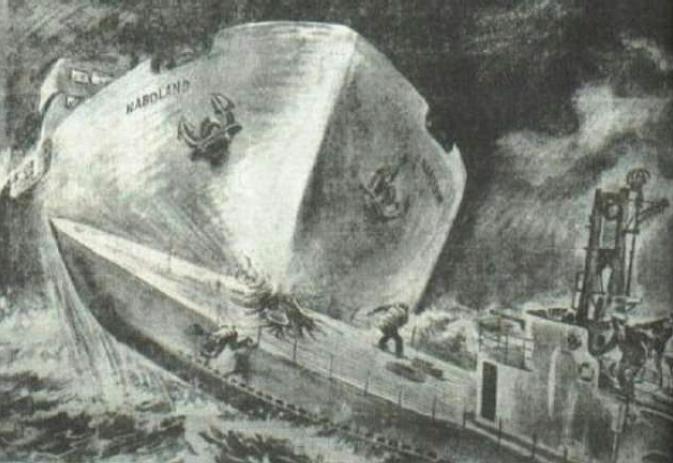
At approximately 02:10, the Dumlupınar submarine and the Naboland trawler met head-on near Nara Point. The trawler struck the starboard side of Dumlupınar’s forward torpedo room. This impact, devastating for the submarine due to its relatively weak bow structure, caused rapid flooding. The front section of Naboland also sustained serious damage, but its crew remained unharmed. The Dumlupınar crew, meanwhile, became scattered across the vessel and the sea surface.
Immediately after the collision, Naboland issued an emergency distress call via radio, specifying its location and the nature of the incident and requesting assistance from nearby naval units. Simultaneously, it turned its searchlights toward the sea, released phosphorescent life vests, and launched lifeboats to initiate rescue operations. This initial response enabled the rapid coordination of nearby Turkish naval units.
However, given the depth of the collision area and the strength of the currents, it quickly became apparent that the incident was not merely a physical collision but a serious submarine disaster. As Dumlupınar began to sink, both surface and underwater rescue possibilities were confined to a very narrow time window.
The collision on 4 April 1953 at 02:10 is recorded as one of the most tragic events in Turkish maritime history. The Dumlupınar submarine, proceeding northward near Nara Point in the Dardanelles, collided with the Swedish-flagged Naboland trawler on its starboard bow. The collision site, approximately half a nautical mile from Akbaş Lighthouse, lies in a dense current and fog-prone maritime zone with poor visibility.
Short Documentary on the Dumlupınar Incident (TRT)
Naboland’s captain, Oscar Lorentzon, reported that shortly before the collision, two lights were observed on the port side, which he believed belonged to a small motorboat. No course change was made, and the submarine’s failure to maneuver prevented avoidance. The captain claimed he attempted an evasive maneuver by turning to starboard only seconds before the collision, but the impact occurred immediately after.
The collision struck one of the most vulnerable sections of Dumlupınar: the forward torpedo room. The force of the impact caused major structural damage, and water rapidly began flooding internal compartments. Simultaneously, a powerful explosion occurred in the central power room, which housed the submarine’s main systems. This caused the submarine to lose balance and sink rapidly from the bow. The sounds of the collision were heard by ships in nearby ports.

Depiction of the Collision Moment (Cyprus Turkish Coast Guard)
Immediately after the collision, some members of the submarine’s crew managed to reach the surface. The ship’s commander, Senior Lieutenant Sabri Çelebioğlu, and several officers and non-commissioned officers jumped into the sea and were rescued by a lifeboat launched by the Swedish vessel. However, one of those who jumped into the water, Non-Commissioned Officer Şaban Mutlu, was swept away by the current and drowned at the scene.

Group of Dumlupınar Martyrs (Yaşar Semiz)
A group of crew members who reached the aft torpedo room became the last surviving group aboard the submarine. Communication with the outside world was maintained through the telephone buoy. Non-Commissioned Officer Selami Özben, who established contact, reported that 22 sailors were alive, no contact could be made with other compartments, oxygen levels were limited, and they were awaiting external assistance. According to the information transmitted, approximately 14 hours’ worth of oxygen remained in that compartment. The buoy connection enabled brief but effective communication with the outside world, buying time for rescue efforts.
When examined within the framework of maritime regulations, this tragic collision was not merely a technical accident but an example of combined human and structural risks. The submarine’s structural vulnerabilities, sea conditions, navigation practices, and communication deficiencies determined both the causes and consequences of the disaster.
Immediately after the Dumlupınar submarine collided with the Naboland trawler and sank near Nara Point on 4 April 1953, the severity of the incident was quickly recognized and immediate rescue efforts were launched. Some crew members who reached the surface were rescued by nearby vessels and the Naboland crew. Among those who survived with minor injuries was the ship’s commander, Lieutenant Sabri Çelebioğlu.
Immediately after the collision, the Naboland crew turned its searchlights toward the sea, released life rings and phosphorescent life vests, and launched lifeboats. Simultaneously, emergency distress calls were made via radio, and the coordinates of the incident were communicated to relevant maritime and coastal units. Naboland’s rapid response facilitated the quick identification of survivors.
Interview with Survivor Officer Hüseyin Akış (TRT)
One of the most critical developments in the incident was the communication established between the trapped crew in the aft torpedo room and the outside world. Due to the submarine’s design, limited communication with the surface was possible via the telephone buoy. This capability became active during the incident, enabling communication between the crew and the surface through the efforts of radio operator Non-Commissioned Officer Selami Özben.
According to information transmitted via the buoy line, 22 sailors were alive in the aft torpedo room. Özben reported that their health condition was good, oxygen levels were limited, they could not reach other compartments, and they were awaiting urgent assistance. This communication played a critical role in raising awareness among both the public and rescue teams. Özben’s phrase, “May the homeland remain safe,” became one of the symbolic elements shaping the incident’s emotional and social impact.
The initial rescue effort extended beyond mere recovery operations to include coordination of military units and technical equipment deployment. Immediately after receiving news of the incident, the Naval Forces Command dispatched rescue units from Gölcük and Istanbul. The rescue vessel Kurtaran, along with divers, medical personnel, and technical engineering teams, was directed to the site.
However, numerous factors complicated the rescue effort. The accident site’s depth of approximately 90 meters, the strength of the currents, and adverse weather conditions severely hampered rescue operations. Given the technological capabilities of the time, effective and rapid intervention at such a depth offered only limited prospects for success. The buoy connection provided only a few hours of opportunity, after which contact with those inside was completely lost.
In light of these developments, the initial rescue phase following the accident constituted a highly instructive case for both maritime history and search-and-rescue operations.
Immediately after the sinking of the Dumlupınar submarine, the communication established between the trapped crew in the aft torpedo room and the surface became one of the most striking and dramatic aspects of the incident. The telephone buoy, a system designed for emergency situations, enabled limited but direct communication between the submarine’s crew and the surface. The buoy, released from the submarine’s exterior, allowed connection with surface rescue teams via an internal telephone line.
In the Dumlupınar disaster, this system was activated. During search operations in the area, rescue teams located the telephone buoy released onto the surface and established contact. Initial conversations via this line provided information on the number of survivors and their health condition.

Visual Depiction of Rescue Operations (Yaşar Semiz)
At the telephone’s end was Non-Commissioned Officer Selami Özben, the submarine’s radio operator. Özben reported that 22 personnel were alive in the aft torpedo room, unable to reach other compartments, with limited oxygen remaining and awaiting external assistance. The conversations revealed that the atmosphere inside was calm and disciplined, demonstrating the crew’s dedication and composure despite the dire conditions.
One of the messages sent by Selami Özben to the outside world contributed significantly to the symbolic nature of the incident. During communication, Özben used the phrase “May the homeland remain safe”; this phrase not only reinforced the incident’s place in national memory but also became a symbolic expression reflecting the crew’s stance. The phrase received extensive coverage in the press and generated profound public impact.
However, the communication established via the telephone buoy could not be sustained for long due to technical and temporal limitations. It was quickly determined that the buoy line was weakened and at risk of breaking due to natural currents, pressure, and physical stress. Indeed, within a few hours, the connection was completely severed, and no further communication with those inside was possible.
This communication process revealed both the human dimension of the incident and the capabilities and limitations of maritime technology at the time. The ability to reach survivors through a limited communication line provided moral support to rescue operations; however, due to technical inadequacies, this hope was soon replaced by deep concern.
Following the sinking of the Dumlupınar submarine, the “Kurtaran” vessel, designated for diving rescue operations and part of the Turkish Navy’s inventory, played a central role in rescue efforts. The “Kurtaran,” dispatched from Istanbul to the accident site, became the first major rescue platform to arrive. However, its arrival occurred approximately seven hours after the incident, critically limiting the time available for rescuing the trapped crew.

The Kurtaran Vessel at the Accident Site (Yaşar Semiz)
The “Kurtaran” was equipped with the limited technical capabilities available to the Turkish Navy at the time. Reaching the Dumlupınar, which had settled on the seabed at a depth of approximately 90 meters, was nearly impossible with the equipment on board. The depth, high underwater pressure, and strong currents in the area made rescue operations technically extremely difficult. The divers on board lacked the capacity to safely reach such depths, and significant risks were involved regarding dive duration and pressure resistance.
Despite all limitations, the rescue team made several diving attempts but failed to reach the exact position of the submarine. Poor visibility, underwater currents, and the drifting of the telephone buoy contributed to the failure of these efforts. Moreover, the absence of specialized equipment such as direct access systems, pressure chambers, or vacuum rescue tubes further reduced the chances of operational success.
The limited capabilities of the “Kurtaran” revealed not only the inadequacy of Turkey’s submarine rescue capacity in this specific case but also the broader structural weaknesses in the country’s maritime rescue infrastructure. While Turkey had received advanced warships through foreign military aid, it lacked the technical rescue infrastructure to respond to such extraordinary situations.
Under these conditions, Turkish authorities requested international technical assistance to improve the sustainability and success chances of the rescue operation. In response, a team of American experts was dispatched to the area within a short time, providing international support to the rescue efforts.
Following the sinking of the Dumlupınar submarine, Turkish authorities assessed that the current technical capacity would not achieve success and requested international assistance. In response, a group of American experts and technicians, accompanied by naval personnel, arrived at the site.
The American team arrived in Istanbul on 5 April 1953, one day after the accident, bringing with them various deep-diving equipment and underwater rescue gear. This equipment included high-pressure-resistant diving suits, advanced breathing systems, and limited deep-sea communication systems. However, it was quickly realized that even this technology was insufficient to reach a wreck at approximately 90 meters depth under strong currents.

Images from Contemporary Newspapers Regarding Dumlupınar (Yaşar Semiz)
The American experts worked in coordination with Turkish naval forces, conducting technical analyses and preparing for direct intervention. Initial assessments confirmed that the telephone buoy connection was no longer active and that no sound or movement had been detected from the submarine. This situation generated serious doubts that the crew inside had perished.
Nevertheless, rescue efforts continued on a moral level. Both public opinion and military authorities hoped to reach any surviving crew members. However, diving attempts by divers failed due to strong currents, poor visibility, and the silt covering the submarine’s location on the seabed. Methods proposed by American experts, such as vacuum suction or hull drilling, were deemed unfeasible with available equipment.
After the final unsuccessful diving attempts on 7 April 1953, it was officially announced that all 81 crew members aboard the submarine had likely perished. This announcement caused profound sorrow in public opinion and signaled that the rescue operation had transitioned from recovery to search and identification.
The contribution of the American experts was significant in evaluating the technical aspects of the incident and clarifying the limits of underwater rescue. However, the weight of the prevailing diving technology and environmental conditions rendered the human rescue objective impossible.
The Dumlupınar disaster was not merely a military tragedy but also a national catastrophe that generated widespread social impact. Upon the news of the accident, deep sorrow spread across Türkiye; reactions from various segments of society revealed that the incident had opened a deep wound in the national conscience. The press followed the developments day after day on the front pages, reporting them in both technical and human dimensions.
In particular, the brief telephone contact established with the trapped crew in the aft torpedo room generated significant national attention and sensitivity. The phrase “May the homeland remain safe,” symbolizing this contact, reflected the disciplined and dignified demeanor of the crew inside and fostered a sense of shared emotion among the public. During those days, prayers were recited in mosques across Türkiye’s cities, flags were lowered to half-mast in official institutions, and diverse social groups—from students to workers—gathered to honor the Dumlupınar crew.

Letter Sent by the Ministry of National Defense to the Families of the Martyrs (Yaşar Semiz)
Immediately after the accident, the highest state authorities intervened directly in the process; President Celâl Bayar and Prime Minister Adnan Menderes were regularly briefed on rescue efforts. On 7 April 1953, an official announcement declared that the 81 crew members aboard the submarine could not be rescued and had all been martyred. This announcement created a profound atmosphere of mourning across Türkiye, beginning with Çanakkale, the site of the disaster.
The international press closely followed the incident, particularly due to the participation of American experts and the course of rescue operations. The fact that the accident occurred after a NATO exercise prompted various interpretations within the context of regional security and military cooperation.
Official authorities regularly informed the public through press bulletins, detailing rescue operations and the investigation process. Technical assessments by the Naval Forces Command included initial findings on the causes of the accident and the submarine’s sinking process. Simultaneously, information on the incident was presented in parliamentary sessions, and legal measures were announced to classify the deceased as martyrs and provide support to their families.
The events of this period constituted not only a significant case in maritime history but also an important example in the context of state-society relations and the concept of national mourning. The Dumlupınar incident demonstrated how social solidarity forms during crises and how collective memory is constructed in Türkiye.
Immediately after the sinking of the Dumlupınar submarine on 4 April 1953 in the Dardanelles, determining the legal status of the 81 crew members who lost their lives became one of the state’s top priorities. In this context, following the failure of rescue efforts, both executive and legislative bodies swiftly acted to initiate steps toward officially classifying the crew as martyrs.
This matter was discussed in the Grand National Assembly of Türkiye on 18 April 1953. During the deliberations, it was agreed that despite the crew’s deaths occurring during peacetime, their service context, the nature of the incident, and its public impact warranted their classification as martyrs under Law No. 5434 on the Pension Fund. As a result, the 81 servicemen aboard the Dumlupınar submarine were officially recognized as “martyrs on duty” and “martyrs.”

Some of the Sailors Who Died on Dumlupınar (Yaşar Semiz)
This decision went beyond a mere legal status; it also established social security and compensation rights for the families of the deceased. Compensation amounts under the Pension Fund were recalculated, and monthly allowances were granted to widows and orphans, with educational opportunities secured for children. Additionally, a special quota was allocated for the employment of 65 families in public institutions.
During parliamentary deliberations, it was emphasized that this regulation should not be limited to this incident alone but should serve as a precedent for similar future cases. Thus, the Dumlupınar crew was officially recognized as martyrs and given a symbolic place within Türkiye’s military and social security system.
This decision also marked a significant turning point in collective memory; the state’s explicit embrace of the losses not as mere technical incidents but as part of national service resonated deeply in the public conscience.
The sinking of the Dumlupınar submarine generated a national mourning atmosphere that affected not only military circles but broad segments of society. Immediate public reactions manifested in various symbolic and official commemorative forms across Türkiye. This situation is regarded as one of the rare examples in modern Turkish history where collective mourning occurred simultaneously at state and societal levels.
The first commemorative activities began immediately after the accident, centered in Çanakkale, the site of the disaster, and extended to major cities such as Istanbul, Ankara, İzmir, and Antalya. Prayers were recited in mosques, rituals were organized through muftiates, and commemorative programs were conducted by both official institutions and civil initiatives. The Presidency of Religious Affairs and other public institutions organized central-level activities recognizing the spiritual dimension of the incident.
Commemoration Ceremony for Dumlupınar (TRT)
Flags were lowered to half-mast in state offices for a week, schools held moments of silence, and teachers and students wrote letters to the submarine’s crew. The social sensitivity generated during this period was shaped not only around the personal stories of the lost officers but also around the hardships and sacrifices inherent in the maritime profession. The Dumlupınar crew was thus perceived by society not merely as soldiers but as public service martyrs.
In particular, the emotional dimension of the final communication via the telephone buoy, widely publicized in the media, was frequently emphasized in commemorative events. The phrase “May the homeland remain safe” was repeatedly cited in ceremonial texts and commemorative speeches, becoming a shared language symbolizing the emotional weight of the incident.
Commemoration ceremonies became traditional in the years following the disaster. Every year on 4 April, official programs are held in Çanakkale, attended by the families of the martyrs, naval personnel, local officials, and citizens. Symbolic practices such as laying wreaths in the sea, observing moments of silence with sirens, and reciting prayers for the martyrs have become enduring traditions.
The commemorative culture established following the Dumlupınar disaster also contributed to raising public awareness of the maritime profession and military service. Through this event, society did not merely remember a tragedy but also re-remembered the risks and the necessity of solidarity inherent in public duty.
Following the Dumlupınar submarine disaster, official measures extended beyond the military and technical aspects to include various social support mechanisms aimed at protecting the 81 crew members’ families. These supports were evaluated within the legal and social security framework of the time and implemented in both material and spiritual dimensions.
In accordance with the decision of the Grand National Assembly of Türkiye, the Dumlupınar crew was recognized as “martyrs on duty.” Under this status, pensions were granted to beneficiaries, ensuring financial security for widows and orphans. Official records indicate that employment rights were granted to 65 families, with spouses and children assigned positions in various state institutions.
Furthermore, the incident’s wide public resonance prompted civil society and charitable organizations to become involved. Donation campaigns were organized for the families of the martyrs, with aid collected through these campaigns delivered to beneficiaries via governorates and municipalities. Some municipalities provided housing to the families of the martyrs and contributed to their children’s educational expenses.
The Dumlupınar incident, in its social implications, did not merely involve aid and support activities; it also strengthened Turkish society’s sense of solidarity and national belonging. Letters, interviews, and testimonies published in the press demonstrated that different segments of society had formed an emotional bond with the incident. Particularly, the emerging common discourse around the concept of “duty martyrdom” led to the perception of such losses not as individual tragedies but as natural extensions of social responsibility and service.
At the same time, the social support policies implemented after the incident are regarded as one of the first comprehensive social protection examples in modern Turkish history for the families of military personnel. This approach laid the groundwork for future legal regulations regarding support for the families of personnel who lose their lives in public service.
The Dumlupınar disaster was one of the rare incidents in 1950s Türkiye that remained on the press agenda for an extended period. Both the technical aspects and the human drama involved received extensive coverage in newspapers, magazines, and radio broadcasts, with public emotional interest closely mirroring the tone of reporting.

News Reports on the Dumlupınar Disaster (Yaşar Semiz)
Media outlets immediately began reporting daily developments from the accident site; in particular, the brief communication established via the telephone buoy became the primary material for front-page headlines. The phrase “May the homeland remain safe,” spoken by Non-Commissioned Officer Selami Özben, was frequently used in headlines and opinion columns, becoming the symbol of the incident.
The visual and narrative elements used in publications focused public attention on the risks of the maritime profession and the dangers inherent in military service. While some media outlets emphasized the elevation of national unity and duty, others questioned technical shortcomings and negligence. Thus, the press simultaneously reinforced a sense of national unity and contributed to demands for accountability by bringing the structural causes of the incident to public attention.

News Reports on Dumlupınar (Yaşar Semiz)
Additionally, state announcements regarding the rescue process were disseminated to the public through the press; the government’s information policy served as an effective tool in balancing public sentiment. In particular, written statements by the Naval Forces Command and the Prime Minister’s Office aimed to inform the public about the technical aspects of the incident, although the information provided was observed to be limited and controlled.
Radio, one of the most influential mass communication tools of the era, played a central role in conveying the disaster to the public. Special broadcasts on Istanbul Radio and other outlets ensured continuous public engagement with the incident. The event was not only reported through news texts but also reached wide audiences through special commemorative programs and documentary-style content.
The media’s reflection of the Dumlupınar disaster played a decisive role in transforming the incident from a mere military catastrophe into a national trauma and memory element. This process revealed both the public’s sensitivity during crises and the media’s role in constructing collective memory.
Immediately after the Dumlupınar submarine collided with the Swedish-flagged cargo vessel Naboland and sank in the Dardanelles on 4 April 1953, numerous military and administrative investigations were initiated to determine the causes and responsibilities. The first reports were prepared based on observations, statements from rescued crew members, and technical assessments conducted at the accident site.
The military investigation team appointed by the Naval Forces Command analyzed the underwater structure, maritime traffic, and meteorological conditions of the area to establish preliminary findings on the physical dimensions of the incident. Initial assessments indicated that the collision occurred at 02:10, visibility was limited, and strong currents were active in the area. It was emphasized that these conditions narrowed maneuvering space and increased the collision risk for two vessels navigating near Nara Point.

Surviving Sailors of Dumlupınar in the Hospital (Yaşar Semiz)
The statements of the surviving crew members were a vital source for the reports. Commander Lieutenant Sabri Çelebioğlu and other officers and non-commissioned officers who reached the surface provided information on Dumlupınar’s course, speed, and maneuverability, confirming that Naboland had struck the starboard bow. These statements revealed that the collision caused serious damage to the forward section of the submarine and led to its rapid flooding from the bow.
Technical observation reports prepared by the Maritime Bank and the Coast Guard Command were also added to the investigation file. These documents analyzed Naboland’s visibility of navigation lights, the obligation to use a pilot, the strait transit protocol, and its course at the time of collision using technical data.
Another notable aspect in the investigation reports was the documentation of Naboland’s actions after the collision. It was confirmed that the vessel issued a distress call via radio, scanned the sea with searchlights, released life vests and lifeboats, and rescued some sailors. This demonstrated the vessel’s intent to provide assistance.
However, all these technical and testimonial data did not directly determine the primary responsibility for the accident. The preliminary reports’ purpose was limited to outlining the physical conditions and development process of the incident; the determination of judicial responsibility was left to the judicial authorities. In this sense, the preliminary investigation reports functioned as essential documents for both administrative and criminal inquiries.
The Swedish-flagged Naboland trawler, which collided with the Dumlupınar submarine, became the central focus of investigation under both international maritime law and Turkish judicial authorities. The vessel’s captain, Oscar Lorentzon, was interrogated by Turkish authorities immediately after the accident and provided a detailed statement regarding the circumstances of the collision.
Lorentzon stated that on the night of the incident, his vessel was proceeding northward on a heading of 250 degrees. At around 02:00, he observed two lights on the port side, which he believed belonged to a small motorboat. He claimed that he attempted an evasive maneuver by turning to starboard seconds before the collision but that this action was insufficient to prevent the impact. He maintained that Naboland was following its designated course and that the collision resulted from difficulties in identifying the other vessel’s (Dumlupınar’s) course.

Captain Lorentzon of the Swedish Vessel in Court (Yaşar Semiz)
Within the investigation, Lorentzon’s statements were not limited to explaining the technical aspects of the accident; the actions of the Naboland crew after the collision were also evaluated. The captain stated that he immediately issued a distress call via radio, scanned the sea with searchlights, released phosphorescent life vests and lifeboats, and rescued some sailors. While these statements demonstrated the crew’s intent to assist, they were not deemed sufficient alone to determine primary responsibility for the accident.
Another notable aspect in the captain’s statement was the absence of a Turkish pilot during the strait transit. Although Turkish regulations at the time did not require the use of a pilot for strait transit, this circumstance was interpreted by some commentators as an indirect indication of negligence.
Captain Lorentzon’s statements were recorded by Turkish authorities and international insurance and maritime organizations and became part of the investigation file. Turkish authorities noted that his account contained inconsistencies and that it was unclear whether he had fully complied with maritime traffic rules.
These statements later became one of the primary foundations of the judicial process; however, determining the responsibility for the accident required more than these testimonies. Consequently, the investigation was expanded to include technical expert reports and witness statements before being transferred to court.
Following the collision and sinking of the Dumlupınar submarine with the Naboland trawler, investigations quickly transitioned into legal proceedings, and judicial authorities were activated to determine the responsible individuals and institutions. The captain of the Naboland, Oscar Lorentzon, was detained immediately after the incident and subjected to a judicial process in Turkish courts.

Martyr Ihsan Yeter and His Wife (Yaşar Semiz)
The trial process was conducted based on multiple dimensions, including the nature of the accident, compliance with navigation rules, visibility conditions, and technical maneuvering capabilities. Witnesses heard in court included surviving Turkish submarine crew members, rescue teams, and Naboland personnel. Additionally, technical expert reports conducted after the accident were included in the court file.
The prosecution argued that Captain Lorentzon had failed to fulfill his duty of care and diligence, had not navigated in accordance with maritime regulations, and should be punished for causing death through negligence. The defense, however, contended that the accident resulted from external conditions—strong currents, a narrow passage, and limited visibility—and that the captain had attempted to avoid the collision by maneuvering and had provided immediate assistance afterward, requesting acquittal.
After evaluating the evidence and witness statements, the court concluded that Captain Oscar Lorentzon had not committed direct intent or gross negligence; however, it ruled that a degree of negligence was present. Accordingly, Lorentzon was convicted, but his sentence was reduced under legal provisions and he was subsequently deported to his home country.
The judicial process was not only a technical effort to clarify the direct causes of the accident but also held significance in meeting public expectations of justice. The verdict was viewed as insufficient by some circles; the light sentence imposed on the captain sparked public debate. Nevertheless, judicial authorities refrained from imposing a heavier penalty, citing insufficient evidence, international maritime law, and the multi-factorial nature of the incident.
Following the court ruling, Turkish authorities took various measures to prevent such an incident from recurring, particularly by encouraging the use of pilot captains during nighttime transits and strengthening navigation warning systems in the strait.
The investigation and judicial proceedings following the Dumlupınar disaster were closely followed not only by judicial institutions but also by public opinion and the press. From the first days of the incident, media outlets began reflecting public expectations regarding whether justice would be served. In particular, the debate over the responsibility of the Naboland’s captain, Oscar Lorentzon, became a matter of intense public interest.

Martyr Colonel Hakkı Burak (Yaşar Semiz)
The newspapers of the time viewed the trial of the captain in Türkiye as a significant development, and the course of the hearings and the statements given were shared with the public. However, the limited assignment of criminal responsibility and the reduction of the captain’s sentence leading to his deportation caused some segments of society to feel that justice had not been fully served.
Commentaries in the press acknowledged that the court’s decision could be defended on technical grounds, but given the emotional weight of the incident and the large number of lives lost, many argued that the punishment had failed to meet public sentiment. In this context, some newspapers advocated for a heavier punishment for the captain, while others defended the court’s decision by emphasizing the multi-factorial nature of the incident and the difficulty of identifying technical faults.

Martyr Non-Commissioned Officer Necdet Yaman (Yaşar Semiz)
These public debates did not remain confined to individual responsibility; they also triggered broader questioning of maritime oversight mechanisms, strait traffic regulations, and navigation rules. Particularly, the absence of a mandatory pilot captain, the lack of nighttime transit controls, and technical inadequacies were frequently raised in public discourse.
All these reflections demonstrated that the Turkish press was not merely fulfilling an information function but also acting as a platform for expressing societal sensitivity and demanding transparency in decision-making processes. During this period, the media often served as a critical, and at times mediating, bridge between public opinion, the judiciary, and the executive.
Following the sinking of the Dumlupınar submarine near Nara Point in the Dardanelles in 1953, the area became a symbolic site of mourning for many years. Public demand arose to honor the memory of the 81 crew members who perished by building a memorial and martyrs’ site on the opposite shore of Çanakkale, and this demand was gradually realized through official initiatives.
Initial commemorative efforts began a few months after the accident in 1953 with symbolic wreath-laying at the site. In subsequent years, the area became the central location for annual commemorative ceremonies held on 4 April. Until the early 2000s, ceremonies were conducted on temporary platforms; however, in 2004, a permanent memorial complex was constructed through the cooperation of the Ministry of National Defense and the Naval Forces Command.

Commemoration Ceremony at Nara Point Martyrs’ Site (Anadolu Ajansı)
Today, the Dumlupınar Martyrs’ Site on the Nara Point shore is distinguished by its simple and symbolic design. The monument directly reflects the spatial memory of the incident through its orientation toward the sea and its inscriptions. Granite panels bearing the names of the 81 martyrs convey to visitors the transformation of personal losses into collective memory. Additionally, a replica of the telephone buoy and informational panels are located on the site.
The location of the monument at Nara Point, one of the narrowest and most current-intensive points of the Dardanelles, also symbolizes the technical context of the accident. Thus, the monument is not merely a place of remembrance but also a space of awareness for Turkish maritime history. This point, frequently emphasized during ceremonies, reinforces the symbolic and educational dimensions of the incident.
Annual commemorative programs include wreath-laying in the sea, moments of silence signaled by sirens, recitation of the Qur’an, and official speeches by the Naval Forces Command. Attendees include not only military officials but also families of the martyrs, civil society organizations, students, and citizens. In this way, the Dumlupınar Memorial stands at the intersection of personal mourning and collective commemoration practices.
The tragic accident of the Dumlupınar submarine in 1953 is recognized as one of the pivotal moments in the history of the Republic of Türkiye’s maritime forces, and permanent sections dedicated to the incident have been established in various museums under the Naval Forces Command. These museum areas serve both to document the technical and historical dimensions of the incident and to convey collective memory to visitors.
The Naval Museum Command in Beşiktaş, Istanbul, houses the most comprehensive collection of documents and artifacts related to the Dumlupınar disaster. Within its “History of Submarines” section, a dedicated area has been allocated to Dumlupınar, where visual documents and physical artifacts are presented in chronological and thematic order.
Video on the Istanbul Naval Museum (Anadolu Ajansı)
Among the exhibited documents are photographs, service lists, official correspondence, and personal belongings of the Dumlupınar crew. These materials contribute not only to documenting the accident but also to making the individual stories of the crew visible. Additionally, an example of the telephone buoy, critical in the rescue efforts, is displayed to demonstrate the functioning of underwater rescue systems in concrete terms. Detailed informational panels explain the buoy’s structure, communication line, and usage.
The museum also presents archival footage and press clippings from official ceremonies held after the incident on digital screens for visitors. In this way, the Dumlupınar section functions not merely as a memorial but also as a documentation and educational space.
Symbolic corners dedicated to Dumlupınar have also been established in some branch units of the Naval Forces Command, particularly in Gölcük and Çanakkale. These areas feature panels listing the names, ranks, and service locations of the martyred crew. These arrangements aim to foster professional memory among naval personnel and military students.
Through these museum sections and memorial corners, the Dumlupınar incident is preserved in institutional memory not merely as a past maritime accident but as a historical experience that shaped Turkish maritime culture.
The Dumlupınar submarine disaster has taken shape as one of the significant events of 20th-century Türkiye, not only in military history but also in social memory. Since the incident in 1953, various forms of remembrance have been developed at both state and civil society levels to ensure the incident is not forgotten, transforming Dumlupınar into a collective symbol beyond individual tragedy.
In constructing this memory, media outlets, educational institutions, cultural production tools, and commemorative ceremonies have played vital roles. Particularly, the marches, poems, and news articles written immediately after the disaster created an emotional and symbolic narrative framework. The phrase “May the homeland remain safe,” uttered by Non-Commissioned Officer Selami Özben via the telephone buoy, became one of the key expressions of collective memory, reinforcing the symbolic dimension of the incident.
Commemoration Ceremony for Dumlupınar Martyrs (DHA)
Following the Dumlupınar incident, 4 April was officially declared “Day of Remembrance for Naval Martyrs.” Annual commemoration ceremonies on 4 April have transformed into events with direct public participation, not merely state protocol. This continuity has prevented the incident from being forgotten and institutionalized memory through ritual practices.
Moreover, the Dumlupınar disaster has been incorporated into the education system. References to the incident appear in textbooks from primary school through high school, within contexts of maritime history, heroism examples, or national tragedies. In this way, Dumlupınar is not only a historical event but also an educational reference point.
Visual and auditory media have also played a significant role in shaping collective memory. Short documentary films produced in the 1950s and 1960s were supported by later television programs and radio broadcasts. These productions, addressing both the dramatic and technical dimensions of the incident, strengthened the knowledge and emotional connection of different generations with the Dumlupınar event.
All these elements have ensured that the Dumlupınar disaster has become not only a part of Türkiye’s military history but also a permanent component of the nation’s collective memory. The incident is remembered not as the loss of individuals but as the loss of a nation; in collective memory, it occupies a place as a symbol of sacrifice, loyalty, and responsibility.
Anadolu Ajansı. "Çanakkale Boğazı'nda Batan 'Dumlupınar' ve 'Atılay' Denizaltılarında Şehit Olan Denizciler Anıldı." April 4, 2024. Accessed April 1, 2026. https://www.aa.com.tr/tr/gundem/canakkale-bogazinda-batan-dumlupinar-ve-atilay-denizaltilarinda-sehit-olan-denizciler-anildi/3528258.
Anadolu Ajansı. "İstanbul Deniz Müzesi." YouTube. Accessed April 1, 2026. https://www.youtube.com/watch?v=ZwQQNSeeQx0.
Batur, Furkan. "Türkiye’deki Deniz Kazaları Üzerine Bir Değerlendirme: Dumlupınar Faciası Örneği." International Academic Social Resources Journal 8, no. 49 (May 2023): 2678–83. Accessed April 1, 2026. https://asrjournal.org/files/asrjournal/49f5cd70-ae3a-46f4-aa2c-40c503fb65f9.pdf.
DHA. "TCG Dumlupınar Denizaltısında Şehit Olan 81 Asker İçin Anma Töreni." YouTube. Accessed April 1, 2026. https://www.youtube.com/watch?v=jPggsrK5Egk.
Denizcilik Dergisi. "71 Yıl Geçse de Kapanmayan Yara: Dumlupınar Faciası." April 4, 2024. Accessed April 1, 2026. https://www.denizcilikdergisi.com/denizcilik-gundem-haberleri/71-yil-gecse-de-kapanmayan-yara-dumlupinar-faciasi/
Kıbrıs Türk Kıyı Emniyeti ve Gemi Kurtarma. "Tarihin Tozlu Sayfalarından; 4 Nisan Dumlupınar Faciası." 2024. Accessed April 1, 2026. https://www.ktgemikurtarma.org/tarihin-tozlu-sayfalarindan-dumlupinar-faciasi/
Semiz, Yaşar. "Türk Basınında Dumlupınar Deniz Faciası (4 Nisan 1953 ve Sonrası)." In Prof. Dr. Nejat Göyünç Armağanı, 217–48. Accessed April 1, 2026. https://www.scribd.com/document/849379038/Prof-Dr-Nejat-Goyunc-e-Arma%C4%9Fan-638061121820950646
TRT Haber. "Dumlupınar Denizaltısı 65 Yıl Önce 81 Mürettebatıyla Battı." April 4, 2018. Accessed April 1, 2026. https://www.trthaber.com/haber/gundem/dumlupinar-denizaltisi-65-yil-once-81-murettebatıyla-batti-358719.html.
TRT. "1953'te Batan Dumlupınar Denizaltısının Hayatta Kalan Son Gazisi Hüseyin Akış." YouTube. Accessed April 1, 2026. https://www.youtube.com/watch?v=XacMTXMCgh4.
TRT. "Dumlupınar Denizaltı Faciası." YouTube. Accessed April 1, 2026. https://www.youtube.com/watch?v=pZrsn2ObRos.
TRT. "Dumlupınar Denizaltısı'nda Şehit Olan 81 Denizci Törenle Anıldı." YouTube. Accessed April 1, 2026. https://www.youtube.com/watch?v=qYKycjdU7Gg.
Türkay, Kürşad. "Dumlupınar (Denizaltı) Belgeseli- Son Söz Vatan Sağolsun." YouTube. Accessed April 1, 2026. https://www.youtube.com/watch?v=9kj-k9Ik3nM.
Yalçın, Osman, and Mustafa Şahin. "İkinci Dünya Savaşı’nda Refah Şilebi Hadisesi ve Sonrası Gelişmeler." Atatürk Araştırma Merkezi Dergisi 34, no. 98 (2018): 181–226. Accessed April 1, 2026. https://dergipark.org.tr/tr/pub/aamd/article/488892.
Çoban, Cezmi. "Yazılı ve Sözlü Kaynakların Anlatımı ile Turgutreisli Bir Deniz Şehidi: Emin Süzen (1931–1953)." Kesit Akademi Dergisi 1, no. 2 (December 2015): 86–105. Accessed April 1, 2026. https://dergipark.org.tr/tr/pub/kesitakademi/article/864835.


Date(s) | 1953 April 4 | ||||||||
|---|---|---|---|---|---|---|---|---|---|
Place | near Nara Cape Dardanelles Strait | ||||||||
Parties | Swedish-flagged Naboland ferry TCG Dumlupınar submarine | ||||||||
Commander | Lt. Cmdr. Sabri Çelebioğlu | ||||||||
Victims | 81 martyrs (5 people survived) | ||||||||
Historical Significance | The third largest submarine disaster of the Republican era | ||||||||
Henüz Tartışma Girilmemiştir
"Dumlupınar Submarine Disaster" maddesi için tartışma başlatın
History of the TCG Dumlupınar Submarine
The First Dumlupınar: The Short Story of the 1931 Mine Layer
The Birth of the Second Dumlupınar: USS Blower (SS-325)
Delivery to Türkiye and Integration into the Navy
Technical Specifications and Combat Capability
Exercise Missions and the Final Voyage
The Path to the Disaster
NATO Exercise: Rendezvous and Blue Sea Operations
Return Journey and Entry into the Dardanelles
The Collision and the Accident
Survivors and Initial Response
Rescue Operations
Communication Established via the Telephone Buoy
The “Kurtaran” Vessel and Inadequate Technical Equipment
Participation of American Experts and the Unsuccessful Operation
Public Reaction and Official Statements
After the Disaster
Classification of the Crew as Martyrs and Parliamentary Decisions
Commemoration Ceremonies and Collective Mourning
Support Provided to Families and Social Implications
Media Coverage and Public Reaction
Investigation and Legal Proceedings
Preliminary Investigation Reports Prepared After the Accident
Naboland Vessel and Captain Oscar Lorentzon’s Statement
Judicial Proceedings and Court Rulings
Reflection of the Investigation in the Press and Public Opinion
Monuments, Museums, and Dumlupınar in Collective Memory
Nara Point Martyrs’ Memorial in Çanakkale
Naval Forces Museum and Sections Dedicated to Dumlupınar
Dumlupınar in Collective Memory