

Bu içerik Türkçe olarak yazılmış olup yapay zeka ile otomatik olarak İngilizceye çevrilmiştir.
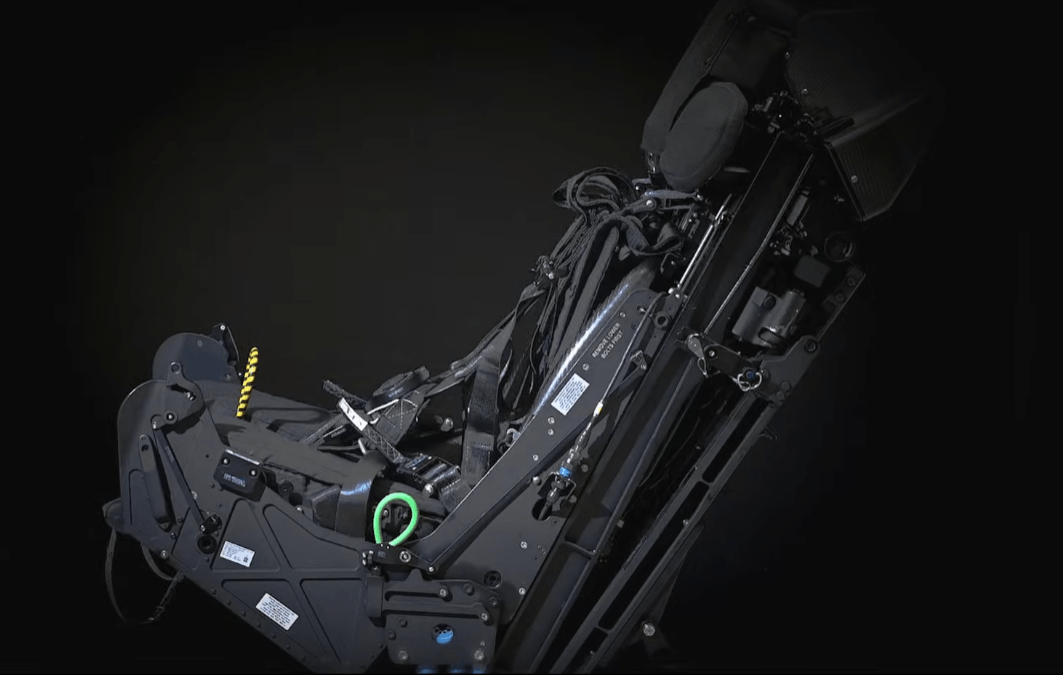
Ejection Seat is a multi-stage, integrated escape system designed to safely extract the pilot or crew from an aircraft during emergency situations when the vehicle becomes uncontrollable, particularly in military and some space vehicles. This system is not merely a seat with a propulsion mechanism; it is a complex safety apparatus comprising subsystems for sensing, timing, guidance, deceleration, and survival.
Ejection seats are critical safety systems developed primarily to protect pilot life in military aircraft, requiring real-time operation under extreme conditions. In high-speed, high-altitude fighter aircraft, they aim to increase the pilot’s chance of survival during emergencies such as structural failure, loss of control, or inevitable collision. Since escaping the aircraft is often the only viable option in such scenarios, ejection seat systems prioritize human life preservation over aircraft recovery and are regarded as one of the fundamental elements of pilot safety in military aviation.

Martin-Baker Ejection Seat Test (Martin-Baker)
Early ejection seat systems were developed using compressed air and simple mechanical springs. During the early years of World War II, pilots were forced to manually jump from malfunctioning aircraft. However, as aircraft speeds increased, high wind pressure, cockpit turbulence, sudden accelerations, and aerodynamic disturbances around open cockpits aerodynamics made safe egress extremely difficult and often fatal. Under these conditions, traditional parachute jumps lost reliability, resulting in widespread serious injuries and spinal trauma.
These challenges led to the emergence and rapid adoption of the ejection seat concept: a system capable of cleanly separating the pilot from the aircraft with sufficient thrust. Over time, these systems became indispensable in military aviation, with pilot safety emerging as a core policy area for air forces and naval aviation.
In subsequent decades, particularly with the advent of the jet age, early ejection seats proved inadequate. Spinal injuries, aerodynamic instability, and insufficient separation distances became major issues, prompting the development of rocket-assisted ejection systems and transforming ejection seats into modern integrated escape systems.

Early Ejection Seat (Martin-Baker)
Today, nearly all modern fighter aircraft are equipped with ejection seats. These systems ensure pilot survival when the aircraft becomes uncontrollable or a collision is unavoidable. The control systems of ejection seats operate under extremely strict real-time constraints; timing errors can lead directly to fatal outcomes.
One example is the ACES II (Advanced Concept Ejection Seat II), developed by Raytheon and used in aircraft such as the F-15, F-16, F-22, A-10, B-2, and F-117. This system features a barometric sub-system that measures ambient pressure and speed at the moment of ejection, enabling it to select one of three operational modes based on these parameters.

Pilot escaping from a U.S. F-35 fighter jet using an ejection seat. (Anadolu Agency)
A modern ejection seat system consists of the following key components:
All these stages are managed by a control system operating within millisecond-level constraints and strict real-time requirements.
Ejection seats operate in different modes depending on environmental conditions. For instance, the Raytheon ACES II system automatically selects one of three primary modes by measuring speed and altitude at ejection via barometric sensors:
Since any timing error during this process can be fatal, these systems are designed with extremely stringent real-time requirements.

Martin-Baker Mk18 Ejection Seat (Martin-Baker)
Ejection seats are not limited to aircraft; they have also been employed in certain spacecraft. During the Gemini spacecraft missions and the first four flights of the Space Shuttle, ejection seats were installed to enable crew escape in emergencies. In Gemini missions, the seats were designed to be ejected sideways through pyrotechnically opened hinged panels; the seat back structure was shaped around a rocket-catapult mechanism mounted on a rail system.
The most critical design scenario for these systems was a launch vehicle failure on the pad. The rocket-catapult mechanism was sized to propel the seat and crew beyond the maximum fireball radius and thermal radiation effects expected during such an event. Simultaneously, it was essential that the heat flux and acceleration forces experienced by the pilot remained within human tolerance limits.
During ejection, the pilot is subjected to high aerodynamic loads, sudden accelerations, and complex aerodynamic forces. This has made pilot aerodynamic instability and severe injuries to the spine and neck critical research areas in system design. Both experimental and numerical studies have been conducted to understand the aerodynamic forces causing pilot injuries.
Over the past thirty years, computational analysis methods have gained prominence due to the time, cost, and practical limitations of experimental testing. Computational Fluid Dynamics (CFD) analyses have been widely used to determine the aerodynamic coefficients and loads acting on the ejection seat and pilot. Based on these results, seat geometry, aerodynamic stability, and restraint systems have been optimized.
Advances in Aviation technologies and the increasing performance of next-generation fighter aircraft continuously raise the requirements placed on ejection seats. Current research focuses on reducing pilot injury risk, enhancing aerodynamic stability, and ensuring reliable operation across a broader speed–altitude envelope. In this context, more advanced systems have been developed that reduce biomechanical loads on the pilot and are adaptable to multiple platforms.
Today, ejection seats are no longer viewed merely as isolated mechanisms for separating pilots from high-speed aircraft; they are regarded as tangible outcomes of a holistic safety approach centered on pilot protection. The historical evolution, operational principles, and future research of these integrated systems—capable of sensing environmental conditions, making decisions, and managing a multi-stage rescue process—hold significant academic importance in the field of aviation safety.
[1]
B. A. Parate, “Science and Technology of Aircraft Seat Ejection: Advanced Concepts,” Taylor & Francis Online. Erişim tarihi: 30 Ocak 2026. https://doi.org/10.1080/23311916.2022.2034267.
Henüz Tartışma Girilmemiştir
"Ejection Seat" maddesi için tartışma başlatın
Definition and Purpose
Historical Development
Use in Modern Fighter Aircraft
System Components and Operational Modes
Ejection Seats in Spacecraft
Aerodynamic and Biomechanical Effects
Current Approaches and Research Areas