


Bu içerik Türkçe olarak yazılmış olup yapay zeka ile otomatik olarak İngilizceye çevrilmiştir.
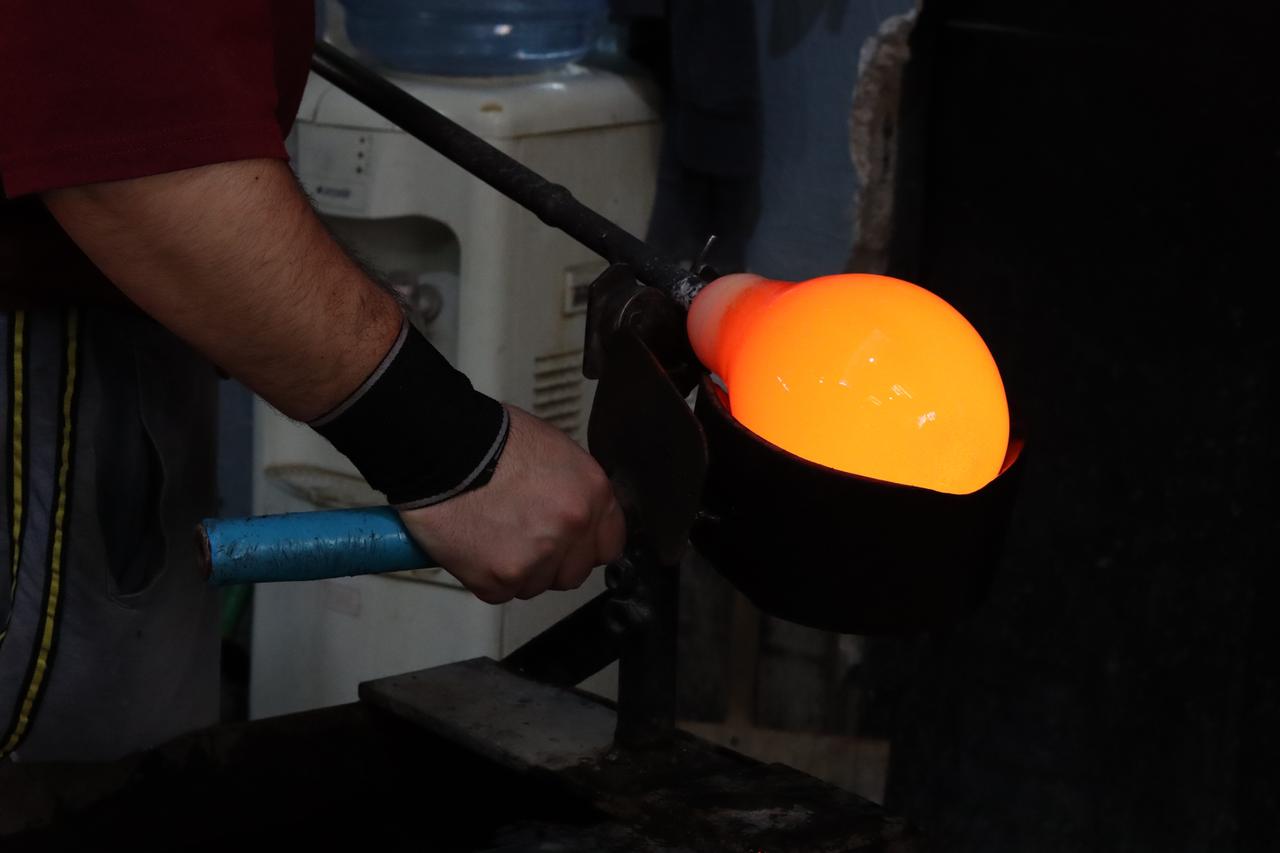
(Fotoğraf: Fatma Fırat)
Glassmaking is a production field based on shaping glass, an amorphous material obtained by melting raw materials such as silica sand, soda, and limestone at high temperatures. This shaping process is carried out using various techniques while the glass is in a hot and plastic state. Over its historical development, this field has formed a multifaceted technical and aesthetic tradition encompassing both craft and modern industrial glass production.
In antiquity, glass production was largely focused on the manufacture of small vessels due to the limitations of available techniques and the difficulties in processing raw materials. Glass vessels produced during this period typically measured between 5 and 15 cm in size.【1】 Early glassmakers worked within the technical constraints of the core-forming technique, before the development of free-blown methods. As a result, vessel forms were heavily influenced by contemporary ceramic, stone, and metal containers, which were replicated in glass. These vessels were primarily used for storing perfumes, aromatic oils, and cosmetics.

From Left to Right: Examples of Alabastron, Amphoriskos, and Aryballos (Generated by AI)
Among the glass vessels produced for this purpose in the 1st millennium BCE, the most common forms were the alabastron, amphoriskos, and aryballos.【2】
Alabastron is a vessel type characterized by a wide rim, short neck, and elongated cylindrical body. In most examples, two small handles are positioned opposite each other on the upper part of the body. This form was inspired by vessels made of alabaster stone in antiquity. Although its use varied by region, it was generally employed for storing perfumes, cosmetics, and eye paint.
Amphoriskos is a glass vessel form derived from small-scale versions of ceramic amphorae. These vessels were typically decorated with zigzag or wavy patterns created by winding and combing yellow, white, or turquoise glass threads over a dark glass base. Structurally, they have a short neck, pronounced shoulders, and a body tapering downward. With either pointed or rounded bases, most could not stand independently and required a stand or base. Their primary use was for storing perfumes and aromatic oils.
Aryballos is a small vessel with a spherical or hemispherical body, short neck, and wide rim. Most examples feature handles located between the neck and body. In the ancient Greek world, it was especially favored by athletes for carrying and applying body oils. Inscriptions on ancient vases and archaeological finds indicate that these vessels, often suspended or carried by cords threaded through their handles, were closely associated with athletic and bathing culture.
These vessel types illustrate how early glassmaking techniques adapted ancient ceramic forms to the medium of glass.
With the advent of the Iron Age, increased demand for monochrome and semi-transparent glass products facilitated the widespread adoption of the casting technique. In this method, molten glass is poured into preformed molds. For closed forms, models made of beeswax were commonly used; the wax melted during firing, leaving cavities that were filled by the glass. Mosaic glass vessels are among the early examples of this technique.

Glass Shaped by Blowing Method (Pexels)
A major technological shift in glassmaking occurred in the mid-1st century BCE with the development of glassblowing in the Syria-Palestine region.【3】 The use of a hollow metal blowpipe enabled molten glass to be expanded by blowing air into it. This method accelerated production and allowed for a wider variety of forms to be produced more rapidly. Glassblowing also reduced production costs and expanded the everyday uses of glass.

Glassmakers Shaping Glass by Mold-Blowing (Photo: Fatma Fırat)
Following the widespread adoption of glassblowing, the mold-blowing technique was developed, enabling the serial production of identical forms. In this method, molten glass is blown into molds made of clay, metal, or wood. The use of molds ensured standardization of form and allowed surface decorations to be imprinted directly from the mold. Additionally, various mold-texturing techniques were employed, in which the glass was first shaped in a mold and then inflated to create raised or helical surface effects.
In early glassmaking, various decorative techniques were developed. One of the most common was the application of colored glass threads to the surface. In these techniques, colored glass threads were applied to the hot glass surface and then combed or shaped with tools to create patterns. Such practices contributed to the perception of glass vessels not merely as functional objects but also as decorative items.
During the Ottoman Empire, glass production experienced significant development, particularly in workshops active in Istanbul and its surroundings during the 18th and 19th centuries.【4】 Production during this period was largely based on the blowing technique, giving rise to local production traditions. Beykoz glass and çeşmibülbül technique are characteristic examples of Ottoman glassmaking from this era.

Çeşmibülbül Pattern (Generated by AI)
Beykoz glass refers to glass objects produced in workshops around Beykoz in Istanbul during the 19th century. Sources indicate that Mehmet Dede, sent to Venice by Sultan III Selim to study glass art, established workshops near Beykoz that played a key role in the formation of this production tradition.【5】 Beykoz glass utilized colorless transparent, opal white, and various colored glass types. Different vessel forms such as gülabdan, pitchers, and bowls were produced; some examples featured gilded decorations and botanical motifs on the surface.
Çeşmibülbül (nightingale’s eye) is a production and decorative technique used in Ottoman glassmaking. In this method, pre-prepared colored glass rods are arranged in a specific pattern and fused with hot glass. The glass is then expanded using the blowing technique and rotated during shaping, producing helical lines on the surface. These patterns, formed by the fusion of different colored glass layers, are among the decorative techniques applied during the Ottoman period.
The foundation of glass production lies in the raw material mixture known as the “batch.” The primary component of the batch, which forms the structural framework of glass and constitutes approximately 70 percent of the total composition, is silica sand. To lower silica’s high melting temperature, soda (sodium carbonate) is added, while dolomite serves as an additive that enhances the mechanical strength and workability of the glass. Limestone contributes to the chemical stability of glass, preventing degradation over time, while feldspar alumina acts as a source of alumina to increase glass strength. Additionally, cullet—recycled broken glass—is added in specific proportions to reduce energy consumption and facilitate the melting process.
In glass production, controlling natural impurities in raw materials is as crucial as preparing the composition in correct proportions. Silica sand, the primary raw material, may contain heavy minerals such as chromite, diaspore, zircon, and similar substances. Some of these minerals may not fully dissolve in the molten glass, leading to various defects in the final product.
The main defects caused by such impurities in glass production are known as stone, button, and habbe.
Stone defect refers to the presence of solid particles in the glass matrix that have either failed to dissolve completely or have recrystallized later. These defects typically originate from undissolved mineral grains in the raw materials or particles detached from furnace refractories during production.
Button is a defect consisting of glassy inclusions with a different chemical composition from the surrounding glass matrix. Unlike solid mineral particles, these inclusions exhibit glassy properties and can create lens-like visual effects within the glass due to differences in refractive index.
Habbe refers to gas bubbles trapped within the glass. These bubbles typically form due to insufficient refining during melting or incomplete reactions in the batch. In some cases, solid particle residues may be found at the center of these bubbles.
The behavior of heavy minerals in silica sand within the molten glass varies with temperature. Glass melting furnaces typically operate in a temperature range of approximately 1450 °C.<kure-citation citation-content='<p class="paragraph"><span style="white-space: pre-wrap;">Pelin Akkaya, “Determination of Mineral Limitations in Raw Materials for Glass Production” (PhD thesis, 2024), Access Date 4 March 2026, </span><kure-link link-reference-type="external" link-reference="https://tez.yok.gov.tr/UlusalTezMerkezi/TezGoster?key=usXiZIM9Lp0wk-YzRoaT--aC_IrBSCVNhhQU1TEvitsnL5_oDrPeB1XUpYp2G1Tb">https://tez.yok.gov.tr
Akkaya, Pelin. “Cam Üretiminde Kullanılan Hammaddelerin Mineral Sınırlamalarının Belirlenmesi.” PhD thesis, 2024. Accessed March 4, 2026. https://tez.yok.gov.tr/UlusalTezMerkezi/tezSorguSonucYeni.jsp
Atik, Şeniz. “MÖ. I. Binde Anadolu'da Cam Üretimi ve Tasarımı.” PhD thesis, 2004. Accessed March 4, 2026. https://tez.yok.gov.tr/UlusalTezMerkezi/tezSorguSonucYeni.jsp
Cottonbro Studio. “İsimsiz (Cam Üfleme).” Photograph. Pexels, 2021. Accessed January 2, 2026. https://www.pexels.com/tr-tr/fotograf/erimek-eritmek-eller-sanat-7519891/
Crane, Pam. “Waterford Cam Fabrikasında Çalışan Cam Üfleyiciler.” Photograph. Pexels, 2024. Accessed January 6, 2026. https://www.pexels.com/tr-tr/fotograf/waterford-cam-fabrikasinda-calisan-cam-ufleyiciler-33619195/
Doğan, Elif Tuğba. “İşin Anlamı ve Yaratıcı Emeğin Piyasada Konumlanması Bakımından Türkiye'de Zanaatkârlık: Cam İşçiliği Örneği.” PhD thesis, 2011. Accessed March 4, 2026. https://tez.yok.gov.tr/UlusalTezMerkezi/tezSorguSonucYeni.jsp
Kılıç, Atilla Cengiz. “Cam Üretiminde Üfleme Yöntemiyle Biçimlendirme.” Master's thesis, 1995. Accessed March 4, 2026. https://tez.yok.gov.tr/UlusalTezMerkezi/tezSorguSonucYeni.jsp
Saint-Gobain Glass. "What is Glass? Glass Manufacturing Process." Knowledge Center. Accessed January 6, 2026. https://in.saint-gobain-glass.com/knowledge-center/glass-manufacturing-process
T.C. Ministry of Culture and Tourism. "Cam Üretme Teknikleri." Accessed January 6, 2026. https://kvmgm.ktb.gov.tr/TR-44946/cam-uretme-teknikleri.html
T.C. Ministry of Environment and Urbanization and Dokuz Eylül University. *Cam Üretimi: Sektörel Uygulama Kılavuzu (Taslak)*. Sanayiden Kaynaklanan Hava Kirliliğinin Belirlenmesi ve Azaltılmasına Yönelik Uygulamanın Kolaylaştırılmasının Sağlanması Projesi. Ankara: 2020. Accessed January 2, 2026. https://webdosya.csb.gov.tr/db/sanayihavarehberi/icerikler/06_cam-uret-m--20200103075113.pdf
T.C. Ministry of Industry and Technology. *Cam ve Cam Ürünleri İmalatı Kaynak Verimliliği Rehberi*. Prepared by: TÜBİTAK Marmara Research Center. Industrial Resource Efficiency Guide No. 6. Publication No: e-13. Ankara: July 2019. Accessed January 2, 2026. https://www.ahika.gov.tr/assets/upload/dosyalar/cam-ve-cam.pdf
[1]
Şeniz Atik, “Glass Production and Design in Anatolia in the 1st Millennium BCE” (PhD thesis, 2004), Access Date 4 March 2026, https://tez.yok.gov.tr/UlusalTezMerkezi/TezGoster?key=-L8ilcwn9ZRRc_YMKxXW1tJqN_LxGBJ77S7ET8vlMwIbbROfg_xUlUQhq6YeFtL4
[2]
Şeniz Atik, “Glass Production and Design in Anatolia in the 1st Millennium BCE” (PhD thesis, 2004), Access Date 4 March 2026, https://tez.yok.gov.tr/UlusalTezMerkezi/TezGoster?key=-L8ilcwn9ZRRc_YMKxXW1tJqN_LxGBJ77S7ET8vlMwIbbROfg_xUlUQhq6YeFtL4
[3]
Ministry of Culture and Tourism of the Republic of Türkiye, “Glass Production Techniques,” Access Date: 6 January 2026,https://kvmgm.ktb.gov.tr/TR-44946/cam-uretme-teknikleri.html.
[4]
Atilla Cengiz Kılıç, “Shaping Glass by Blowing Method in Glass Production” (Master’s thesis, 1995), Access Date 4 March 2026,https://tez.yok.gov.tr/UlusalTezMerkezi/tezSorguSonucYeni.jsp.
[5]
Elif Tuğba Doğan, “Craftsmanship in Türkiye from the Perspective of Meaning and the Position of Creative Labor in the Market: The Case of Glassmaking” (PhD thesis, 2011), Access Date 4 March 2026, https://tez.yok.gov.tr/UlusalTezMerkezi/tezSorguSonucYeni.jsp.


(Fotoğraf: Fatma Fırat)
Henüz Tartışma Girilmemiştir
"Glasswork" maddesi için tartışma başlatın
Historical Development of Glassmaking
Ancient Glass Vessel Forms
Casting Technique
Glassblowing
Mold-Blowing and Other Early Techniques
Early Decorative Practices
Ottoman Glassmaking and Traditional Glass Art
Basic Raw Materials of Glass
Impurities in Raw Materials and Glass Defects