


Bu içerik Türkçe olarak yazılmış olup yapay zeka ile otomatik olarak İngilizceye çevrilmiştir.
+1 Daha
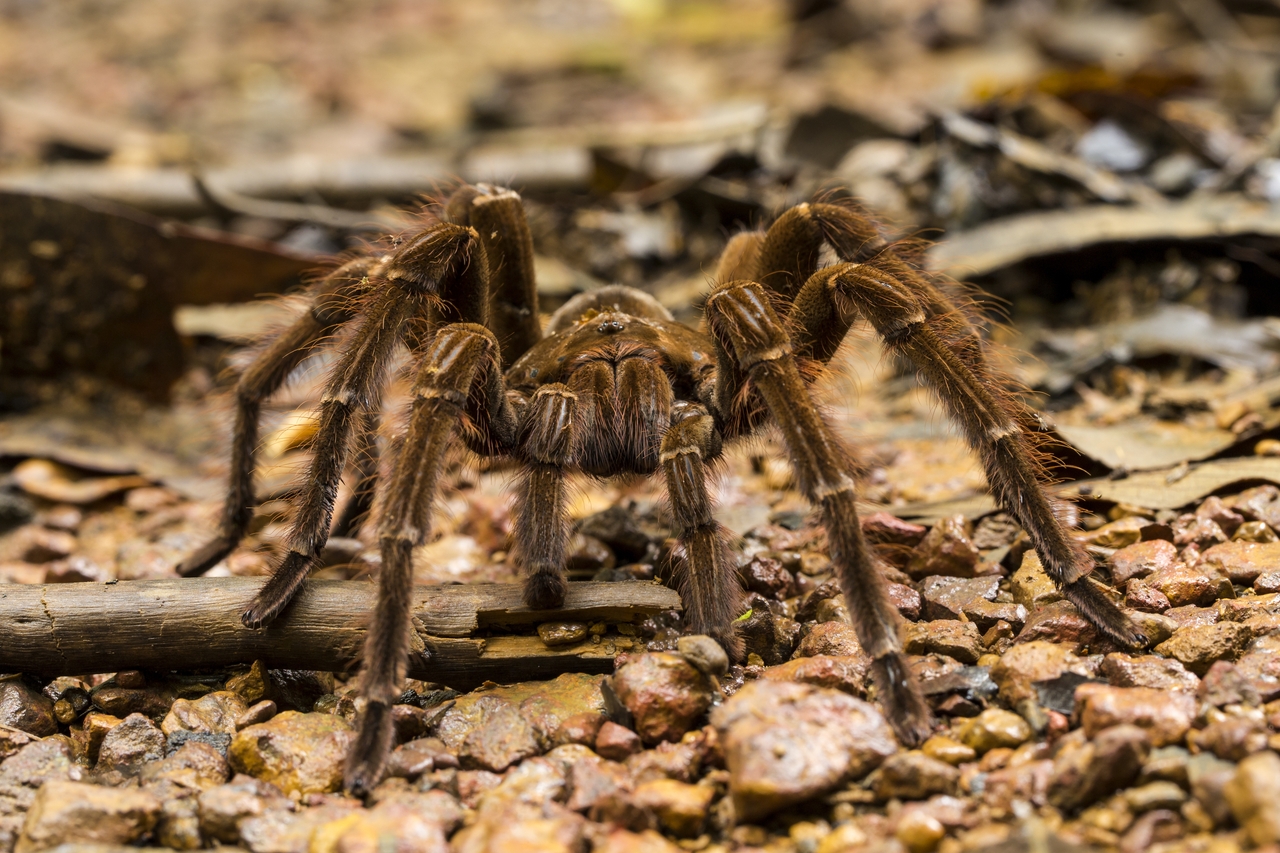
The Goliath Bird-Eating Tarantula (Theraphosa blondi) is known as the largest tarantula species in the world. It was first scientifically described by Pierre André Latreille in 1804. This spider, belonging to the family Theraphosidae, is particularly notable for its size. The name “Goliath” derives from a term used in ancient times to describe giants, while the term “bird-eating” does not refer directly to its feeding habits. It was inspired by an 18th-century engraving depicting a spider believed to have eaten a bird.
The genus Theraphosa contains only a few large species, and T. blondi is the largest representative of this group. Morphologically, this species is covered in dark brown or reddish-brown hairs. Males are smaller and have shorter lifespans, while females are both larger and longer-lived. Systematically, this species is classified within the class Arachnida and the order Araneae, under the family Theraphosidae. Its close relatives include Theraphosa apophysis and Theraphosa stirmi; however, T. blondi surpasses these species in size.
The most striking feature of T. blondi is its size. Its leg span can reach up to 30 cm, and its body weight can exceed 170 grams. Its body has a thick, hairy, and muscular structure. These hairs aid in environmental perception and are also used for defense. Its eyes have limited visual acuity and are generally only capable of detecting movement at close range. Therefore, environmental awareness is largely achieved through sensitive hairs on its legs that detect vibrations and air currents.
Among its defensive mechanisms is the ability to flick microscopic hairs called “urticating hairs” from its abdominal region using its hind legs. These hairs can cause irritation to the skin, eyes, or respiratory systems of potential predators. Additionally, when threatened, it may raise its legs into a threatening posture or produce a hissing-like sound. Its fangs are powerful enough to pierce human skin, even if only briefly. However, its bite is generally not toxic.
Theraphosa blondi inhabits tropical rainforests of South America, particularly in northern Venezuela, Guyana, Suriname, and Brazil. This species requires high humidity and warm temperatures. Its natural habitats typically include forest floors, riverbanks, and areas with dense undergrowth. An ideal environmental range for this species is a temperature of 24–30°C and humidity above 80%.
As a burrowing species, it constructs its own burrows in moist soil. These burrows are usually 20–40 cm deep and are concealed by vegetation. T. blondi remains hidden within its burrow during daylight hours and becomes active at night to hunt and feed. Leaf litter, rock crevices, and fallen logs in the forest floor provide natural shelter.
T. blondi is a predatory species whose diet consists primarily of insects, worms, small frogs, rodents, and occasionally birds. Upon capturing prey, it uses its strong chelicerae to hold it and injects digestive fluids to initiate external digestion. It then sucks up the liquefied tissue. Its digestive system is adapted for external digestion: enzymes secreted by the spider soften and liquefy the prey’s tissues, allowing the spider to consume the resulting protein-rich fluid.
The term “bird-eating” is a widespread misconception. The birds it occasionally consumes are typically nestlings of ground-nesting species, and such occurrences are rare. Its primary food sources are insects and small vertebrates. Frogs that fall into water, rodent pups, and even small snakes are occasionally part of its diet.
Its hunting strategy is ambush-based. Highly sensitive to vibrations, it detects approaching prey and launches a sudden strike to capture and immobilize it. Even small prey that fall into water can be retrieved and consumed. Its level of aggression is relatively high among tarantula species, especially during mating season or when defending itself.

A feeding T. blondi (Pixabay)
Female T. blondi are significantly larger than males and can live up to 15–20 years, whereas males have lifespans limited to just a few years. During the mating season, males approach female burrows and signal their intent through leg tapping and vibrations. Mating occurs only if the female accepts, after which the male quickly retreats.
After mating, the male typically flees immediately, as the female may become aggressive. The female produces a cocoon containing 100 to 200 eggs, which hatch after approximately 6–8 weeks. The spiderlings remain near their mother during their first few molts before dispersing to construct their own burrows.
Tarantulas molt multiple times throughout their lives. This process occurs frequently during growth phases. During molting, the spider lies on its back and sheds its old exoskeleton. Females continue molting throughout their lives, while males reach maturity after their final molt and die shortly thereafter. The growth period for spiderlings varies depending on temperature and food availability, but they typically reach adulthood within 2–3 years.
T. blondi is a popular species among exotic pet enthusiasts, but due to its size and defensive mechanisms, it is not recommended for inexperienced keepers. Although its bite is not fatal, it can be painful. The flicked hairs can cause skin irritation and serious reactions in the eyes and respiratory tract. For these reasons, it is not recommended for home keeping and is illegal in many countries.
In the wild, natural predators of T. blondi include snakes, large mammals, and wild wasps. Particularly, the “tarantula hawk” wasp paralyzes tarantulas and uses them as live hosts for its larvae. However, habitat loss and excessive collection for the pet trade also pose significant threats. Illegal exotic pet trade further endangers its populations.
Theraphosa blondi is not officially listed by the IUCN under any threat category; however, increasing habitat loss and illegal trade have raised concerns about its conservation needs. It is monitored under CITES regulations, and its inclusion in international frameworks regulating the exotic pet trade is recommended.
Scientifically, T. blondi has made significant contributions to research. The structure of the silk it produces has inspired studies in biomaterials. Additionally, certain protein components affecting immune systems are under investigation. Genetic mapping and metabolic studies of this species have also provided insights into the evolutionary history of spiders.

Henüz Tartışma Girilmemiştir
"Goliath Bird-Eating Tarantula (Theraphosa blondi)" maddesi için tartışma başlatın
Physical Characteristics and Anatomical Structure
Habitat and Geographic Distribution
Behavior and Feeding Habits
Reproduction, Development, and Life Cycle
Human Interaction and Threat Status
Conservation Status and Scientific Importance