

+1 Daha

Henry Howard (1517?–1547), who held the title of Earl of Surrey, was an English poet and military leader. As the eldest son and heir of Thomas Howard, 3rd Duke of Norfolk, he belonged to one of England’s most distinguished noble families. In literature, he is renowned for adapting the Italian sonnet form to the English language and for being the first to employ blank verse—unrhymed iambic pentameter—in English poetry.
Henry Howard was born to Thomas Howard, Duke of Norfolk, and Elizabeth Stafford, daughter of Edward Stafford, Duke of Buckingham. Although his exact date of birth is unknown, he is believed to have been born around 1517, likely in Hunsdon, Hertfordshire. Through his mother, he traced his lineage to King Edward III, and through his father, to Edward the Confessor. Howard received an education grounded in classical humanist traditions and maintained close ties with the royal household from an early age. Between 1530 and 1532, he lived at Windsor Castle alongside Henry Fitzroy, the illegitimate son of Henry VIII, forming a strong bond with him. In late 1532, he was sent to the court of King Francis I of France alongside Fitzroy, where he spent approximately a year immersed in French court culture. The death of Henry Fitzroy in 1536 was not only a personal loss for Howard but also isolated him further within the court environment.
During the final years of Henry VIII’s reign, Henry Howard assumed significant military roles. He participated in campaigns in Scotland and France, demonstrating his commitment to chivalric ideals. In August 1545, he was appointed lieutenant general of English forces in France. Despite council advice to surrender Boulogne, Howard encouraged the king to pursue further conquests. However, his military defeat at St. Etienne on 7 January 1546 damaged his reputation and standing at court. He was subsequently removed from command and replaced by his rival, Edward Seymour, Earl of Hertford.
In the political arena, Howard positioned himself as a defender of ancient nobility and was in constant conflict with rising bureaucratic figures whom he regarded as parvenus. In 1543, he was briefly imprisoned in Fleet Prison for acts of vandalism, including smashing church windows and breaking the Lenten fast. He defended these actions in a satirical poem, claiming they were spiritually motivated efforts to awaken London to its sins.
Henry Howard introduced fundamental structural and technical innovations to English poetry. He adapted the Italian sonnet form of the poet Francesco Petrarca to the characteristics of the English language, developing a structure later known as the Shakespearean sonnet, consisting of three quatrains and a concluding couplet (abab cdcd efef gg). Additionally, while translating portions of Virgil’s Aeneid (Books II and IV), he employed blank verse for the first time in English literature.
In his poems, Howard explored themes of nature, love, morality, and loyalty. Particularly in his later years, he reflected religious and political ideas through his adaptations of the Psalms and Ecclesiastes. These works reveal the use of Reformation-era (evangelical) discourses such as “election,” “grace,” and “simple faith.” Although his writings were not published during his lifetime, they were posthumously included in the 1557 anthology Tottel’s Miscellany, exerting a profound influence on subsequent generations of poets including Philip Sidney and William Shakespeare.
Henry Howard’s political decline occurred as Henry VIII’s health deteriorated and competition for the regency intensified. Howard entered into a fierce power struggle with the Seymour family, particularly with Edward Seymour, Earl of Hertford. His emphasis on ancient nobility and his characterization of the Seymours as parvenus heightened tensions at court. By the end of 1546, a group including former friends such as Richard Southwell and George Blage, known as the “conjured league,” began gathering evidence against Howard.
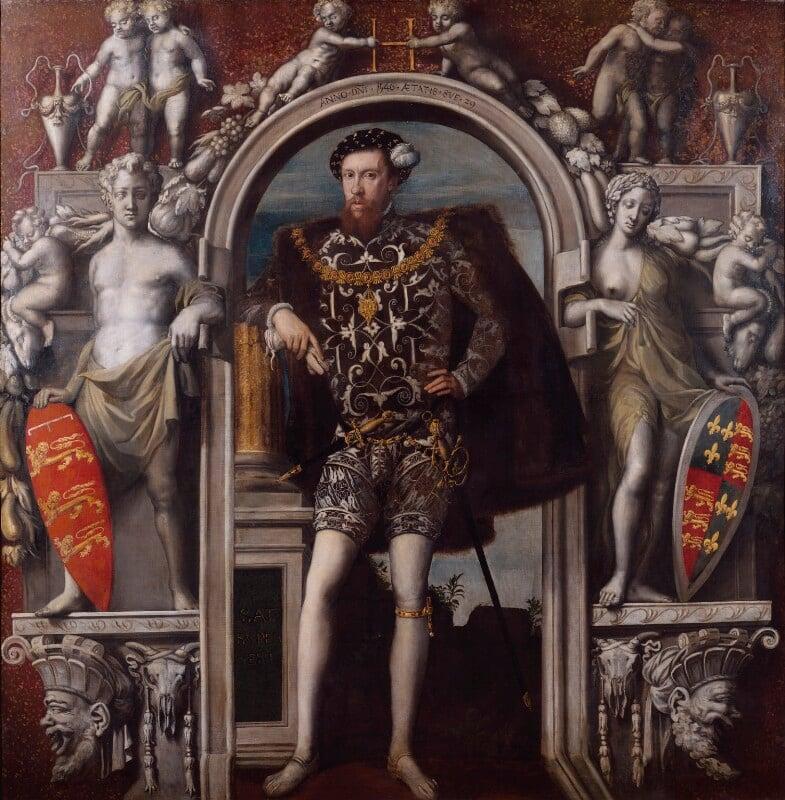
The primary charge against Howard was the unauthorized incorporation of royal arms—including those of Edward the Confessor—into his own coat of arms, an act considered treason under the laws of the time. Symbols in his commissioned paintings and tapestries were interpreted as claims to the throne. In particular, portraits depicting him leaning against a broken column, accompanied by the motto “Sat super est” (“What remains is sufficient”), were presented as evidence of his political ambitions. It was also alleged that Howard pressured his sister to become Henry VIII’s favorite, seeking to enhance his influence at court through her.
Henry Howard was arrested in December 1546 following a dispute with Richard Southwell and transferred to the Tower of London on 12 December. At his trial in Guildhall on 13 January 1547, Howard denied all charges and mounted a vigorous defense. He argued that the “H” and “R” in his portraits did not stand for “Henricus Rex” but for “Hereditas restat” (“The inheritance remains”), and that the broken column symbolized the dynasty’s collapse under the king’s wrath.
Despite his defense, Howard was found guilty by the jury and sentenced to death. He was beheaded on Tower Hill on 19 January 1547, just nine days before the death of Henry VIII. Howard’s execution is recorded as one of the last major political purges of the Tudor period. His literary legacy, preserved in works published after his death, became one of the foundational pillars of English Renaissance poetry.
Brigden, Susan. "Henry Howard, Earl of Surrey, and the 'Conjured League'." *The Historical Journal* 37, no. 3 (September 1994): 507-537. Accessed March 24, 2026. https://www.jstor.org/stable/2639916
Poetry Foundation. "Henry Howard, Earl of Surrey." Accessed March 24, 2026. https://www.poetryfoundation.org/poets/henry-howard
Poets.org. "About Henry Howard, Earl of Surrey." Academy of American Poets. Accessed March 24, 2026. https://poets.org/poet/henry-howard

Henüz Tartışma Girilmemiştir
"Henry Howard" maddesi için tartışma başlatın
Lineage and Early Life
Military Career and Political Activities
Literary Contributions and Style
Downfall and Charges of Treason
Trial and Execution