


Bu içerik Türkçe olarak yazılmış olup yapay zeka ile otomatik olarak İngilizceye çevrilmiştir.
+2 Daha
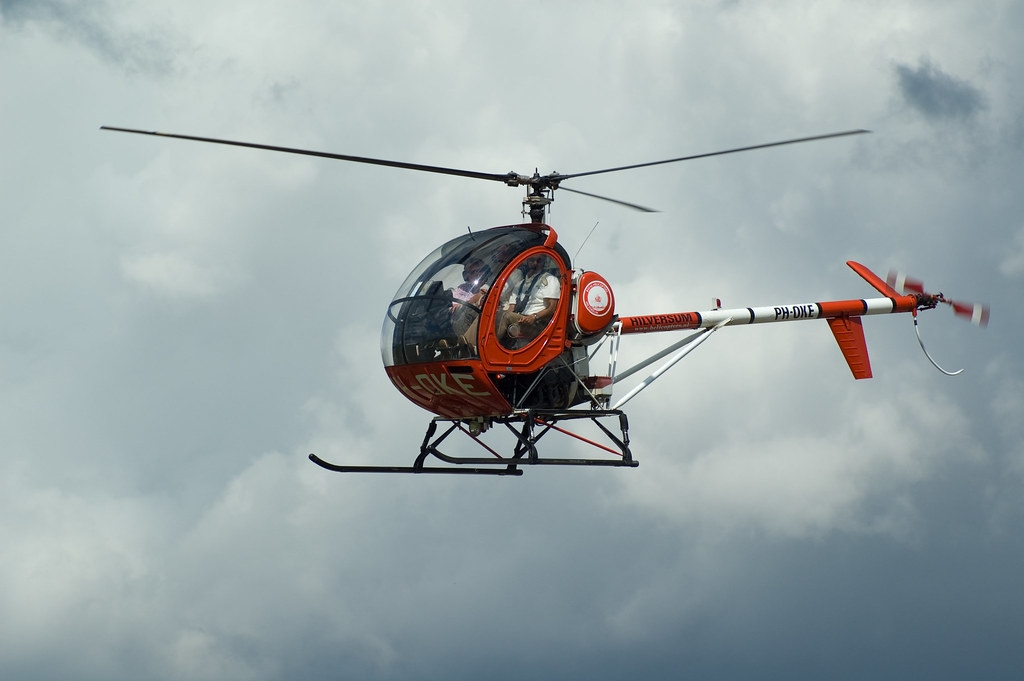
Hughes 269 (Flickr)
The Hughes 269 (TH-55 Osage / Model 300) is a two-seat, piston-engine, light helicopter developed by the Aviation Division of Hughes Tool Company. This rotary-wing aircraft made its first flight in October 1956 and is used in civil aviation for training, agricultural spraying, and police patrols. In the military domain, the United States Army extensively employed it as a primary training helicopter under the designation TH-55A "Osage". Renowned for its low cost, simple construction, and reliability, the Hughes 269 was continuously improved over time, evolving into the Hughes 300 and Schweizer 300 series, proving itself to be a long-lived design with production continuing from the 1950s well into the 21st century【1】.
The origins of the Hughes 269 stem from a market study commissioned in 1955 by Hughes Tool Company from the Stanford Research Institute. This study revealed that the civil market had a need for a low-cost, lightweight, two-seat helicopter capable of fulfilling a significant portion of commercial missions. Based on these findings, the "Model 269" project was launched in September 1955 under the leadership of Fred C. Strible.
The first prototype, registered as N78P, made its maiden flight on 2 October 1956 in Culver City, California, with pilot Gale Moore at the controls【2】. The initial design featured a tubular tail boom and a fully glazed cabin. In 1957 and 1958, Hughes delivered five pre-production helicopters to the U.S. Army under the designation YHO-2 for evaluation. Although the aircraft performed successfully during tests at Fort Rucker and Edwards Air Force Base, the Army rejected the project due to budget constraints and existing inventory of Bell and Hiller models.
Following this rejection, Hughes engineers improved the design for the civil market. The tubular tail boom was replaced with a tubular aluminum tail boom, the cockpit was redesigned, and the horizontal stabilizer was moved to the tail. This revised version was designated "Model 269A" and received FAA type certification in April 1959. Serial production began in July 1960, with the first deliveries made in 1961.
The Hughes 269 is a helicopter designed around principles of simplicity and economy. Its main rotor system consists of a three-bladed, fully articulated design rotating clockwise; the tail rotor is two-bladed and features a "teetering" (seesaw) configuration【3】【4】. The fuselage structure is built from welded steel tubing, while the tail section is constructed on a single-piece aluminum tube. The landing gear consists of skids equipped with four oleo-pneumatic shock absorbers, and wheels can be added to facilitate ground maneuvering.
The powerplant typically consists of a four-cylinder, horizontally opposed Lycoming engine. Unlike conventional helicopter engines mounted vertically, the engine is mounted horizontally, similar to aircraft engines, eliminating the need for modifications to the lubrication system. Power transmission is achieved through eight belts connecting the engine to the transmission, which dampen vibrations. Flight controls are directly linked to the main rotor control mechanism (swashplate) without hydraulic assistance.
The standard empty weight of the Model 269A ranges from approximately 413 to 457 kg, with a maximum takeoff weight between 703 and 839 kg. Cruise speed is approximately 120 to 136 km/h, and range is about 320 to 370 km【5】【6】.
TH-55 Osage The U.S. Army, having initially rejected the design, adopted it in 1964 as a primary training helicopter and designated it TH-55A "Osage" (named after the Osage Native American tribe). The TH-55A is technically nearly identical to the civil Model 269A-1 but is equipped with military radios and systems. From 1965 to 1988, the Army used the TH-55 fleet as its primary training platform, during which over 60,000 pilots received training on this helicopter. A total of 792 TH-55A helicopters were produced for the U.S. Army.
The aircraft’s logistical resilience was demonstrated in 1967 during a hurricane disaster at Fort Wolters, which damaged 179 helicopters. Thanks to a special repair line established at the Hughes factory, damaged helicopters were repaired within 50 days, allowing the training program to continue without interruption. Outside the United States, armed forces of Japan (licensed production as TH-55J), Sweden (Hkp 5), Colombia, Spain, and Thailand also used this helicopter for training and light observation missions【7】.
Building on the success of the Model 269A in the civil market, Hughes developed the three-seat "Model 269B" in 1964 and marketed it commercially as the "Hughes 300". This model featured a redesigned cabin with a side-by-side seating arrangement for three occupants instead of individual seats.
In 1969, the "Model 300C" (or 269C) was introduced, featuring a more powerful engine (190 hp Lycoming HIO-360-D1A) and a larger main rotor diameter of 8.18 meters. This model offered 45% greater useful load capacity compared to earlier versions. Specialized variants were also produced, including the "Model 300AG" equipped with tanks and spray booms for agricultural use, and the "Sky Knight" for police operations, featuring noise-reducing equipment that lowered noise levels by 75%.

Hughes 269 (Flickr)
Hughes Helicopters transferred the production license for the Model 300 series to Schweizer Aircraft Company, based in New York, in 1983. Following McDonnell Douglas’s acquisition of Hughes Helicopters in 1984, Schweizer purchased all rights in 1986 and continued production under the name "Schweizer 300C". Under Schweizer’s management, the design was further developed, leading to derivatives such as the turbine-powered Schweizer 330. In 2004, Sikorsky acquired Schweizer and rebranded the helicopter as the "Sikorsky S-300". Since 1956, over 3,000 (some sources cite 3,300) Hughes 269/300 series helicopters have been produced under various manufacturers【8】.
Hughes 269 (Siivet - Wings)
[1]
RotorShop. “Hughes 269.” Last updated 3 January 2025. Access: 19 February 2026.
[2]
Heli Archive. “Hughes 269, Hughes 269A History and technical description.” Heli Archive. Access: 19 February 2026
https://www.heli-archive.ch/en/helicopters/in-depth-articles/hughes-269a
[3]
Heli Archive. “Hughes 269, Hughes 269A History and technical description.” Heli Archive. Access: 19 February 2026
https://www.heli-archive.ch/en/helicopters/in-depth-articles/hughes-269a
[4]
Prairie Aviation Museum. “Hughes 269A.” Prairie Aviation Museum. Access: 19 February 2026.
https://prairieaviationmuseum.org/exhibits/aircraft/th-55a-osage/
[5]
“Hughes 269.” (Web Page). Last updated 3 January 2025. Access: 19 February 2026.
[6]
Heli Archive. “Hughes 269, Hughes 269A History and technical description.” Heli Archive. Access: 19 February 2026
https://www.heli-archive.ch/en/helicopters/in-depth-articles/hughes-269a
[7]
Aviastar. “Hughes Model 269/300 helicopter - development history, photos, technical data.” Aviastar.org. Access: 19 February 2026.
[8]
Aeroseum. “Hughes 269 – Long-lived lightweight.” Aeroseum. Access: 19 February 2026.
https://aeroseum.se/en/exhibitions-objects/hughes-269-long-lived-lightweight/

Hughes 269 (Flickr)
Henüz Tartışma Girilmemiştir
"Hughes 269" maddesi için tartışma başlatın
Development Process and History
Technical Specifications and Design Structure
Military Service
Civil Variants and Model 300 Series
Transfer of Production Rights and Current Status