

+2 Daha

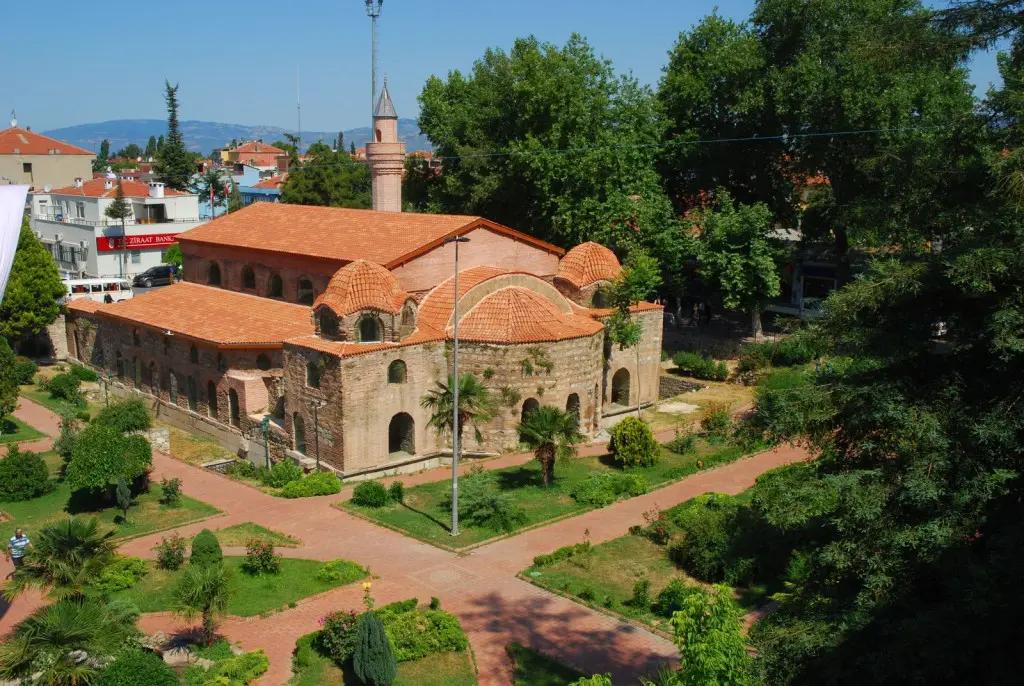
İznik Hagia Sophia Mosque
Initial Construction | 6th century (Reign of Justinian I) | ||||||||
|---|---|---|---|---|---|---|---|---|---|
Council | 787 (Seventh Ecumenical Council) | ||||||||
Conversion to Mosque | 1331 – Orhan Gazi | ||||||||
Renovation | 16th century – Mimar Sinan | ||||||||
Last Restoration | 2007 | ||||||||
Function(s) | Mosque (active use) cultural heritage site | ||||||||
Location | İznik Bursa | ||||||||
Hagia Sophia Mosque of İznik is a multi-layered historical structure located in the district of İznik in Bursa Province, Turkey, embodying architectural features from both the Byzantine and Ottoman periods. Situated in the center of the ancient city of Nicaea, the building holds symbolic importance in religious, political, and cultural contexts. It is notable for being the site of the Seventh Ecumenical Council in Christian history, as well as for being among the earliest Christian structures converted into a mosque by the Ottomans outside of Bursa.
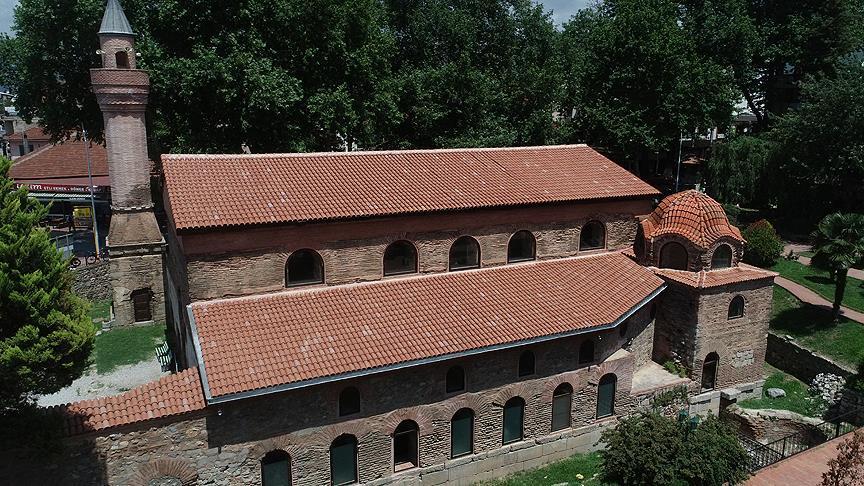
İznik Hagia Sophia Mosque (AA)
Although the exact construction date of the Hagia Sophia of İznik is not definitively known, architectural features and historical context suggest that it dates back to the reign of Byzantine Emperor Justinian I (527–565). The structure holds particular theological significance due to its role as the venue for the Second Council of Nicaea in 787, the Seventh Ecumenical Council in Christian tradition. This council marked a turning point in the debate over iconoclasm, resulting in the restoration of the veneration of icons within the church.
In 1331, following the conquest of İznik by the Ottoman army under Orhan Gazi, the church was converted into a mosque. This transformation marks one of the earliest examples of Christian structures being adapted for Islamic worship outside of Bursa. As part of the conversion, typical mosque elements such as a mihrab, minbar, and minaret were added. The minaret was constructed at the northwest corner of the building, and the interior was rearranged to accommodate Islamic rituals.
During the 16th century, under the reign of Suleiman the Magnificent, the mosque underwent a significant restoration and redesign by Mimar Sinan, the chief architect of the Ottoman Empire. During this period, the roof structure was rebuilt, and the entrance doors and windows were reorganized to enhance structural integrity and aesthetic harmony.
In the Republican era, the building functioned as a museum for a period before undergoing another phase of restoration in 2007. Following these restorations, it was reopened for worship as a mosque.
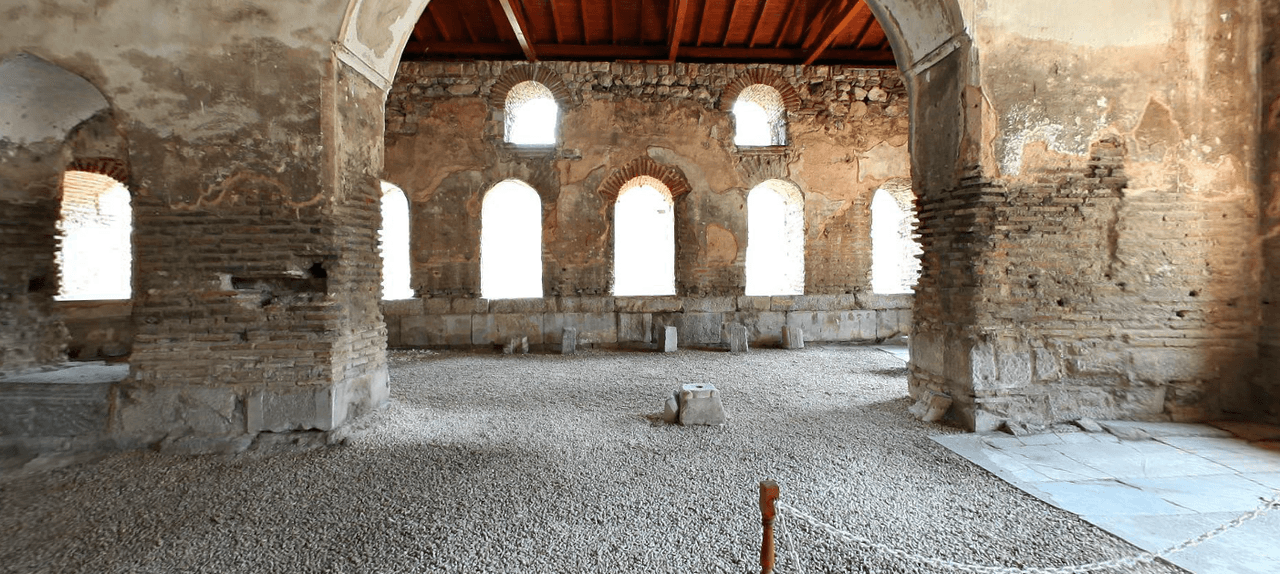
İznik Hagia Sophia Mosque (Türkiye Kültür Portalı)
The structure follows a basilican plan, consisting of a rectangular mass oriented along an east–west axis and divided into three naves. The central nave is both wider and higher than the side aisles, a common feature in classical Byzantine basilicas. These naves are separated by two rows of columns connected by arches, creating a rhythmic spatial division typical of early Christian architecture.
At the eastern end lies a semi-circular apse, which contains remnants of frescoes dating back to the building’s period as a church. In addition, traces of Byzantine mosaics featuring geometric and vegetal motifs are visible on some wall surfaces, further reflecting its original religious function.
During the Ottoman period, the additions to the building—including the mihrab, minbar, and minaret—were constructed using brick and stone materials that blended respectfully with the Byzantine fabric. The main façade was kept relatively plain, with minimal ornamental design, prioritizing function over decorative plasticity. The mihrab features modest muqarnas ornamentation, while the minbar was constructed using simple stone craftsmanship. The minaret, built of brick, is single-shafted with one balcony (şerefe).
The Hagia Sophia Mosque of İznik stands as a symbolic structure bearing witness to a multi-faith and multi-era past. Its role as the venue for the Second Council of Nicaea in 787, which ended the contentious iconoclasm period, grants it a notable place in Christian theological history.
In the Ottoman period, the building played a pivotal role in the Islamization of İznik, serving as one of the earliest examples of church-to-mosque conversions in newly conquered territories. Its conversion reflected broader strategies of integrating new cities into the Ottoman religious and administrative framework.
Today, the building is perceived within collective memory as a shared heritage of both the Byzantine and Ottoman periods. It holds sacred significance for both Christian and Muslim communities and represents a rare architectural testimony to the spatial transitions between religions, reinforcing its status as a living historical document.
In 2007, a comprehensive restoration project was initiated by the General Directorate of Foundations to preserve the structural and historical integrity of the Hagia Sophia Mosque of İznik. The restoration process adhered closely to the building’s original form, ensuring that both Byzantine architectural elements and Ottoman-era mosque additions were conserved and structurally reinforced.
As of today, the building functions both as an active place of worship and as a site of historical and cultural interest. It attracts visitors within the scope of cultural heritage tourism and serves as an important destination for those studying Byzantine and Ottoman architecture.
Post-restoration enhancements included lighting systems, floor arrangement, and informational displays, all of which have improved the site's accessibility for academic research and guided tourism. Through the collaborative efforts of İznik Municipality and the Ministry of Culture and Tourism, the site has become one of the key focal points of regional cultural tourism.
Anadolu Ajansı. “İznik’in Fethinin Nişanesi: Ayasofya Camii.” Anadolu Ajansı. Accessed May 22, 2025. https://www.aa.com.tr/tr/kultur-sanat/iznikin-fethinin-nisanesi-ayasofya-camii/1170147
İznik Municipality. “Ayasofya Camii.” İznik Municipality Official Website. Accessed May 22, 2025. https://iznik.bel.tr/tr/sayfa/ayasofya-camii-53
Kültürel Miras Envanteri. “İznik Ayasofya Camii.” Accessed May 22, 2025. https://kulturenvanteri.com/yer/iznik-ayasofya-camii/#17.1/40.429289/29.720083
T.R. Ministry of Culture and Tourism. “İznik Ayasofya Camii.” Kültür Portalı. Accessed May 22, 2025. https://www.kulturportali.gov.tr/turkiye/bursa/gezilecekyer/znik-ayasofya
TRT Haber. "İznik'in fethinin sembolü: Ayasofya Orhan Camii." TRT Haber Youtube Channel. Accessed May 22, 2025. https://www.youtube.com/watch?v=wL17h7pxaOU
Türkiye Diyanet Foundation. “Ayasofya Camii (İznik).” TDV İslâm Ansiklopedisi. Accessed May 22, 2025. https://islamansiklopedisi.org.tr/ayasofya-camii--iznik

İznik Hagia Sophia Mosque
Initial Construction | 6th century (Reign of Justinian I) | ||||||||
|---|---|---|---|---|---|---|---|---|---|
Council | 787 (Seventh Ecumenical Council) | ||||||||
Conversion to Mosque | 1331 – Orhan Gazi | ||||||||
Renovation | 16th century – Mimar Sinan | ||||||||
Last Restoration | 2007 | ||||||||
Function(s) | Mosque (active use) cultural heritage site | ||||||||
Location | İznik Bursa | ||||||||
Henüz Tartışma Girilmemiştir
"İznik Hagia Sophia Mosque" maddesi için tartışma başlatın
Historical Background
Architectural Features
Religious and Cultural Function
Restoration and Current Status
Bu madde yapay zeka desteği ile üretilmiştir.