


This article was automatically translated from the original Turkish version.
+1 More
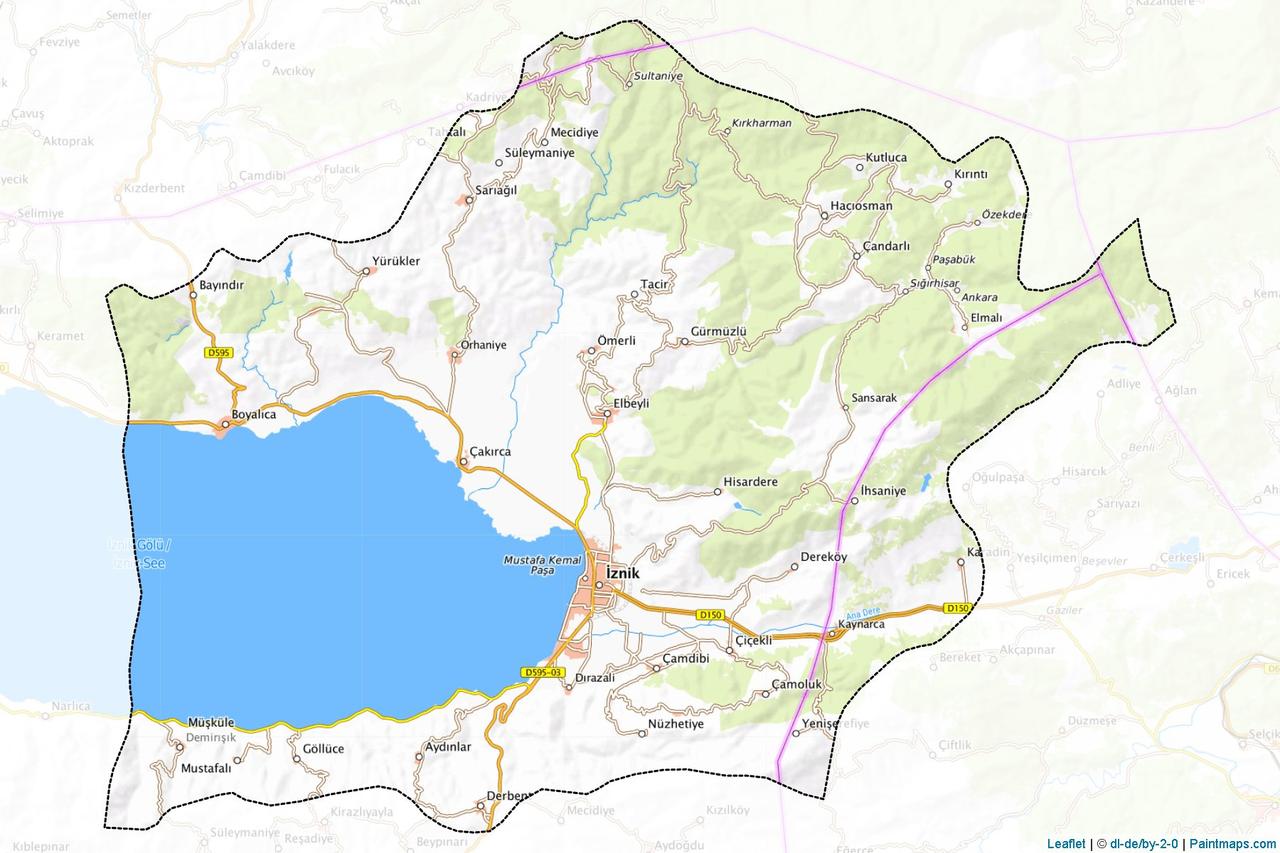
Iznik (District)
İznik (District)
Location | Bursa | ||||||||
|---|---|---|---|---|---|---|---|---|---|
Geographic Coordinates | 29°30’-29°57’ east longitudes, 40°21’-40°37’ north latitudes | ||||||||
Elevation(s) | 85 metres | ||||||||
Area(s) | 753 km² | ||||||||
Population | 45.208 (as of 2025) | ||||||||
Attached Settlements | 2 towns, 37 villages | ||||||||
District Governor | Arif KARAMAN | ||||||||
Mayor(s) | Kağan Mehmet USTA | ||||||||
İznik is a historically and culturally rich district located on the eastern shore of Lake İznik in the southeastern part of the Marmara Region, under the administration of Bursa Province. Situated in a fertile plain surrounded by the Samanlı Katırlı Gürle and Avdan mountains İznik has hosted numerous civilizations throughout history and is one of the rare settlements that served as capital to four empires. Its monumental structures from the Roman Byzantine Seljuk and Ottoman periods its world-famous ceramics and natural beauty make İznik akin to an open-air museum.
The history of İznik extends back to prehistoric times. Remnants of civilizations dating to around 2500 BCE have been found at the Karadin Çiçekli Yüğücek and Çakırca mounds. These mounds were preferred for settlement due to their proximity to the lake fertile soils and water sources. Çakırca Mound is notable for its Late Bronze Age ceramics dating to 1200 BCE while Karadin and Çiçekli mounds yield findings from the Early Middle and Late Bronze Ages. Yüğücek Mound is known for ceramics dated to 2200–1700 BCE.
Before the migrations of the Thracian tribes in the 7th century BCE the city was known as Helikare. In 316 BCE it was refounded by Antigonus Monophthalmos a general of Alexander the Great and renamed Antigoneia. After Alexander’s death Lysimachus defeated Antigonus in 301 BCE and renamed the city after his wife Nikaia. The name Nikaia derives from the Greek phrase “Eis ten Nikaion” meaning “toward Nikaia” and evolved into the vernacular form İznik. According to mythology Nikaia was the daughter of the goddess Kybele and the river Sangarios (Sakarya) and the city was named after her by Dionysus.
In 293 BCE İznik became part of the Kingdom of Bithynia and was known as the “Golden City” with gold coins minted in its name. For a time it served as the capital of Bithynia before coming under Roman administration between 91 and 74 BCE. During the Roman period İznik grew significantly but was destroyed by an earthquake in 123 CE and subsequently rebuilt by Emperor Hadrianus who is regarded as its second founder. The city was plundered by the Goths in 258 CE and restored between 259 and 269 CE. During the Roman and Byzantine periods İznik was laid out according to the Greek cross plan with four main gates (Lefke Istanbul Yenişehir and Göl) and the central intersection marked by the Ayasofya Camii.
From a Christian perspective İznik gained prominence as the site of the First Council of Nicaea in 325 CE. At this council attended by Emperor Constantine I the teachings of Arius of Alexandria claiming that Jesus Christ was merely a human were rejected and the doctrine that Jesus was the Son of God was affirmed. The Nicene Creed and the dates of religious feasts were established at this council. In 787 CE the Seventh Council of Nicaea convened in the Church of Hagia Sophia and lifted the ban on icons thereby endorsing the veneration of religious imagery.
Conquered in 1075 by Süleyman Shah of the Kutalmışoğlu dynasty İznik became the first capital of the Seljuk State of Turkey and from the 1080s onward earned the title of the first Turkish capital in Anatolia. In 1097 during the First Crusade the city was handed over to the Byzantines and after the Latin conquest of Constantinople in 1204 during the Fourth Crusade it became the capital of the Empire of Nicaea under Theodore I Laskaris (1204–1261). During this period the city walls were strengthened and churches and palaces were constructed.
Conquered by Orhan Gazi in 1331 İznik became a center of art trade and culture during the Ottoman period. The Ayasofya Church was converted into a mosque and the first Ottoman mosque madrasa and imaret were built here. Scholars such as Davud-u Kayseri and Eşrefoğlu Abdullah Rumi produced significant works in İznik. Monumental structures such as the Yeşil Camii and the Nilüfer Hatun Imaret were constructed during the Çandarlı period. However from the late 16th century onward İznik lost its prominence due to a decline in ceramics production the Celali rebellions and outbreaks of malaria and cholera leading to population decline. The city suffered damage during the Greek occupation of 1920 and experienced revival from the 1950s onward. In 1988 it was declared a historic urban conservation area and placed under protection.
İznik is located 85 km from Bursa between 29°30′ and 29°57′ east longitude and 40°21′ and 40°37′ north latitude. It is situated on the eastern shore of Lake İznik within a plain surrounded by the Samanlı Mountains to the north and the Katırlı Gürle and Avdan mountains. The lake is 32 km long and 10 km wide with an elevation of 85 meters above sea level and a maximum depth exceeding 70 meters. The region connects to the Lefke Strait and the Sakarya Valley in the east and to the Karsak Creek Valley and the Gemlik Bay in the west. The Istanbul-Bursa highway passes to the west of the region and İznik lies on a spur road. With the decline of historical caravan routes the city lost its commercial vitality.
İznik has a temperate transitional climate. The annual average temperature is 14.4°C with the coldest month (January) averaging 5°C and the hottest months (July–August) around 25°C. Annual precipitation ranges between 500 and 800 mm; 528 mm in İznik and 775 mm in Orhangazi. Precipitation mostly occurs as rain with snowfall in higher elevations and peaks during winter and early spring. The average number of frost days is 33.6 the number of foggy days is 16.8 and the number of snowfall days is 6.9.
The natural vegetation lies at the intersection of the Mediterranean and Paleoboreal European floristic regions. Forests are dominated by oak in lowlands and pine in higher elevations. Due to human activity forests have been replaced by maquis and pseudomaquis areas. Common maquis species include kocayemiş (wild olive) funda (laurel) akçakesme (rockrose) sandal (sandalwood) defne (bay laurel) delice and erguvan (pomegranate). Maquis prevails on the northern slopes of Lake İznik while pseudomaquis dominates the southern mountains.
The social structure of İznik has historically been multicultural. Christianity dominated during the Roman and Byzantine periods while Islam prevailed during the Seljuk and Ottoman periods yet diverse religious and ethnic groups coexisted. During the Ottoman period İznik was known as the “Cradle of Ulema” and became a center for scholars and artists. According to 16th-century tax registers İznik within the walls had 23 neighborhoods: 21 Muslim and 2 Christian. The city contained mosques madrasas imarets and zaviyes.
Today İznik has a society based primarily on agriculture. Approximately 90 percent of the population is engaged in farming and family-run enterprises are common. Limited cooperativization and corporate organization have led to marketing challenges. The standard of living exceeds the Turkish national average. Tourism driven by historical and natural attractions is increasingly important in social life.
İznik’s economy is based on agriculture. Of a total of 23 000 hectares of agricultural land 13 100 hectares are irrigable. The majority of the 10 000 hectares of arable land lies on alluvial soils classified as first and second class and produces olives grapes peaches cherries plums pears apples walnuts tomatoes green beans broccoli and Brussels sprouts. Olives are the primary source of income for 90 percent of farming households. Müşküle grapes are a local specialty. Lake İznik is home to 27 freshwater fish species including crayfish tench carp bream and silver fish with silver fish being targeted for export.
Ceramics production has been a vital part of İznik’s historical economic identity. During the 14th to 16th centuries İznik ceramics were used in monuments such as the minaret of the Yeşil Camii and decorated with motifs of tulips hyacinths pomegranates and carnations. In the 17th century Evliya Çelebi noted over 300 ceramic kilns in İznik. However ceramics production declined from the 17th century onward and the city lost its economic significance. Today agriculture and tourism form the main pillars of the economy.
İznik possesses significant tourism potential due to its historical and natural attractions. Walls from the Roman Byzantine Seljuk and Ottoman periods the Ayasofya Camii the Yeşil Camii the Nilüfer Hatun Imaret and ceramic artifacts attract visitors. Due to hosting the First and Seventh Ecumenical Councils İznik is also a religious destination for Christians. The natural shoreline of Lake İznik picnic areas paragliding in Hacı Osman Village waterfalls in Sansarak Village and mountain trekking opportunities enhance tourism. Its status as a historic urban conservation area helps preserve İznik’s cultural heritage and boosts its tourism potential.
The population of İznik has fluctuated throughout history. In the 16th century the population lived in 23 neighborhoods but declined from the 17th century onward due to the Celali rebellions epidemics and migration. By the late 19th century the population had dropped to 1 220 and by the early 20th century to 600. After the Greek occupation of 1920 the city was devastated and began to recover from the 1950s onward. The population which was 2 500 in 1935 reached 45 208 by 2025. İznik covers an area of 753 km² and includes two towns and 37 villages. The majority of the population is engaged in agriculture and the levels of education and welfare exceed the Turkish national average.
İznik with its historical fabric natural beauty agricultural richness and ceramic art is one of Türkiye’s most important cultural and tourism centers.
Bursa Valiliği. “İlçelerimiz.” Accessed April 20, 2025. http://www.bursa.gov.tr/ilcelerimiz.
T.C. Ministry of Culture and Tourism, General Directorate of Cultural Assets and Museums. “İznik (Bursa) 2014,” Accessed April 20, 2025. https://kvmgm.ktb.gov.tr/TR-93767/iznik-bursa-2014.html.
T.C. Ministry of Culture and Tourism, General Directorate of Promotion. "İznik." Accessed April 20, 2025. https://tanitma.ktb.gov.tr/TR-22796/iznik.html.
İznik Belediyesi. "Coğrafi Durum." Accessed April 20, 2025. https://iznik.bel.tr/tr/sayfa/cografi-durum-48.
İznik Belediyesi. “İznik Tarihçesi.” Accessed April 20, 2025. https://iznik.bel.tr/tr/sayfa/iznik-tarihcesi-38.
İznik Kaymakamlığı. “İznik Coğrafi Yapı.” Accessed April 20, 2025. http://www.iznik.gov.tr/iznik-cografi-yapi.
İznik Kaymakamlığı. “İznik’in Tarihçesi,” Accessed April 20, 2025. http://www.iznik.gov.tr/iznikin-tarihcesi.
Iznik (District)
İznik (District)
Location | Bursa | ||||||||
|---|---|---|---|---|---|---|---|---|---|
Geographic Coordinates | 29°30’-29°57’ east longitudes, 40°21’-40°37’ north latitudes | ||||||||
Elevation(s) | 85 metres | ||||||||
Area(s) | 753 km² | ||||||||
Population | 45.208 (as of 2025) | ||||||||
Attached Settlements | 2 towns, 37 villages | ||||||||
District Governor | Arif KARAMAN | ||||||||
Mayor(s) | Kağan Mehmet USTA | ||||||||
History
Geographical Structure
Climate and Vegetation
Social Structure
Economic Structure
Tourism Potential
Demographic Structure