

Bu içerik Türkçe olarak yazılmış olup yapay zeka ile otomatik olarak İngilizceye çevrilmiştir.
+2 Daha
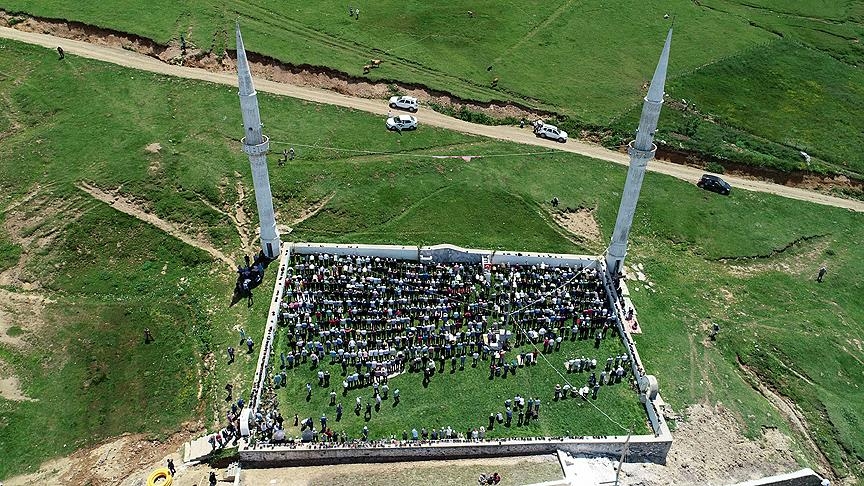
Open-Air Mosque (Kadırga Yaylası Open-Air Mosque) is a historical place of worship located within the boundaries of the Kürtün district of Gümüşhane province, along the Gümüşhane-Trabzon border. Situated at an elevation of 1,800 meters above sea level on Kadırga Yaylası, the structure has a history spanning 565 years as of 2026. With no enclosed space or roof, the mosque has functioned for centuries as a venue where local communities perform worship outdoors directly on the grass.
Written sources and local narratives trace the mosque’s founding to the year 1461, coinciding with the region’s conquest by the Ottoman Empire. According to tradition, Fatih Sultan Mehmet visited Kadırga Yaylası to pay respects at the grave of a companion during the conquest of Trabzon. As the day coincided with Friday prayers, a space was designated for him and his soldiers to pray, and the area was enclosed with stones.【1】
Accounts also state that Fatih Sultan Mehmet had a dream urging the improvement of the site and its enclosure with stones. Following this event, low stone walls were constructed around the area, and from the time of the conquest onward, it became a regularly used open-air place of worship for Friday prayers.【2】The structure is regarded as a legacy of history and a site of high spiritual value.【3】

Kadırga Yaylası Üstü Açık Camii(AA)
The Open-Air Mosque is distinguished by the absence of traditional mosque elements such as domes, roofs, and exterior walls. Its physical features consist of the following:
The mosque’s religious services are coordinated by the Kürtün District Muftiate of Gümüşhane. Due to its location, there is no permanent settlement in the area during winter months, and the mosque operates only during the summer season. In accordance with official directives from the Kürtün Subgovernorship, a religious official is dispatched to the mosque every Friday. The assigned imams are responsible for leading Friday prayers and fulfilling religious duties.
The mosque serves as a shared gathering point for transhumant communities from Trabzon, Giresun, and Gümüşhane provinces. Particularly on the third Friday of July, the site experiences a large influx of visitors, and this date is recognized as a traditional day of worship.【5】
Friday prayers attended by thousands of worshippers are regarded as a unifying force that strengthens feelings of solidarity within the region. Worshippers describe the spiritual atmosphere of the mosque using terms such as “peace,” “reverence,” and “serenity.” The preservation of the structure as a heritage passed from generation to generation holds significant cultural importance for the region.
[1]
Karadeniz Kültür Envanteri, "Kadırga Yaylası Üstü Açık Cami," karadeniz.gov.tr, Erişim Tarihi: 24 Aralık 2025, https://karadeniz.gov.tr/kadirga-yaylasi-ustu-acik-cami-2/
[2]
Anadolu Ajansı, "Üstü açık tarihi camide cuma namazı," Anadolu Ajansı, Erişim Tarihi: 2 Şubat 2026, https://www.aa.com.tr/tr/yasam/ustu-acik-tarihi-camide-cuma-namazi/1190817
[3]
Diyanet Haber, "Üstü açık tarihi camide cuma namazı geleneği devam ettiriliyor," Diyanet Haber, Erişim Tarihi: 24 Aralık 2025, https://www.diyanethaber.com.tr/ustu-acik-tarihi-camide-cuma-namazi-gelenegi-devam-ettiriliyor
[4]
Diyanet Haber, "Üstü açık tarihi camide cuma namazı geleneği devam ettiriliyor," Diyanet Haber, Erişim Tarihi: 24 Aralık 2025, https://www.diyanethaber.com.tr/ustu-acik-tarihi-camide-cuma-namazi-gelenegi-devam-ettiriliyor
[5]
İhlas Haber Ajansı, "Üstü Açık Camide 563 Yıldır Çimen Üzerinde Cuma Namazı Kılınıyor," YouTube, Erişim Tarihi: 2 Şubat 2026, https://youtu.be/cD9DOiN7y5A?si=JxVSEsN4HoorxF9C


Henüz Tartışma Girilmemiştir
"Kadırga Yaylası Üstü Açık Camii" maddesi için tartışma başlatın
History
Architectural Structure and Spatial Features
Management and Staff
Social and Cultural Impact