
Bu içerik Türkçe olarak yazılmış olup yapay zeka ile otomatik olarak İngilizceye çevrilmiştir.
+1 Daha
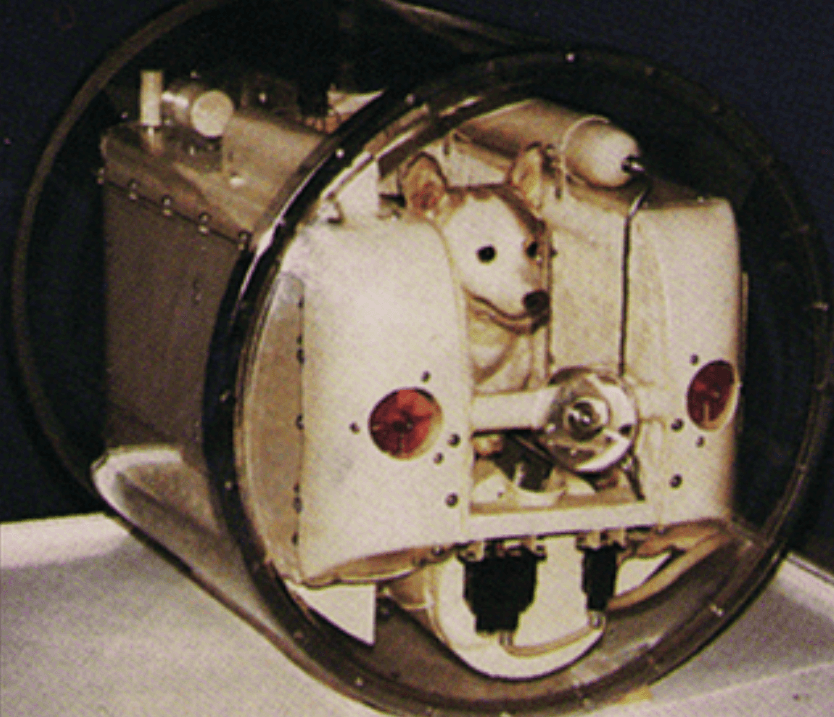
Laika is the first living creature to be sent into Earth’s orbit, launched by the Soviet Union aboard the Sputnik 2 spacecraft on 3 November 1957. Laika, a stray mixed-breed dog from the streets of Moscow, was selected for this historic mission to test the effects of spaceflight on living organisms. space travel's
In the mid-1950s, the “Space Race” between the United States and the Soviet Union had evolved into a global technological competition by August 1955. The Soviet Union gained temporary superiority in this race by successfully launching Sputnik 1, the world’s first artificial satellite, on 4 October 1957, and sought to reinforce this achievement as a propaganda victory. The Soviet leadership planned a new mission to coincide with the 40th anniversary of the Russian Revolution on 3 November 1957.【1】
While the construction of Sputnik 1 had taken more than a decade, scientists were given less than a month to prepare Sputnik 2, resulting in severe engineering compromises. Due to the limited time, the spacecraft's Laika’s spacecraft was designed without any “re-entry” strategy or heat shield to ensure her safe return to Earth.【2】
This Soviet move generated concern in the United States and provided the impetus for American officials to view the program as a “legitimate step” toward human spaceflight, accelerating the organization of their own space program.【3】
A Video About Laika, the First Dog in Space (Popular Science)
Laika, chosen from stray dogs collected from the streets of Moscow as part of the Soviet space program, was a female mixed-breed approximately two years old, weighing about six kilograms, and believed to be part Samoyed and part terrier. Her original name was Kudryavka, meaning “Little Curly” in Russian, but she later became known worldwide by the name “Laika,” which refers to her breed and barking nature.
The primary reason Soviet scientists preferred stray street dogs for their experiments was their belief that these animals, having naturally adapted to Moscow’s harsh conditions of cold, hunger, and adversity, would better withstand the stresses of spaceflight. During selection, candidates were evaluated not only for physical resilience but also for temperament. Laika stood out among dozens of candidates due to her calmness under high stress, curious nature, and peaceful demeanor around other dogs.
Described by scientist Vladimir Yazdovsky as “calm and affectionate,” Laika’s success in training and her composed behavior under pressure led to her being selected as the primary candidate after undergoing a series of demanding medical examinations. Of the three dogs chosen for the mission, Albina—a seasoned “veteran” who had previously flown twice on high-altitude missions and was a new mother—was deemed too valuable to risk again on a mission with a certain fatal outcome. Thus, Laika, no less successful than Albina, was chosen as the primary cosmonaut for the doomed Sputnik 2 mission.【4】

Laika Sent into Earth’s Orbit Aboard Sputnik 2 (NASA)
Laika’s training program was designed to be rigorous and disciplined, preparing her for the physical and psychological pressures of the upcoming space mission. A critical phase involved cage training to acclimate her to the confined space of Sputnik 2’s capsule; Laika and other candidate dogs, including Albina and Mushka, were gradually confined in progressively smaller cages until they were forced to remain motionless for days in spaces too narrow to allow movement. This confinement caused disturbances in their digestive and excretory systems, leading to discomfort and health issues, but scientists used this process as a criterion to measure the dogs’ mental resilience.
In physical endurance tests, Laika was placed in high-speed centrifuges simulating launch G-forces, during which her heart rate and blood pressure reached extreme levels. She also underwent training in special sound chambers to desensitize her to the deafening noise of rocket engines and sudden vibrations within the capsule. To enable real-time transmission of scientific data, Laika underwent surgical procedures to implant various medical sensors capable of monitoring her heart rate, respiration rate, and blood pressure.
Unlike its predecessor Sputnik 1, which was a simple spherical structure carrying only a radio transmitter, Sputnik 2 was a much heavier, multi-layered engineering structure weighing 508 kilograms, specifically designed to meet the biological needs of a living organism. At the center of the spacecraft was a pressurized metal capsule in which Laika was secured by a harness with severely restricted movement. This life-support area was equipped with innovative yet hastily assembled devices of the era: an oxygen generator to absorb carbon dioxide and purify the cabin air, an automatic fan that activated when internal temperature exceeded 15 degrees Celsius, and an automated feeding mechanism that provided seven days’ worth of high-nutrient gel food for Laika.
The spacecraft’s outer structure was designed so that the main propulsion from the rocket would not separate after reaching orbit, meaning a massive object would remain in orbit indefinitely. Despite all this technical equipment, Sputnik 2’s critical deficiency was the absence of a heat shield capable of withstanding the thousands of degrees of heat during atmospheric re-entry and a braking system to initiate de-orbiting.

Launch of Sputnik 2 from the Baikonur Cosmodrome (NASA)
At the moment of launch on 3 November 1957 from Baikonur Cosmodrome in Kazakhstan, Laika was subjected to violent shaking and noise she had never experienced; during this stressful period, her heart rate rose from 103 to 240 beats per minute—three times its normal rate. After reaching orbit and entering microgravity, it took Laika approximately three hours—three times longer than predicted by ground simulations—for her heart rate to return to pre-launch levels.
Shortly after reaching orbit, a malfunction in the thermal control system, combined with the spacecraft’s failure to fully separate from its main rocket body, caused the cabin temperature to rise above 40 degrees Celsius. Approximately five to seven hours after launch, during her fourth orbit around Earth, Laika died from extreme heat, humidity, and severe stress. Her lifeless body remained aboard Sputnik 2, which continued orbiting Earth for 2,570 revolutions until it re-entered the atmosphere and burned up on 14 April 1958.【5】
Laika’s death prompted a re-evaluation of ethical standards in space science and led to significant changes in Soviet space program safety protocols. Subsequent missions following Sputnik 2 established that for a living organism to survive in orbit, sufficient oxygen alone was inadequate; a sophisticated thermal control system and a reliable “re-entry” technology for return to Earth became essential requirements.
The biological data collected from Laika and the thermal control failures that caused her death formed the foundation for the Sputnik 5 mission launched on 19 August 1960, in which two dogs, Belka and Strelka, became the first living creatures to return safely from space.【6】 Although Soviet scientists continued to argue that animal experiments were vital before the first human flight of Yuri Gagarin in 1961, later confessions from participants deepened the ethical reflection on the mission.
Oleg Gazenko, a senior scientist involved in the project, expressed his remorse over Laika’s death in 1998:
“The more time passes, the more I am sorry. We did not learn enough from this mission to justify the dog’s death.”【7】

Stamps Issued in Honor of the First Dog to Travel to Space (Starchild NASA)
To honor Laika’s memory, approximately 50 years after the historic flight, a bronze monument was erected in 2008 near Star City, the military facility in Moscow where Laika underwent her grueling training. The monument depicts a rocket transforming into a human hand, lifting Laika toward the sky and the stars. Laika’s legacy extends beyond physical memorials; she has left an enduring imprint across a wide spectrum—from postage stamps and literary works to popular culture and scientific ethics debates. Today, Laika is remembered as an “unwilling pioneer” on the path to human spaceflight, and her story remains a historical lesson reminding us of the ethical responsibilities inherent in scientific progress.
[1]
Johnson, J. U, “60 years ago: The First Animal in Orbit,” NASA, Erişim tarihi: 30 Ocak 2026, https://www.nasa.gov/history/60-years-ago-the-first-animal-in-orbit/
[2]
Tara Gray, “A Brief History of Animals in Space,” NASA, Erişim tarihi: 30 Ocak 2026, https://www.nasa.gov/history/a-brief-history-of-animals-in-space/.
[3]
Johnson, J. U, “60 years ago: The First Animal in Orbit,” NASA, Erişim tarihi: 30 Ocak 2026, https://www.nasa.gov/history/60-years-ago-the-first-animal-in-orbit/.
[4]
Laken Greene, “The Sacrifice of a Stray: Laika’s Mission to the Stars Aboard Sputnik 2,” East Tennessee State University, syf 5-6, https://faculty.etsu.edu/odonnell/2021fall/engl3130/Laika_Mission_Sputnik_2_Soviet_Union.pdf.
[5]
Royal Museums Greenwich, “What Was the First Animal in Space?” Royal Museums Greenwich, Erişim tarihi: 30 Ocak 2026, https://www.rmg.co.uk/stories/space-astronomy/what-was-first-animal-space.
[6]
Royal Museums Greenwich, “What Was the First Animal in Space?” Royal Museums Greenwich, Erişim tarihi: 30 Ocak 2026, https://www.rmg.co.uk/stories/space-astronomy/what-was-first-animal-space.
[7]
Laken Greene, “The Sacrifice of a Stray: Laika’s Mission to the Stars Aboard Sputnik 2,” East Tennessee State University, syf 1, https://faculty.etsu.edu/odonnell/2021fall/engl3130/Laika_Mission_Sputnik_2_Soviet_Union.pdf

Historical Background
Selection Process and Physical Characteristics
Training Process
Sputnik 2 Spacecraft
Events During the Mission and Death
Subsequent Developments
Memorial and Legacy