Bu içerik Türkçe olarak yazılmış olup yapay zeka ile otomatik olarak İngilizceye çevrilmiştir.


This article is the second in a two-part series. The first article, “Leaving Traces: Working Principles and Costs”, examined how traces are left, how they are detected, and their cost on Turkish data. This article can be read independently: the necessary information from the first article is summarized in Section 1, and the data generated in the first article is explained in Section 3.
One may ask whether a model trained without access to its training data has been exposed to a published benchmark dataset or whether it was trained on outputs from a competing model. Even if access to the model weights is available, the training data itself remains invisible; thus, this question is far more difficult than answering “who wrote this text?” by examining the text alone.
Watermarking was not designed for this question; it was developed to determine which model generated a given text. However, the same mechanism is effective in this unforeseen problem: if data has been previously marked, it becomes statistically testable whether a model encountered that data during training.
This article first briefly summarizes how traces are left and detected. It then explains how watermark-laden data enters a model, what strengthens or weakens the trace, and under what conditions the detection yields false alarms. Finally, these findings are tested through original experiments on Turkish data: how much watermark-laden data must a model see before the trace becomes detectable? Does the trace propagate to a second generation by passing through an intermediary model? The final section discusses the method’s limitations.
A language model computes a probability for each token (the smallest unit of text) in its vocabulary at each step, and a sampler selects the next token based on these probabilities. The core idea of watermarking lies in this final step. A secret key and the last k tokens (the watermark window) are fed into a pseudorandom function (PRF), which generates an R value between 0 and 1 for each token in the vocabulary. To someone without the key, these values are indistinguishable from random; to someone with the key, they are identical each time.
All experiments in this article use the Gumbel-max scheme. Instead of true randomness, the PRF’s R values are used: for a token with probability p, the token with the highest R^(1/p) value is selected. When averaged across keys, each token is still selected with exactly its original probability; thus, the scheme does not distort the model’s distribution. However, for a single key, the R values of selected tokens systematically tend to be higher: this is precisely the trace. Watermarks can be inserted in two ways: while the model generates text (during production) or by rewriting an existing text through a watermark-laden model (post-hoc marking).
No external model is needed for detection; only the key and the tokenizer (the component that splits text into tokens) are required. The detector recalculates the PRF value for each token and uses −ln(1 − R) as its score. In a watermark-free text, the average score per token is 1; in a watermark-laden text, the selected tokens tend to have higher R values, causing the total score to exceed expectation. The probability that such a high total score could occur by chance is the p-value; in this article, it is reported as −log₁₀(p): a value of 6 means p = 10⁻⁶. A single token proves nothing, but the trace accumulates with length: if the same trend persists over 100 tokens, the p-value falls below one in a million; over 400 tokens, it drops below 10⁻²⁰.
The rate at which the trace accumulates is determined by entropy. When the model is uncertain, the watermark has room to influence the selection. When the model is confident—for example, after writing “2 + 2 =”—only one correct answer remains, and that token carries no trace. Therefore, the difficulty of detection varies by text type: creative text can be detected in relatively short passages, while code or mathematics requires much longer texts.【1】
For Gumbel-max, the score takes the form S = −Σ ln(1 − R_t). In the absence of a watermark, R_t is uniformly distributed and the sum follows a Γ(N, 1) distribution:
The lower bound for the expected score in a watermarked text is .
H_N is the entropy of the text. This is the mathematical expression of the signal being scaled by entropy.
For the test to be valid, the scores must be independent. Since the PRF is deterministic, the same (window, token) pair produces the same score when encountered twice; therefore, duplicate pairs are counted only once.【2】 This process is called deduplication and is identified in the Radioactivity section as the primary source of false alarms.
"Non-disturbing" is defined at two levels. At the token level, the probability of selection at each step is preserved. At the sequence level, the probability of the entire response is preserved. When the same window repeats within a response, the PRF generates the same value, violating the second condition; this is the source of the loop problem described in the first paper.
Key inference: A watermark signals the randomness with which words are selected from among alternatives. The signal accumulates only in long and uncertain texts. The question addressed in this section is which model generated a given text; the next section asks whether the signal has migrated from the text to the model.
When a watermarked text enters a model’s training data, the question changes:
“Is this text AI-generated?” → “Did this text enter the training data of the relevant model?”
The second question is far more difficult, because there is no longer a text to examine—only a model, and the trace must be sought in the model’s behavior. Sander and colleagues have shown that such a trace exists, and borrowing a term introduced for image classifiers, they call it radioactivity.【3】 A model trained on watermarked data carries this trace in its own predictions.【4】
Data contamination is not a single problem. The term encompasses three distinct issues, each with different parties and standards of evidence.
Table 1: Three Types of Data Contamination
The data entering training, the resulting outcome, and the party making the claim differ across types; therefore, the standard of evidence varies.
Distillation contamination is not always intentional; for example, if data labelers outsource their work to a chatbot, the bot’s outputs may enter a dataset undetected.【5】 Current tools for addressing this issue either require the auditor to know the suspicious model’s training data, or fail to provide a valid p-value【6】 or lose power when the data is repeated only a few times.【7】 Watermark addresses all three limitations: the data is pre-labeled, the test yields a valid p-value, and the auditor does not need to know the suspicious model’s training data. Its limitation is a single prerequisite:
Watermark can only test whether pre-labeled data entered a model. It cannot detect spontaneously occurring, unlabeled contamination; for that, other methods are needed, such as those that examine whether the published order of an evaluation test is more probable under the model.【8】For the test to function, the data must be labeled by the tester, the key must be held by the tester, and the contamination must be large enough to affect the model.
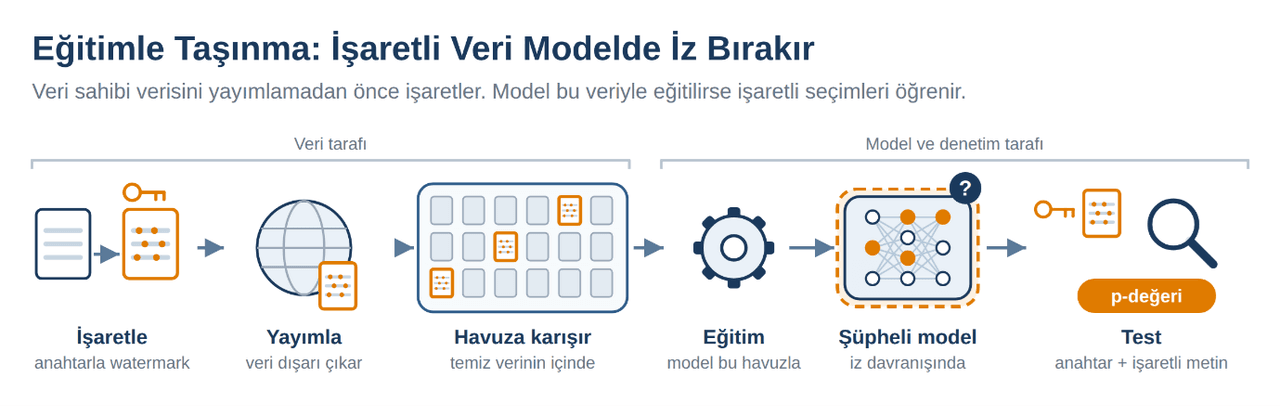
The Marked Data Leaving a Trace in the Model and Subsequent Retrieval (Generated by Artificial Intelligence.)
The process consists of four steps. First, the data owner applies watermarks before publishing their data: they either generate the data using a watermarked model or rewrite existing data using a watermarked model. Then the data is published and mixed into a training pool alongside other data. Next, a model is trained on this pool, either intentionally or unintentionally. In the final step, the data owner tests the model using their key.
Evaluation test contamination is a typical example of this process. Before publishing test questions, the test owner rewrites them using a watermarked model, preserving their meaning and correct answers.【9】 The test continues to measure the same thing, but now every question carries the owner’s key.
What does the model learn from this data? A model that has consistently seen the word “gray” following the context “The weather is cold today and” in the training data develops a tendency to favor “gray” in that context. This tendency applies only to that specific context; the model does not learn the watermark’s rule or extract the key. What it learns is a preference for certain tokens in specific contexts it has observed. Thus, the mechanism is not a generalization but a context-dependent statistical memorization. For this reason, generating free text from the model and running a standard watermark test is ineffective: the generated text rarely passes through those contexts, and the signal becomes indistinguishable from noise.
A counterintuitive question arises here: If the Gumbel-max distribution is not altered, how can the model learn an imprint? What is preserved is the average across keys. In a text generated using a single key, the selected tokens are correlated with that key. The model does not see the average; it sees only that single text. Therefore, what it learns is the relationship between token selections and the key.
The type of training directly affects the strength of the imprint. In fine-tuning, watermarked data can constitute a significant portion of a small dataset, and the model encounters this data repeatedly; the imprint is strong. In pretraining, however, the same data represents only a tiny fraction within a corpus of billions of tokens; the imprint is much weaker.
Two practical conclusions can be drawn from this process. Considering the study by Sander and colleagues on evaluation test contamination, which suggests that if only the questions are watermarked and training is performed only on the answers, the test can be bypassed, it follows that watermarks must be placed on the tokens where loss is computed during training. In instruction tuning, loss is typically computed only on the answers; marking only the questions does not guarantee that the imprint will be learned.【10】 The second conclusion concerns the tokenizer: if the suspect model uses a different tokenizer, only tokens common to both vocabularies can be scored, reducing the test’s power.【11】
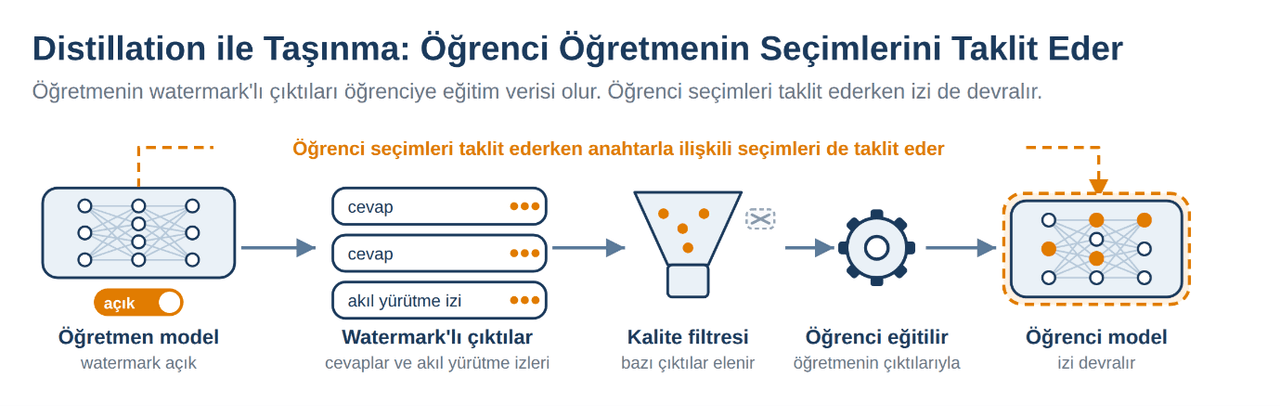
Transition from Damıtmada İzin to Student (Generated by Artificial Intelligence.)
Two details are important in distillation. First, the teacher’s outputs are typically filtered through a quality filter; different watermark schemes may pass through this filter at different rates. If data volumes are not equalized when comparing schemes, differences may stem from data quantity rather than the watermark itself.【12】 Second, during detection, scores can be weighted by entropy at each position, so that low-entropy tokens without watermarks do not dilute the test.【13】
Distillation is one of today’s most common contamination methods: a student model is trained using the responses and reasoning traces of a powerful teacher model.【14】 If the teacher’s outputs are watermarked, the process works as in fine-tuning: the student learns to repeat the tokens selected by the teacher in the same contexts and thereby inherits the watermark.【15】
To detect a watermark, contexts must be reconstructed. If the detector has access to the model’s weights, the reading mode is used: the detector passes its own watermarked text through the suspicious model and scores the top multiple predictions at each position against its own key. This technique is also known as teacher forcing, because at each step the model sees the correct prefix from the detector’s text rather than its own generated prefix. Thus, each watermarked context is reconstructed exactly, requiring only a single forward pass.
Table 2: Comparison of Predictions in Reading Mode (Representative Values)
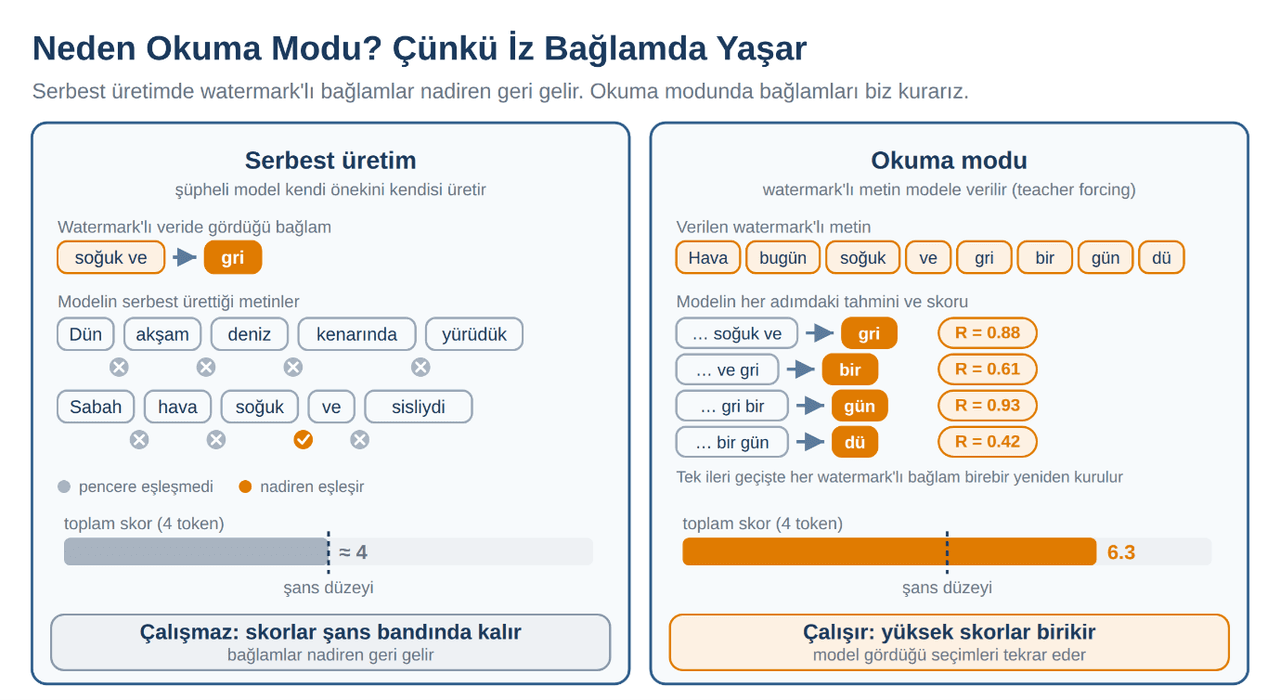
Comparison of Free Production and Reading Modes (Generated by Artificial Intelligence.)
The clean model’s predictions receive random R values according to the key; the suspicious model’s predictions typically yield higher R values.
The values in the table are representative, not measured results. The clean model’s predictions receive random values according to the key; the suspicious model tends to repeat choices it encountered during training, and these choices carry high PRF values. As in Section 1, individual predictions do not prove anything; only when hundreds of thousands of predictions accumulate do they form strong evidence.
Table 3: Testing Method Based on Detector Access
If model weights are accessible, the watermarked text is passed through the model and each prediction is scored (strong); if only the API is available, familiar response windows are searched for in the outputs (weaker).
Watermark strength is determined by the combined effect of several variables. General trends are as follows:
Table 4: Variables Influencing Watermark Strength
Watermark strength increases with higher proportions of watermarked data, greater watermark strength, higher entropy, and increased learning rate and epoch count. LoRA training, training from scratch, and API-only access weaken the watermark. The effect of window size depends on data size.
Window size exerts two opposing effects. With a small k, the same window repeats more frequently in the data, making it easier for the model to memorize. However, because each window is counted only once during deduplication, a small k also reduces the number of tokens available for scoring. Which effect dominates depends on the size of the data.【16】
Could a similar signal arise even in a clean model? Yes, if the test is improperly configured. In a clean model, p-values should be uniformly distributed between 0 and 1, meaning their average should be around 0.5.【17】 To ensure this, several rules are necessary:
The simplest way to remove the trace is to retrain the contaminated model on a different dataset; this weakens the trace but may not eliminate it.【21】 A stronger approach is to alter the data at its source: rewrite watermarked data using a watermarked-free model.【22】 Rewriting can play three distinct roles in this context.
Table 5: The Three Roles of Rewriting
The same technique becomes an attack (removing the trace from text), marking (leaving a trace on data), or defense (removing the trace from training data), depending on who applies it.
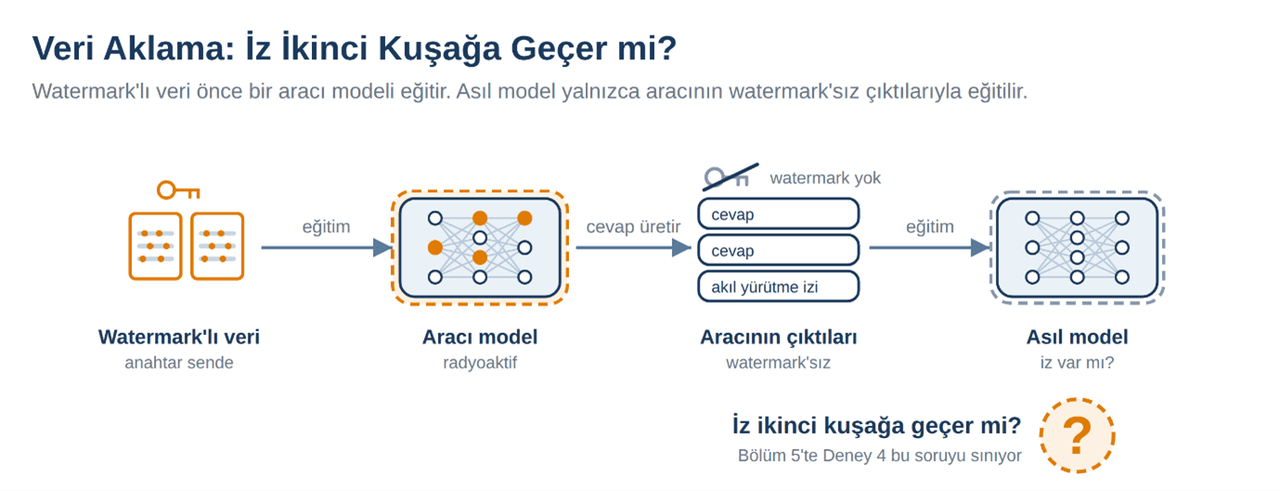
Data Clarification System (Generated with Artificial Intelligence.)
There is also a more indirect form of defense: watermarked data is never used directly; instead, an intermediary model is first trained on this data, and then the main model is trained on the outputs of the intermediary. This method is called data sanitization. In this case, does the watermark trace pass to the second generation? This is the question addressed by the second experiment in Section 3.
Key inference: A model trained on watermarked data carries the trace in the contexts it has seen. A properly configured test transforms this trace into strong evidence; an improperly configured test can falsely indicate contamination even in a clean model.
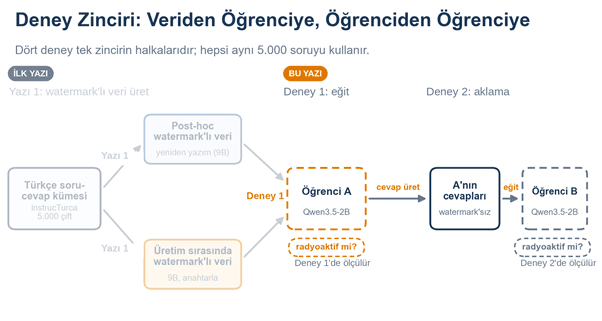
Chain of Experiments (Generated with Artificial Intelligence)
The processes described in Section 2 are tested on Turkish data in this section. The experiments are designed as a four-stage chain and span two papers. The first paper produces watermark-laden Turkish data in two ways: by post-hoc marking of existing text and by marking during answer generation. The two experiments in this paper use this data to train a model (Experiment 1) and then train a second-generation model using the outputs of the trained model (Experiment 2). A preliminary control test is conducted before either of these two. All four experiments use the same question set, ensuring comparisons are made on identical content.
Models: All models are selected from the Qwen3.5 family, which share the same tokenizer; tokenizer incompatibility, as noted in Section 2, would reduce the test’s power. The watermarking and teacher model is Qwen3.5-9B, including the post-hoc rewriting method from the first paper. Students are trained from the Qwen3.5-2B base model. No model exceeds 10 billion parameters.
Data: Five thousand question-answer pairs are selected from the open-source Turkish instruction dataset InstrucTurca【23】; additionally, 500 answers not used in training are reserved for loss measurement, and 300 answers are set aside for post-hoc scanning from the first paper. This dataset is synthetic, generated by machine translation of English instruction sets; the key point is that the answers are existing texts never marked with the key. Answers average 282 tokens in length; the total dataset is approximately 1.4 million tokens. The watermark is always in the answers, as loss is computed only over the answer portions during training.
Watermark: Gumbel-max with window size k = 2. As shown in Section 2, the effect of k varies with data size; this dataset is larger than a small evaluation test but smaller than large instruction sets, and k = 2 provides a balanced choice for this intermediate range.【24】 To avoid being disruptive at the sequence level, repeated windows within the same answer are skipped.【25】
Key: Twenty candidate keys are tested on watermark-free Turkish text, and the key with a p-value distribution closest to uniform is selected (Kolmogorov-Smirnov test). This step is especially important for Turkish because its agglutinative structure causes certain token patterns to repeat excessively. All experiments in this paper use the same key selected in the first paper.
Detection: Detection is performed at two levels using a reading mode: each window within the same answer is scored once, and each (window, prediction) pair across the entire dataset is scored once. Once the model’s predictions are computed, re-scoring with different keys incurs nearly zero additional cost; therefore, in each test, five incorrect keys are used alongside the correct key.
Table 6: Estimated Duration of Experiments (single H100)
The total of the four steps is approximately 3 hours.
The raw material for the experiments in this text consists of three datasets generated in the first text【26】; all derive from the same 5,000 questions.
Production data: Qwen3.5-9B generated one watermark-free and one watermark-embedded response to each of the 5,000 questions (T = 0.8). In watermark-embedded responses, the median −log₁₀(p) = 7.6; 99.8% of 400-token responses exceeded the p < 0.01 threshold. The false alarm rate for watermark-free (clean) responses was 1.2%. The signal accumulates steadily along the response: median at 25 tokens is 1.3, at 100 tokens is 3.4, and at 400 tokens is 11.2.
Post-hoc data: Original answers from InstrucTurca were rephrased using watermark-embedded Qwen3.5-9B. A sweep tested four model sizes (0.8B, 2B, 4B, 9B) and three temperature values (0.7, 1.0, 1.2); semantic similarity, length band, and detectability were jointly evaluated, leading to the selection of Qwen3.5-9B with T = 1.2 (sweep results: semantic similarity 0.933, median −log₁₀(p) = 106; overall median across all data: 102). Long responses were split into segments, with each segment rewritten using the previous segment as context. When all 5,000 answers were rewritten under these settings, 2,141 (42.8%) fell outside the length band of 75–125% of the original length; these were not removed from the training data. The cost is fluency: at high temperature, some sentences exhibit insertions and word boundary shifts.
Rewriting control: Same settings as post-hoc data but without watermarking. The post-hoc data carries not only the watermark but also the rewriting model’s stylistic signature; this control represents the condition “style present, watermark absent.”
Production data and post-hoc data were both generated using the same model (Qwen3.5-9B), differing only in temperature (T = 0.8 and T = 1.2). The average score per token is 3.45 for post-hoc data, 1.35 for production data, and 1.01 for clean data (chance level: 1.0): the signal in post-hoc data is approximately seven times stronger than in production data. One of the questions in Experiment 1 is whether this difference transfers to the model.
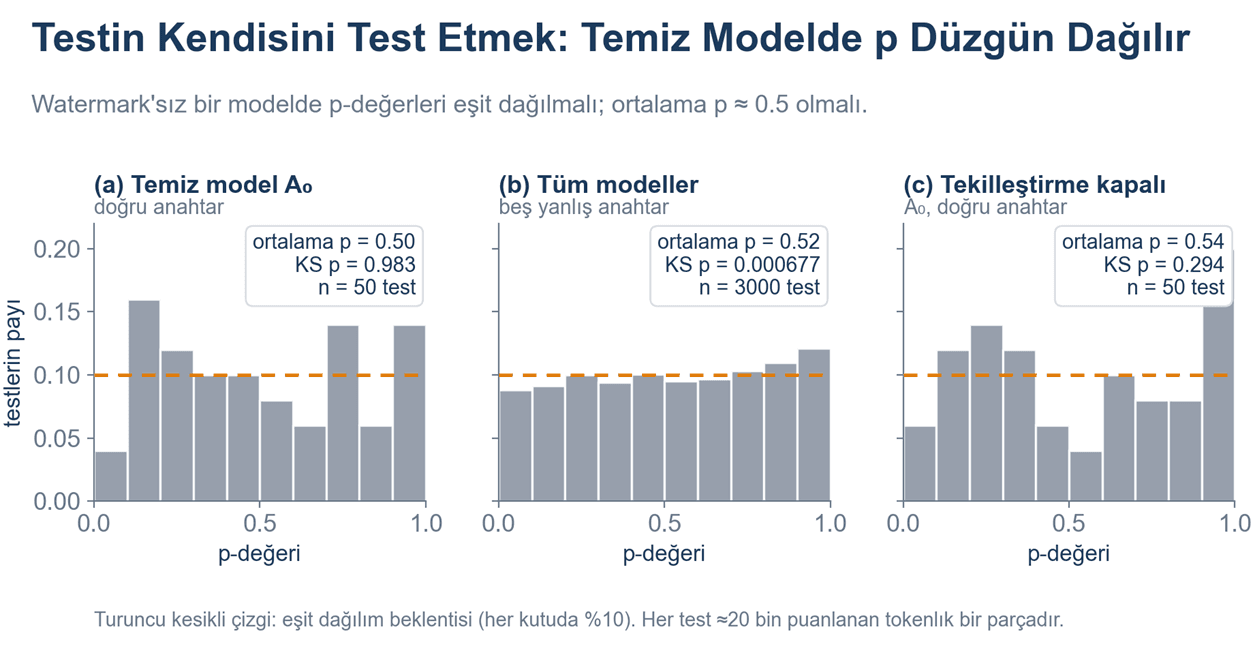
Preliminary Control: False Alarm Test on Clean Model (Generated by Artificial Intelligence.)
Setup: Two negative controls are used: a model never trained on watermark-embedded data (A₀, Experiment 1) is tested with the correct key, while watermark-embedded models are tested with five incorrect keys. In both cases, the mean p-value should be approximately 0.5; otherwise, all results are invalid. To demonstrate the scale of the issue in Turkish data, the same test is also run with deduplication turned off.
Results: For the clean model, mean p = 0.50 (KS p = 0.98); for the five incorrect keys, mean p = 0.52 (3,000 tests). The accepted range of 0.4–0.6 is satisfied, confirming reliability of subsequent results. With deduplication turned off, the clean model yields mean p = 0.54 (KS p = 0.29): the expected inflation is not observed in this setup. The pooled KS test for incorrect keys gives p = 0.0007; individual key-based KS p-values range from 0.02 to 0.54. Deviations are minimal: p < 0.05 occurs in 4.2% of cases (expected 5%), and p < 0.01 occurs in 0.7% (expected 1%); the test does not inflate false alarms but behaves slightly conservatively.
Question: How much watermark-embedded data must a model see before the signal becomes detectable? Does it matter whether the watermark was applied during data generation or post-hoc?
Setup: Student model A is fully fine-tuned for three epochs starting from the Qwen3.5-2B base model; full fine-tuning is preferred because LoRA weakens the watermark signal, as shown in Table 2 of Section 2. The total data volume is held constant across all conditions; watermark-embedded data constitutes proportion ρ, with the remainder filled by original answers from the dataset. Eight conditions are tested.
Table 7: Eight Conditions of Experiment 1
A₀ is the negative control; production and post-hoc data are compared at ρ = 10%, 50% and 100%; A-rerewrite is used to distinguish whether the post-hoc signal originates from style or from the watermark.
Although the last row may appear optional, it is a mandatory control. A model trained on post-hoc data learns both the watermark and the rewriting model’s style. A model trained with rewrite control represents the condition “style present, watermark absent.” If a signal is detected in this model, all post-hoc results are suspect.
Detection is performed on each A model using the watermark-bearing data itself in reading mode. Two downstream measurements are taken to assess whether contamination has corrupted the student: multiple-choice accuracy on the Turkish extended version of GPQA (ytu-ce-cosmos/gpqa-extended_tr)【27】 and loss on 500 unseen InstrucTurca responses. Confidence intervals are calculated via bootstrapping due to a single training run.
Expectation: A strong signal is expected at ρ = 100%, a noticeable one at 50%, and a weak or marginal one at 10%. In Sander et al.’s study, with a larger student model (7B) and approximately ten times more data (14M tokens), a significant signal was reported even when only 5% of the data was watermarked.【28】 Since this setup is smaller, a weaker result than that ratio is expected. In post-hoc conditions, it is anticipated that the per-token signal difference measured in the initial production experiment will also manifest as radioactivity.
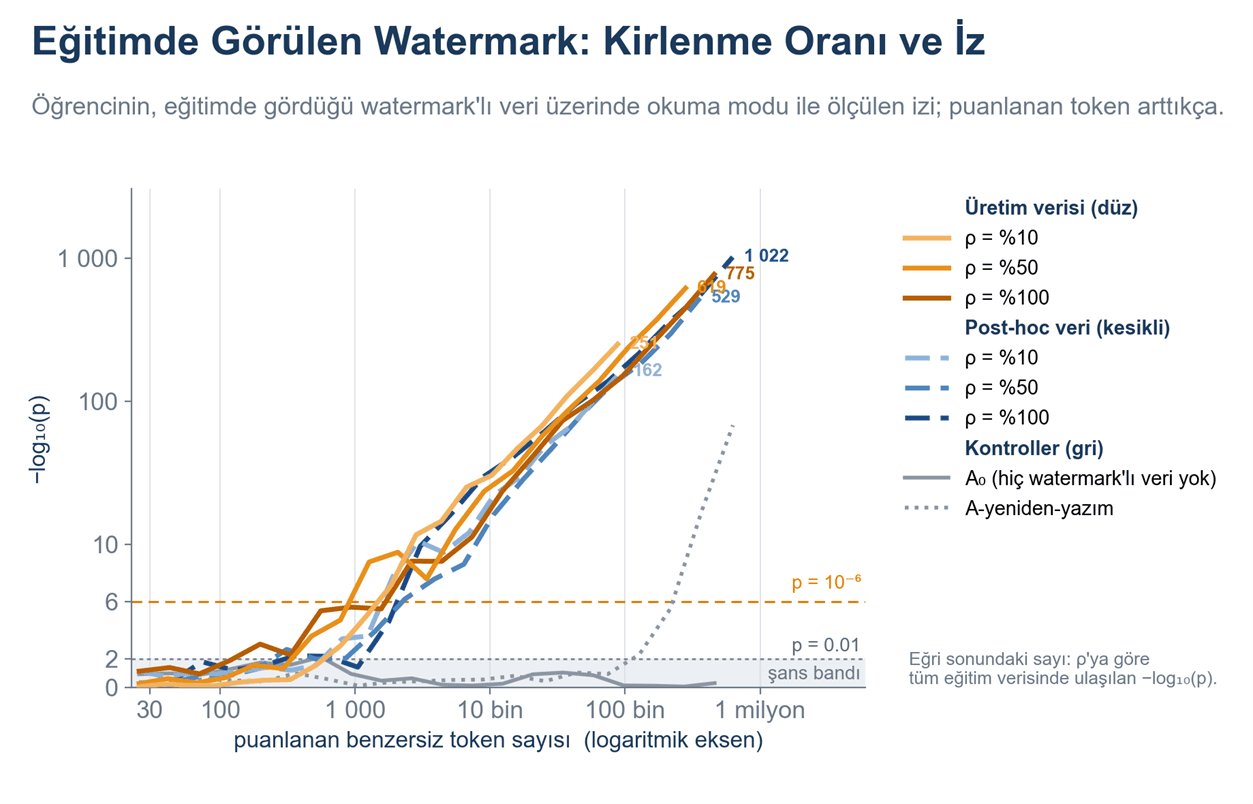
Trace (Generated by Artificial Intelligence) Based on Watermarked Data Ratio (ρ)
Findings: When read on watermark-bearing production data, the untrained A₀ remained in the chance band (−log₁₀(p) = 0.30; average p across false keys was 0.47). Among the six models trained on watermark-bearing data, the average p across false keys was 0.53 (expected 0.5), and all showed a systematic increase in signal with ρ. The final −log₁₀(p) on production data was 251, 619, and 775 for ρ = 10%, 50%, and 100%; on post-hoc data, it was 162, 529, and 1,022. Thus, even a small contamination rate of ρ = 10% yields a signal far above the p < 10⁻⁶ threshold (based on N ≈ 88,000–94,000 scored tokens). This implies a stronger signal than anticipated (“weak or marginal at 10%”): even with a small student model and limited data, a signal is detectable when only one-tenth of the training data is marked.
Post-hoc and production conditions remained at similar magnitudes: the ratio of final −log₁₀(p) (post-hoc / production) was 0.64, 0.85, and 1.32 for ρ = 10%, 50%, and 100%. In the initial production experiment, the per-token signal in post-hoc data was approximately seven times stronger; this difference did not transfer to the model. A plausible explanation is that the student learns not the watermark in the text, but the altered prediction distribution caused by the watermark, and this bias saturates over the three phases; thus, the limiting factor for radioactivity is not the watermark’s strength in the text but how much the model can learn. Note on controls: even when reading the post-hoc data itself, the untrained A₀ yields a value of 50, because the text itself is marked and the model “leaks” the signal in reading mode when it correctly predicts the text; this forms the baseline for the post-hoc test. A-rewrite yields 68, slightly above this baseline but far below the post-hoc models’ values of 162–1,022; thus, the signal in post-hoc conditions originates from the watermark, not from the rewrite model’s style.
Table 8: Experiment 1 Results
In every model trained with watermark-labeled data, the watermark signal is far above the p = 10⁻⁶ threshold (−log₁₀(p) = 162–1022); it remains within the A₀ chance band but is well below the performance of A-rephrasing post-hoc models. GPQA-TR accuracy is not discriminative across models; it increases with separated data loss at ρ = 100%.
Subtask: GPQA-TR accuracy across all models ranges between 0.28 and 0.31 (chance level 0.25; confidence interval ±0.04): on the 2B base model this test is not discriminative, therefore the phrase “no damage in subtask” is replaced with “not measurable by this test.” Separated data loss shows variation: A₀ 1.43; A-generation-100 2.27 (+0.84); A-posthoc-100 1.63; A-rephrasing 1.65. Intermediate ρ values show losses of 1.44 / 1.50 (generation, 10% / 50%) and 1.43 / 1.48 (post-hoc). Since post-hoc and rephrasing controls show similar losses, most of the loss under post-hoc conditions stems from rephrasing style rather than from the watermark. The larger loss in generation data at ρ = 100% is likely due to the 9B model’s answer distribution differing from original answers; however, no control trained on unlabeled 9B data exists to disentangle this from watermark effects. Notably, at ρ = 10% the loss is indistinguishable from A₀ while the watermark signal remains detectable.
Question: If a new model is trained using outputs from a watermark-labeled intermediary model, but without any watermark applied to those outputs, can the watermark signal still be detected in the second model?
Setup: The intermediary model is the most radioactive from Experiment 1 (A-generation-100). This model generates responses to the same 5,000 questions without applying any watermark. A critical point here is that, as shown in Section 2, the watermark signal is only present in contexts the model encountered during training. If the intermediary model is asked questions from unrelated domains, its responses will not reflect those contexts and the watermark cannot be detected from the outset. Therefore, the same questions are used for the intermediary model; this corresponds to the real-world scenario where the intermediary model is used within its own target domain.
The intermediary’s bias manifests in its most probable prediction. Greedy decoding preserves this bias by selecting the most probable token at each step, while sampling with temperature dilutes it. Therefore, the intermediary generates responses twice: once with greedy decoding and once with temperature T = 0.7. Each set of outputs is used to train a new Qwen3.5-2B student model (B), with the same settings as in Experiment 1. As a control, a second student model B′ is trained using greedy outputs from the clean model (A₀).
Table 9: Three Conditions of Experiment 2
B-greedy and B-sampling are trained on the greedy and T = 0.7 responses of the radioactive intermediary respectively; B′ is trained on greedy responses from the clean model.
Measuring the watermark ring by ring: A separate measurement is taken at each stage of the chain to observe where the signal degrades:
Expectation: A noticeable degradation is expected at each stage. The intermediary’s bias is only slightly stronger than chance in selecting high-score tokens according to the key; this is a much weaker signal than the original watermark. If a signal is detected in B, the most likely explanation is greedy decoding.
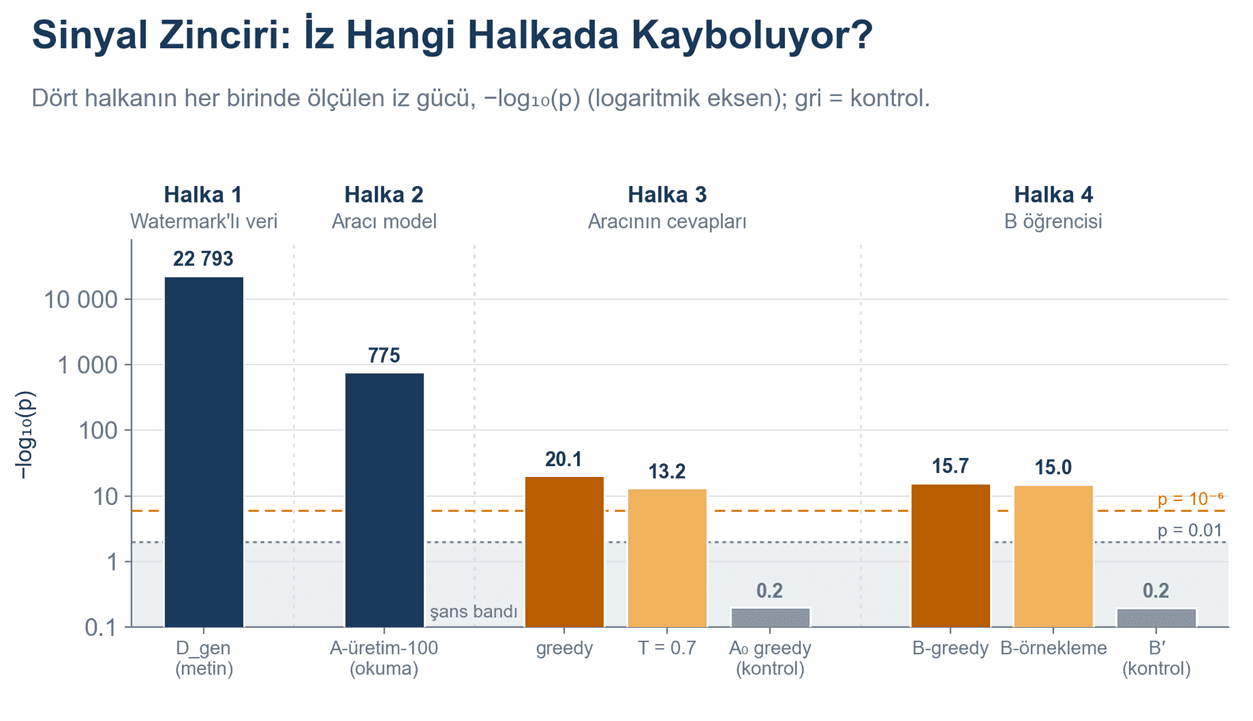
Power Along the Chain of Authorization (Generated by Artificial Intelligence.)
Findings: The watermark weakened step by step along the chain but did not break. In the original watermarked data, −log₁₀(p) = 22 793 (N = 787 656); in the model, it was 775. The watermark remains detectable in the model’s watermark-free greedy responses: −log₁₀(p) = 20.1 (N = 644 763; p ≈ 8×10⁻²¹), yet the average score per token is only 1.01. With T = 0.7 sampling, it rises to 13.2, while in the control model’s (A₀) responses it is 0.2. Both second-generation students carry the key: B-greedy yields 15.7 (p ≈ 2×10⁻¹⁶), B-sampling yields 15.0 (p ≈ 1×10⁻¹⁵); the control B′ is 0.2, within chance levels. No ring in the false keys deviates from chance (median −log₁₀(p) < 0.6). All four measurements are statistically significant.
The first half of the hypothesis is confirmed: the watermark weakened at each ring (22 793 → 775 → 20 → 16), because the model’s bias only slightly favors high-scoring tokens aligned with the key over random chance. The second half—that greedy decoding would be uniquely detectable—holds only at the third ring: the model’s responses show greedy at 20.1 and sampling at 13.2 (sampling dilutes the watermark), but this difference vanishes among the B students (15.7 and 15.0). A plausible explanation is that B learns the watermark not from individual responses but from the overall distribution of the model’s outputs: sampling alters one response but not the underlying distributional tendency. The B′ control ensures two things: the student was trained on the same questions, so the question set itself does not carry the watermark; and the same training protocol does not generate the watermark spontaneously. What this section does not test is whether the watermark persists in a student trained on the model with fewer questions or a different question set.
Table 10: Experiment 2 Results
The watermark is present both in the model’s responses (20.1 and 13.2) and in the second-generation students (15.7 and 15.0); the control B′ remains within chance levels (0.2). No signal is detected in any ring of the false keys.
Subtask: GPQA-TR accuracy is near chance levels in all three B’s (0.28, 0.29, 0.29); this test, like in Experiment 1, is not discriminative. The separated data loss is higher in the two B’s derived from the watermarked model than in the control (3.19 and 2.96; control 2.19). This difference is consistent with the increase in the model’s own loss (2.27, compared to 1.43 in A₀); no control isolates the watermark effect from the distributional effect.
Table 11: Objectives and One-Sentence Results of Experiments
It is more useful to think of the limitations not as a checklist but as a threat model. The key question is: who holds the key, who has access to the model, and at what scale is it operating?
Key holder: The radioactivity test requires the key. Anthropic’s detection API is in limited preview and is accessible only to parties such as moderators, law enforcement, media, fact-checking organizations, and independent researchers.【29】 Thus, watermark-based detection is structurally closed as a capability, independent of its technical strength. The statement “it can be verified whether the evaluation test has been contaminated” is practically true only for the party that itself marks the test.
Model access: Access to model weights provides a significantly stronger test than API access alone. The API owner can make testing difficult by limiting the number of required queries.
Scale: The largest controlled from-scratch training experiment was conducted with 1 billion parameters and 10 billion tokens.【30】 Does a contamination trace persist in datasets of trillions of tokens at a rate of one in a thousand? This has not yet been measured.
Scope: Radioactivity has been demonstrated only for token-level bias and hash-based schemes. It is incorrect to claim “all watermarks are radioactive.” Moreover, the test yields a statistical result, not a definitive conclusion: under certain schemes and poorly constructed tests, clean models may also appear significant. There is no absolute solution that eliminates false alarms entirely; a properly constructed test only maintains the probability of false alarms at a known and controlled level.
Training method: All results are based on supervised fine-tuning and distillation. It is currently unknown how radioactivity behaves under reinforcement learning or preference optimization for indirect learning.
At first glance, what watermarking does is modest: it causes a model to make the random choices it would make anyway, but using values derived from a secret key. The first paper addressed what this intervention promises at the text level and where it falls short.
Yet the same mechanism proves unexpectedly powerful in a problem it was never designed for: proving what a model was trained on. If the data is labeled and the key is held by the data owner, and the scheme leaves an imprint at the token level, then if the model truly conforms to the data and the test is properly constructed, a statistically valid proof can be obtained without knowing the model’s training data. If any one of these conditions is missing, the result either remains silent or produces false alarms.
Therefore, watermarking should be viewed as a labeling infrastructure. The question it answers is not “Is this model dirty?” but “Did labeled data enter this model?” This is a more limited claim than the former, but it is a provable one; provable claims are rare in the literature on data contamination.
Evaluation of experiments: The findings in Section 3 reinforce the above framework in two key ways. At small scale, the threshold of radioactivity turned out lower than expected: even when only 10% of the training data was labeled, an imprint readable at p < 10⁻⁶ was detected in a 2B student model; this shows that the condition in Section 2—that contamination must be large enough to be effective—is overly strict at this scale. The imprint did not vanish when passing through an intermediary model: the intermediary’s watermark-free outputs were slightly biased against the key (−log₁₀(p) = 20.1), and the imprint remained detectable in a new student model trained on these outputs (−log₁₀(p) = 15.7; control: 0.2). Thus, the data owner’s ability to exert control persists for at least two generations in this setup: it is possible to monitor the second generation without ever seeing the intermediary model. These results pertain to a single setup, a single training condition, and the 2B scale; larger-scale repetitions are needed to assess generalizability. Knowing under which conditions a method works is more useful than merely knowing that it works.
Open questions, in order of priority, are as follows: resilience against intermediary models and rephrasing-based obfuscation, radioactivity at full scale in models trained from scratch, the balance between detection sensitivity and radioactivity for window size, transferability of imprints in reinforcement learning, false accusation attacks, and perhaps most importantly, who will have access to the keys. This final question is not technical, but it determines who will benefit from the method in practice.
Anthropic. “How Claude's text watermark works.” August 14, 2026. Accessed October 5, 2026.https://www.anthropic.com/news/claude-text-watermark
Erdem, Yusuf Erdem. "LLM Watermarking (1/2): İz Bırakmak, Çalışma Prensipleri ve Bedelleri." *KÜRE*. October 24, 2026. Accessed October 15, 2026.https://kureansiklopedi.com/tr/detay/llm-watermarking-12-iz-birakmak-calisma-prensipl-2
Fernandez, P., A. Chaffin, K. Tit, V. Chappelier, T. Furon. “Three Bricks to Consolidate Watermarks for Large Language Models.” *arXiv* 2023. Accessed October 6, 2026.https://arxiv.org/abs/2308.00113
Fernandez, P., T. Sander, H. Elsahar et al. “How Good is Post-Hoc Watermarking With Language Model Rephrasing?” *arXiv* 2025. Accessed October 12, 2026.https://arxiv.org/abs/2512.16904
Oren, Y., N. Meister, N. Chatterji, et al. “Proving Test Set Contamination in Black Box Language Models.” *arXiv* 2023. Accessed October 7, 2026.https://arxiv.org/abs/2310.17623
Rialland, R., S. Veitner, T. Ruiz. “Watermarking in vLLM.” *vLLM Blog*. September 24, 2026. Accessed October 8, 2026.https://vllm.ai/blog/2026-09-24-watermarking-in-vllm
Sablayrolles, A., M. Douze, C. Schmid, H. Jégou. “Radioactive Data: Tracing Through Training.” *arXiv* 2020. Accessed October 14, 2026.https://arxiv.org/abs/2002.00937
Sander, T., H. Chang, T. Soucek et al. “TextSeal: A Localized LLM Watermark for Provenance & Distillation Protection.” *arXiv* 2026. Accessed October 3, 2026.https://arxiv.org/abs/2605.12456
Sander, T., P. Fernandez, A. Durmus, M. Douze, T. Furon. “Watermarking Makes Language Models Radioactive.” *arXiv* 2024. Accessed October 9, 2026.https://arxiv.org/abs/2402.14904
Sander, T., P. Fernandez, S. Mahloujifar, A. Durmus, C. Guo. “Detecting Benchmark Contamination Through Watermarking.” *arXiv* 2025. Accessed October 10, 2026.https://arxiv.org/abs/2502.17259
Shi W., A. Ajith, M. Xia et al. “Detecting Pretraining Data from Large Language Models.” *arXiv* 2023. Accessed October 2, 2026.https://arxiv.org/abs/2310.16789
Turkish NLP Suite. "InstrucTurca." Hugging Face. Accessed October 15, 2026.https://huggingface.co/datasets/turkish-nlp-suite/InstrucTurca
Yıldız Teknik Üniversitesi COSMOS Araştırma Grubu. “GPQA Extended Translated to Turkish Language (gpqa-extended_tr).” Hugging Face. Accessed October 13, 2026.https://huggingface.co/datasets/ytu-ce-cosmos/gpqa-extended_tr
Zheng-Wei, J. T., R. Wang, R. Jia. “Proving Membership in LLM Pretraining Data via Data Watermarks.” *Findings of Association for Computational Linguistics* (2024): 13306–13320. Accessed October 11, 2026.https://aclanthology.org/2024.findings-acl.788.pdf
[1]
R. Rialland, S. Veitner, T. Ruiz, “Watermarking in vLLM,” *vLLM Blog*, September 24, 2026. Accessed October 8, 2026.
[2]
T. Sander, H. Chang, T. Soucek et al. "TextSeal: A Localized LLM Watermark for Provenance & Distillation Protection." *arXiv* 2026, 8. Accessed October 3, 2026.
[3]
A. Sablayrolles, M. Douze, C. Schmid, H. Jégou, “Radioactive Data: Tracing Through Training,” *arXiv* 2020, 1-2. Accessed October 14, 2026.https://arxiv.org/abs/2002.00937T. Sander, P. Fernandez, A. Durmus, M. Douze, T. Furon, “Watermarking Makes Language Models Radioactive,” *arXiv* 2024, 3. Accessed October 9, 2026.https://arxiv.org/abs/2402.14904
[4]
Sander, T., P. Fernandez, A. Durmus, M. Douze, T. Furon, “Watermarking Makes Language Models Radioactive,” 1, 4-5.
[5]
Sander, P., Fernandez, A., Durmus, M., Douze, T., Furon, T. “Watermarking Makes Language Models Radioactive,” 2.
[6]
Sander, P., Fernandez, A., Durmus, M., Douze, T., Furon, “Watermarking Makes Language Models Radioactive,” 3, 21–22.
[7]
Sander, T., P. Fernandez, A. Durmus, M. Douze, T. Furon, “Watermarking Makes Language Models Radioactive,” 9, 23.
[8]
Sander, P., Fernandez, A., Durmus, M., Douze, M., Furon, T., “Watermarking Makes Language Models Radioactive,” 1–2, 4; Oren, Y., Meister, N., Chatterji, N. et al., “Proving Test Set Contamination in Black Box Language Models,” *arXiv* 2023, 2–4. Accessed October 7, 2026.
[9]
T. Sander, P. Fernandez, S. Mahloujifar, A. Durmus, C. Guo, “Detecting Benchmark Contamination Through Watermarking,” *arXiv* 2025, 1-3. Accessed October 10, 2026.
[10]
T. Sander, P. Fernandez, S. Mahloujifar, A. Durmus, C. Guo, “Detecting Benchmark Contamination Through Watermarking,” 3–4, 10.
[11]
T. Sander, P. Fernandez, S. Mahloujifar, A. Durmus, C. Guo, “Detecting Benchmark Contamination Through Watermarking,” 5, 9.
[12]
T. Sander, H. Chang, T. Soucek et al. "TextSeal: A Localized LLM Watermark for Provenance & Distillation Protection." *arXiv* 2026, 14–15, 38–40. Accessed October 3, 2026.
[13]
Sander, T., Chang, H., Soucek, T. et al. “TextSeal: A Localized LLM Watermark for Provenance & Distillation Protection,” 6-7, 16, 40.
[14]
Sander, P., Fernandez, A., Durmus, M., Douze, T., Furon, “Watermarking Makes Language Models Radioactive,” 1-2.
[15]
Sander, T., Chang, H., Soucek, T. et al. "TextSeal: A Localized LLM Watermark for Provenance & Distillation Protection," 14-15.
[16]
T. Sander, P. Fernandez, S. Mahloujifar, A. Durmus, C. Guo, “Detecting Benchmark Contamination Through Watermarking,” 8, 16.
[17]
Sander, T., P. Fernandez, A. Durmus, M. Douze, and T. Furon, “Watermarking Makes Language Models Radioactive,” 8.
[18]
Sander, T., P. Fernandez, A. Durmus, M. Douze, and T. Furon, “Watermarking Makes Language Models Radioactive,” 4-5, 8, 19.
[19]
Sander, T., P. Fernandez, A. Durmus, M. Douze, and T. Furon, “Watermarking Makes Language Models Radioactive,” 5-6, 19.
[20]
P. Fernandez, T. Sander, H. Elsahar et al. “How Good is Post-Hoc Watermarking With Language Model Rephrasing?” arXiv 2025, 4, 6, 19. Accessed October 12, 2026.
[21]
T. Sander, P. Fernandez, A. Durmus, M. Douze, and T. Furon, “Watermarking Makes Language Models Radioactive,” 10.
[22]
T. Sander, P. Fernandez, S. Mahloujifar, A. Durmus, and C. Guo, “Detecting Benchmark Contamination Through Watermarking,” 10.
[23]
Turkish NLP Suite, “InstrucTurca,” Hugging Face, Accessed October 15, 2026.
[24]
T. Sander, P. Fernandez, S. Mahloujifar, A. Durmus, and C. Guo, “Detecting Benchmark Contamination Through Watermarking,” 8; T. Sander, P. Fernandez, A. Durmus, M. Douze, and T. Furon, “Watermarking Makes Language Models Radioactive,” 6, 9–10.
[25]
R. Rialland, S. Veitner, T. Ruiz, “Watermarking in vLLM.”
[26]
Yusuf Erdem Erdem, "LLM Watermarking (1/2): İz Bırakmak, Çalışma Prensipleri ve Bedelleri," *KÜRE*, October 24, 2026. Accessed October 15, 2026.
[27]
Yıldız Teknik Üniversitesi COSMOS Araştırma Grubu. "GPQA Extended Translated to Turkish Language (gpqa-extended_tr)." Hugging Face, Accessed October 13, 2026.
[28]
T. Sander, P. Fernandez, A. Durmus, M. Douze, T. Furon, “Watermarking Makes Language Models Radioactive,” 6–8.
[29]
Anthropic, “How Claude's text watermark works,” August 14, 2026. Accessed October 5, 2026.
[30]
T. Sander, P. Fernandez, S. Mahloujifar, A. Durmus, C. Guo, “Detecting Benchmark Contamination Through Watermarking,” *arXiv* 2025, 1-2. Accessed October 10, 2026.

How Are Traces Left and Detected?
How Does Watermark Interfere with the Selection Step?
How Is the Trace Detected?
Detail: The Mathematics of Detection
Radioactivity: Did This Text Enter the Training Data of the Relevant Model?
What Forms Does Data Contamination Take?
How Is a Watermark Transferred Through Training?
How Is a Watermark Transferred Through Distillation?
How Is a Watermark Read in the Suspicious Model?
What Determines Watermark Strength?
How Can False Alarms Be Prevented?
Can the Trace Be Erased?
Experiments
Common Setup
Data Borrowed from the First Text
Preliminary Control: Is the Test Reliable?
Experiment 1: Training with Watermark-Embedded Data
How to Interpret the Results?
Experiment 2: Distillation from a Radioactive Model
How Are the Results Interpreted?
Summary of Experiments
Limitations of the Measurement Method
Conclusion