


Bu içerik Türkçe olarak yazılmış olup yapay zeka ile otomatik olarak İngilizceye çevrilmiştir.
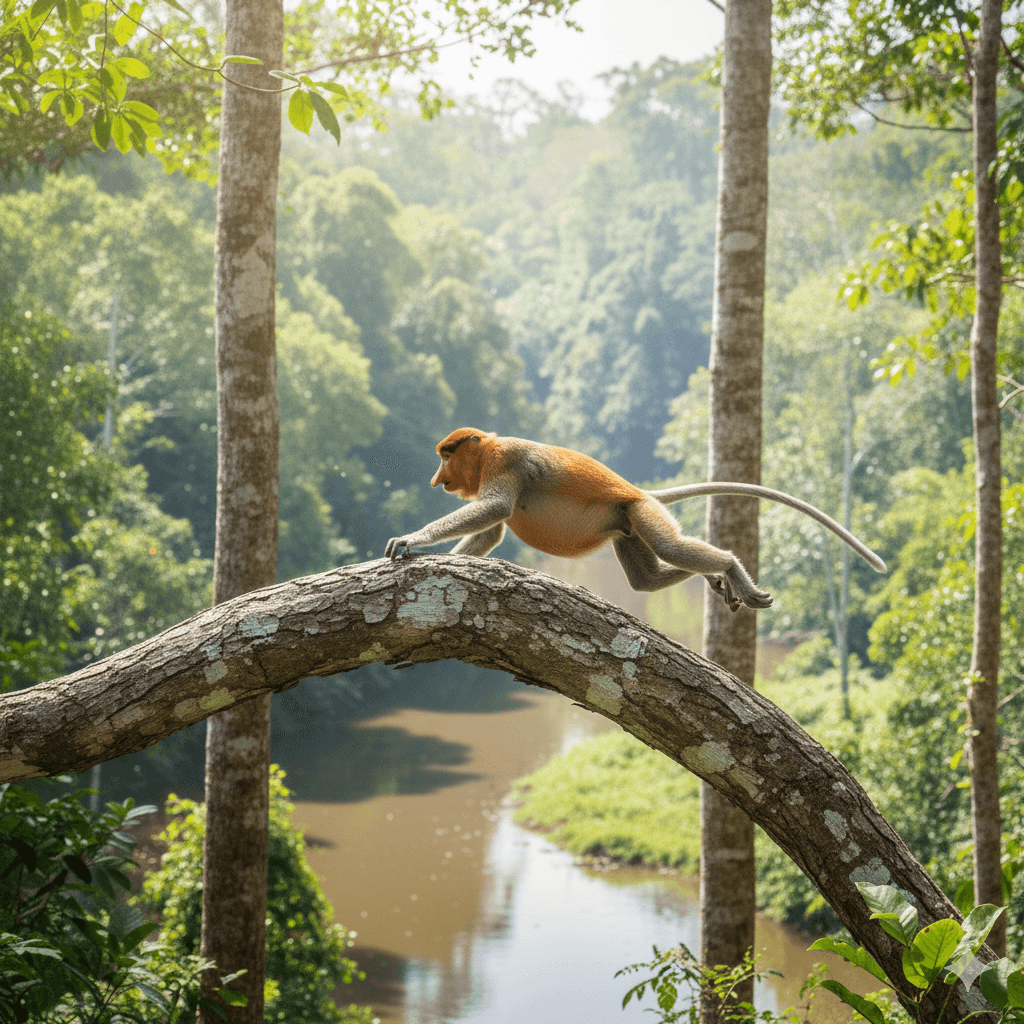
Uzun Burunlu Maymun (Nasalis larvatus) (Görsel Yapay Zeka ile Oluşturulmuştur)
Nasalis larvatus (Long-nosed Monkey or Proboscis Monkey) is a primate species belonging to the order Primates, family Cercopithecidae (Old World monkeys), and subfamily Colobinae. Nasalis is a monotypic genus, meaning it contains only this single species. Endemic to the island of Borneo, it is the largest-bodied member of the Colobinae subfamily. Phylogenetically, it forms part of the “odd-nosed” group or tribe Rhinopithecini together with the genera Rhinopithecus (snub-nosed monkeys), Pygathrix (douc langurs), and Simias (pig-tailed langur).

Long-nosed Monkey (Nasalis larvatus) (Image Generated by Artificial Intelligence)
Nasalis larvatus exhibits one of the most pronounced cases of sexual dimorphism among primates. Adult males are significantly larger and heavier than females; males weigh between 16 and 22 kg while females weigh between 7 and 12 kg.【1】 The most distinctive morphological feature of the species is its large, pendulous nose, which in adult males can extend down to the chin and reach a length of approximately 17.5 cm.【2】 Females and juveniles have smaller, upturned noses.
Adults have fur coloration that is brick-red or orange on the back, darker tones on the head and shoulders, and gray on the arms, legs, and tail. The scrotum of males is black and the penis is bright red. Infants are born with a dark blue facial color and nearly black fur; the facial color changes to gray by about 2.5 months and to the creamy tone of adults by 8.5 months. The webbing between fingers and toes is a key anatomical adaptation supporting the species’ swimming ability. Additionally, due to a specialized multi-chambered stomach adapted for digesting cellulose-rich foods, individuals have a characteristic pot-bellied appearance.
The species is endemic to the island of Borneo in Southeast Asia and is found within the territorial boundaries of Brunei, Indonesia, and Malaysia. Nasalis larvatus primarily inhabits coastal areas, mangrove forests, riparian dipterocarp forests, and peat swamps. It rarely ventures more than 600 meters away from rivers or other water sources, and its inland habitats are restricted to areas accessible via river corridors.
Nasalis larvatus has a folivorous and frugivorous diet. The bulk of its diet consists of young leaves and unripe fruits; it also consumes seeds, sprouts, flowers, and some invertebrates. Simple sugars found in ripe fruits often cause excessive gas buildup in its fermentation-based digestive system, so they are generally avoided; when fruits are consumed, the animal typically eats the seeds and unripe portions rather than the fleshy parts.
The species possesses a foregut fermentation digestive system. It is the only primate known to regurgitate and re-chew its food (regurgitation and remastication) to aid digestion and improve nutrient absorption, a behavior similar to that of ruminants.

Long-nosed Monkey (Nasalis larvatus) (Image Generated by Artificial Intelligence)
These monkeys are diurnal and primarily arboreal, but they enter the water to cross rivers. They are considered among the most skilled swimmers of all primates, capable of diving up to 20 meters underwater and leaping into rivers to escape predators such as crocodiles or to reach opposite banks.
Their social organization consists of “harems” typically comprising one adult male, multiple adult females, and their offspring, as well as all-male “bachelor” groups. Levels of aggression between groups are low, and at night, several groups may gather together in larger aggregations (bands) on trees near rivers for sleeping. It is common for females to disperse from their natal group and transfer to other groups, a pattern that contrasts with the female philopatry seen in many other primate species. The large nose of males is thought to enhance vocalizations through resonance and plays a role in sexual selection.

Long-nosed Monkey (Nasalis larvatus) (Image Generated by Artificial Intelligence)
Reproduction is not strictly seasonal, but births typically occur between February and November. The gestation period averages 166 days and usually results in a single offspring. Females reach sexual maturity at approximately 4 to 5 years of age, while males reach it at around 7 years. Infants are nursed for about 7 months and remain dependent on their mothers until they are about one year old.
Nasalis larvatus is classified as “Endangered” on the International Union for Conservation of Nature (IUCN) Red List.【3】 Populations have declined by approximately 50 percent over the past 40 years due primarily to habitat loss—including destruction of mangrove forests, expansion of oil palm plantations, and logging—and hunting.【4】 The species is listed on Appendix I of the Convention on International Trade in Endangered Species of Wild Fauna and Flora (CITES), which prohibits all international commercial trade.【5】
[1]
New England Primate Conservancy. “Proboscis Monkey, Nasalis larvatus,” Zach Lussier. Access date: 12 February 2026.
[2]
Animal Diversity Web. "Nasalis larvatus." Woltanski, Amy. Access 12 February 2026. https://animaldiversity.org/accounts/Nasalis_larvatus/
[3]
Animal Diversity Web. "Nasalis larvatus." Woltanski, Amy. Access 12 February 2026. https://animaldiversity.org/accounts/Nasalis_larvatus/
[4]
World Land Trust, “Proboscis Monkey (Nasalis larvatus),” World Land Trust, Access date: 12 February 2026.
https://www.worldlandtrust.org/species/mammals/proboscis-monkey/
[5]
Animal Diversity Web. "Nasalis larvatus." Woltanski, Amy. Access 12 February 2026. https://animaldiversity.org/accounts/Nasalis_larvatus/

Uzun Burunlu Maymun (Nasalis larvatus) (Görsel Yapay Zeka ile Oluşturulmuştur)
Henüz Tartışma Girilmemiştir
"Long-nosed Monkey (Nasalis larvatus)" maddesi için tartışma başlatın
Physical Characteristics and Morphology
Distribution and Habitat
Feeding Ecology and Digestion
Behavior and Social Structure
Reproduction
Conservation Status