



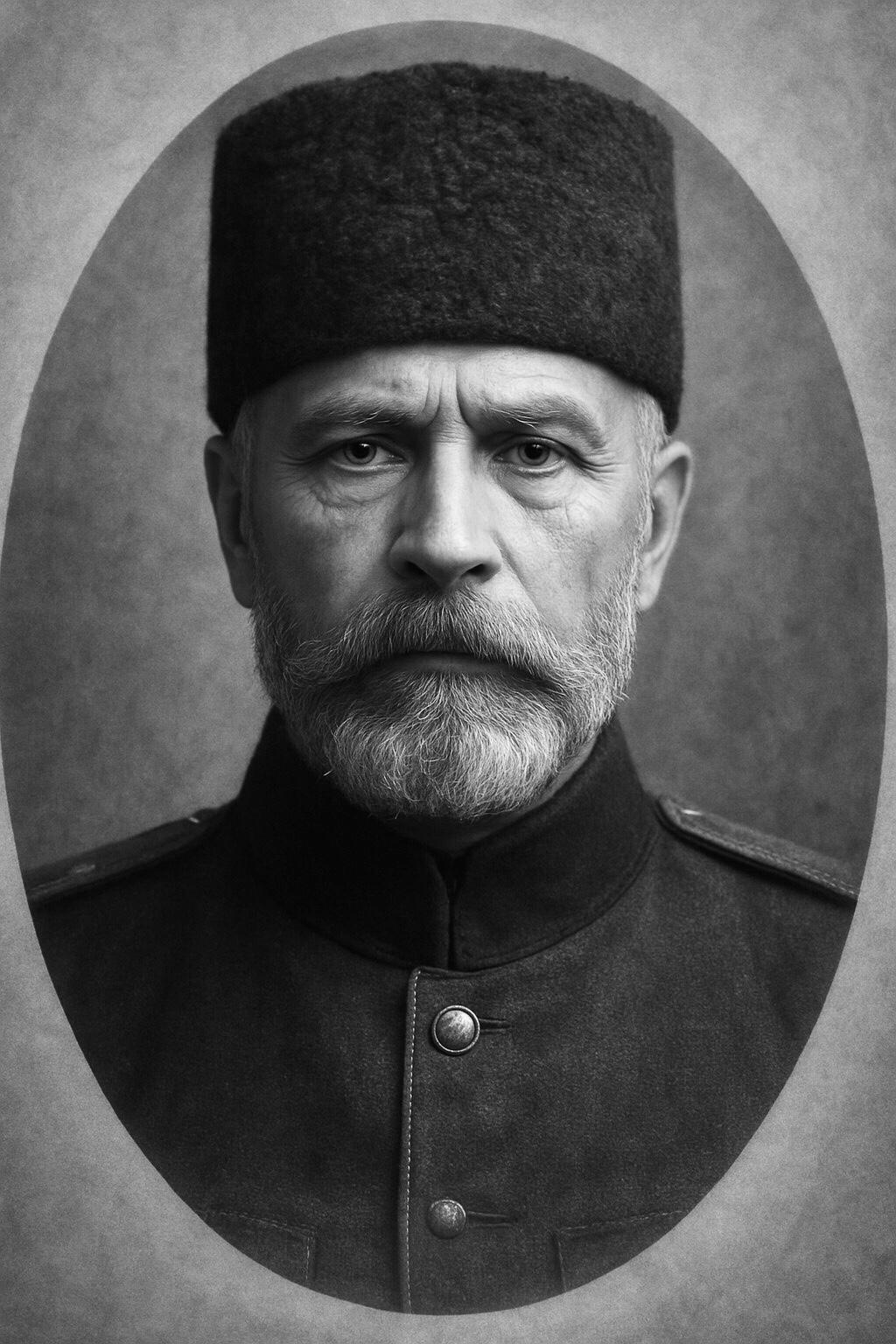
Major Mahmut Sabri Bey
Birth | 1874 Ottoman Empire Syria Damascus | ||||||||
|---|---|---|---|---|---|---|---|---|---|
Babası | Yahya Efendi | ||||||||
Military Rank | Major | ||||||||
Retirement | 24 November 1923 | ||||||||
Medals | Silver Medal of Merit Merit Medal War Medal Iron Cross with Swords | ||||||||
Major Mahmut Sabri Bey was born in Damascus in 1874. He is the son of Yahya Efendi. A distinguished officer who served in both the Ottoman and subsequently the Turkish Republic armies, he is particularly renowned for his heroism during the defense of Seddülbahir in the Gallipoli Campaign.
Major Mahmut Sabri Bey entered the War School on 14 May 1892 and graduated on 14 March 1895 with the rank of second lieutenant (mülazım-ı sani), after which he was assigned to the 5th Army reserve. He began his military career on 15 December 1895 in the 1st Company of the 30th Regiment and was transferred to the 2nd Company of the same regiment on 14 September 1899. He was promoted to first lieutenant (mülazım-ı evvel) on 27 September 1899 and continued his service within his unit.
In December 1906, he was promoted to captain and appointed as acting commander of the 2nd Company. On 21 July 1908, he was assigned to the 4th Company of the 8th Cavalry Regiment in Kırkkilise, and on 6 April 1910, he was promoted again to captain and resumed his duties. After completing his service in his unit until April 1911, he was assigned to the cadre battalion of the 35th Regiment under the 12th Regular Division.
With the outbreak of the Libyan War, he and his unit were tasked with observing and defending Taşoz Island. During the Balkan Wars, he commanded the 1st Battalion of the 35th Regiment for five months in the Paşmaklı-Ahi Çelebi region. He was promoted to major on 19 October 1912. In January 1913, he was assigned to the 1st Kirmasti Reserve Battalion of the Kirmasti Reserve Regiment and participated in offensive operations during the defense of the Çatalca Line alongside his unit.
In April 1914, he was appointed commander of the 3rd Battalion of the 26th Infantry Regiment under the 9th Division of the 3rd Army. In July 1914, he and his unit were deployed to the Gallipoli Peninsula to observe and defend the shores of Seddülbahir.
On the morning of 25 April 1915, as the British 29th Division began landings at five separate points along the Seddülbahir coast (Pınariçi Cove, İkiz Cove, Tekke Cove, Ertuğrul Cove, and Morto Cove), the 3rd Battalion under Major Mahmut Sabri Bey assumed a critical role. The main center of Turkish defense was concentrated in the Seddülbahir region, and the coastline under the 26th Regiment’s responsibility extended over 20 kilometers. The 3rd Battalion had been assigned to the Seddülbahir coastal defense since 22 April 1915.

Seddülbahir Region (AA)
On 25 April 1915, the first day of the Gallipoli Land Battles, Major Mahmut Sabri Bey positioned two companies in defensive positions along the village of Seddülbahir and its western coastline, with two additional companies held in reserve behind the shore.
Combat erupted as Allied forces landed at Pınariçi Cove, Tekke Cove, and İkiz Cove. Although the 12th Company resisted fiercely at Tekke Cove, enemy troops managed to establish themselves on the shore under naval bombardment and reinforcements. British units landing at İkiz Cove advanced toward Karacaoğlan Hill and began encircling the rear of the 12th Turkish Company.
In response, Major Mahmut Sabri Bey deployed his reserve companies to the shore, but realizing their insufficiency, he requested reinforcements from Battalion Commander Major Kadri Bey. The 7th Company under Captain Yusuf Kenan Efendi, transferred from the 2nd Battalion, moved toward Kızıltoprak Position and made contact with the enemy. Captain Yusuf Kenan Efendi took the initiative and ordered a counterattack, which halted the advance of British units at Kızıltoprak and caused them to become disorganized. This resistance provided crucial support to the 3rd Battalion and played a decisive role in maintaining the continuity of Turkish defense throughout the 36-hour battle.
According to Mahmut Sabri Bey’s memoirs, the enemy’s initial bombardment began around 04:30. Despite naval gunfire, Turkish soldiers held their positions. The hunter trenches along the shore were destroyed by enemy fire, yet the soldiers continued their duties despite injuries. Enemy ships attempted to land troops along the stretch from Tekke Point to Seddülbahir Pier but encountered fierce Turkish resistance. Particularly at Ertuğrul Cove, the seawater turned red with the blood of enemy corpses. Turkish resistance significantly impeded the enemy’s advance.

Seddülbahir Fortress (AA)
On 26 April, the enemy continued landing operations. After receiving orders from the regimental command to withdraw, the units under Major Mahmut Sabri Bey began retreating toward Kirte and the second defensive line through Kanlıdere (Kirte Creek). This withdrawal occurred under heavy enemy fire and naval bombardment. According to Mahmut Sabri Bey’s account, contact could not be established with units previously sent to the second line, and soldiers struggled to climb the ridges from the creek under intense fire. The units were unable to reach the planned second defensive positions at Yalçıtepe and the southern edge of Delilesırtı and were forced to retreat as far as Kirte Village.
According to Mahmut Sabri Bey’s memoirs, the retreat began at 15:00 through Kanlıdere. The enemy infantry did not pursue, but naval artillery swept the rear lines. While attempting to reach the second defensive line, Mahmut Sabri Bey came under heavy fire and lost contact with his companies. He described the retreat as follows: “The distance to the enemy was between 500 and 600 meters. At that moment, we opened intense fire and then received orders to withdraw through Kanlıdere toward Kirte and the second positions. Our forces retreated toward the creek and descended into it.”
Delilesırtı, the ridge where Major Mahmut Sabri Bey’s units retreated from Seddülbahir, is a roughly 4.5 km² area between Zığındere and Kirte Creek. Known to the British as Fir Tree Spur, this region remained a critical defensive line throughout the later stages of the land battles.
On the afternoon of 26 April, following Major Mahmut Sabri Bey’s report, his units withdrew from Kanlıdere toward the second defensive line. The 9th Division Commander, Colonel Halil Sami Bey, ordered the retreating units to hold the Harapkilise (Papazın Çiftliği)-Domuzderesi (Kerevizdere) line and establish a new defensive arrangement.
On 27 April, the enemy line began advancing gradually, and intense fighting ensued. Naval artillery fire continued. By evening, the distance between the opposing forces had narrowed to 600–700 meters.
On 28 April 1915, during the First Battle of Kirte, as the exhausted 26th Regiment on the eastern flank collapsed under enemy pressure, Major Mahmut Sabri Bey assumed command of his reserve group and nearby troops and launched a counterattack against enemy trenches. This advance prompted other units to move forward and contributed to the recapture of several lost positions. The disintegration of French units at this moment played a decisive role in the Turkish defense’s recovery.
In early May, under the reorganization of forces on the Seddülbahir front, his unit remained within the 9th Division’s area of responsibility. The Delilesırtı region was shared between the 25th and 20th Regiments during this period. He also participated in subsequent major battles, including the Second Battle of Kirte (6–8 May 1915) and the Third Battle of Kirte (4 June 1915). These battles were characterized by Turkish units’ determined efforts to hold their positions despite intense enemy artillery fire and numerical superiority. Particularly during the Third Battle of Kirte, enemy assaults following heavy bombardment were halted by Turkish machine gun and infantry fire, and captured positions were recaptured during night bayonet charges.
First Battle of Kirte (28 April 1915): In response to the Allied offensive under General Hunter Weston, the 19th and 20th Regiments reinforced the 9th Turkish Division. Especially on the eastern flank, where the exhausted 26th Regiment had collapsed, Major Mahmut Sabri Bey led his reserve group in a counterattack and played a decisive role in recapturing lost positions. The British suffered heavy losses in this battle.
Second Battle of Kirte (6–8 May 1915): Initiated under General Hamilton’s orders, the British and French launched attacks with superior numbers. However, the 7th and 9th Turkish Divisions inflicted heavy casualties through bayonet assaults and maneuvering, preventing the British from establishing contact with their main forces. Over the three-day battle, Turkish forces suffered 2,000 casualties, while the enemy lost 6,500. General Hamilton reported the operation as a failure, having failed to reach its objective.
Third Battle of Kirte (4–6 June 1915): Despite Hamilton’s declining morale, the British and French Armies launched an assault with intense artillery fire. The 12th Turkish Division and other units inflicted heavy casualties through machine gun and infantry fire and recaptured captured positions during night bayonet charges. In this battle, the British lost 4,500 men, the French 2,031, and the Turks 9,000.
Zığındere Battle (28 June 1915): During this offensive launched across Delilesırtı, the British 156th Brigade’s assault waves were repelled by Turkish troops emerging from their trenches despite inadequate artillery support, resulting in heavy losses and no meaningful advance.
On 1 May 1915, during intense fighting in the Seddülbahir region, Major Mahmut Sabri Bey was wounded in the right shoulder by Allied machine gun fire and was transferred to Istanbul for treatment. For his heroism during the Gallipoli Campaign, he was awarded the Combat Silver Medal of Merit.
After the conclusion of the Gallipoli Campaign, Major Mahmut Sabri Bey, now commanding the 27th Regiment as part of the 9th Division, participated in clashes in the Lazistan, Bayburt, and Erzurum regions. He was wounded in the left groin during fighting near Pulur in July 1916 and was transferred to Sivas Hospital.
In April 1917, he was appointed commander of the 1st Battalion of the 62nd Regiment under the 20th Division of the 15th Corps in Galicia. On 26 October 1917, he was appointed acting commander of the 61st Regiment under the 20th Division and participated in battles in Palestine around Jerusalem and Jaffa with this unit.
On 1 September 1918, he was assigned to the Kafkas Teşkilatı Ahz-ı Asker Şubesi. On 24 November 1923, he was retired in accordance with Article 5 of the law dated 8 October 1923.
Throughout his military career, Major Mahmut Sabri Bey was awarded the Second Class Iron Medal of Merit, War Medal, Distinction Medal, and Silver Medal of Merit for his outstanding service.
No definitive information has been found regarding Major Mahmut Sabri Bey’s life after retirement or his death.
Albayrak, Muzaffer. *10 Ağustos 1915: Conkbayırı Süngü Hücumu*. T.C. Çanakkale Tarihi Alan Başkanlığı. Accessed June 8, 2025. https://canakkaletarihialan.gov.tr/data/uploads/corporate/files/9h37DMQJi1SfzKxMC1TxXbNoRmjzQcWqxSxK37qP.pdf.
Anadolu Ajansı. "Seddülbahir Kalesi'nin Restorasyonu Avrupa'dan 'Miras Projesi' Ödülü Kazandı." Anadolu Ajansı, November 28, 2024. https://www.aa.com.tr/tr/kultur/seddulbahir-kalesinin-restorasyonu-avrupadan-miras-projesi-odulu-kazandi/3407020.
Armutak, Şaban Murat. “Kızıltoprak Mevkii.” *Çanakkale Muharebeleri 1915*, December 3, 2015. Accessed June 8, 2025. https://canakkalemuharebeleri1915.com/genel/muharebe-alani-yer-isimleri/seddulbahir/177-kiziltoprak-mevkii.
Armutak, Şaban Murat. “Seddülbahir.” *Çanakkale Muharebeleri 1915*, July 23, 2024. Accessed June 8, 2025. https://canakkalemuharebeleri1915.com/genel/muharebe-alani-yer-isimleri/seddulbahir?start=11.
Büyüker, Kâmil. *Her İnsan Bir Çanakkale: Hatıratlarda Çanakkale’yi Okumak*. Accessed June 8, 2025. https://www.alternatifarastirmalar.org/ekler/4301her-insan-bir-c%CC%A7anakkale.pdf.
Erdemir, Lokman. “25 Nisan 1915: Çanakkale’nin En Uzun Sabahı.” *Bilim ve Teknik*, May 2015. PDF. Accessed June 8, 2025. https://services.tubitak.gov.tr/edergi/yazi.pdf?dergiKodu=4&cilt=48&sayi=878&sayfa=22&yaziid=37637.
Esenkaya, Ahmet. “Çanakkale Cephesinde Karargâhlar.” *ÇOMÜ Uluslararası Sosyal Bilimler Dergisi* 1, no. 2 (October 30, 2016): 47–80. PDF. Accessed June 8, 2025.
Esenkaya, Ahmet. “Çanakkale Cephesi’nde 19 Mart–24 Nisan 1915 Günleri.” *Çanakkale Araştırmaları Türk Yıllığı* 11, no. 14 (Spring 2013): 49–83. PDF. Accessed June 8, 2025. https://dergipark.org.tr/tr/download/article-file/45121.
Sayılır, Burhan. “Mahmut Sabri Bey ve Seddülbahir Savunmasının İlk Üç Günü.” Gelibolu’yu Anlamak. Accessed June 8, 2025. https://www.academia.edu/36494632/M_AHMUT_SABR%C4%B0_BEY_VE_SEDD%C3%9CLBAH%C4%B0R_SAVUNMASININ_%C4%B0LK_%C3%9C%C3%87_G%C3%9CN%C3%9C.
T.C. Çanakkale Valiliği. "Kirte Muharebeleri." Canakkale.gov.tr. Accessed June 8, 2025. http://www.canakkale.gov.tr/kirte-muharebeleri.

Major Mahmut Sabri Bey
Birth | 1874 Ottoman Empire Syria Damascus | ||||||||
|---|---|---|---|---|---|---|---|---|---|
Babası | Yahya Efendi | ||||||||
Military Rank | Major | ||||||||
Retirement | 24 November 1923 | ||||||||
Medals | Silver Medal of Merit Merit Medal War Medal Iron Cross with Swords | ||||||||
Henüz Tartışma Girilmemiştir
"Major Mahmut Sabri Bey" maddesi için tartışma başlatın
Military Education and Early Assignments
Advancement and Key Appointments
Libyan and Balkan Wars
Gallipoli Campaign and the Defense of Seddülbahir
Retreat and Attempt to Establish a Second Defensive Line
Defense of Delilesırtı and Subsequent Battles
Participation in the Kirte Battles
Eastern Front and Subsequent Assignments
Medals and Decorations