


Bu içerik Türkçe olarak yazılmış olup yapay zeka ile otomatik olarak İngilizceye çevrilmiştir.
+2 Daha
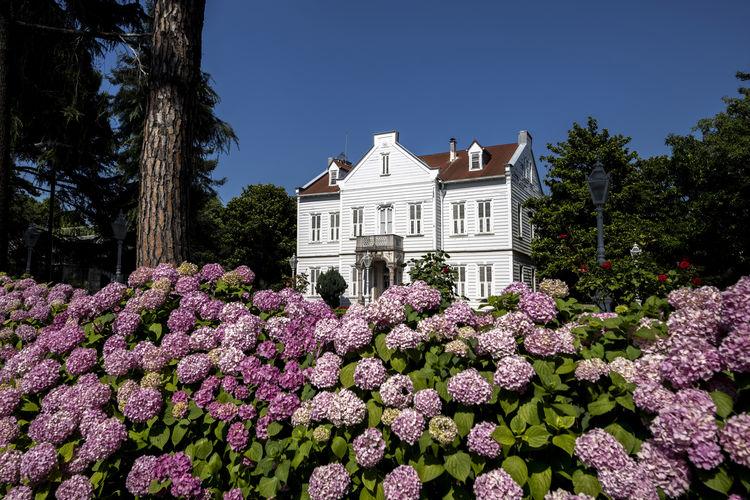
The Maslak Palaces, located in the Maslak neighborhood of the Sarıyer district in the northern region of Istanbul, are a historical complex representing one of the late Ottoman palace architectural examples. Situated within a forested area of approximately 170,000 square meters, the Maslak Palaces consist of the Kasr-ı Hümâyûn, Mâbeyn-i Hümâyûn, Seyir Köşkü, Limonluk, a bathhouse, the Ağalar Dairesi, a kitchen, and a greenhouse. They served as a residence during both the princehood and sultanate periods of Sultan Abdülhamid II.

Maslak Palace (Presidency of the National Palaces of the Republic of Türkiye)
The area where the Maslak Palaces stand was used during the Ottoman period, especially under Sultan Mahmud II (1808–1839), as a hunting and leisure ground for the sultans. Although no exact date exists for the construction of the palaces, it is known that the existing structures were largely built during the reign of Sultan Abdülaziz (1861–1876). In 1868, Sultan Abdülaziz assigned the Maslak Palaces to his nephew Şehzade Abdülhamid Efendi. From that date onward, the complex ceased to function solely as a royal residence and evolved into a self-sustaining living area engaged in agriculture, animal husbandry, and carpentry like activities. During his years spent here, Prince Abdülhamid acquired surrounding lands to expand the estate and incorporated the facilities into the Ottoman farm system under the name “Maslak Çiftlikât-ı Hümâyûnu.” He established direct contact with the local population, gave music lessons to his children, composed poetry and musical pieces, and worked in the carpentry workshop. The fact that residence was invited to ascend the Ottoman throne from within the Maslak Palaces added historical depth to the site.
Following the proclamation of the Republic, the Maslak Palaces were used as a preventive sanatorium between 1937 and 1982, serving as a health facility that protected individuals infected with the tuberculosis bacterium from contracting the disease. After a comprehensive restoration in 1984, the complex was incorporated into the National Palaces Administration under the Presidency of the Republic of Türkiye and opened to the public as a museum-house museum. Today, it holds a place among Istanbul’s cultural heritage sites, recognized for both its historical identity and its natural landscape value.
The Maslak Palaces form a settlement ensemble reflecting characteristic features of late 19th-century Ottoman residential architecture, harmoniously integrated with the natural landscape. Located within a vast forested area of approximately 170,000 square meters, the complex illuminates the civil architecture of its era in terms of both planning and ornamentation. The main building, Kasr-ı Hümâyûn, follows the traditional Turkish house plan type and served as the private residence; adjacent to it, the Mâbeyn-i Hümâyûn functioned as the sultan’s official reception space. Additional auxiliary structures—including the Seyir Köşkü, Ağalar Dairesi, hamam, limonluk, its associated külhan, a telegraph room, a kitchen (matbah), a water storage room, a guard room, bird-keepers’ and gardener rooms, and a stable (tavla)—were designed to meet the daily needs of the inhabitants.

Tent Pavilion (Presidency of the National Palaces of the Republic of Türkiye)
The architectural composition of the palaces reflects an integrated approach with nature. The buildings are positioned to command views over the Bosphorus and the Black Sea, blending seamlessly with the dense green tissue of the surrounding forest. Interior spaces display refined examples of Ottoman decorative arts: ceiling reliefs, wall pen work, and delicate embellishments enhance the aesthetic value of the structures. The camellias in the limonluk, which bloom especially during winter months, have also become an aesthetic component of the architecture. The pathways connecting the buildings and the garden landscape ensure both functional and visual coherence of the complex.
Throughout its transition from the Ottoman period to the Republic, the Maslak Palaces served various functions and underwent multiple physical alterations. After years of neglect, the palaces underwent a comprehensive restoration in 1984. These efforts aimed to reveal and preserve the building’s historical fabric without compromising its original architectural elements.
As part of the restoration, the Kasr-ı Hümâyûn, Mâbeyn-i Hümâyûn, Limonluk, Seyir Köşkü, gardens, and auxiliary structures were renovated in accordance with their original forms, guided by historical records and period photographs. Interior decorative elements, ceiling reliefs, and wall embellishments were meticulously restored by expert teams using original materials. Garden layouts were redesigned according to principles of landscape architecture, and climate control systems enabling the cultivation of tropical plants in the greenhouse were modernized.

Interior Space (Presidency of the National Palaces of the Republic of Türkiye)
The Maslak Palaces hold cultural significance as one of the final imperial palace complexes of the Ottoman era and as the residence of Sultan Abdulhamid II during his princely years. Sultan Abdulhamid II’s simple yet productive life here—marked by personal pursuits ranging from carpentry to literature and music—transformed the palace from a mere residence into a cultural production space.
Its use as a military sanatorium during the Republican period enabled the building to assume a health-based social function. Following its restoration, its status as a publicly accessible museum emphasized its educational and culture role. Today, the buildings serve as exhibition, reception, and leisure spaces, securing their place in social memory through both their historical documentation and their public accessibility.
Anadolu Ajansı. "Maslak Kasrı FPV dron ile görüntülendi." Accessed April 14, 2025.
Ministry of Culture and Tourism. "Maslak Kasırları." *Turkey Culture Portal.* Accessed April 14, 2025. https://www.kulturportali.gov.tr/turkiye/istanbul/gezilecekyer/maslak-kasirlari
Türkiye Cumhuriyeti Cumhurbaşkanlığı Milli Saraylar Başkanlığı. "Maslak Kasrı." *Milli Saraylar.* Accessed April 14, 2025. https://www.millisaraylar.gov.tr/Lokasyon/10/Maslak-Kasri

Henüz Tartışma Girilmemiştir
"Maslak Kasırları" maddesi için tartışma başlatın
History
Architectural Features
Restoration Efforts
Cultural and Social Significance