

Bu içerik Türkçe olarak yazılmış olup yapay zeka ile otomatik olarak İngilizceye çevrilmiştir.
+1 Daha
Madāʼin Ṣāliḥ (Hegra) is an ancient Botanical city located in northwestern Saudi Arabia, near al-‘Ula. After Petra, it developed as the second major center of the kingdom, distinguished by its monumental rock-cut tombs, advanced water systems, and strategic location. It was annexed by the Roman Empire in AD 106 and gradually lost its significance before being abandoned. It was inscribed on the UNESCO World Heritage List in 2008.
Madāʼin Ṣāliḥ (Hegra) began to develop from the 1st century BC. Although evidence suggests the region was inhabited during earlier periods including the Iron Age and Hellenistic era, the main urban settlement originated under Nabataean rule.
The Nabataeans selected Hegra as a strategic center to control the incense and spice trade and established it as their second capital. During this period, the city expanded with a walled urban core, extensive necropolises, religious sites, and agricultural zones.

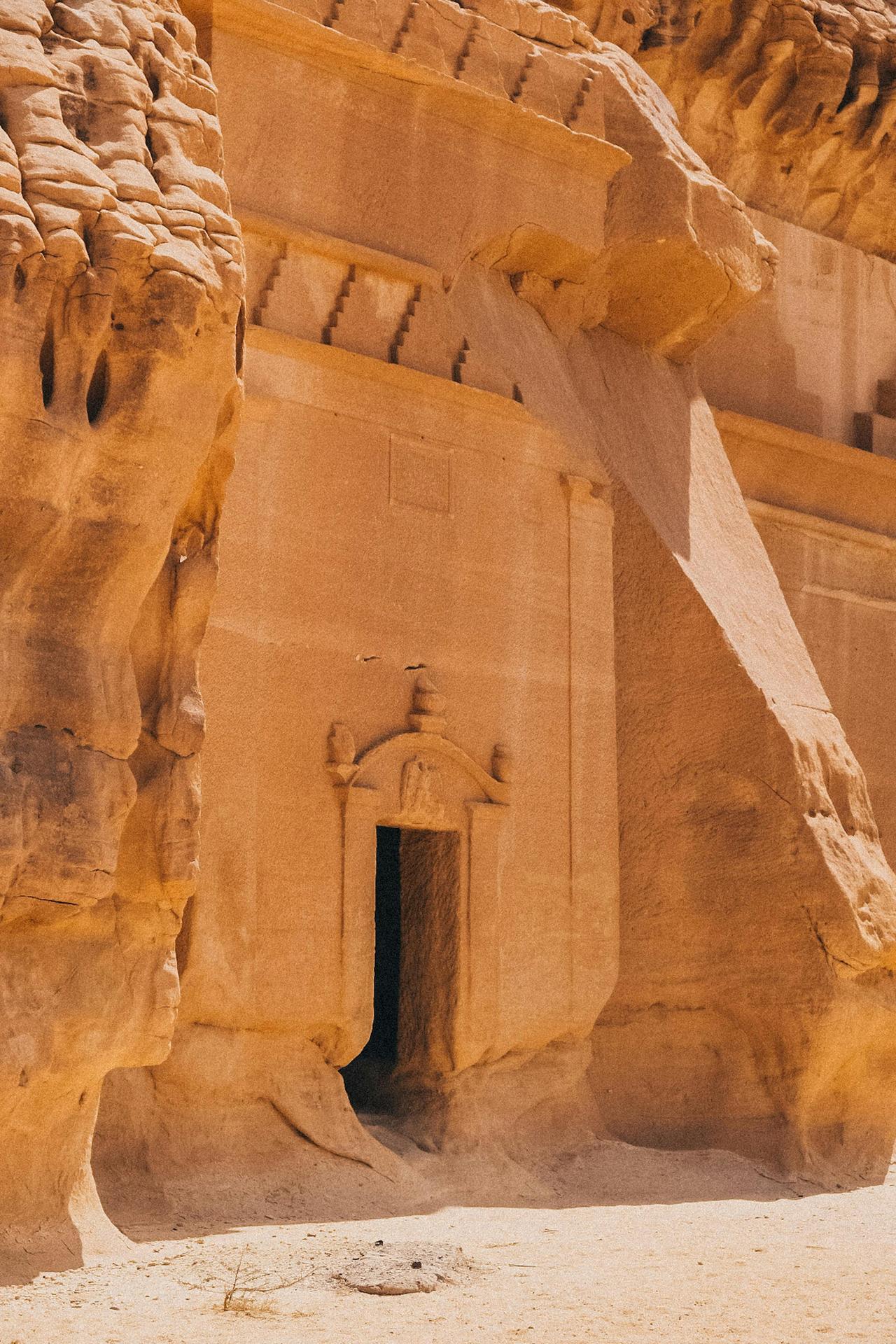
Madāʼin Ṣāliḥ (Hegra) (Pexels)
In the 1st century AD, Hegra gained prominence through its monumental rock-cut tombs; inscriptions on the tomb facades provide significant insights into the city’s social and religious life. The city walls, constructed during the same century, reinforced Nabataean authority in the region.
In AD 106, the Roman Emperor Trajan incorporated Nabatean Kingdom into his empire, and Hegra became the southern frontier town of the province of Arabia. Roman legionary presence in the city is documented epigraphically. However, as maritime trade intensified along the Red Sea, Hegra’s commercial and political importance gradually declined.
From the late Antique period onward, Hegra was gradually abandoned. During the Umayyad era, settlement completely lost its significance, yielding to new centers such as al-Mābiyāt. Today, Hegra is recognized as one of the best-preserved ancient cities of the Arabian Peninsula, renowned for its Nabataean architecture and epigraphy.
Hegra is located in the Hejaz region, between Medina and Tabuk. This area is characterized by a desert climate with an average annual rainfall of approximately 50 mm. However, its position atop a natural aquifer fed by waters from Jabal al-‘Uveyrid and Hadb Hamar mountains enabled the city’s development. Thanks to this geographical advantage, extensive agricultural lands were irrigated, allowing for rich oasis farming. In antiquity, this region served as a hub for both local agriculture and caravan trade.
Hegra consists of an urban center, necropolises, religious structures, and water systems.
Research at Hegra has uncovered numerous inscriptions, coins, ceramics, and other small archaeological finds.
BBC. "Saudi Arabia’s Silent Desert City." BBC. Accessed October 7, 2025. https://www.bbc.com/travel/article/20170418-saudi-arabias-silent-desert-city
Hajıjamshıdı, Helıa. "Hegra The Lost City." *UNIMUSEUM*, 6(2) (2023): 90–95. Accessed October 7, 2025. https://dergipark.org.tr/en/pub/unimuseum/issue/82117/1403874
Karaca, Khadijah. "tas-mezar-girisi" Pexels. Accessed October 7, 2025. https://www.pexels.com/tr-tr/fotograf/tas-mezar-girisi-13314590/
Kochekov, Kerim. "kent-sehir-tarih-cephe" Pexels. Accessed October 7, 2025. https://www.pexels.com/tr-tr/fotograf/kent-sehir-tarih-cephe-14773067/
Nehmé, Laila. "Ancient Hegra, a Nabataean Site in a Semi-arid Environment. The Urban Space and Preliminary Results from the First Excavation Season." *XVII International Congress of Classical Archaeology*, Roma 22-26 Eylül 2008. *Bollettino di Archeologia* on line, Volume Speciale (2010): 13-25. Accessed October 7, 2025. https://www.academia.edu/2106922/Ancient_Hegra_a_Nabataean_Site_in_a_Semi_arid_Environment_The_Urban_Space_and_Preliminary_Results_from_the_First_Excavation_Season
UNESCO. "Hegra Archaeological Site (al-Hijr / Madā ͐ in Ṣāliḥ)." *whc.unesco*. Accessed October 7, 2025. https://whc.unesco.org/en/list/1293/

Henüz Tartışma Girilmemiştir
"Medain Salih (Hegra) Ancient City" maddesi için tartışma başlatın
History
Geography
Structures
Artifacts