



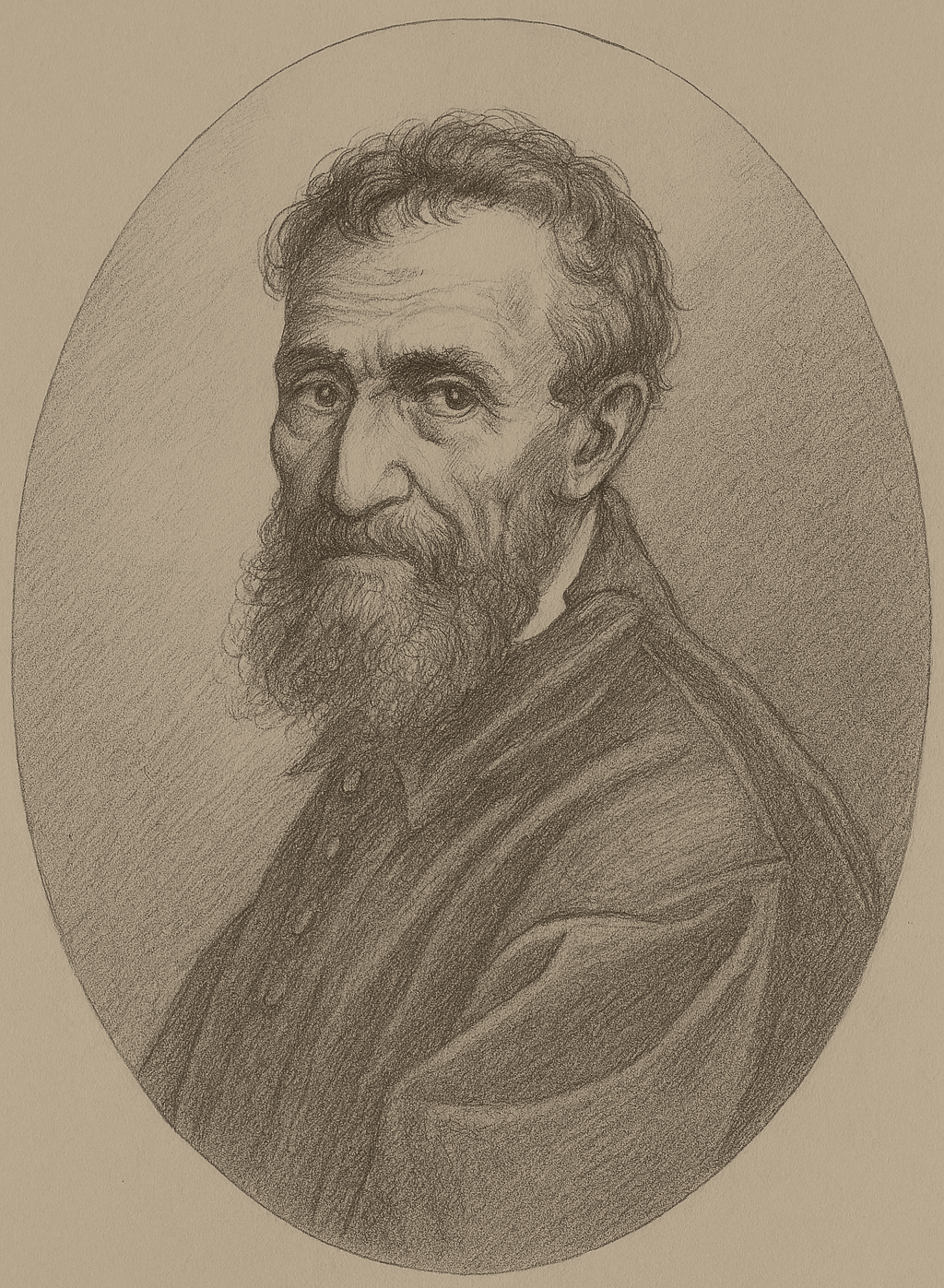
Michelangelo di Lodovico Buonarroti Simoni (Generated by Artificial Intelligence)
Profession(s) | Poet Architect Painter Sculptor | ||||||||
|---|---|---|---|---|---|---|---|---|---|
Period(s) | High Renaissance | ||||||||
Style | Anatomical Precision, Idealized Figures, Dramatic Expression | ||||||||
Notable Works | David (1501–1504) – Marble Sculpture, Pietà (1498–1499) – Marble Sculpture, Doni Tondo (c. 1507) – Oil on Panel, Sistine Chapel Ceiling (1508–1512) – Fresco Cycle, The Last Judgment (1536–1541) – Fresco, Sistine Chapel Medici Chapel Sculptures (1520s) – Marble Figure Groups | ||||||||
Michelangelo di Lodovico Buonarroti Simoni (1475–1564) was an Italian sculptor, painter, and architect who worked during the Renaissance period. He is best known for his statue of David and the frescoes of the Sistine Chapel.
Michelangelo was one of the most important artists of the High Renaissance in Italy. He produced work in various disciplines such as sculpture, painting, architecture, poetry, and drawing, and was referred to by his contemporaries as “il Divino” (The Divine One). Art historians have often considered him the first artist to surpass the standards of antiquity. His technical mastery and his strong assertion of individual artistic identity placed him at the center of a paradigm shift in the history of art.
His art is particularly known for his knowledge of human anatomy and his ability to translate this knowledge into visual representation. His emotionally powerful compositions and figures, possessing both intellectual and physical depth, became definitive of the Renaissance understanding of figurative art. Michelangelo’s drawings are regarded not only as tools for the creative process but also as sources that offer insight into artistic education, interdisciplinary connections, and the professional formation of the artist.
Michelangelo was raised in Florence, a city that embodied the merging of intellectual and aesthetic production, and he benefited from the cultural patronage of the Medici family. In 15th-century Italy, art was not merely a field of aesthetic appreciation but also a domain of political power, religious authority, and individual creativity. During this period, the term “disegno” did not solely refer to visual depiction but also encompassed intellectual planning and conceptual design. Michelangelo placed this concept at the heart of his art practice, establishing drawing as a fundamental element of both the technical and conceptual dimensions of artistic creation.
Academic assessments of Michelangelo’s drawings gained greater depth with the “Michelangelo Drawings: Closer to the Master” exhibition, held in collaboration between the British Museum and Teylers Museum in 2005–2006. This exhibition brought together many of the artist’s drawings that had not been exhibited together for years, allowing new interpretations regarding both the authenticity of these works and Michelangelo’s drawing process.
Michelangelo was born on March 6, 1475, in the town of Caprese, and shortly thereafter, his family moved to Florence. At the age of 13, he began an apprenticeship in the workshop of the painter Domenico Ghirlandaio, where he gained foundational knowledge of fresco techniques. During the same period, within the Medici court’s cultural environment and under the guidance of Bertoldo di Giovanni, he studied examples of ancient sculpture. In this setting, Michelangelo’s concept of disegno deepened. Starting with copies of works by earlier masters such as Giotto and Masaccio, his drawing practice evolved through anatomical studies based on cadaver dissections and direct observation.
In 1496, Michelangelo traveled to Rome, where he created the Bacchus statue, followed by the Pietà for St. Peter’s Basilica. The Pietà (1498–1500) in particular brought him significant fame in Rome. In 1501, he returned to Florence and completed the David statue (1501–1504). This work carried not only technical mastery but also political symbolism, representing civic virtues.
Michelangelo’s first major experience with painting came with the Battle of Cascina fresco, commissioned for the Hall of the Five Hundred in Florence. Although the fresco was never completed, his cartoon drawings for the project became essential educational models for younger artists. In these drawings, Michelangelo’s anatomical exploration of the male body was especially prominent.
Michelangelo’s drawings were not merely preparatory tools but were also considered an independent domain of artistic creation. Each of his works began with an extensive drawing process. Over time, these drawings transcended their function as sketches and gained artistic and aesthetic value on their own. His drawings reflect the processes of mental planning and visualization, and testify to the importance he attributed to the discipline of drawing—more so than many of his contemporaries.
Completed in Michelangelo’s early twenties, this work stands out as his first large-scale public commission. The marble sculpture, located in St. Peter’s Basilica, was commissioned by Cardinal Jean de Bilhères. Carved from a single block of marble, Pietà depicts Mary holding the dead body of Jesus on her lap.

Pietà, Michelangelo. (flickr)
One of Michelangelo’s most iconic sculptures, David was carved from a single large block of marble. Initially intended for the roofline of Florence Cathedral, it was eventually placed in a public square in Florence.

David, Michelangelo. (flickr)
Commissioned by Pope Julius II, this fresco cycle covers approximately 570 square meters of the Sistine Chapel’s ceiling. Michelangelo completed the project largely alone over four years.

Sistine Chapel Ceiling Frescoes, Sistine Chapel. (SmartHistory)
Commissioned by Pope Paul III, this fresco represents Michelangelo’s second major project in the Sistine Chapel. The theme is based on the apocalyptic vision from the New Testament.

The Last Judgement, Michelangelo. (flickr)
This group of sculptures is located in the tomb chapel designed by Michelangelo for the Medici family in the Church of San Lorenzo. The sculptures reflect themes of the passage of time and the cyclical nature of human life.
This drawing series was prepared as part of the sculptural process for the figure of Day in the Medici Chapel. It reveals how Michelangelo conceptually broke down the design for sculptural realization.

Night (Left) and Day (Right) Statues, Medici Chapel. (flickr)
This sculpture, created for the tomb of Pope Julius II, is one of Michelangelo’s most dramatically expressive works. Although the final monument was significantly reduced in scale from its original plan, the statue of Moses remained central to the project.

Moses (1513–1515, San Pietro in Vincoli, Rome). (flickr)
This circular composition, the only surviving painting by Michelangelo, was definitively executed on panel, depicts the Holy Family. The nude figures in the background introduce a historical and symbolic dimension to the scene.

The Doni Tondo. (flickr)
Commissioned for the Palazzo della Signoria in Florence but never executed, this fresco design is a major example of Michelangelo’s expertise in figurative composition.

The Battle of Cascina. (flickr)
This drawing is a preparatory study for the Libyan Sibyl figure featured on the ceiling of the Sistine Chapel. Executed in red chalk, the sketch reveals Michelangelo’s technical precision in figurative analysis.

Studies for the Libyan Sibyl. (SmartHistory)
During the Renaissance, the drawings of master artists were frequently copied by young apprentices as educational tools. Michelangelo’s Battle of Cascina cartoon became a vital reference point—even after the original was lost, its legacy persisted through reproductions, complicating issues of authenticity.
In 1534, Michelangelo relocated from Florence to Rome, where he spent the remainder of his life. From 1546 onward, he served as chief architect of St. Peter’s Basilica. During this period, he turned away from major painting and sculptural commissions to focus on architectural projects and personal works.
Among these was the Florentine Pietà (Deposition), completed in the 1550s. Designed for his own tomb, the sculpture features the face of Michelangelo himself in the figure of Nicodemus. The work reflects the artist’s emotional depth and religious intensity in his later years.
Even during the final years of his life, Michelangelo continued producing sculptures. He died in Rome on February 18, 1564. His body was later transferred to Florence and buried at the Basilica of Santa Croce. Leaving behind around 600 original drawings and a vast artistic legacy, Michelangelo secured his place as one of the most enduring figures in the history of Western art.
Flickr. “Michelangelo Drawing – Drapery Study.” Uploaded by stella12. Accessed August 7, 2025. https://www.flickr.com/photos/stella12/31509786737.
Flickr. “Michelangelo Drawing – Libyan Sibyl Study.” Uploaded by profzucker. Accessed August 7, 2025. https://www.flickr.com/photos/profzucker/51607491097.
Flickr. “Michelangelo Drawing – Male Study for Battle of Cascina.” Uploaded by profzucker. Accessed August 7, 2025. https://www.flickr.com/photos/profzucker/50710803298.
Flickr. “Michelangelo Drawing – Male Torso Study.” Uploaded by stella12. Accessed August 7, 2025. https://www.flickr.com/photos/stella12/46448750311.
Flickr. “Michelangelo Drawing – Seated Figure.” Uploaded by profzucker. Accessed August 7, 2025. https://www.flickr.com/photos/profzucker/52287409127/in/photostream/.
Flickr. “Michelangelo Drawing – Sketch for David.” Uploaded by snarfel. Accessed August 7, 2025. https://www.flickr.com/photos/snarfel/3133441682.
Flickr. “Michelangelo Drawing – Torso with Bent Leg.” Uploaded by 50879678@N03. Accessed August 7, 2025. https://www.flickr.com/photos/50879678@N03/27849986860.
Getty Museum. “Michelangelo Drawings: Explore the Exhibition.” J. Paul Getty Museum. Accessed August 7, 2025. https://www.getty.edu/art/exhibitions/michelangelo_drawings/explore.html.
Getty Museum. “Michelangelo: Mind of the Master.” J. Paul Getty Museum. Accessed August 7, 2025. https://www.getty.edu/art/exhibitions/michelangelo/.
Gottfried, William. The Life and Works of Michelangelo Buonarroti. Vol. II. London: George Bell and Sons, 1876. Accessed August 7, 2025. https://archive.org/stream/lifeandworksmic02gottgoog/lifeandworksmic02gottgoog_djvu.txt.
National Gallery. “Michelangelo Buonarroti.” The National Gallery. Accessed August 7, 2025. https://www.nationalgallery.org.uk/artists/michelangelo.
Picryl. “Michelangelo Buonarroti (1475–1564), Bust Portrait Facing Right.” Accessed August 7, 2025. https://picryl.com/media/michelangelo-buonarroti-1475-1564-bust-portrait-facing-right.
SmartHistory. “Italian Renaissance Drawing.” Accessed August 7, 2025. https://smarthistory.org/italian-renaissance-drawing/.
SmartHistory. “Michelangelo: Studies for the Libyan Sibyl (Recto); Studies for the Libyan Sibyl and a Small Sketch for a Seated Figure (Verso).” Accessed August 7, 2025. https://smarthistory.org/michelangelo-studies-for-the-libyan-sibyl-recto-studies-for-the-libyan-sibyl-and-a-small-sketch-for-a-seated-figure-verso-2/.
SmartHistory. “Who Was Michelangelo?” Accessed August 7, 2025. https://smarthistory.org/who-was-michelangelo/.
Smarthistory. “Michelangelo, Ceiling of the Sistine Chapel.” Smarthistory. Accessed August 7, 2025. https://smarthistory.org/michelangelo-ceiling-of-the-sistine-chapel/.
Vasari, Giorgio. The Life of Michelangelo Buonarroti. British Institute of Florence. Accessed August 7, 2025. https://britishinstitutehoa.wordpress.com/wp-content/uploads/2014/05/vasari-the-life-of-michelangelo.pdf.
Web Gallery of Art. “Michelangelo Buonarroti: Biography.” Accessed August 7, 2025. https://www.wga.hu/frames-e.html?/bio/m/michelan/biograph.html.
Zipser, Arie. “Michelangelo – The Drawings.” Zipser.nl (Web Archive). Accessed August 7, 2025. https://web.archive.org/web/20060411203848/http://www.zipser.nl/michelangelo1.html#twistingnude.


Michelangelo di Lodovico Buonarroti Simoni (Generated by Artificial Intelligence)
Profession(s) | Poet Architect Painter Sculptor | ||||||||
|---|---|---|---|---|---|---|---|---|---|
Period(s) | High Renaissance | ||||||||
Style | Anatomical Precision, Idealized Figures, Dramatic Expression | ||||||||
Notable Works | David (1501–1504) – Marble Sculpture, Pietà (1498–1499) – Marble Sculpture, Doni Tondo (c. 1507) – Oil on Panel, Sistine Chapel Ceiling (1508–1512) – Fresco Cycle, The Last Judgment (1536–1541) – Fresco, Sistine Chapel Medici Chapel Sculptures (1520s) – Marble Figure Groups | ||||||||
Henüz Tartışma Girilmemiştir
"Michelangelo Buonarroti" maddesi için tartışma başlatın
Historical and Cultural Context
Life and Artistic Vision: Early Period and Education
Early Life and Education
Early Career and the Roman Period
The Role of Drawing and Technical Approach in His Work
Materials and Techniques
Selected Works and Analyses
Pietà (1498–1500, St. Peter’s Basilica, Rome)
David (1501–1504, Galleria dell’Accademia, Florence)
Sistine Chapel Ceiling Frescoes (1508–1512, Vatican, Rome)
The Last Judgment (1536–1541, Altar Wall of the Sistine Chapel, Vatican)
Medici Chapel Sculptures: "Day", "Night", "Dawn", "Dusk" (1524–1534, San Lorenzo, Florence)
Seven Studies for "Day" (1520s)
Moses (1513–1515, San Pietro in Vincoli, Rome)
The Doni Tondo (c. 1506–1508, Uffizi Gallery, Florence)
The Battle of Cascina (1504–1506)
Studies for the Libyan Sibyl (c. 1510–11)
Forgery, Copies, and the Art Historical Context
Final Years and Death
Bu madde yapay zeka desteği ile üretilmiştir.


