

Location of Discovery | Royal Cemetery of Ur, Mesopotamia (Modern-day Iraq) | ||||||||
|---|---|---|---|---|---|---|---|---|---|
Excavation | Sir Leonard Woolley / 1927 | ||||||||
Material(s) | Shell Bitumen Red limestone Lapis lazuli | ||||||||
Dimension(s) | 21.6 × 49.5 × 12 cm | ||||||||
Collection | British Museum Object No: 1928.1010.3 | ||||||||
Theme(s) | The Sumerian king is depicted both achieving military victory and presiding over a banquet Scenes of war and peace | ||||||||
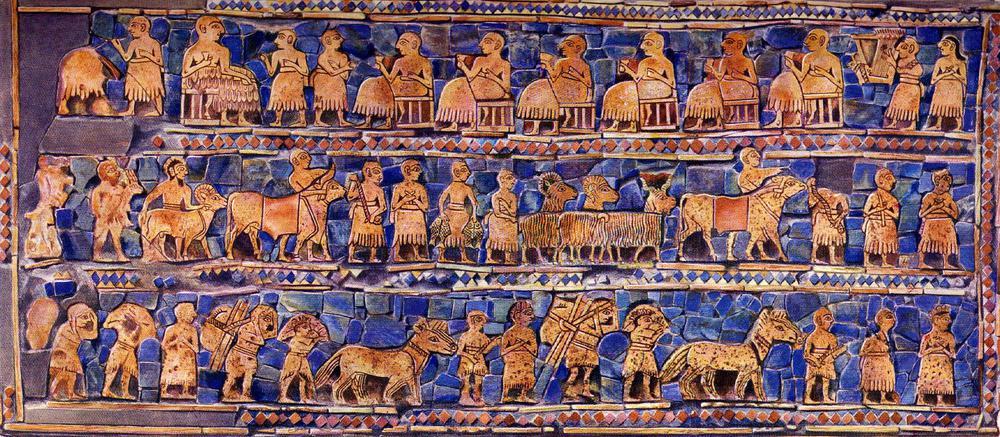
The Standard of Ur is a rectangular, box-shaped art object discovered in the ancient city of Ur in Mesopotamia, adorned with mosaic decorations on all four sides. The two longer sides of the artifact are embellished with scenes depicting the two dominant themes of Sumerian kingship: war and peace. The mosaics are crafted from valuable materials such as shell, red limestone, and lapis lazuli, set into a natural asphalt base (bitumen). Each long side is composed of three horizontal bands (registers), featuring notable symbolic elements that reflect the social hierarchy. The artifact offers significant insights into Sumerian art and ideology.
The object was discovered in the 1920s by Sir Leonard Woolley during excavations at the Royal Cemetery of Ur (tomb PG 779). Remains of four individuals were found in the tomb, and the Standard was located on the right shoulder of one of them. The wooden frame had decayed, and the panels were crushed under the pressure of the soil. The bitumen layer had disintegrated, and the mosaics had detached. Therefore, its current state is a reconstruction based on archaeological clues. Today, the artifact is on display at the British Museum.

The Standard of Ur, British Museum. (flickr)
The Standard was constructed using valuable materials that indicate foreign trade: the shells came from the Persian Gulf, red limestone from India, and lapis lazuli from Afghanistan. The bitumen was sourced locally. The absence of these materials in Mesopotamia points to Ur’s extensive trade networks and developed internal organization. Furthermore, the presence of surplus production and a specialized artisan class reflects the existence of an early state structure.
The two long sides of the Standard of Ur are organized around the themes of “war” and “peace,” each presented through three horizontal panels. This layout exemplifies the register system commonly used in Mesopotamian art. The panels symbolically portray the social structure and the functions of the king.
The war side contains scenes illustrating the military power of the Sumerian king and the orderly nature of warfare.
Every element of this panel is constructed to glorify the king as a military leader and to humiliate the enemy. War is presented as a means to establish divine order.

War Panel, The Standard of Ur. (flickr)
The peace side emphasizes the king’s role in ensuring prosperity and order, portraying him as an intermediary and guardian of divine harmony.
This scene likely depicts a victory banquet but also symbolizes the wealth, ritual, and hierarchical structure brought by peace. It reflects a courtly culture where social order and religious ritual are deeply intertwined.

Peace Panel, The Standard of Ur. (flickr)
In the Standard, the king is represented in two distinct roles:
These representations reflect the dual identity of the Sumerian ruler, who bore the titles of both lugal (military leader) and en (religious leader). The Standard of Ur idealizes this dual function. The king is portrayed as both a protector of society and a sacred mediator between the gods and the people.
In Mesopotamian mythology, there is no explicit god of peace. However, deities like Enlil and Ninlil are associated with both destruction and the reestablishment of order. Peace is understood as synonymous with abundance, health, and social harmony. The Sumerian word silim and the Akkadian terms šulmu/šalamu fall within this semantic domain.
While war and heroism are depicted prominently in art, peace is often conveyed through indirect symbols such as animal abundance, music, feasting, and agricultural products. The Standard of Ur also portrays peace not directly, but through the postwar prosperity and ceremonial imagery. This aligns with Mesopotamian ideology, where peace is seen as the natural result of divine order restored through victory.
The Standard of Ur serves as:
Its dual narrative (war and peace) symbolizes the dialectical structure of Mesopotamian thought: order arises only through the overcoming of chaos. The king is the guardian of this order—both destroyer and creator. The bloody victory brought by war is fulfilled and sanctified by the ceremonial abundance of peace.
Amin, Osama Shukir Muhammed. “Detail of the War Scene of the Standard of Ur Showing Sumerian Warriors.” World History Encyclopedia. Accessed August 6, 2025. https://www.worldhistory.org/image/8428/detail-of-the-war-scene-of-the-standard-of-ur-show/.
Asher-Greve, Julia M. “Insinuations of Peace in Literature, the Standard of Ur, and the Stele of Vultures.” Alter Orient und Altes Testament 401 (2010): 21–34. Accessed August 6, 2025. https://d1wqtxts1xzle7.cloudfront.net/35211579/AOAT_401_Asher-Greve_Peace-libre.pdf.
British Museum. “Box.” Digital collection. Accessed August 6, 2025. https://www.britishmuseum.org/collection/object/W_1928-1010-3.
British Museum. “The Standard of Ur (Wall Painting or Relief).” Digital collection. Accessed August 6, 2025. https://www.britishmuseum.org/collection/image/8056001.
British Museum. “The Standard of Ur.” British Museum Images. Accessed August 6, 2025. https://www.bmimages.com/preview.asp?image=00012547003.
Crabben, Jan van der. “The Standard of Ur.” World History Encyclopedia. Accessed August 6, 2025. https://www.worldhistory.org/image/501/the-standard-of-ur/.
German, Senta. “Standard of Ur and Other Objects from the Royal Graves.” Khan Academy. Accessed August 6, 2025. https://www.khanacademy.org/humanities/ap-art-history/ancient-mediterranean-ap/ancient-near-east-a/a/standard-of-ur-and-other-objects-from-the-royal-graves.
Harvard University. “Material Construction – The Standard of Ur: A Novel Model of State Development.” Hist1039-16 Course Exhibit, Harvard OMEKA. Accessed August 6, 2025. https://hist1039-16.omeka.fas.harvard.edu/exhibits/show/standard-of-ur--a-novel-model-/material-construction.
Poczai, Péter, and Jorge A. Santiago-Blay. “Chip Off the Old Block: Generation, Development, and Ancestral Concepts of Heredity.” Frontiers in Genetics 13 (2022): 1–11. Accessed August 6, 2025. https://www.researchgate.net/publication/359114629_Chip_Off_the_Old_Block_Generation_Development_and_Ancestral_Concepts_of_Heredity.
Zucker, Steven. “Standard of Ur JPG.” Flickr. Accessed August 6, 2025. https://flic.kr/p/2kpU7HK.
Zucker, Steven. “Standard of Ur JPG.” Flickr. Accessed August 6, 2025. https://flic.kr/p/2kpU7s9.
Zucker, Steven. “Standard of Ur: War Panel (Detail) JPG.” Flickr. Accessed August 6, 2025. https://flic.kr/p/2kpXVdf.

Location of Discovery | Royal Cemetery of Ur, Mesopotamia (Modern-day Iraq) | ||||||||
|---|---|---|---|---|---|---|---|---|---|
Excavation | Sir Leonard Woolley / 1927 | ||||||||
Material(s) | Shell Bitumen Red limestone Lapis lazuli | ||||||||
Dimension(s) | 21.6 × 49.5 × 12 cm | ||||||||
Collection | British Museum Object No: 1928.1010.3 | ||||||||
Theme(s) | The Sumerian king is depicted both achieving military victory and presiding over a banquet Scenes of war and peace | ||||||||
Henüz Tartışma Girilmemiştir
"The Standard of Ur" maddesi için tartışma başlatın
Discovery and Preservation
Materials and Craftsmanship
Iconography and Composition
War Panel
Lower Register
Middle Register
Upper Register
Peace Panel
Lower Register
Middle Register
Upper Register
The Dual Role of the King: Warrior and Intermediary
Cultural Interpretation of War and Peace
Interpretation and Significance
Bu madde yapay zeka desteği ile üretilmiştir.