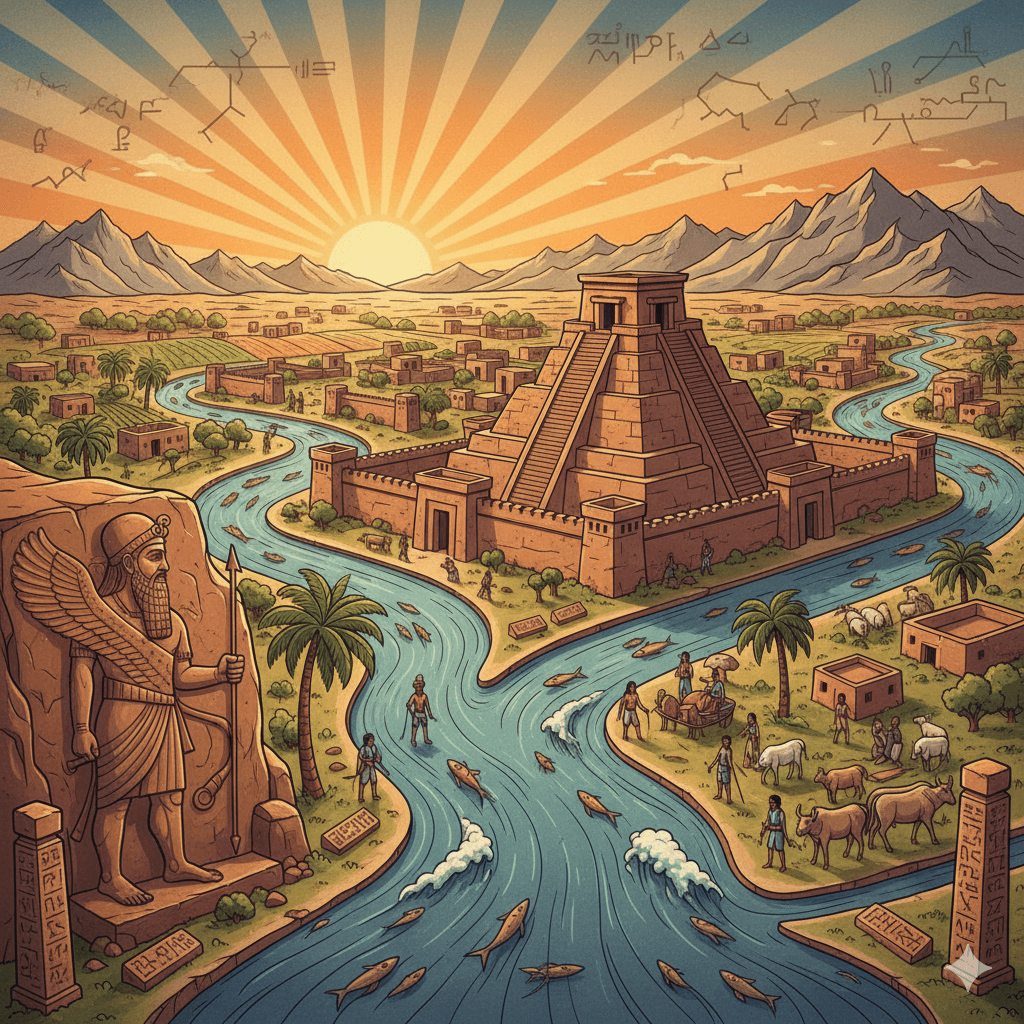




Cradle of Civilizations: Mesopotamia
Mesopotamia derives its name from the Tigris and Euphrates rivers. This region, meaning “land between two rivers,” is where humanity’s earliest civilizations emerged. Today, these lands extend as far as Iraq, Syria, and southeastern Türkiye. In Türkiye, the provinces of Şanlıurfa, Adıyaman, Gaziantep, Diyarbakır, Batman, Siirt, and Mardin are considered part of the Mesopotamian cultural region. The rich historical remains found in these areas reveal the earliest steps of civilization in Anatolia.
🏞️ First Settlements and Civilizations
Evidence of human presence in Mesopotamia dates back to the 7000s BCE. During this period, people transitioned from hunting to agriculture, established villages, and eventually gave rise to cities.

Agriculture in Mesopotamia (Image generated by artificial intelligence).
The first great civilization was established by the Sumerians, who invented writing and recorded information on clay tablets using cuneiform script. They were followed by the Akkadians, Babylonians, and Assyrians, each of whom made significant innovations in governance, science, law, and art.
🔭 The First Steps of Science and Wisdom
In Mesopotamia, science was central to life.
🌠 They studied the heavens and developed calendars.
🧮 They used mathematics for measurement and calculation.
👨🏻⚕️ In medicine, they attempted to treat illnesses with herbs.
🧱 In architecture, they built massive temple structures known as ziggurats.
These efforts represented humanity’s earliest attempts to understand nature and establish order.

A healing house using herbal remedies (Image generated by artificial intelligence).
🌾 Daily Life and Art
In Mesopotamia, most people engaged in farming. They cultivated wheat, barley, and dates, and raised livestock. Women wove textiles while men practiced crafts. Children played games and learned writing in tablet schools. Music, poetry, and storytelling were integral parts of life. One of the most famous works, the Epic of Gilgamesh, tells the story of humanity’s quest for meaning and immortality.

Children excavating clay tablets inscribed with cuneiform (Image generated by artificial intelligence).
🏺 The Connection Between Göbeklitepe and Mesopotamia
Göbeklitepe, located in the Şanlıurfa province of Türkiye, lies at the northern edge of Mesopotamia within the region known as the “Fertile Crescent.” Archaeologists have determined that it was constructed between 9500 and 8000 BCE.
At Göbeklitepe, massive T-shaped stone pillars form circular temple structures adorned with carvings of animals and various symbols. These structures demonstrate that humans were already capable of expressing religious beliefs long before they fully mastered agriculture. Göbeklitepe is recognized as “the world’s oldest known temple” and carries the earliest traces of religious life in Mesopotamia.

Göbeklitepe, representative (Image generated by artificial intelligence).
Göbeklitepe is crucial to understanding the origins of Mesopotamian civilizations. The structures there reveal that humans had already developed the abilities for communal living, belief systems, and symbolic expression thousands of years before the rise of Mesopotamian cities. Göbeklitepe was not merely a temple; it was a center where people worked together, thought, and sought meaning. In this sense, it is regarded as the first light of Mesopotamian civilization.
🌍 Mesopotamia Today
The legacy Mesopotamia left for humanity is still preserved today. The lands where writing, the calendar, and agriculture originated are kept alive in museums and archaeological sites.

Visitors observing archaeologists at work, representative (Image generated by artificial intelligence).
Göbeklitepe in Şanlıurfa is listed on the UNESCO World Heritage List. Thousands of visitors come each year to see this ancient site. Stone houses, narrow streets, and historical walls in cities such as Mardin and Diyarbakır also bear traces of Mesopotamian architecture.